The Best Thing Of 2012

I know that it is only the first day of August, but I am supremely confident that nothing will surpass this story reported by ITV News.

Apparently the Mayor of London, Boris Johnson, was at an Olympic event in Victoria Park, trying out a zipwire ride, when it malfunctioned and he became stuck, suspended some distance above the ground:

Boris Johnson flies the flag for Britain. Image from ITV News.

He spent several minutes in this indecorous pose, to the amusement of the crowds, apparently shouting “Get me a rope, get me a ladder!” until he was able to be winched to safety.

London Mayor Boris Johnson dangles above the ground before being rescued. Image from ITV News

I more or less support Boris Johnson’s mayoralty of London (he’s a zillion times better than “Red” Ken Livingstone, anyway), and while it is a little mean-spirited to laugh at another person’s misfortune, I seriously think that this may have made my political year.

Olympics Past And Present

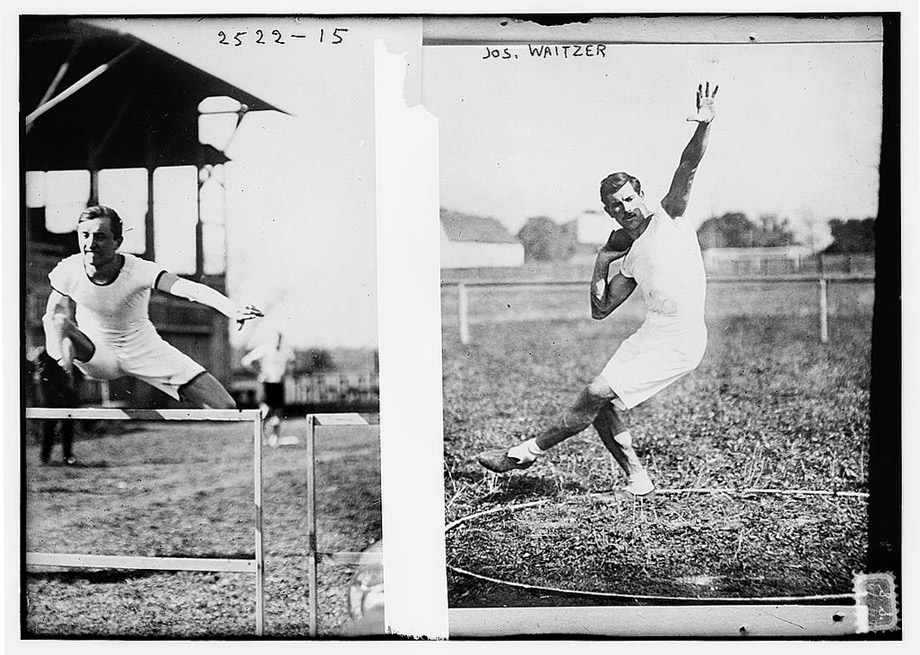
Today seems to be the day to look back at Olympic Games past and marvel how far we have come. Both NPR and Slate have pieces documenting the differences in styles, fashions and sporting events that a spectator might have seen at the Olympics in 1908 and 1912 respectively.

NPR looks at the 1908 London games, the first time that the United Kingdom’s capital hosted the competition:

Topical Press Agency/Getty Images

Slate reviews the following games, which took place in Stockholm in 1912:

Flickr Commons project and database, 2008, via Library of Congress.

They go on to explain:

… the 1912 Stockholm Games were “the last Olympics where any individual could just turn up and hope to enter a competition.” In that era, the idea that “natural” skill might enable someone to win a competition without any specialized training was still widely embraced.

As I sit in my living room with twenty four high-definition BBC channels showing almost every Olympic event taking place live, with commentary and instant replay and now apparently optional 3D, it is nice to appreciate what we have now, but also to look back at a time when people were happy to be entertained by watching the tug-of-war and a master of ceremonies wielding a megaphone to address the crowds.

Only In Britain

Isabel Hardman, writing in The Spectator’s Coffee House blog, is concerned that government ministers do not have any real power to effect changes to the London Olympic Games seating policy that would correct the scandal of so many seats remaining empty during popular and supposedly over-subscribed events:

The problem for ministers is that they do not have any official influence over this matter. Jeremy Hunt made this clear when he appeared on the World at One a few minutes ago. He said:

‘We want to be completely upfront with the public, this is a negotiation, we don’t have a right to demand these back, in fact contractually these seats do belong to the International Sports Federations and to the IOC. But, we got 3,000 back last night, including 600 for the gymnastics.’

Meanwhile, the Number 10 spokeswoman repeatedly said today that ‘this is a matter for Locog’, although when asked whether the government was powerless to change the seating situation, added: ‘We have influence: it’s the government.’ Whatever that influence is, it’s in the government’s interest to exert it as powerfully as possible: the public is unlikely to discriminate between ministers and Locog officials when apportioning blame for those empty chairs.

Come on, Spectator. Your Coffee House blog is one of the things that keeps me sane when I’m following British politics. You espouse sensible, Conservative, common sense solutions, and you echo my own beliefs that government doesn’t need to run everything.

The British government has already done enough for the Olympic Games organisers, even going so far as suspending the right to free speech and freedom of expression in some cases with provisions banning small businesses from using certain words or phrases which, if uttered by a non Olympic sponsor, would now constitute a criminal offence.

Of the various possible culprits responsible for the fact that far too many seats at Olympic events remain empty despite massive demand from the British public, David Cameron or Jeremy Hunt’s respective doorsteps are probably the last place I would think of pinning the blame. I would dare to believe and hope that a majority of Brits, despite Gordon Brown’s attempts to turn us into a state dependent society, also would not look to government to be the solution to this or every other problem, even ones that may impact on our national prestige.

Maybe in the case of the “empty seat fiasco”, the British people are not looking to the government for a solution, but to the people organising the Olympic Games. A quick solution, brought about by the people responsible for the problem.

Get Out Of Jail Free (If You Are A Girl)

Claire Perry, Conservative MP for Devizes, thinks that boys who commit crimes should go to prison, but not girls.

You would think that such a striking and illiberal proposal would be backed up by some powerful facts or hitherto-unseen observations, right? But no. Instead, she gives us this:

Generally speaking, girls are much better behaved than boys. That isn’t some ludicrous Victorian stereotype, but a fact drawn out by crime statistics. Of 1,744 young people in custody, just 95 are girls. Just 22 per cent of offences committed by children are committed by girls. Moreover, of the few girls that do end up in court, the majority have committed low level, non-violent offences such as shop theft or criminal damage.

Okay, Claire Perry. I’m waiting to see how you twist this observation into the idea that those girls who do commit violent or high-level offences should receive different punishments their male counterparts. Oh wait, that part never comes.

Using inappropriate and unnecessary criminal justice interventions for girls’ low level behaviour is like using a sledgehammer to crack a nut.

It’s fine for boys though. Go to town with that sledgehammer.

The Howard League for Penal Reform has conducted research on children in the penal system and legally represented children in custody.  The charity has been supporting the APPG inquiry and found that many of the girls who do end up in court had led chaotic lives, experienced poor parenting, neglect or abuse.  They have grown up in communities blighted by poverty and deprivation.  However, magistrates in the youth court lack the powers to invoke care proceedings, even when it is obvious that the young girl before them is vulnerable and in need.

True. But again, how is this terrible and depressing fact any different in the case of boys?

Failing to address a girl’s underlying welfare issues makes it more likely she will end up in court again.  A criminal conviction can exacerbate problems instead of solving them.  It can make it harder to find employment or a college place in the future.  Rather than criminalising girls for minor misdemeanours we should be ensuring that they and their families have the support they need in order to turn their lives around and make a positive contribution to their communities. We need to intervene early and give girls appropriate support in order to reduce further the small number of girls who end up in the penal system.

Change the word “girl” to “person” in this paragraph and you would have my agreement, Claire.

And she goes out on a strong note:

Prison for girls is not the answer and we should shut down all three prison units for girls immediately.

Wow, you really convinced me with the power and fact-based nature of your argument.

I’m actually not going to discuss the merits and drawbacks of Britain’s existing penal system in this blog post, though it certainly deserves discussion in future. For now I’m just going to marvel at the ridiculous notion of proposing different punishment methods for individuals, based not on the nature of their crime, or their treatment needs, or the danger that they pose to society, but based exclusively on their sex.

How disappointing to hear such discriminatory tosh emanating from the mouth of a Conservative MP.


How Not To Do Tax Policy

Priti Patel, writing in The Spectator’s Coffee House blog, warns that:

… we should all fear Ed Miliband’s praise for a new socialist French President who plans to raise the top rate of tax to 75 per cent. It is a chilling reminder of Miliband’s own commitment to a permanent 50 per cent income tax rate in this country.

But as he visited the Elysée Palace this week, one of France’s leading newspapers warned that the 75 per cent tax rate threat is already leading to French businesses evacuating senior executives to London. Since François Hollande’s victory on 6 May, this exodus of enterprise has caused the waiting list of the prestigious Charles de Gaulle school in our capital to rocket by over 700 places. We haven’t even rolled out the red carpet yet.

Very true. Let this be a warning to all those who think either that there is a binary choice between “austerity” and “growth”, or that Britain’s (or France’s) finances can be rectified, and the current excessive levels of government spending maintained, simply by turning the screws on the rich a little more.

Unfortunately, Patel’s article also misses out the most crucial actions required to get the British economy moving again – introducing much needed supply side reforms. Note:

Yesterday’s economic news reminds us of the need for the Government to continue to focus relentlessly on getting our economy moving – dealing with the debt crisis, boosting bank lending to the real economy, and ensuring sustainable long-term prosperity through radical economic reform.

Nothing about reducing regulation, either independently or through the European Union. Nothing about tackling the restive trades union that are always a day or so away from striking for spurious reasons.

By all means warn about Labour’s policies on tax, but given the fact that Osborne messed up the Budget and left us with a 45% top rate of tax for the foreseeable future, let’s focus on where the coalition government has the political strength to do the most good to restore economic growth.