Naked Hypocrisy, Ctd.

Of the various things written in the aftermath of TV chef Jamie Oliver’s recent comments about nutrition and cooking habits among poor people and families in Britain, I eventually found perhaps the most reasoned analysis at The Telegraph.

Joanna Blythman writes:

I make a point of trading up with food, buying good quality unprocessed ingredients, and often pay with a debit card. Occasionally, when the bill comes to more than I’d expect, I make a mental note to pay more attention to prices, but a little overspend isn’t a disaster; I won’t end up down the pawnshop.

So how humbling it was to see that that most customers in this store had no such security. These were people – it’s generally women who shoulder the responsibility for the family food spend – who always paid in cash, often a mixture of notes, coins, tokens and vouchers, which they meticulously counted out, sometimes betraying a slight anxiety that there wouldn’t be quite enough. They clearly budgeted by the day, not the week. As for the luxury of stocking up on things that might come in handy at some point, forget it. Their finances were on a knife-edge, and food outlay was a critical factor.

I could have given them a sanctimonious little lecture about spending their money more wisely – in many cases, pet food was arguably the most nutritious item in their trolleys, amid a pile of processed junk – but it would have been monstrously insensitive to do so. If you’re trying really hard to eke out your money, it seems cheaper, and it’s the line of least resistance, to fill everyone up on cheap carbs and low-grade processed meat. And yet, there were nearly always a couple of products in the line-up – some apples on promotion, or clementines, perhaps – that showed a touching aspiration to eat better.

This is exactly the point that I was trying to make in my own comments yesterday. It is easy to make smug and sanctimonious throwaway remarks about how people should take an axe to their broadband internet subscriptions or mobile phone contracts (as if most of us could realistically imagine living without either) before deigning to eat a cheap, unhealthy microwave meal, and many commenters seem to have fallen into precisely this trap.\

Like me, Blythman also gives Oliver credit where credit is due:

To be fair to Oliver, though, his thoughts are more nuanced than the provocative headlines might suggest. If he manages to show graphically how some of the poorest people are routinely ripped off by companies selling products that seem cheap, but that are actually rotten value for money, then more power to his elbow.

Be under no illusion, our large food retailers and manufacturers are making a mint from selling poor people over-packaged, nutrient-light, additive-dense food products, while trumpeting how they are helping them make ends meet.

And if Oliver can help people see how, by buying unprocessed raw ingredients, and cooking more, rather than relying on the sweepings from the manufacturer’s floor, they can eat better for the same, or less money, then that will be a sterling service to the nation.

This is an important area that I somewhat overlooked when I wrote my initial reaction to Oliver’s comments yesterday. In that piece I focused on the three aspects of food preparation knowledge, available spare time and social norms that go into determining what ends up on the family dining table (or, let’s be realistic, our laps while we sit and watch television). But supermarkets and food manufacturers cannot entirely escape censure for their part in making it harder for consumers to choose healthy options through their use of awkward quantity packaging and opaque pricing special offers.

Whether the answer lies with a government enquiry, more heavy-handed regulation of the food retail industry and active subsidisation of local markets and other initiatives, as Blythman seems to advocate, is another question entirely. Readers can probably anticipate my immediate reaction to the idea of another government enquiry and the further empowerment of our controlling, paternalistic government. But yet she does raise some valid points, and so I will give her the last word.

This sums up perfectly the issue that Jamie Oliver struggled to articulate in his controversial comments:

So what Oliver should address is how, when all the pressures in our society conspire to woo people away from scratch cooking of good-quality raw materials onto a convenience food diet, we can help them to resist.

Cooking is to food what books are to literacy: it allows us to become the controllers of our personal food destiny. Poor or rich, we’re all just suckers for processed food without it.

Amen to that.

Naked Hypocrisy?

Jamie Oliver is, generally speaking, a great force for good in British society.

His campaign to coax, cajole or bully local authorities into serving more nutritious school meals was a great example of non-government-inspired citizen activism (and Lord knows we need more of that in today’s Britain, where nearly everyone instinctively turns to the government for solutions to everything), and his television shows (starting with The Naked Chef) and books helped to breathe a breath of fresh air into what at the time was a somewhat stale genre.

But today, Oliver seems to be in the press for less auspicious reasons – namely, his holding forth on the problem of poor nutrition and overconsumption of junk food among the poorer people and families in society. The Telegraph reports:

The celebrity chef, who was enlisted by the Labour Government to improve the quality of school meals, has now rounded on the British working class diet.

Oliver recalled being appalled by the diet of a British family who lived on a diet of junk food, but still had the money for consumer goods.

“You might remember that scene in Ministry Of Food, with the mum and the kid eating chips and cheese out of styrofoam containers, and behind them is a massive TV. It just didn’t weigh up,” he said.

“The fascinating thing for me is that seven times out of 10, the poorest families in this country choose the most expensive way to hydrate and feed their families. The ready meals, the convenience foods.”

Oliver contrasts this observation with his experience of “economically deprived” people in other countries, such as Italy, where people apparently still enjoy a varied, healthy diet despite their circumstances. He seems bemused by this contradiction (apparently choosing to overlook such factors as different attitudes to work/life balance and family life between the UK and the southern European nations that he lauds).

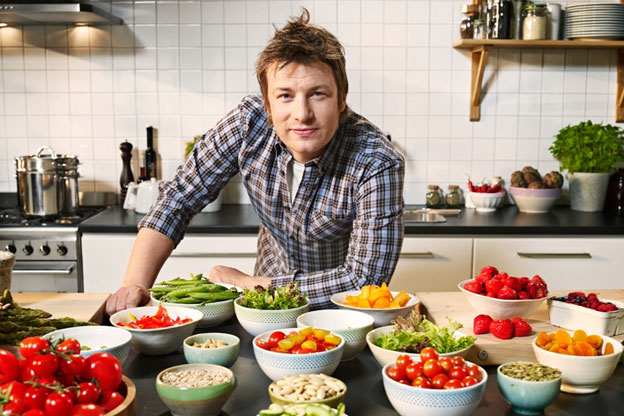
All you need to make a delicious, nutritious family meal

Indeed, the Telegraph aludes to this very point when they quote Oliver:

“I meet people who say, ‘You don’t understand what it’s like.’ I just want to hug them and teleport them to the Sicilian street cleaner who has 25 mussels, 10 cherry tomatoes, and a packet of spaghetti for 60 pence, and knocks out the most amazing pasta,” said Oliver, 38, whose own wealth is estimated at £150 million.

Quite.

While I see this as merely a somewhat misguided intervention by Oliver – borne of the fact that his knowledge of good food and nutrition probably vastly outstrips his knowledge of the economic and social forces at work that do so much to determine family eating habits – Mic Wright, also writing in The Telegraph, takes a somewhat dimmer view:

Oliver comes from the same school of thinking as the most banal of modern politicians. He sees simple solutions where there are complex problems. He believes that the state can fix everything and that right-thinking men like him should have more power to make the working class see the error of their ways.

And, like the best part-time proselytisers, he assures us that he knows the pain of the poor: “I’m not judgmental but I’ve spent a lot of time in poor communities and I find it quite hard to talk about modern-day poverty.” Popping in to film a TV programme or capitalise on a photo opportunity is not experiencing poverty. It is, as the Sex Pistols sang about trips to East Berlin, a holiday in someone else’s misery.

Fair point, to a degree. Oliver has spent a lot of on-screen time talking to and interacting with people scraping by on the lower end of the income scale – I always think of the moving scenes in “Jamie’s America” where he cooked with a young Hispanic Los Angeles native, Rigo, empathised with his troubled upbringing and learned to cook some decent Mexican food – but this does not make him an expert on balancing the budget or managing the schedule of a poorer family, day-in and day-out.

When you “spen[d] a lot of time in poor communities” filming a TV cooking show, you generally aren’t there for the weekly or daily grocery shop, which may often come at the end of a backbreaking day of hard work, to be followed by an evening looking after a young family. You may not appreciate the limited culinary options available to the family without a car or easy access to public transportation, whose only local option is a small convenience store specialising in heavily processed junk food and ready meals at the expense of fresh fruit and vegetables.

But the kicker for me was this excerpt and analysis of Oliver’s thoughts, this time from The Guardian:

“One of the other things we look at in the series is going to your local market, which is cheaper anyway, but also they don’t dictate size,” Oliver said. “From a supermarket you’re going to buy a 200g bag of this or a 400g pack of that. If you’re going past a market, you can just grab 10 mange tout for dinner that night, and you don’t waste anything.”

He also urged people to look overseas to learn how to eat well on a limited budget. “Some of the most inspirational food in the world comes from areas where people are financially challenged. The flavour comes from a cheap cut of meat, or something that’s slow-cooked, or an amazing texture’s been made out of leftover stale bread,” said Oliver, who was promoting his new Channel 4 series, Jamie’s Money Saving Meals.

“I meet people who say, ‘You don’t understand what it’s like.’ I just want to hug them and teleport them to the Sicilian street cleaner who has 25 mussels, 10 cherry tomatoes, and a packet of spaghetti for 60 pence, and knocks out the most amazing pasta. You go to Italy or Spain and they eat well on not much money. We’ve missed out on that in Britain, somehow.”

Right. The friendly local farmer’s market that we all have time to browse through on our way home from work or picking the kids up from school. And the slow-cooked meals that we can lovingly tend to all day while we aren’t out earning a living.

This is the crux of my problem with Jamie Oliver, much as I admire him and consume his TV shows and some of his recipe books – he is able to envision eating well on a budget only as himself, with his vast knowledge of how to source fresh ingredients and combine them in tasty ways, and with his reserves of free time to purchase these ingredients and make these healthy meals. It is this same lack of self-awareness that enables him to publish a book called “Jamie’s 30 Minute Meals”, a volume full of wonderful recipes but whose realistic time to make (once you have factored in the preparation, cooking time for a non-professional, and cleanup) stretches into the hours, not the promised minutes.

That is not to say that Jamie Oliver’s intervention is unhelpful. It is true that it can often be cheaper to bulk buy goods such as rice and pasta, and source fresh meat, fruit and vegetables, than it is to subsist on a diet of ready meals and fast food. If you have the knowledge, time and inclination to do so.

Oliver’s new television show, “Jamie’s Money Saving Meals”, will certainly help to tackle the knowledge part of the equation. But until he appreciates that the equally important countervailing forces of time and deeply ingrained social factors remain stacked against the poor, he will sadly continue to be frustrated in his efforts.

On International Video Copyright Restrictions

Rant Of The Day.

So apparently some crazy stuff went down at the VMAs last night. Something about Miley Cyrus gyrating inappropriately, Justin Timberlake reuniting with the Backstreet Boys (or is it ‘NSync?) and all manner of Hollywood elite naughtiness that promised to both amuse and titillate the audience.

I know this because various websites that I read to pass the time – Buzzfeed, Slate, et al. – have been writing and posting articles about the VMA shenanigans throughout the day. The format of said articles (and this doesn’t just apply to the VMAs, but about more or less anything that happens in America) generally follows this pattern:

1. EYE-CATCHING HEADLINE

2. FERVENT ASSURANCE THAT I REALLY WANT TO READ THIS STORY

3. BREATHLESS PARAGRAPH FILLING ME IN ON THE SCANDALOUS DETAILS

4. EMBEDDED VIDEO OF SAID SCANDALOUS HAPPENING IN ALL ITS SALACIOUS GLORY

5. THE “WASN’T THAT SH*T CRAZY?” PERORATION

Only I happen to live in the United Kingdom. Which means that the whole process falls apart when I reach Step 4. Instead of seeing the embedded video (from YouTube, or MTV, or Comedy Central or whoever the hell else), I get this:

4. SORRY, THIS VIDEO IS NOT VIEWABLE FROM YOUR CRAPPY THIRD WORLD COUNTRY. SUCK IT.

Thanks, Slate.com for linking to a video that only 4.45% of the world's population can watch
Thanks, Slate.com for linking to a video that only 4.45% of the world’s population can watch

But – and here’s the kicker – not before they make me sit through the obligatory 30-second commercial for J-Lo’s latest crappy perfume or whatever other shoddily-conceived and made wares that they want me to purchase. As a result, for viewers that God has chosen to curse by not conveniently placing them within the contiguous 48 states of the USA, Step 5 then becomes this:

5. WASN’T THAT GREAT THING THAT YOU DON’T GET TO SEE REALLY AWESOME?

I wouldn’t know, would I? I wouldn’t bloody know.

Comedy Central at least tries to be amusing about the fact that their bloodsucking intellectual property lawyers want to extinguish any last drop of enjoyment that I might possibly derive from their shows:

Even Colbert is in on the heinous conspiracy

But somehow this lame attempt at humour just makes it all the worse.

And no, it isn’t one of the “detriments of living under a monarchy”. It is one of the detriments of living in a modern digital age still governed by dinosaurs and fossils from a previous era who seriously think that today’s web-savvy, enlightened global consumer will put up with their bullshit and tolerate a smug, scornful, condescendingly second-class service.

And the fact that many such content providers, such as Comedy Central above, offer to redirect you to “your local country website” – which is, without exception, massively inferior to the US version in every way, from design to content – merely rubs additional salt into the wound.

THIS IS WHY INTERNET PIRACY HAPPENS. THIS. RIGHT HERE.

Do the suits seriously think that I am going to shrug my shoulders and hop on a plane to the US of A so that I can watch their two-minute-long, mildly entertaining video clip, or else sorrowfully abstain from ever viewing it?

No. In my rage, I will turn to Google and hammer out a stream-of-consciousness search request into my long-suffering keyboard, and fifty websites of dubious legality will instantly offer to show me the same goddamn video clip, without asking me to move continents, kill my firstborn son or jump through a fiery hoop.

The bottom line is that I get to watch the thing that I wanted to see. Semi-Partisan Sam wins. Always. In fact, the only people who lose out are the blood-sucking corporations who tried to throw pathetic, unenforceable legal obstacles in my path, and – sadly – the content creators, who would have materially benefited had I been able to watch on the official site, maybe sit through a couple more ads, and even make a purchase from the online store once in a blue moon.

But I don’t expect much from the likes of ViaCom-NBC-Universal-CBS-Fox-MediaTron-Gargamel-Corp.

It would be nice, however, if the news and entertainment websites that I frequent – respectable websites and publications that should know that much of their readership originates from outside the continental USA and does not appreciate being titillated with the promise of content that they cannot watch – smartened their act up and linked to sources that do not enforce petty, control-freakish regional access restrictions (or at least pressured content providers to stop their errant ways for the good of humanity).

Henceforth, I will be naming and shaming any site that falls short of this entirely reasonable standard of behaviour on this blog.

Fair warning.

The Distant Dream of Lords Reform

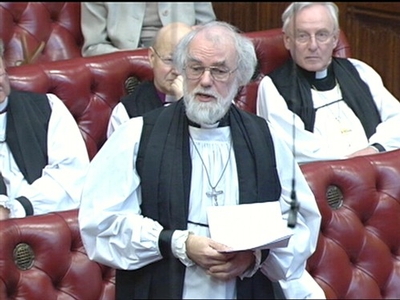
A walking, talking advertisement for the benefits of separation between church and state


In their latest editorial on the subject, The Guardian appears to have given up on the one-step, transformative reform of the House of Lords that was set in motion by the last Labour government and the next steps enshrined in the coalition agreement (before the Tories and LibDems blew the plan to bits in a fit of politically childish pique). Instead, they now advocate a slower (if that were possible), multi-step process of gradual and incremental reforms before we arrive at the cherished goal of having a working bicameral legislature where both houses hold democratic legitimacy.

We begin with the usual wailing and gnashing of teeth at the current state of affairs, and lamentation that the yearly spectacle of undeserving people being honoured with the privilege of sitting in the upper house has taken place yet again:

What an embarrassment to the so-called mother of parliaments. Thirty more cronies and party donors, leavened by a handful of the genuinely worthy and the downright eccentric (what’s an active journalist like Danny Finkelstein doing on the list?), appointed to the democratic world’s largest legislative chamber. It’s hard to imagine where they’ll find room to sit, never mind a job to do, in a chamber where in some debates there’s a 90-second limit on speeches. Yet proposals for reform are discarded. Even a modest suggestion of voluntary retirement founders. And prime ministerial patronage continues more or less unchecked.

The whole exercise is, in the widest sense of the word, corrupt: a system where individuals who make huge party political donations and – however sound their judgment and broad their experience – are awarded a place in the legislature as a gift from the leader of the party is just as much a scandal waiting to happen now as it was when Maundy Gregory was operating the system in the interests of Lloyd George.

But after this strident denunciation of the way things work, The Guardian goes turncoat on us:

Yet despite its Ruritanian appointments process, the Lords is generally acknowledged to be working unexpectedly effectively. Peers do take seriously their duty to scrutinise legislation, they have a good record for improving it, and some have been doughty defenders of individual freedoms. And look closely at who actually sits in the Lords: since the hereditaries were largely ejected in 1999, it’s become a more representative cross-section of the electorate – and the share of the votes cast – than the Commons, and more ethnically diverse. Even the gender balance is at least no worse. The danger is that the more useful it is, the harder it will become to reform.

Well, yes. This is why bicameral legislatures are a good thing. A more ruminative upper house will generally act as a brake (if not a stop) on the more reckless or short-term politically calculating moves of the lower house (and Lord knows that countries like Britain and America need such a check). This fact holds true even when the upper house in question has no real democratic legitimacy. But the fact that the House of Lords is doing okay-ish at the moment (if we choose to ignore the recent lobbying scandal and the fact that 26 lords spiritual continue to exert the not-always-benign influence of the Church of England over our lawmaking) is insufficient reason to reduce the pressure for comprehensive reform.

Most of the hereditary peers are now gone, so Britain is at least spared the indignity of having nascent laws scrutinised by the inbred landed gentry of the realm. We are just left to tackle the political appointees, the favoured party fundraisers and other beneficiaries of prime ministerial patronage who continue to occupy the place. We must also end the ridiculous, anachronistic idea that it is in any way appropriate to reward a person for their deeds (no matter how worthy or altruistic) by giving them a seat in our legislature. The honours system must be divorced from the political system as a matter of great urgency.

The Guardian concludes:

No one supposed, in 1999, that removing the hereditary peers was where reform would end. But since then, the next step has invariably been too much for some and not enough for others. So without abandoning the ambition for an elected upper chamber, perhaps it is time to make progress in smaller steps.

I would rather abandon any expectation of further changes in the next two years in the hope that more comprehensive reform can be achieved following the 2015 general election. This is not an unrealistic goal. True reform was part of the coalition agreement and very much on the cards until the Tories and Liberal Democrats decided to have a mutually destructive bust-up over linking the policy to changing electoral boundaries. Assuming the parties can find it within themselves to grow up slightly, Lords reform can be part of a future coalition agreement (or single party manifesto) too.

Semi Partisan Sam says no to any more slow, incremental reform of the House of Lords. The nation would be better off suffering through another two years with the upper house stuffed full of bewigged, enrobed anachronisms and political patronage beneficiaries before finally kicking the lot of them out after 2015 rather than enduring another decade or more of hand-wringing and glacial progress.

On Information Asymmetry

Well said by Julian Assange in this video clip, on the topic of information asymmetry, the media-ocracy and the media elites who encourage or engage in “lively debate” within such narrow boundaries that the outcome of each political battle is, these days, almost entirely inconsequential:


We need only look at how fiercely the 2010 British general election was fought over tiny differences in the preferred trajectory of increased government spending as proof of this.

Assange has now founded the WikiLeaks party in Australia, where he has several candidates contending for seats in parliament. Some recent polls suggest that 26 percent of Australians are strongly considering voting for a a WikiLeaks party candidate.

“Readers by definition are ignorant. We read to quench our ignorance. Readers, in effect, are easy prey for newspapers and the people that own them. Newspapers have a knowledge advantage, an information asymmetry. They know what readers don’t know yet, but want to know. And so they can distort the news or even invent it.” – Julian Assange