The British Immigration Debate: From The Inside Looking Out

SPS UK Immigration Life In The UK Test 4


Most British people will go through life not knowing what it takes for a foreigner to become a citizen of the UK. Why would we? By accident of birth most of us had the immense good fortune to grow up in one of the greatest, most wealthy, powerful and free countries on Earth, never giving our 0.89% against-the-odds luck a second thought. We have no experience of uprooting our lives and moving to these isles from somewhere else, or of the financial and bureaucratic hurdles that must be overcome in order to settle here and acquire a British passport.

Our lack of empathy – together with widespread ignorance of the various types of immigration and the differing rules and laws governing them – makes it very hard to have a rigorous, fact-based discussion of past and present British immigration policy. Throw in the careerist short-term focus of our politicians and a sane debate becomes next to impossible, as we have seen over and over again, most recently in the 2014 European elections.

Witnessing the British immigration system close-up when you are already a UK citizen, safe and secure in your legal status, offers a dispassionate but revealing glimpse of what it is actually like to go through the arduous and often stressful process of settling permanently in Britain. If only our political leaders and opinion-setters in the media would disengage from the battle of the 24 hour news cycle for one day and take the time to see for themselves, they might have a small epiphany and (for those with genuinely open minds) become willing to think and talk about immigration in a different way, giving us the debate we need rather than the one we have.

You don’t have to travel far for this reality check because the heart of Britain’s current immigration problem is best expressed not at passport control at Heathrow airport, the migrant camps in Calais  or the Polish grocery store on the high street, but in the accredited test centres up and down the country that administer the “Life In The UK” test to people seeking permanent residency or citizenship of the UK.

To be clear, the problem is not the “Life In The UK” test itself – though one could certainly quibble with the curious selection of factoids and trivialities that the Home Office proclaims to represent a sound working knowledge of modern Britain, or speculate endlessly about the percentage of immigrants who exercise their right to take the test in Welsh or Scottish Gaelic (at unknown cost to the taxpayer).

The problem is that the “Life In The UK” test takers are in the midst of a long, demanding and expensive process to settle permanently in Britain, one which an equal number of immigrants – by virtue of being EU citizens – are free to bypass altogether. This disparity of treatment, a function of Britain’s membership of the European Union, inadvertently reveals almost everything that is wrong with the current British immigration debate.

Observing the waiting room in of one of these anonymous-looking test centres as an existing, documented British citizen is a revelatory and slightly humbling experience, because here you are surrounded by people who fiercely covet something that you already have. As you enter, you are quite likely to pass by people leaving in tears because they have failed the test and have to take it (and pay the fee) again.

The prevailing mood is one of fear – the candidates sit in tense silence, often with heads bowed over test prep books, going over a few final practice questions before showtime. Did the Roman occupation of Britain last for 150 years or 400 years? Who fought in two wars against Napoleon – Horatio Nelson or Winston Churchill? And is driving your car as much as possible one of the two things you can do to look after the environment?

Softball questions aside, the bar to settle here when you come from outside the EU is set very high. To seek permanent residency or citizenship is to make a significant investment of time, energy and money towards an application which may not even be successful (and for which there is no refund in the event of rejection).

It involves divulging every conceivable detail about your life and proving to immigration officials beyond reasonable doubt that you are capable of sustaining yourself economically without becoming a burden on the state. And to top it off, your biometric information is taken and added to a database for identity verification whenever you enter or leave the country, and for any other purpose that the government may concoct in future.

SPS UK Immigration Life In The UK Test 2
A and B might be more fun.


The process by which someone from the European Union settles in the United Kingdom is rather simpler. The single market ensures that citizens of any EU member state  can move to the UK to work and live indefinitely as they please, bypassing all of the steps and hurdles facing a Sri Lankan, American, Turkish or Chinese immigrant. The minimum logistical requirements consist of packing a bag and turning up.

This is great for those of us who want (and are able) to live an itinerant life or pursue a multinational European career – the benefits of the single market cannot then be overstated. But for every British person who sees only opportunity in the EU’s free movement of people, there is another working for the minimum wage who will never be offered a secondment to the Brussels office by their company, and who must console themselves with the second-order benefits of free movement – such as “delighting in the capital’s kaleidoscopic culture” or being served their “early morning coffee” by someone from Spain.

The single market in its current and unamended form may yet be in Britain’s best interest, and the free movement of people may be a net positive thing – but the British people have not had a say in the matter since the 1975 European Community referendum, and it’s quite clear that they want to have a debate about it now.

Sometimes that desire is expressed forcefully and unpleasantly – any talk from politicians and their supporters about “hordes of Romanians” or slurs about eastern European workers is rude, disrespectful and unbecoming – but it is categorically not racist. Those who disagree need to check their dictionary and contemporary history books to reacquaint themselves with the true meaning of the word.

(It should – but does not – go without saying that just because the immigration sceptics have their fair share of racists within the ranks, this does not imply or prove that all anti-immigrant positions are necessarily racist. All racists are against immigration by definition, but not all people – or even most people – with concerns about immigration are racist).

Our British democracy is neither perfect or universal. That’s how it comes to pass that people have voted in every general and European election since the 1975 referendum but still ended up in 2014 with an immigration policy widely considered unsatisfactory. We have been guided to this bad place by generations of politicians who were too cowardly to start a difficult conversation on the subject during their own tenures, happy to leave the issue on the back-burner until it is now finally starting to boil over in the age of Cameron, Clegg, Miliband and Farage.

A real leader would seize the opportunity to give the British people the debate that they want, and which has been wrongly suppressed for too long by a political consensus that cried “racism!” at the first mention of immigration. A real leader would step up and proclaim the many benefits that immigration confers on Britain, while acknowledging its wildly varying impact on different sections of society, and discussing ways to mitigate the negative aspects. A real leader – and for all he has done to start the debate, Nigel Farage has failed here – would do all of this without resorting to scapegoating or undue exploitation of people’s fears.

In short, none of Britain’s party chiefs can at present be described as a responsible leader on one of the most important political issues of the day for many people. As it stands, our country loses no matter who wins in 2015.

If Labour (who have been almost entirely captured by their metropolitan professional class at the expense of their former party base) win the general election, nothing will change and the increasingly poisonous status quo will continue. A majority within this rootless Labour Party still see any questioning of immigration as morally equivalent to owning a signed first edition of Mein Kampf, and Ed Miliband has apparently decided that refusing to acknowledge UKIP’s victories and the public sentiment behind them will somehow be interpreted as a sign of his strength and resoluteness.

If the Conservatives win, they will likely fail in their attempts to extract meaningful concessions for Britain on inter-union movement of people from the EU or changing the eligibility for immigrant access to public services and the welfare state (getting unanimous support from the other 27 member states being a dim prospect). The only way the Tories will then be able to save face is to increase the already onerous barriers and impediments to those seeking to come to the UK from outside the European Union, many of whose talents and skills we urgently need – and the last thing we should be doing is further discouraging them from coming here.

If the Liberal Democrats avoid complete electoral annihilation in 2015, their best hope is to join another coalition government, in which case their natural instincts could only lead them to solidify Ed Miliband’s “full steam ahead” policy on Europe in the event of a Labour-led government or act as a minor brake on any destructive moves to crack down further on non-EU immigration in the event of another Conservative-led coalition.

And if UKIP were to perform well and capture a significant number of seats at Westminster without toning down their overly strident rhetoric or adding any kind of nuance or acknowledgement of geopolitical reality to their own policies, the other parties would likely be so unwilling to deal with them that their MPs would simply be frozen out of the process altogether.

SPS UK Immigration Visas

For all this ambivalence, Britain is a diverse and mostly tolerant land, and immigrants have played a huge part in our history and heritage. In today’s modern economy we need to be able to compete for the brightest and best of all the world’s talent, making it attractive for people to study at British universities, work for British firms and settle here with their families.

Somewhere between the onerous and expensive application process for non-EU immigrants combined with quotas and limited access to public services on one hand, and the EU single market’s wide open borders on the other, lies the best answer to Britain’s immigration conundrum. Unfortunately, Britain is not able to choose the perfect point along this spectrum because  the EU mandates an all-or-nothing approach. You are either part of the European Union and a full member of the single market, or you are on the outside.

The free-movement aspect of the single market makes perfect sense in the context of the ‘ever-closer union’ that the EU’s founders envisaged would one day become a single political European superstate – indeed, such a goal cannot be realised without total, unimpeded free movement of people. But if the goal is anything less than total political union (and a vanishingly small proportion of Brits  or other Europeans want to be subsumed into such an entity) then there is no real reason for the absolutist status quo, in which any controls on people coming from the EU to live and work in Britain are prohibited.

Unlike the United States of America – a real political, cultural and economic union – in Europe there are naturally occurring impediments to the free movement of people anyway, due to differences in language, culture, currency (not all of the EU is within the Eurozone) and other factors. Imposing modest, light-touch limitations in response to the wishes of the people need not bring the European Union crashing down or mean the imposition of ‘fortress Britain’.

The free movement of people within the EU may or may not remain the correct policy for Britain once all is said and done. But those who trumpet only the benefits and view any discussion of the cost as tantamount to xenophobia are guilty of shutting down an important debate whose time has come.

In this age of austerity, the main political fault line is over how much the rich should contribute versus the poor at a time of cuts to government services. Some of those who speak out most eloquently and forcefully on behalf of the poor are the same relatively wealthy middle class people who also unquestioningly support unlimited immigration.

These left-wing champions of the downtrodden would be aghast at the suggestion that their noble and high-minded political beliefs are in any way hurting the working classes for whom they presume to speak, but in supporting unlimited EU immigration and seeking to shut down any debate on the matter with accusations of racism and ignorance, they are doing just that – preserving benefits for themselves at the expense of the less privileged.

And if you personally benefit from immigration because it keeps your gentrified city neighbourhood more interesting and makes it affordable to get your house cleaned twice a week, but you don’t care about the effect – real or perceived – on those who are never likely to enjoy these benefits, how are you any better than the hated ‘bankers’ who protest higher taxes because (according to the received wisdom) they are good for society but bad for them?

The current immigration debate sees the British metropolitan left doing what it does best – high mindedly pontificating on what’s best for the country and for the less well-off in particular, and then being horrified when those same people actually express ideas and opinions of their own rather than following the script carefully prepared for them.

Immigrants studying for the “Life in the United Kingdom” exam often use the official Home Office approved test preparation book, which contains 408 practice questions to rehearse before subjecting themselves to the real thing. As a result, some newly-arrived immigrants find themselves better versed in fundamental aspects of British life than those of us who have lived here our whole lives.

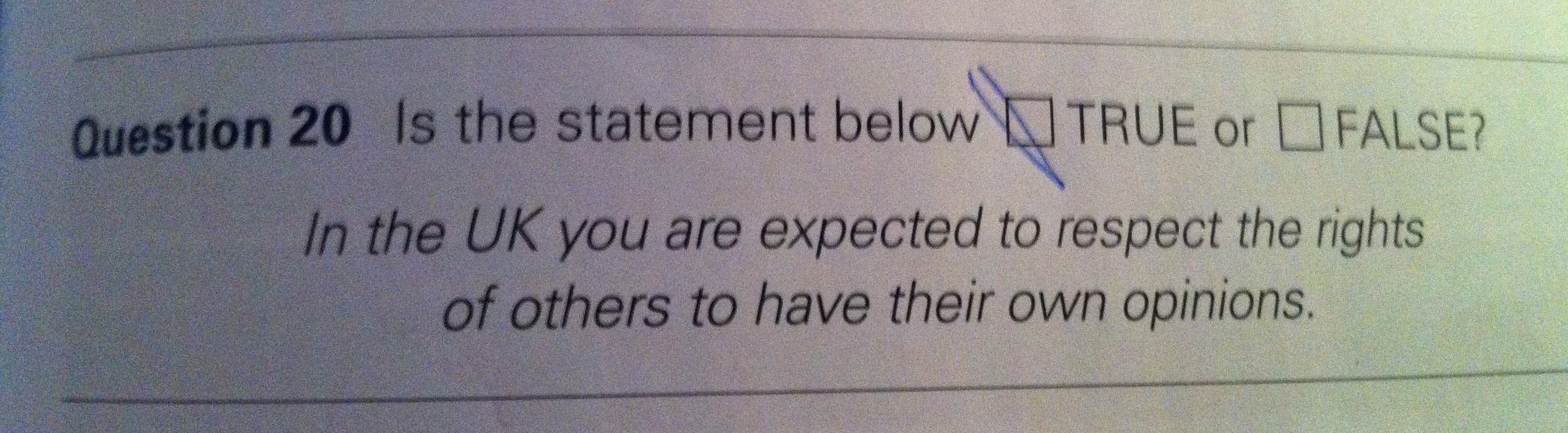
Those politicians, journalists and activists who still seek to police the immigration debate and preordain its outcome could do worse than studying up on this one, known to every new British citizen:

Is the statement below TRUE or FALSE?

In the UK you are expected to respect the rights of others to have their own opinions.
SPS UK Immigration Life In The UK Test 3


If you enjoyed reading this article, please take a second to LIKE or SHARE it on social media using the buttons below. Help to spread the word and continue the debate.

Newark And Beyond: What Will It Take To Stop UKIP?

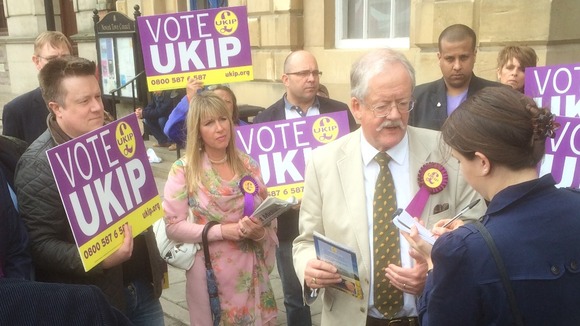
Roger Helmer Newark UKIP


If UKIP manages to defy the odds (and the polls) and win the Newark by-election, claiming their first seat in the House of Commons, the achievement will speak for itself – and the strength of the British political earthquake will be confirmed.

But what will a Conservative victory in Newark mean? What will it mean if the Tories squeak across the finish line ahead of UKIP when the votes are counted on Thursday?

The Conservatives will spin a very upbeat narrative, as would be well within their rights. For an incumbent governing party locked into an unpopular coalition and coming off the back of a double mauling in the local and European elections, managing to staunch the bleeding and retain the confidence of the voters of Newark would be just the shot in the arm that David Cameron’s team needs.

But given the extraordinary amount of effort that the Conservatives are expending to beat UKIP (in a race where Labour and the Liberal Democrats are relegated to the status of also-rans), have the Tories blundered by raising expectations so much that anything other than an emphatic Conservative victory will now be perceived as underwhelming, even worrying?

Be in no doubt, the Conservatives are desperate to hold on to Newark in the by-election. David Cameron has ordered all of the key cabinet members to go to Newark to campaign, while prospective Conservative Party candidates for 2015 and beyond have been sternly warned that they will be struck from the list of approved candidates unless they campaign vigorously enough in the town. Meanwhile, the local campaign office has an MP “roll of honour” prominently displayed on the wall, where visiting Tory MPs have to clock in and out. CCHQ takes the UKIP threat in Newark extremely seriously.

But many Tory seats are vulnerable to a UKIP surge in the general election, and no party will be able to mount the kind of desperate scorched-earth campaign against UKIP currently underway in Newark, replicated 30 or more times across the country. If this is what it takes for the Conservatives to halt the UKIP advance in just one parliamentary constituency, how will they cope when all of their incumbents are up for re-election in 2015 and all of their seats in play?

Of course, the opposite could also hold true. Some argue – quite plausibly – that it is the growing, insurgent party that fights best in a single constituency but which will struggle to marshal the resources to compete in multiple constituencies in a national general election. These people certainly have overwhelming evidence from other parties once seen as “the next force in British politics” on their side.

But what they miss – those who still blithely write off UKIP’s future prospects – is the fact that UKIP’s appeal and current performance is very little to do with their party organisation chart or their untried and untested voter mobilisation tactics. Previous insurgent parties such as the SDP were formed from schisms at the top of the establishment; the power of UKIP comes from the grass roots and lies in an idea.

The idea of UKIP is sometimes fuzzy around the edges, is articulated slightly differently by each activist the media might stop and question in the street, and is sometimes expressed forcefully and unpleasantly in a way that the party would not like; but for all that, it has the huge advantage of being small-c conservative without the long half-life toxicity of the Conservative party, unabashedly pro-British and demonstrably not of the “same old” political establishment.

Such is the British public’s current disdain for the same old Westminster political parties with their platitudes and broken promises, and such is the growing desire for a return to conviction politics where ideas and principles actually mean something and are worth arguing about, Britain could now be entering a phase where the country is unusually receptive to new ideas and bold solutions. If this is the case, even Grant Shapps, his computerised voter data models and his army of young student activists may be powerless to stop the advance of Nigel Farage.

We last saw this weariness with the status quo and desire for radical change in 1979, when Margaret Thatcher won election. Back then, the crisis facing Britain was economic and existential – would we continue to allow the trades union and the tired accommodations of the post-war consensus to continue sapping away at Britain’s vitality until there was nothing left but an impoverished, third-rate, failed socialist state.

In 2014, many Britons (save UKIP) do not see an existential threat, but there is nonetheless a crisis of ennui, disengagement, democratic illegitimacy and the return of that 1970s fatalism that says Britain can no longer prosper without pooling political sovereignty with Europe on the unfavourable terms of the vanquished.

The Newark by-election campaign is revealing exactly what the revamped Conservative Party machine and ground game is capable of when the Tories really, really want something. Thursday’s result will give the first hint as to whether this will be enough to stop UKIP in 2015.


UPDATE:  The Telegraph’s James Kirkup appears to be in agreement with this assessment. He writes:

A win in Newark would show that the Tory election machinery is in good nick – or at least that a professional party campaign apparatus can trump a band of amateurs with more conviction than organisation.

And is that the same thing as winning the argument? Have a quick glance at the national opinion polls: the Tory number is hovering around 33, with Labour a couple of points ahead. Remember 2010? Those figures were CON 36 LAB 29. And that still wasn’t enough for a Tory majority.

A win in Newark will solidify Tory optimism about the general election, but it won’t change the awkward fact of national politics: the party still has a long, long way to go to win that majority.

Anti-Independence Bribes For Scotland Could Wreck The Union

RBS banknote


Hearteningly for those who believe in the United Kingdom and do not want to see the fragmentation and balkanisation of our country, the latest opinion polls still show a large (if slightly falling) majority in favour of voting No in the upcoming referendum on Scottish independence. But this has not put the No camp at ease, as evidenced by new reports of more hurried ‘concessions’ being offered to sweeten the deal for those Scots still vacillating over how to vote.

The Guardian reports:

David Cameron has backed plans for Scotland to set its own income tax rates, including the freedom for the first time to cut taxes below the level of the rest of the UK. He said the proposals, published by Scottish Tory leader Ruth Davidson on Monday, would offer Scottish voters “real powers with real consequences” if they voted no in September’s independence referendum.

The new powers, potentially including control of housing benefit and Scotland’s share of VAT receipts, were described by Davidson as a radical and “thoroughly Conservative vision” for greater devolution.

It is certainly true that additional devolution of powers could fall within the remit of a “thoroughly conservative vision”, as the Scottish Tory leader says – but only if the entirety of the Strathclyde report is implemented, not just the eye-catching parts about tax. Ruth Davidson has taken an excellent piece of constitutional work and boiled it down into a single policy that would actually be harmful if implemented.

The ill-conceived focus on tax is just another reactive move, likely to serve only two purposes, both negative:

1. Offering additional concessions suggests fear and panic on the part of the “Better Together” campaign. When issues of momentum and public perception are known to be so important, it reeks of political amateurism to carelessly give the impression that the pro-Union campaign is somehow on the back foot and in need of new eye-catching reasons for Scots to remain part of the United Kingdom.

2. Offering additional areas for devolved power in a reactive way because of opinion polling is just about the worst way of charting a path toward constitutional reform imaginable. And this latest bribe raises all sorts of questions that our political leaders (many of whom are out of their depth on constitutional matters anyway) are unable and unwilling to answer at the moment. Why, for example, will Scotland be given this new power over income tax, but not Wales, Northern Ireland or England?

The danger is that by touting ill-conceived bonus incentives such as these to remain within the Union without the context of broader constitutional change for the UK (which Lord Strathclyde gave in his report but is going largely unreported), the “Better Together” advocates are simply punting on the issue and creating more problems that the UK must wrestle with in future.

Offering greater income tax and VAT altering abilities may have the short term effect of pleasing a few wavering Scottish voters, but it will also sow the seeds of discontent in the other home nations which are not equally favoured with these powers. How is it wise to fight the flames of Scottish separatism today in a way that can only fuel the fires of Welsh and English nationalism tomorrow?

As with any discussion about devolution of powers, there are also important considerations around the West Lothian question that remain unanswered.

From what little we currently know of the proposal, the Scottish Parliament would be given full power over income tax rate setting (over and above the +/- 3% deviation currently allowed), as well as some control over VAT. But while there is a partial link between taxes raised in Scotland and the amount of money available for Scottish public services, in reality most of the UK’s finances are ultimately fungible, with a big central pot satisfying demands from all corners of the United Kingdom.

If the Scottish Parliament assumes these new powers of taxation but Scottish MPs at Westminster are not prevented from voting on matters of taxation involving England, Wales and Northern Ireland, it would create an extraordinarily strong perverse incentive for Scottish MSPs to vote to lower income tax and VAT as much as possible within Scotland while Scottish MPs vote to keep taxes higher in the rest of the UK, knowing that the rest of the country must continue to subsidise Scottish defence, infrastructure and other critical areas.

But more than questions of hurt pride, inequality or the creation of an incentive to effectively steal from the rest of the Union, this represents yet another cack-handed attempt by politicians to solve a short-term problem at the expense of the longer-term stability of the United Kingdom. More devolved powers over taxes and other areas are a great idea, but all of the home nations deserve these power equally; they should not be granted to Scotland alone.

Giving out important constitutional waivers whenever one part of the union becomes restive is a terrible way to govern, and yet this is increasingly becoming the norm, with the incomplete rollout of Strathclyde’s excellent report being preceded by Gordon Brown’s one-sided suggestion of the same thing – more devolution on taxes and not much else.

This blog has strongly and consistently advocated for a full constitutional convention to be held to debate and agree precisely how we want to move forward as a United Kingdom of four home nations, which powers we want to reserve for “we the people” and which we lend to government at the local, county, devolved country and national level – with equality of powers among the home nations a central tenet.

The current settlement – with broad powers given to the Scottish Parliament, lesser powers to the Welsh Assembly and the fractious Northern Ireland Assembly never more than five angry words away from suspension and the reimposition of direct rule from Westminster – is rapidly becoming more complicated than any of us, least of all our politicians, can wrap our heads around.

At the time of Gordon Brown’s unrequested intervention in January, this blog warned:

When the unionist side is already making such a convincing case and steadily holding a majority of public opinion, why come out proposing “major constitutional changes” as a deal-sweetener? Not only does it reek of panic and desperation, it is a cast-iron certainty that the constitutional changes being proposed will be of a narrow, specific and non-universal nature, designed to bribe voters but carrying with them the unintended consequence of making the architecture of the UK’s political governance even more complex and inequitable than it is today.

Unfortunately, it seems that what was just a doodle in the margins of Gordon Brown’s notebook in January is now well on the way to becoming part of the UK government’s official pitch to Scottish voters, and blueprint for the constitutional future of the entire UK.

Scottish tartan enjoys timeless fashion appeal not just because of the rich culture and history associated with it, but also because of the intricacy and precision, the warps and wefts intersecting and being spaced apart just so in order to produce a unique pattern in the larger tapestry.

It is sadly ironic that the panicked and misguided efforts of short-sighted politicians north and south of the border risk turning the UK – if it survives 2014 at all – into a far messier, less pleasant patchwork than we are today.

Biased Or Not, The BBC’s Political Coverage Is Shockingly Bad

BBC Daily Politics Political Journalism SPS


The BBC – our national treasure or money and creativity-sapping black hole (depending on your viewpoint) has been given due notice by Sajid Javid, the new Culture Secretary, that every aspect of its future funding and existence is under review.

The Huffington Post reports:

All aspects of how the BBC is run and paid for will be reviewed when its charter comes up for renewal, the Culture Secretary has said. Sajid Javid said “everything” would be looked at, including licence fees and governance structures, when negotiations get under way … Tory Party chairman Grant Shapps warned the corporation last year it could lose its exclusive right to the £3.6 billion raised by the licence fee if it failed to tackle what he believes is a culture of secrecy, waste and unbalanced reporting in the organisation.

For those who believe that on balance the BBC is currently doing more harm than good, this is welcome news. Indeed, this kind of root-and-branch re-evaluation of public services is precisely what many people who voted Conservative in 2010 expected but have not seen thus far under the coalition government.

Re-evaluation and reform is sorely needed. The BBC has recently struggled to defend itself against allegations of incompetence and institutional corruption following the Jimmy Savile sexual abuse scandal, excessive remuneration of top talent and high level executives, and catastrophically poor editing of it’s flagship nightly news programme. And only last week the corporation defiantly kept the editor of the BBC News Channel in her post despite the fact that she posted highly partisan and derogatory comments about a political party on her Twitter account, in flagrant violation of BBC rules.

This blog is not alone in noting the gradual fall in the quality of the BBC’s political output in particular. The Telegraph’s Dan Hodges rightly lambasted the corporation’s recent election results coverage for being both lightweight and unresponsive to complex, dynamic situations. Hodges notes that despite token efforts by the legacy broadcasters to acknowledge the existence of social media, the BBC’s election results programme (for the recent local council and European elections) was way off the mark in its analysis, seizing upon the first narrative that emerged and stubbornly sticking with it throughout the evening even as Twitter started to better reflect the more nuanced results which later emerged.

It is worth quoting Hodges at length, because he makes a vital point:

I’m usually quite sceptical about the whole “social media is taking over the world” meme. But on Sunday night it became very obvious. Twitter and the other social media outlets are making the big election night programs utterly redundant.

It wasn’t apparent when they were the only outlet for results and analysis. But last week both main broadcasters were horribly exposed. What was amazing was the way it was clear neither Sky nor the BBC were taking the slightest bit of notice of their own output. They were engaged in a logistical exercise – “Let’s make sure we don’t miss the returning officer from Torquay” – rather than an analytical one.

What I also couldn’t understand was who they thought their audience was. The same headline mantra was chanted – “Ukip earthquake, Ukip earthquake” – over and over again, but no serious effort was made to deconstruct it. Surely the only people watching local election results at one in the morning are political geeks like me. And what we’re looking for is serious analysis.

Watching the difference between the discussion in the election studios and the discussion on Twitter was like the difference between watching Gary Lineker and Alan Shearer on Match of the Day and Gary Neville and Jamie Carragher on Monday Night Football. The former talk blandly about great attacking or terrible defending. The latter explain in granular detail precisely why it’s great attacking or terrible defending.

Sadly, that just about sums up the BBC’s approach to political programming today. There is a heavy focus on the personality-based politics (epitomised by the need to muckrake, sensationalise and have a “gotcha” moment in every interview) and the logistics of electioneering, but a rapidly fading focus on the comparative assessment and scrutiny of opposing policies. These days, the BBC’s political coverage is all about The Game – who’s up and who’s down at any given moment. Who’s wrong and who’s right barely gets a look-in any more.

What’s worse, the increasingly lightweight personalities – journalists and contributors – deployed by the BBC to cover the political beats are often incapable of the latter, more serious type of reporting, able only to offer superficial ‘analysis’ of the ups and downs of parties and personalities as measured by the twenty-four hour news cycle. Over time, the BBC divested itself of much of the expensive, skilled talent needed for good quality political coverage, either reshuffling them, demoting them or letting them go – and with them, their vital knowledge.

Before the BBC apologists leap to their feat in protest, no it does not have to be this way. High quality, penetrating analysis is not thwarted by the need to remain impartial (an imperative that the BBC fails to achieve anyway), but the BBC is in danger of succumbing to the worst current instincts of political coverage on American network television – giving each ‘side’ of an argument equal weight and validity out of desperation to appear non-partisan, even when the truth is quite clear-cut and largely occupied by one particular party.

The liberal comic Bill Maher perfectly skewers this unnecessary impulse, increasingly seen in BBC political broadcasting, as it pertains to the non-existent flat-Earth debate:


In other respects, though, Americans enjoy far better political coverage than their British cousins. America benefits from the existence of C-SPAN, a private but nonprofit cable network set up by the US cable television industry, who pooled their resources to establish a one-stop shop that they could all draw on for in-depth political coverage.

The BBC’s own effort, BBC Parliament, does not compare favourably with C-SPAN. BBC Parliament occupies one channel, while C-SPAN has three. C-SPAN provides much more extensive and flexible coverage of both houses of Congress, while BBC Parliament is bound by the ludicrous and archaic rules governing the televising of Parliament. C-SPAN offers a much wider range of other programming such as book talks, public debates and call-in shows, while BBC Parliament has to fit its own meagre offerings of this type in the periods when Parliament is not sitting. C-SPAN’s online presence vastly outstrips that of BBC Parliament in terms of depth of analysis and availability of archive footage.

But most importantly of all, C-SPAN has a reputation for balanced programming and is well-regarded by both liberals and conservatives. British conservatives, by contrast, have long since given up trying to get a fair shake from the BBC – though this article makes a persuasive case for the BBC’s innate small-C conservatism.

It is impossible to properly compare the entire outputs of two news networks in this short space, but a lot can be learned by watching the following excerpts of political output from the BBC and C-SPAN respectively.

First the C-SPAN show, a typical and broadly representative example of their output; in this case a call-in show featuring the national security journalist Glenn Greenwald as special guest:


And here is a C-SPAN StudentCam short film, also on the topic of national security. Such segments form a regular part of C-SPAN programming, filling the time slots between regular programming and encouraging young people to take an active interest in civic issues:


Contrast these with the BBC’s recent efforts, this exerpt taken from the flagship Daily Politics show:


The difference in focus, tone and overall quality could not be more striking. Even the student effort on C-SPAN outmatched the quality and seriousness of the BBC’s political output – and again, these examples are fairly representative of each network’s normal output, not chosen to unduly embarrass the BBC.

The obvious question that must be asked is this: Why the grave disparity in service, given the deep pockets and institutional clout of the BBC compared to its upstart American counterpart?

(In the interest of fairness, it must be mentioned that much of the BBC’s radio coverage is of significantly higher quality, particularly Radio 4’s Today in Parliament).

It’s not that there are necessarily more smart people with a burning interest in politics and public policy in America than there are in Britain. But because the BBC’s omnipresent dumbed-down approach crowds out all other offerings in the marketplace, politically interested citizens are much better catered to in the United States than they are in Britain, where the Daily Politics-style cartoonification of politics insults those with real knowledge and interest.

The truth is that the quality gap between C-SPAN and BBC Parliament has not always existed – it was brought about fairly recently by people who should be ashamed of their decisions, and whose CVs should carry indelible black marks as a consequence.

Before the Daily Politics came along and ruined everything, the BBC’s flagship political programming consisted of shows such as On The Record, Despatch Box and Westminster Live. Much like C-SPAN’s offerings in the United States, the budgets were small and the production values cheap; but this had the beneficial effect of making it all about the programming – the quality expertise and the analysis shared with the viewer.

This all changed when former BBC Director General Greg Dyke commissioned a review of the BBC’s political output, leading to a wholesale relaunch and rebranding. By 2003, out had gone the old shows with their dull but informative content, and in came the quirky, zany future where everything is a joke, everything is accompanied by a jaunty animation and theme tune, and everything is lightly mocked from the couch by host Andrew Neil and his unglamorous assistants.

Viewers can discern everything they need to know about the Daily Politics from the opening title sequence, without sticking around to suffer the show itself:


Portraying the British political system as some kind of sputtering, wheezing steam engine perpetually on the verge of breakdown may sometimes be uncomfortably close to the truth, but the BBC’s flagship daily political programme should not lead with this suggestion. Disillusionment with politics is high enough as it is without making jocular reference to all the reasons why in the opening credits.

To be clear, this is not to say that the politician themselves should be necessarily be treated with respect, reverence or deference, particularly when their actions have merited the opposite – but there should be a baseline of respect for the political process itself that now seems entirely absent from the BBC’s output. And all for what? What grand prize is the BBC seeking that is worth so much debasement?

The BBC is chasing a pipe dream if they believe their new dumbed down approach will result in more people tuning in and engaging with politics. Tacky, irreverent output better suited to satirical comedy shows will not draw in viewers who currently favour watching repeat episodes of Top Gear on Dave – it only serves to patronise and alienate those viewers who are interested in political coverage anyway, without the added allure of bright colours and jaunty theme tunes.

This isn't helping
This isn’t helping.


The point is not that the BBC should be disbanded entirely, or that the license fee should necessarily be scrapped (although it certainly should), or any one other prescription. The point of shaming the BBC with the woeful quality gap in its political programming is to point out that there are other delivery models out there in the world that work and which could produce good results back here in Britain, if only we would allow ourselves to consider them without feeling that we are somehow “cheating” on Auntie.

Those who become overly sentimental about the BBC in its current form suffer from the same forgiving and idealistic delusion as people who create Twitter hashtags or found political parties to “save the NHS”. Just as some NHS activists prize the survival and continuity of that organisation over the outcomes it was created to deliver (the best possible healthcare for British citizens), so BBC defenders cling to nostalgia rather than acknowledge the fact that the beeb can learn a lot from other broadcasters, at home and abroad.

There are many ways in which the BBC must prove its continued legitimacy other than in the field of news and political reporting. Why, for example, does a state-owned broadcaster need to operate eight national television channels, sixteen national radio stations and forty local stations when there is a thriving commercial sector?  But the BBC also gets many things right when it comes to news coverage – no one else in the world can match its depth and breadth, while British audiences tend to trust it above commercial rivals at times of crisis or when major incidents are unfolding.

The BBC’s political coverage, however, goes from bad to worse; and if left unaddressed for much longer it not only runs the risk of negatively colouring Sajid Javid’s upcoming review, but it will start to undermine British democracy itself.

As a first step in the right direction, the BBC News Channel’s editor, Jasmine Lawrence, needs to be reassigned to another role where her toxic anti-UKIP beliefs are in no danger of bringing the corporation’s impartiality into further question. But above all, the BBC needs to stop dumbing down in the one key area where dumbing down offers no benefits at all in terms of audience engagement or viewing figures.

The BBC’s Royal Charter – a delightfully worded document whose preamble would not be out of place in a Shakespeare play – defines the corporation’s public services (in part) as follows:

(a) sustaining citizenship and civil society;
(b) promoting education and learning;

Unless our national broadcaster is happy to continue fostering a state of cultural apartheid, where radio listeners receive tolerably decent political news output while television viewers are talked down to and belittled at every turn, the BBC must acknowledge that it is currently failing to meet these public service requirements.

And as it goes for anyone finding themselves on the wrong path in life, the first step toward the BBC’s redemption will be admitting that they have a problem.

Does Privacy Exist? Yes, But Only For Our Leaders At Bilderberg 2014

Bilderberg 2014 Copenhagen 3


If 100 of the world’s top celebrities – from Angelina Jolie to Will Smith – suddenly dropped what they were doing and hunkered down together in a luxury hotel to debate the future of the entertainment industry in complete seclusion from the world, and then emerged three days later as though nothing happened, people would be rightly curious to know what they were up to.

Actually, curious is an understatement. There would be wall-to-wall media coverage, the TMZ drone would hover above the scene capturing aerial footage, pundits would offer endless speculation and real-time ‘analysis’ of what they thought might be taking place inside – in short, the world’s press would make a presidential election look like local newspaper reports about a lost kitten.

Isn’t it odd then, that when 100 of the most wealthy and influential people from outside of Hollywood – powerful establishment politicians, new rising stars, corporate CEOs, high-tech moguls and royalty – meet in secret every year to do the very same thing, nobody gives it a second thought?

The Bilderberg 2014 conference is now under way in Copenhagen, where a star-studded cast of characters from civilian, business and military-intelligence backgrounds are gathering to debate this year’s agenda of topics including sustainable economic recovery, the future of democracy, the Middle East, the Ukraine crisis and whether or not the basic concept of privacy still exists.

And no, you didn’t miss the hype. There has been scarcely any coverage of this year’s confab in the British or American press. Outfits such as the New York Times and the Daily Telegraph do not see fit to mention the meeting to their readers (in contrast to their coverage of the annual World Economic Forum meeting at Davos, Switzerland), and the BBC’s only acknowledgement of Bilderberg this year has been a Daily Politics segment which discussed conspiracy theories in general, and laughingly recalled the occasion last year when the show mocked and denigrated American radio host Alex Jones, one of the few activists to cover the 2013 Bilderberg meeting in Watford, England.

If Bilderberg was just another place for the wealthy and well-connected to hang out, there would be no issue – the world is awash with exclusive places and events for the elite to hobnob with each other. The same cast of characters also meet up at Davos for the World Economic Forum (the red carpet event of the year for people of lesser beauty and charisma), but if twelve months is simply too long to wait between encounters then nobody should begrudge them another opportunity to awkwardly flirt with one another while putting the world to rights.

The problem is not that successful and powerful people are meeting in secret in Copenhagen. The problem is the particularly volatile, toxic blend of people that assemble. Why are serving heads of government and state on the invite list to what is in part a giant, closed-door lobbying event? And how do attendees from the military and intelligence communities such as the secretary general of NATO, the head of MI6 and the former head of the NSA have common cause with corporate leaders including the Chairmen or CEOs of Shell, Barclays, BP, HSBC, Nokia, LinkedIn and Google?

And one more question – when the press are neither invited to the meeting nor briefed on its outcomes, why do the editors of media outlets including The Economist, The Financial Times, Le Monde and Italy’s RAI-TV sanction Bilderberg with their attendance?

In short, the answer is this: Bilderberg is the closest that western democratic societies come these days to openly, flat-out declaring that well-connected, wealthy people have an inherent right to rule and influence national and international policy, and to have their opinions taken more seriously than regular folk. From supposedly meritocratic “if I can make it there, I’ll make it anywhere” New York through the Scandinavian poster-children of equality and back to post-Citizens United Washington DC it holds true; but most of the time we try to convince ourselves that it is otherwise, that our voices still count and that we are all equal before the law. For those who pay attention, the yearly Bilderberg conference serves to disenthrall us, briefly lifting the curtain on the truth.

That truth is the fact that money talks, and exorbitant wealth carries the loudest megaphone of all. It’s hardly a revelation, but the only time when the rest of us have it shoved in our faces quite so explicitly is at the yearly Bilderberg meeting – ironically the one time when almost none of us, led by the press, pay any attention.

Venue for the 2014 Bilderberg conference
Marriott Copenhagen – venue for the 2014 Bilderberg conference


On the agenda for Bilderberg 2014 is the subject of privacy – very topical given the ongoing fallout and scandal resulting from the Edward Snowden surveillance revelations and consequent exposure of the real extent of government surveillance in and by the United States, United Kingdom and other Five Eyes group countries.

Meeting with John Sawers, General Petraeus and others who are intimately involved in the conducting of government surveillance activities will be many high-profile people of vast wealth and influence. Many of these people are likely to hold quite forceful opinions on the issue of privacy, but they are more likely to be interested in protecting their own privacy from the journalists who would make their activities and indiscretions known to the public than altruistically pressuring governments to cease collecting everyone’s private data in their indiscriminate dragnet.

Given the rare opportunity to hold face-to-face meetings with the people who run the surveillance programmes and formulate the policies which underpin them, which aspects of the privacy question – and whose personal  interests, those of the elite or those of society as a whole – are the privileged attendees most likely to discuss?

Charlie Skelton at the Guardian, one of few mainstream journalists to cover Bilderberg every year, also picks up on the irony of an organisation as secretive as Bilderberg holding a discussion about the existence of privacy:

That’s an exquisite irony: the world’s most secretive conference discussing whether privacy exists. Certainly for some it does. It’s not just birthday bunting that’s gone up in Copenhagen: there’s also a double ring of three-metre (10ft) high security fencing … There’s something distinctly chilling about the existence of privacy being debated, in extreme privacy, by people such as the executive chairman of Google, Eric Schmidt, and the board member of Facebook Peter Thiel: exactly the people who know how radically transparent the general public has become.

Precisely. The average person might care about privacy issues because they don’t like being treated as automatic suspects in the intelligence services’ surveillance dragnet, or because they don’t want risk-averse insurance companies from searching out deeply private facts from our lives in order to increase their premiums. The privacy concerns of an oil company CEO or the queen of Spain (attendees all) are likely to be of a different order altogether, more focused on keeping potentially explosive or embarrassing information out of the public domain, and creating a legal framework that punishes those who reveal the truth while empowering those who seek to operate in the dark.

And you can bet that the Bilderberg attendees do want to affect change – they do not assemble for purely social reasons, but to leverage one another’s influence for their own ends – sometimes quite noble ends, but equally possibly very selfish ones. This leads to another sharp observation from Skelton:

The Bilderberg Group says the conference has no desired outcome. But for private equity giants, and the heads of banks, arms manufacturers and oil companies, there’s always a desired outcome. Try telling the shareholders of Shell that there’s “no desired outcome” of their chairman and chief executive spending three days in conference with politicians and policy makers.

If people want to shoot the breeze or have long, meandering yet inconclusive conversations about the state of the world, they go to Starbucks or sneak off to the pub with their friends. Influential and high net worth individuals – whose time is supposedly so valuable – don’t check out for three days and traverse continents unless there’s something significant in it for them, or the causes that they promote.

As Bilderberg 2013 drew to a close in the Hertfordshire countryside, Semi-Partisan Sam had this to say (among other things) about the motivations and biases of the people who get together once a year to decide what’s best for the rest of us:

The reason so many of the actions taken by [Bilderberg members] over the years have been so harmful to ‘normal people’ is because the membership is comprised entirely of the successful. None of the protesters were allowed to remonstrate with the Great Ones within. No refugees from the middle east Arab Spring. No malnourished people from Africa. No failed small business owners from the town of Watford itself, which has struggled in the recession.

If every year you and your chums reassemble at the next Bilderberg meeting and find yourselves even more spectacularly successful and wealthy than the last time you met, “more of the same” could start to seem like a pretty good prescription.

A year later, and this ‘confirmation bias’ explanation is starting to look rather too charitable toward the Bilderbergers. Since the Watford meeting we have learned of more government overreach in the realm of surveillance, more incursions on privacy, more intimidation of the media and the further undermining of national democracy from overturned limits on corporate political spending in the United States to the growing concentration of powers at super-national level in the European Union.

It really would be helpful if the organisers would consent to publishing minutes from their meetings, because at the moment it looks suspiciously as though the 2013 attendees listened to public opinion, then got together and resolved to do the polar opposite.

Perhaps the ultimate irony of Bilderberg 2014 is this: not one week ago, the voters of Europe delivered a stinging rebuke to the political establishment for their growing disconnect with the people and their tendency to talk amongst themselves and prescribe universal solutions from on high without a democratic mandate for their actions. And now today, at a Copenhagen hotel in the heart of Europe, they’re at it once again as though the European elections never happened.

Unfortunately for us, our political elites are seemingly the only ones still able to assert a right to privacy, conducting their business with Bilderberg behind closed doors. But it’s just as much our fault – by not paying any attention, we let them get away with it.