Interview With Andy Burnham

Here’s what happened when I met Labour leadership candidate Andy Burnham after a campaign event in London

Rather than just criticising from afar, I decided to make an effort to see all of the candidates running for the leadership of the Labour Party, in the hope that they might seem more interesting – if not inspiring – in person, when not filtered through television screens or newspaper columns.

First up was Andy Burnham. So earlier tonight I waited outside St. Pancras parish church near Euston in London with a surprisingly large number of supporters waiting to hear Andy Burnham speak.

Overall, Burnham was fairly impressive, though he had the advantage of addressing a capacity crowd buoyed up by the irrepressible John Prescott as a warm-up act. Full impressions of the evening will come later, but suffice it to say that while I still favour Jeremy Corbyn because of the sorely needed ideological difference that he brings, Andy Burnham is not without good ideas of his own.

I spoke with Andy Burnham at the end of the event. I was particularly interested to discuss how – if at all – Andy Burnham intended to reconcile the seething anti-Tory hatred within the Labour Party with the need to persuade and win over current Conservative and UKIP voters in coming elections.

Below is the transcript of my interview:

Question: Your speech has obviously gone down well, you had a standing ovation. You talked about the Bullingdon Boys quite a lot, you talked about the Tory cuts, you talked about Iain Duncan Smith “terrorising disabled people” with ESA changes, and that goes down very well in this hall. But what happens when you try and take the message outside of this room, outside Labour supporters? What happens in 2020 when you try and fight the general election when, let’s face it, you’re going to have to win the support of people who voted Tory and might not like to hear that they have been complicit in maybe a genocide of the disabled or the persecution of the sick? How do you take this passion, but do it in a way that doesn’t necessarily alienate the half of the country who might vote for the Conservatives or for UKIP?

Andy Burnham: Well, I trust in the decency of the British people. They don’t want to see disabled people worrying from one day to the next, full of anxiety, and I think they see how the things that they [the Tories] are doing are cruel. Unfair. Because if people can’t work, people support the idea that they have help. If people can work, then people want to see them helped into work, but Duncan Smith goes further than that, and they’re taking support off people, money off people, who have no ability to replace that income. And the stress, the anxiety that causes is just wrong.

So that’s what I’ve said and I will stand as Labour leader for a fair and humane benefits system, but actually also responding to the concerns people have about immigration, about the economy, I’ve said that we should do that. This party shouldn’t just talk to itself – I said that tonight – it should talk for the whole country, and that’s what we’ll do under my leadership.

Question: And on that note, how does your party connect with aspirational Britain? So we get the compassion, that’s very clear, and that comes through loud and clear in your voice and in the supporters, but what about the people who are striving, you know, maybe trying to move up into those top income tax brackets and don’t think that that is necessarily a bad thing? How do you win them over to the Labour Party and to your cause?

Andy Burnham: Well that’s a really, really good question. And I’ve said that I want to lead a Labour Party that helps everybody get on in life, not a party that drags people back or speaks to the politics of envy but helps people get on, so helps people get onto the housing ladder with a very ambitious housing policy that stops young people having to find a huge deposit, that really helps them get an affordable home, that removes that millstone of debt off the backs of young people, so gets rid of tuition fees, supports young people who want a technical education. These are the policies that I believe in, and actually, when it comes to older people, have a situation where nobody loses everything they’ve worked for just because they happen to be vulnerable and need care. These are the policies that I’ve got and I believe they can speak to the whole country.

You can decide for yourself whether you think Andy Burnham answered my questions or not. But I came away feeling that the message had not quite penetrated, or been fully understood. Burnham’s answers were still predicated on the idea that there is a savage attack being carried out on the vulnerable by the Tories, and that anyone in their right mind must be able to see this.

But more concerning to those who care about Labour’s future, even when I provided a golden opportunity to pitch to Britain’s aspirational voters and perhaps talk about rolling back regulation, taxes and the nanny state, Burnham could only talk about what government has to offer the people by way of state handouts and perks. It’s hard to see this message resonating with the millions of aspirational voters who just want to get on, and who don’t look to government as an essential partner in everything that they do.

My full review of Andy Burnham’s campaign event in London will be available here.
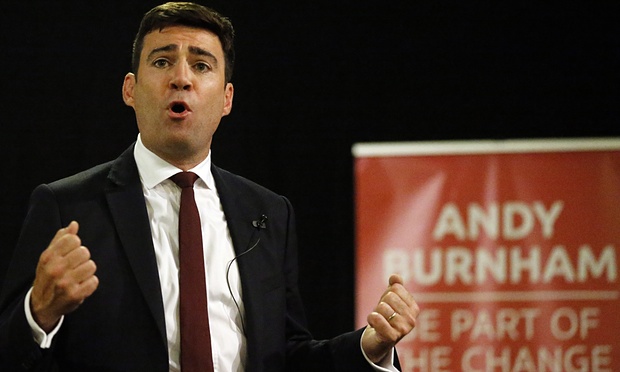
Andy Burnham - Labour Leadership - London Rally - 2

Follow Semi-Partisan Politics on Twitter and Facebook.

What Are The Aims And Values Of The Labour Party?

Labour Party Values - Leadership Election - Jeremy Corbyn

Thousands of new members are being purged from the Labour Party ranks, accused of not supporting the “aims and values” of the party. But the stated aims and values of the Labour Party are so bland and generic that they encompass nearly everyone, Tories and militant entryists included.

Do you agree with the aims and values of the Labour Party?

That was the probing question posed to each of the 121,000 new supporters who have swelled Labour’s ranks since May’s general election defeat by providing the party with a name, email address and the princely sum of £3.

With bookmakers already paying out on a Jeremy Corbyn victory in September’s leadership election, the Labour Party is fighting a rearguard effort to thwart potential ‘entryists’ and troublemaking Tories from infiltrating the party with dishonourable intentions. And the test applied to new supporters as part of the vetting process is intended to ensure that  prospective supporters share the same aims and values as the Labour Party.

But what are these values? Fortunately, the Labour Party website tells us precisely what they are:

Labour has only been in government for four short periods of the 20th century. However its achievements have revolutionised the lives of the British people. The values Labour stands for today are those which have guided it throughout its existence.

• social justice
• strong community and strong values
• reward for hard work
• decency
• rights matched by responsibilities

That one of the Labour Party’s core values is “strong values” tells you everything you need to know about the decline of Labour as a social, intellectual and ideological force, and the utter vacuity at the heart of British politics in general.

Continue reading

Yvette Cooper’s Cynical, Weaponised Brand Of Feminism

Yvette Cooper’s cynical attempt to weaponise the feminist cause to rescue her flagging leadership campaign is too little, too late

Now that some bookmakers are already paying out on bets that Jeremy Corbyn will win the Labour leadership, it is time to look at the also-rans, the bland non-entities currently sparring with each other for the dubious honour of a second place finish. And as a general rule, they have not covered themselves in glory.

Yvette Cooper’s campaign has been notable not so much for her ideas (thoroughly unexciting, as befits her Guardian endorsement) but for her decision to weaponise the feminist angle in the desperate search for votes.

Here she is at a recent speech in Manchester, arguing against Jeremy Corbyn’s plan to re-nationalise the energy companies:

Bringing back clause IV: spending billions of pounds we haven’t got switching control of some power stations from a group of white middle aged men in an energy company to a group of white middle aged men in Whitehall.

Let’s be clear: Yvette Cooper doesn’t think that nationalisation is bad because it would lead to inefficiency, higher prices or less reliable service, or for any other ideological reason. Her only objection to Corbyn’s proposal is that “white, middle aged men” would continue to run the show.

Continue reading

It’s Time For Jeremy Corbyn Detractors To Put Up Or Shut Up

Assailing the veteran left-winger for being “unelectable” is the coward’s way out. Jeremy Corbyn opponents should spell out to the Labour Party membership exactly which of his policies they disagree with, and why.

The three candidates running against Jeremy Corbyn for the Labour Party leadership are willing to talk about almost anything, it seems, other than why Jeremy Corbyn’s policies would be bad for Britain.

Don’t misunderstand – they are more than happy to talk about why a Jeremy Corbyn victory would harm the Labour Party. But pinning them down to any specific criticism of Jeremy Corbyn’s policies is close to impossible. In fact, for every one specific criticism of a Corbyn policy coming from within the Labour Party, there are at least ten other generic complaints that he is “divisive”, or that he will “split the party”.

Why is this so?

The 2015 general election result proved that there are still just enough votes in David Cameron’s wishy-washy, watered down conservatism for the Tories to win an outright majority in Parliament. The margin was not comfortable, but the Tories were able to haemorrhage right wing votes to UKIP and still carry the day.

But Labour no longer have this luxury. Following their wipeout in Scotland, and with the Green Party nibbling at their heels in England, Labour need all the centrist votes they can muster to ever win again – barring some major external shock or unforeseen realignment of British politics.

Continue reading

Gordon Brown Joins The Anti-Corbyn Fray, With Lecture On Electability

Labour’s vote-losing ex prime minister offers his thoughts on electability

Since leaving office, Gordon Brown seems to have gotten it into his head that he is an inspiring, motivational speaker with political opinions that people are clamouring to hear.

Watch any of the former prime minister’s recent speeches, and regardless of the venue or topic he acts like he is delivering a TED talk, roaming the stage and sawing the air with his hands as though he were proposing an end to world poverty or recounting the time he founded a global software firm working out of his garage.

Unfortunately, in reality it is just the same, tedious old Gordon Brown whom the voters were so pleased to be rid of back in 2010. But this hasn’t stopped Labour Party chiefs from drafting him to give a speech on electability, the latest desperate attempt to pour water on Jeremy Corbyn’s inferno.

And yesterday, on a stage overlooking the River Thames and the Houses of Parliament, Gordon Brown duly delivered, pacing the platform like a caged animal as he imparted his wisdom to a grateful nation.

The Spectator nods its approval:

Continue reading