A Sermon On Justice And Reconciliation From Ferguson, Missouri

Ferguson Missouri MO Fourth 4th July parade 2


What to say about the slow-motion tragedy unfolding in Ferguson, Missouri?

The few known facts – that a black teenager, Michael Brown, was shot to death by Darren Wilson, a white police officer, in disputed circumstances – belie the visceral anger that has consumed the town.

The subsequent actions by the authorities, notably the St. Louis County Police – stonewalling on releasing the name of the officer involved, refusing to release the autopsy details, waging an increasingly military-style war of aggression against legitimate protesters and journalists, and releasing CCTV footage of Michael Brown purportedly robbing a convenience store in what can only be interpreted as an act of pre-emptive character assassination – have only compounded the sense that a predominantly white establishment have more interest in protecting their good names and quelling dissent than administering justice.

St. Louis is a city that I know, have spent much time in, and feel close to. People should not be put off St Louis, Missouri and the surrounding area by the horrible scenes unfolding there now on television and Twitter, because the current crisis is not representative of the state and its citizens. But having personal experience of the area,  it is also glaringly evident that the violence and racial tension that forced itself into our collective consciousness with the shooting of Michael Brown last week was looming, unaddressed, for a long time.

Since I have known St Louis, it has been a city of two halves – the still somewhat dicey downtown area and select suburbs with higher black and lower income populations on one level, and the highly desirable enclaves and suburbs (such as Clayton and University City) that surround them, populated by a much wealthier (and whiter) demographic on the other. Everyone may cheer on their hometown St. Louis Cardinals baseball team on game day, but there is a clear divide between those who can afford tickets to watch the game at Busch Stadium and those who have to tune in on the radio or TV.  Tensions between the city’s two halves, while not ordinarily visible to the casual observer, have roiled this part of Missouri for years.

The New York Times thoroughly summarised the history of this divide in a recent article, revealing the underlying causes of the difference between St. Louis City and County:

Back in 1876, the city of St. Louis made a fateful decision. Tired of providing services to the outlying areas, the city cordoned itself off, separating from St. Louis County. It’s a decision the city came to regret. Most Rust Belt cities have bled population since the 1960s, but few have been as badly damaged as St. Louis City, which since 1970 has lost almost as much of its population as Detroit.

This exodus has left a ring of mostly middle-class suburbs around an urban core plagued by entrenched poverty. White flight from the city mostly ended in the 1980s; since then, blacks have left the inner city for suburbs such as Ferguson in the area of St. Louis County known as North County … 

Many North County towns — and inner-ring suburbs nationally — resemble Ferguson. Longtime white residents have consolidated power, continuing to dominate the City Councils and school boards despite sweeping demographic change. They have retained control of patronage jobs and municipal contracts awarded to allies.

This history lesson may seem a million miles away from the reality on the streets of Ferguson today, but it is directly relevant. It is because of structures such as this, where the now-minority white establishment continues to wield almost unchallenged control over the levers of local government, that allow the scenes of high-handed crackdowns on civil assembly and free speech as practiced by the predominantly white County Police.

The attitude – sometimes explicit, sometimes more subtle – of many of the wealthy St. Louis County residents to their St. Louis City and poorer County neighbours – has often been one of impatience and grudging forebearance on one end of the spectrum, and wilful ignorance on the other.

In 2009, St. Louis residents faced draconian cuts to their Metro public transportation service, the network of buses and light rail that connects the city. Residents of generally wealthy St. Louis County voted against an increase in the transit sales tax that would have raised $80 million to fund the Metro’s operation. They made little use of public transportation themselves – they were wealthy and drove cars. But the subsequent service cuts predominantly impacted the poorer County residents and the City residents who rely on public transport to get around. One figure implied that access to jobs in St. Louis County was reduced from 98 to 71 per cent.

Why does this matter? Because it was the poorer, predominantly black workers who served the coffee, sold the groceries and worked in the nursing homes used by the wealthy St. Louis county residents. A measure came up for vote that would have prevented it from becoming exponentially harder for these people to get to work in their low paid jobs every day. And the response of the County voters: Tough luck, we won’t pay a penny more to fund the civic infrastructure that you need. Screw you, we got ours.

Take this attitude and repeat it in every area, from education to police traffic stops, and you get a sense of the climate in which the Michael Brown shooting took place, and how little the two sides of St. Louis have historically been able to empathise with one another.

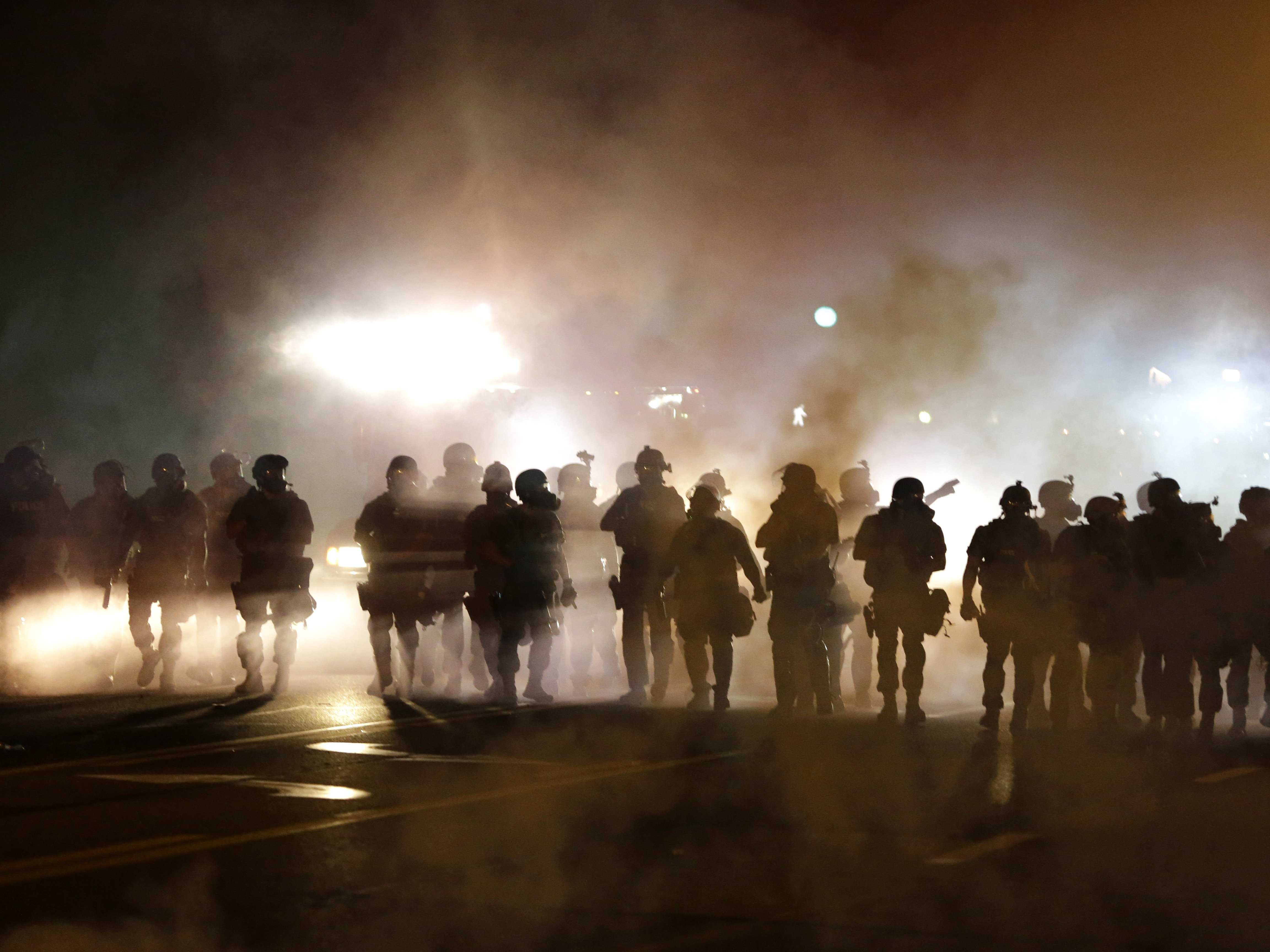
And on Saturday 9th August, it led to this:
Ferguson Missouri Michael Brown Protests Police


On my visits to St. Louis, a visit to the Episcopalian Christ Church Cathedral was always on the itinerary. The church and its community made a lasting impression on me with their many acts and expressions of love, welcoming and tolerance which sometimes seem so much at odds with the prevailing impression of Midwestern Christianity in America.

The way that Christ Church Cathedral (both in its grand stone home on Locust Street and its lively Facebook presence online) is responding to the crisis as it roils the city is perhaps a model to be studied and followed by all of the jostling interest groups – police forces, politicians, civil rights groups, the media and the oft-reported but scarcely-heeded residents – that have descended upon the area.

Yesterday, the Cathedral’s Dean Michael Kinman had this to say:

“The police and the justice system needs to hear the cries of the people and the people need to hear the cries of the police and the justice system, and we as followers of Jesus are the ones to stand in the breach between and even as we are being convicted and converted ourselves, help everyone on every side have their Jesus moment of conviction and conversion, of truth and reconciliation….

“The cry is ringing out from St. Louis around the world. The mothers are crying “Save my child,” and it is time for us to hear that cry and let it change our hearts and with changed hearts together lead this change in the world.

“St. Louis, this is our moment. And we know that this is not a child that will be healed instantly. The tasks are many, the obstacles are large and the journey will be long. But we are the Body of Christ and, with God’s help, together we will get the job done.”

Amen to this. Thus far, the police and the justice system have not been hearing the cries of the people. And in many cases they have conspicuously not been listening, either. Not in Ferguson, Missouri, and, sadly, not in many other towns and cities across America. For black Americans, the police are not automatically the reassuring presence on the street that they are to most whites – in fact, quite the opposite.

The protests taking place now would not be happening on their current scale and intensity if the death of Michael Brown was not just the latest of a litany of tragedies – and perhaps even injustices, depending on the outcome of this investigation – to disproportionally befall black victims and black communities. Looting and violence are reprehensible, but the situation in Ferguson does not exist in a vacuum, and it is not fair or intellectually honest to haughtily condemn them exclusively as failures of personal responsibility and ethics without taking the context of deprivation and repression in which they are happening.

That is not to say that a better, more peaceful path is not there for the taking. The police captain whose empowerment to take over control of the ongoing Ferguson situation from the hapless (and very culpable) St Louis County Police initially caused such a lull in the violence and bitter feeling showed the way with his early remarks:

“And we all ought to be thanking the Browns for Michael. Because Michael is going to make it better for our sons to be better black men. Better for our daughters to be better black women. Better for me so I can be a better black father. And, our mothers, so they can be even better than they are today. Lets continue to show the nation who we are. But, when these days are over and Michael’s family is still weeping, still on their knees praying. No matter what positive comes out, we still need to get on our knees and pray. We need to thank Mike for his life. We need to thank him for the change that he is going to make in America. I love you, I stand tall with you and I’ll see you out there.”

The difference that good leadership – and one man – can make is telling, and is encapsulated in this quote from a local resident, given last Thursday when hopes that the crisis was easing were still high:

But the presence of Johnson was clearly the difference between Thursday and the four nights of turmoil that preceded it.

 “I love this man so much,” said Angela Whitman of Berkeley. “He’s been here since the beginning,giving us encouragement and letting us know we’ll get through this.”

Conversely, the fact that the residents of Ferguson are not yet “through this” shows the limitations of good leadership and one man. Putting a local police chief – with black skin and roots to the community – in charge was a good first step, but it does not make up for the woefully slow response of Missouri Governor Jay Nixon. Nor does it make up for the fact that America’s libertarian political cheerleaders paused so obviously to test the waters before finally jumping into the fray.

The parachuting in of a black police captain does not make up for the many blatant violations of civil liberties – and the dignity of Ferguson protesters – inflicted by the overequipped and underprepared St Louis County Police in the preceding days. It does not make up for the flagrant inequalities in the American justice system, which incarcerates and punishes a huge number of young black men, stamping an indelible black mark on their records and making it even harder for them to ever break free from their circumstances and achieve the American Dream. And it does not make up for the false but universally known fact – reinforced over and over again, in lessons from cautionary tales like those of Trayvon Martin and now Michael Brown – that in America, a black life is worth far less than a white one.

One way or another, the protesters will eventually leave the streets of Missouri. So will the riot police, the clouds of tear gas and the world’s media filming it all. Michael Brown’s family will continue to grieve. These facts are certain, predictable, unchangeable. What remains within the power of people to influence is the legacy of this latest tragic black death on a city street. Will there be a meaningful and lasting change in police tactics, and a broader change in the way that the police seek to interact with – and reflect – the communities that they serve? And will there be a recognition that on America’s present trajectory, Michael Brown’s death was every bit as inevitable as that of the next person shot down without justification or consequences?

It takes a lot to change the culture of a local police department, let alone the judicial system of an entire nation. And for all the good that the players in Ferguson can do to bring these issues to our attention and make us face uncomfortable facts as they seek to reconcile and come to terms with what has taken place, it is usually at the state and national level where any lasting, widespread changes are enacted.

Unfortunately, this means that it is left to the slow-moving and cautious Missouri governor Jay Nixon, the vacationing President Obama (himself hamstrung in his response after failed interventions in the Trayvon Martin shooting and other incidents) and a host of national politicians who are more inclined to use the pain of Ferguson, Missouri for their own ends than to solve a common problem. With this predictable cast list, there seems little hope that we will not be reassembling in a few months’ time to beat our breasts over the next police shooting, mass shooting or other act of wanton violence.

But still, we must hope. And in the absence of any meaningful national leadership, the people of Ferguson, Missouri must lead the way themselves in turning a case study in “Community Policing – How Not To Do It” into a model of outreach and reconciliation for the rest of America.

For the sake of everyone, black and white, city and county, this dark chapter in American history must not be endured for nothing.

  

Statue of Reconciliation Coventry Cathedral Britain


Cover Picture: Fourth of July Parade in Ferguson, Missouri – NOCO magazine

Middle Image: Police in riot gear advance through clouds of tear gas in Ferguson

Closing Image: Statue of Reconciliation, Coventry Cathedral, Coventry, UK


Can The Margaret Thatcher Conference On Liberty Rescue British Conservatism?

Keith Joseph Margaret Thatcher


These are not auspicious times for people who believe in the rights of the individual and the need for a pared-back, smaller, more efficient state.

It says everything about today’s Conservative Party, governing in weary coalition with the Liberal Democrats, that Ed Miliband’s Labour Party find the current Tory spending levels palatable enough that they have vowed to stick to them should they win back power in 2015, while their eurosceptic credentials are now so widely distrusted that UKIP have become the standard-bearers for defending Britain’s national interests abroad.

Just as Gordon Brown agitated for power and eventually deposed Tony Blair without a real agenda for governing (and we all know how well that worked out for him), so David Cameron’s Conservatives stumbled across the finish line and into Number 10 Downing Street with a half-hearted policy agenda built only to address the immediate economic crisis while ‘detoxifying’ the conservative brand rather than building the foundations for twenty-first century Britain.

Meanwhile, the assault on personal privacy and freedom from the surveillance state is gathering speed and momentum. In the United States, those on the side of liberty have at least found voice through whistleblowers such as Edward Snowden and journalists like Glenn Greenwald, forcing American politicians to at least pay lip service to the protections set out in their Constitution.

In the United Kingdom, however, the juggernaut has continued without so much as slowing down. Politicians from David Cameron on downwards have expressed no contrition that such a pervasive surveillance apparatus was constructed without any public debate or approval, while civil servants from the intelligence services remain unrepentant and continue their work without proper Parliamentary oversight.

As this goes on, the British people are assured that there is no reason to worry because we are only being spied on to protect us from terrorists, and that the surveillance takes place under “strict legal controls” – though thanks to the opaqueness of the British legal system and the propensity of the government to interpret laws creatively in their favour, this is of no reassurance at all.

Britain may not yet be facing a new winter of discontent – there may be no widespread industrial unrest, the rubbish may not be piling up uncollected in the streets and the economy may not be in freefall – but you would have to be mad not to pick up on the sense of pessimism and foreboding. The economic recovery remains an “order book recovery” at present, its benefits not yet felt by many financially squeezed families.

And now we are told to rejoice that six years after the financial crash, Britain’s economic output has finally caught up with where it was in the heady days of 2008. More than half a lost decade.

No, these are not auspicious times.

Paul Goodman agrees, writing at Conservative Home:

50 years on from the new social freedoms of the 1960s, and 30 years on from the new economic ones of the 1980s, liberty has decreased, not increased.  What we drink, what we smoke, what we speak, how we drive, how we bank, how we live: all these are far more restricted by law than was the case in the 1970s.  The reasons for curtailment may be contestable – health and safety, Islamist terror, the Dunblane atrocity, NHS costs – but the direction of travel is clear.

While there is no major existential threat to Britain at present as there was in 1979 – the unions having been tamed and the Cold War won – there is still an urgent need for radical conservative thinking and policy solutions, just as there was in 1979 when Britain stood at the abyss.

All those years ago it was the (then) new think tank, the Centre for Policy Studies, that served as the intellectual engine behind the incoming Conservative government under Margaret Thatcher. No mere talking shop, the CPS developed ideas that changed Britain for the better once put into practice, as John O’Sullivan reminds us in the Telegraph:

This stream of pamphlets argued for limited government, reduced public spending, control of the money supply as a means controlling inflation, an end to prices and incomes control, the abolition of exchange controls, the privatization of industry, the scrapping industrial subsidies and the wider dispersal of wealth. Study groups, at one time numbering more than twenty, were set up. One of them, the Trade Union Reform Group under the chairmanship of Sir Len Neal, a former trade union leader, laid the foundation of the legislation later introduced to reform trade union law. Another pamphlet was inspired by Keith’s vision of the wider ownership of wealth; it led to PEPS (later restructured to become ISAs).

In 2014, the CPS is now celebrating its 40th birthday with a major international conference, the Margaret Thatcher Conference on Liberty.

It should be encouraging that the organ which did so much to inform and influence Thatcher’s government is riding to the rescue once again, but a glance at the agenda for today’s event hints more at the degree to which Britain has fallen back from the ‘peak’ of liberty achieved by Thatcher than it offers hope for bold new policy initiatives ready to be rolled out.

The first order of conference business, after the introductory speech by Sir V S Naipaul, is ditheringly titled: “The EU and the Big Corporations: are they ganging up against liberty and its protector, the nation state?”

After everything that has happened in Europe and Britain over the past several months, with the electorate’s rejection of the pro-European integration status quo and the rise of parties like UKIP, is this still a question that really needs to be asked? A forward-looking conference would be debating the best way to take advantage of the public’s growing scepticism and antipathy toward undemocratic supra-national institutions in order to either enact radical reform or achieve freedom from them, not half-heartedly speculate about whether the EU and the Brussels lobbying industry pose a threat in the first place.

And at the risk of venturing into conspiracy theorist territory, the fact that a number of conference attendees will participate in a session entitled “Big Government, Big Corporations: what chance for small business and innovation?” having come fresh from the Bilderberg 2014 meeting in Copenhagen, where big government gets together with (you guessed it) big corporations to the exclusion of everyone else does not speak very well of their legitimacy to discuss such matters.

One gets the sense that the Margaret Thatcher 2014 conference agenda was devised in order to fit the specialist knowledge and talking points of those special guests who accepted their invitations rather than the more fearless approach, which would have been to identify the most pressing trends facing Britain and the West, determining what needs to be discussed, and then engaging the support of those high-profile individuals who can best offer and promote policy solutions.

And while CPS is eager to promote the credentials and resumes of the conference’s star panellists, some of the luminaries scheduled to impart their wisdom – conservative celebrities though they may be – have decidedly questionable records when it comes to standing up for liberty in action.

If the Centre for Policy Studies is serious about rejuvenating conservatism and ushering in a new birth for freedom (to paraphrase Abraham Lincoln), the honoured guests from America should include the likes of libertarian standard-bearer Senators Rand Paul of Kentucky, or Ted Cruz of Texas (abrasive and odious though he may sometimes be) or at the very least Congressman Paul Ryan of Wisconsin.

If this conference really is to recapture the success of 40 years ago and spark some new ideas, there should be representation from that force which is doing the most to upend the stale conservative status quo across the Atlantic, the American Tea Party.

But instead, the Margaret Thatcher Conference on Liberty 2014 will be hearing from discredited, neo-conservative fossils the likes of Jonah Goldberg, who has never seen a war that he was not in favour of launching (though not personally participating in, of course), and Rich Lowry, who openly and unapologetically fantasises about the populist, proudly anti-intellectual Sarah Palin.

Sure, these big-name commentators may talk the talk when it comes to small government – at least, if you consider relentlessly hammering away at a “no new taxes, ever” message whilst simultaneously seeking to shrink the deficit and ringfence government spending on generous benefits for senior citizens or America’s bloated defence budget to be a “principled” form of conservatism – but it all goes out the window when it comes to foreign policy, national security and the surveillance state. On these issues, the likes of Goldberg and Lowry whine and clamour for big government louder than most die-hard left-wingers.

These people are Believers in Liberty in Name Only – or BLINOs. What insights and advice are they expected to give that they do not already regurgitate week after week in their National Review columns?

People like Jonah Goldberg – neo-conservative nepotism beneficiary extraordinaire – should be pariahs at a rejuvinated, forward-looking Centre for Policy Studies conference, not guests of honour.

It is curious that while some of the CPS’s American invitees are both out of power and widely discredited, their British counterparts are currently in power but are struggling to make a noticeable impact on an otherwise very centrist, pro big state, pro-Europe government.

Michael Gove, due to attend, is a formidable intellect and the closest that the Cabinet has to a libertarian (his bravura performance when giving evidence at the Leveson Inquiry saw him at his best); but Gove has achieved all that he feasibly can at the Education Department, and has recently made a series of political missteps that could harm his chances of winning another major government brief in the upcoming reshuffle.

Likewise, the Conservative MEP Daniel Hannan is an articulate advocate for the eurosceptic cause, and yet his caucus did not do enough by way of defending Britain’s national interest to stop the rising tide of public fury at the antidemocratic European Union, which saw the Conservatives’ European Parliament group leader, Martin Callanan, lose his seat.

John O’Sullivan, writing in The Telegraph, notes:

As Henry Kissinger points out, senior people in modern government are simply too busy and too tired to think creatively about the problems facing them. If they haven’t used opposition to do some fresh thinking, they have to fall back on the ideas of their opponents.

The Margaret Thatcher Conference on Liberty 2014 has the advantage of throwing together conservative thinkers in power (albeit the dying days of coalition with the Liberal Democrats) with those in the wilderness of opposition (as President Obama’s administration inches closer to its lame duck days). According to Kissinger, this should be the best of both worlds – a combination of Tory blue sky thinking and hard nosed pragmatism from the coal-face of government.

Such a conference could do more than generate headlines for one day in a slow news season – it could provide the spark that finally drags British conservatism out of its introspective, apologetic, New Labour Continued stupor.

But the conference is heavy on has-beens and light on rising stars. Instead of conservative thinkers like Andrew Sullivan, we get demagogues like Jonah Goldberg. Instead of rising political stars like Marco Rubio or Rand Paul, we will hear from elderly statesmen like former Australian prime minister John Howard. Instead of someone, anyone with a post-Snowden mindset on national security, we get former CIA director General David Petraeus.

That’s not to say that there will be no people of interest to watch – Michael Gove will be attending, along with Daniel Hannan, Estonian prime minister Taavi Rõivas and intellectual heavyweights such as Niall Ferguson. But nothing sums up the tightrope walked by the Centre for Policy Studies more starkly than the fact that Margaret Thatcher’s biographer, Charles Moore, is also a guest of honour at today’s conference.

British conservatism needs to look forward, but too much of the guest list suggests that the focus is on the past, not the future. Margaret Thatcher was right for her time and place – Britain in the eighties. But the next transformative British conservative leader will not look or sound like Thatcher; nor will he or she share the same priorities or advance the same policy goals. In the year 2014 Britain faces different challenges requiring different, bold solutions.

Tempting though it may be to sit back and reminisce about that day forty years ago when the Centre for Policy Studies was founded, there is too much work to be done in the present if British conservatism is to save itself.

And that work needs to start today.

Happy Flag Day


In her own good land here she’s been abused
She’s been burned, dishonored, denied, and refused
And the government for which she stands
Is scandalized throughout the land

And she’s getting threadbare and she’s wearing thin
But she’s in good shape for the shape she’s in
‘Cause she’s been through the fire before
And I believe she can take a whole lot more

So we raise her up every morning, we take her down every night
We don’t let her touch the ground and we fold her up right
On second thought, I do like to brag
‘Cause I’m mighty proud of that Ragged Old Flag.


Happy Flag Day to my American readers.

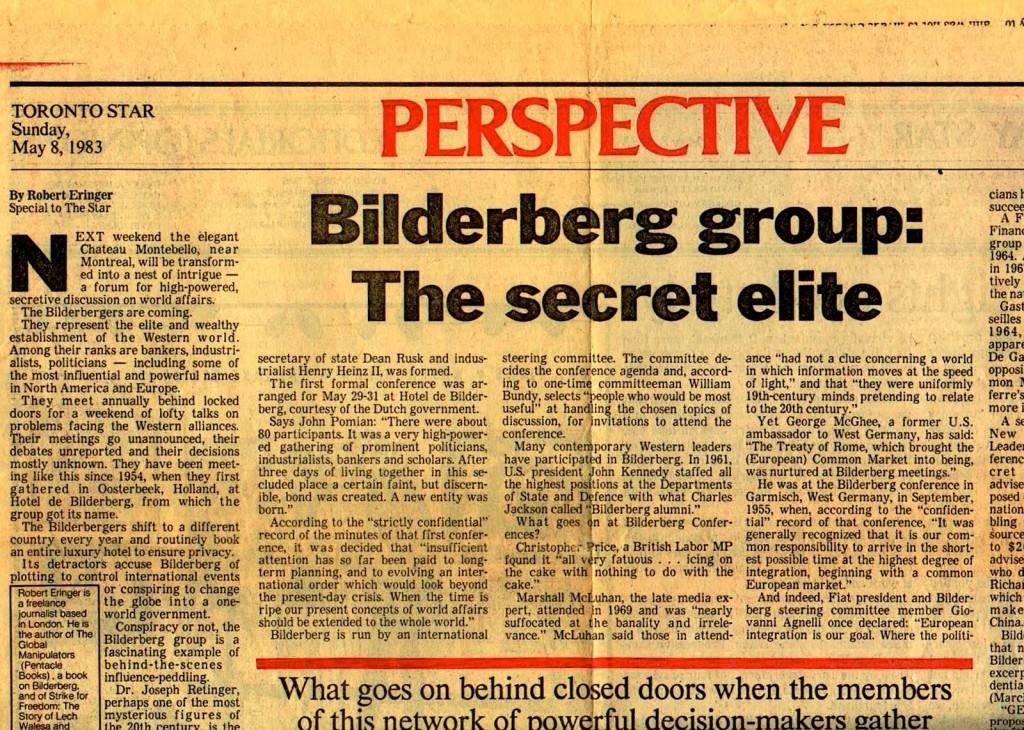
Does Privacy Exist? Yes, But Only For Our Leaders At Bilderberg 2014

Bilderberg 2014 Copenhagen 3


If 100 of the world’s top celebrities – from Angelina Jolie to Will Smith – suddenly dropped what they were doing and hunkered down together in a luxury hotel to debate the future of the entertainment industry in complete seclusion from the world, and then emerged three days later as though nothing happened, people would be rightly curious to know what they were up to.

Actually, curious is an understatement. There would be wall-to-wall media coverage, the TMZ drone would hover above the scene capturing aerial footage, pundits would offer endless speculation and real-time ‘analysis’ of what they thought might be taking place inside – in short, the world’s press would make a presidential election look like local newspaper reports about a lost kitten.

Isn’t it odd then, that when 100 of the most wealthy and influential people from outside of Hollywood – powerful establishment politicians, new rising stars, corporate CEOs, high-tech moguls and royalty – meet in secret every year to do the very same thing, nobody gives it a second thought?

The Bilderberg 2014 conference is now under way in Copenhagen, where a star-studded cast of characters from civilian, business and military-intelligence backgrounds are gathering to debate this year’s agenda of topics including sustainable economic recovery, the future of democracy, the Middle East, the Ukraine crisis and whether or not the basic concept of privacy still exists.

And no, you didn’t miss the hype. There has been scarcely any coverage of this year’s confab in the British or American press. Outfits such as the New York Times and the Daily Telegraph do not see fit to mention the meeting to their readers (in contrast to their coverage of the annual World Economic Forum meeting at Davos, Switzerland), and the BBC’s only acknowledgement of Bilderberg this year has been a Daily Politics segment which discussed conspiracy theories in general, and laughingly recalled the occasion last year when the show mocked and denigrated American radio host Alex Jones, one of the few activists to cover the 2013 Bilderberg meeting in Watford, England.

If Bilderberg was just another place for the wealthy and well-connected to hang out, there would be no issue – the world is awash with exclusive places and events for the elite to hobnob with each other. The same cast of characters also meet up at Davos for the World Economic Forum (the red carpet event of the year for people of lesser beauty and charisma), but if twelve months is simply too long to wait between encounters then nobody should begrudge them another opportunity to awkwardly flirt with one another while putting the world to rights.

The problem is not that successful and powerful people are meeting in secret in Copenhagen. The problem is the particularly volatile, toxic blend of people that assemble. Why are serving heads of government and state on the invite list to what is in part a giant, closed-door lobbying event? And how do attendees from the military and intelligence communities such as the secretary general of NATO, the head of MI6 and the former head of the NSA have common cause with corporate leaders including the Chairmen or CEOs of Shell, Barclays, BP, HSBC, Nokia, LinkedIn and Google?

And one more question – when the press are neither invited to the meeting nor briefed on its outcomes, why do the editors of media outlets including The Economist, The Financial Times, Le Monde and Italy’s RAI-TV sanction Bilderberg with their attendance?

In short, the answer is this: Bilderberg is the closest that western democratic societies come these days to openly, flat-out declaring that well-connected, wealthy people have an inherent right to rule and influence national and international policy, and to have their opinions taken more seriously than regular folk. From supposedly meritocratic “if I can make it there, I’ll make it anywhere” New York through the Scandinavian poster-children of equality and back to post-Citizens United Washington DC it holds true; but most of the time we try to convince ourselves that it is otherwise, that our voices still count and that we are all equal before the law. For those who pay attention, the yearly Bilderberg conference serves to disenthrall us, briefly lifting the curtain on the truth.

That truth is the fact that money talks, and exorbitant wealth carries the loudest megaphone of all. It’s hardly a revelation, but the only time when the rest of us have it shoved in our faces quite so explicitly is at the yearly Bilderberg meeting – ironically the one time when almost none of us, led by the press, pay any attention.

Venue for the 2014 Bilderberg conference
Marriott Copenhagen – venue for the 2014 Bilderberg conference


On the agenda for Bilderberg 2014 is the subject of privacy – very topical given the ongoing fallout and scandal resulting from the Edward Snowden surveillance revelations and consequent exposure of the real extent of government surveillance in and by the United States, United Kingdom and other Five Eyes group countries.

Meeting with John Sawers, General Petraeus and others who are intimately involved in the conducting of government surveillance activities will be many high-profile people of vast wealth and influence. Many of these people are likely to hold quite forceful opinions on the issue of privacy, but they are more likely to be interested in protecting their own privacy from the journalists who would make their activities and indiscretions known to the public than altruistically pressuring governments to cease collecting everyone’s private data in their indiscriminate dragnet.

Given the rare opportunity to hold face-to-face meetings with the people who run the surveillance programmes and formulate the policies which underpin them, which aspects of the privacy question – and whose personal  interests, those of the elite or those of society as a whole – are the privileged attendees most likely to discuss?

Charlie Skelton at the Guardian, one of few mainstream journalists to cover Bilderberg every year, also picks up on the irony of an organisation as secretive as Bilderberg holding a discussion about the existence of privacy:

That’s an exquisite irony: the world’s most secretive conference discussing whether privacy exists. Certainly for some it does. It’s not just birthday bunting that’s gone up in Copenhagen: there’s also a double ring of three-metre (10ft) high security fencing … There’s something distinctly chilling about the existence of privacy being debated, in extreme privacy, by people such as the executive chairman of Google, Eric Schmidt, and the board member of Facebook Peter Thiel: exactly the people who know how radically transparent the general public has become.

Precisely. The average person might care about privacy issues because they don’t like being treated as automatic suspects in the intelligence services’ surveillance dragnet, or because they don’t want risk-averse insurance companies from searching out deeply private facts from our lives in order to increase their premiums. The privacy concerns of an oil company CEO or the queen of Spain (attendees all) are likely to be of a different order altogether, more focused on keeping potentially explosive or embarrassing information out of the public domain, and creating a legal framework that punishes those who reveal the truth while empowering those who seek to operate in the dark.

And you can bet that the Bilderberg attendees do want to affect change – they do not assemble for purely social reasons, but to leverage one another’s influence for their own ends – sometimes quite noble ends, but equally possibly very selfish ones. This leads to another sharp observation from Skelton:

The Bilderberg Group says the conference has no desired outcome. But for private equity giants, and the heads of banks, arms manufacturers and oil companies, there’s always a desired outcome. Try telling the shareholders of Shell that there’s “no desired outcome” of their chairman and chief executive spending three days in conference with politicians and policy makers.

If people want to shoot the breeze or have long, meandering yet inconclusive conversations about the state of the world, they go to Starbucks or sneak off to the pub with their friends. Influential and high net worth individuals – whose time is supposedly so valuable – don’t check out for three days and traverse continents unless there’s something significant in it for them, or the causes that they promote.

As Bilderberg 2013 drew to a close in the Hertfordshire countryside, Semi-Partisan Sam had this to say (among other things) about the motivations and biases of the people who get together once a year to decide what’s best for the rest of us:

The reason so many of the actions taken by [Bilderberg members] over the years have been so harmful to ‘normal people’ is because the membership is comprised entirely of the successful. None of the protesters were allowed to remonstrate with the Great Ones within. No refugees from the middle east Arab Spring. No malnourished people from Africa. No failed small business owners from the town of Watford itself, which has struggled in the recession.

If every year you and your chums reassemble at the next Bilderberg meeting and find yourselves even more spectacularly successful and wealthy than the last time you met, “more of the same” could start to seem like a pretty good prescription.

A year later, and this ‘confirmation bias’ explanation is starting to look rather too charitable toward the Bilderbergers. Since the Watford meeting we have learned of more government overreach in the realm of surveillance, more incursions on privacy, more intimidation of the media and the further undermining of national democracy from overturned limits on corporate political spending in the United States to the growing concentration of powers at super-national level in the European Union.

It really would be helpful if the organisers would consent to publishing minutes from their meetings, because at the moment it looks suspiciously as though the 2013 attendees listened to public opinion, then got together and resolved to do the polar opposite.

Perhaps the ultimate irony of Bilderberg 2014 is this: not one week ago, the voters of Europe delivered a stinging rebuke to the political establishment for their growing disconnect with the people and their tendency to talk amongst themselves and prescribe universal solutions from on high without a democratic mandate for their actions. And now today, at a Copenhagen hotel in the heart of Europe, they’re at it once again as though the European elections never happened.

Unfortunately for us, our political elites are seemingly the only ones still able to assert a right to privacy, conducting their business with Bilderberg behind closed doors. But it’s just as much our fault – by not paying any attention, we let them get away with it.

The ‘Tolerant’ Millennials Who Hate Free Speech

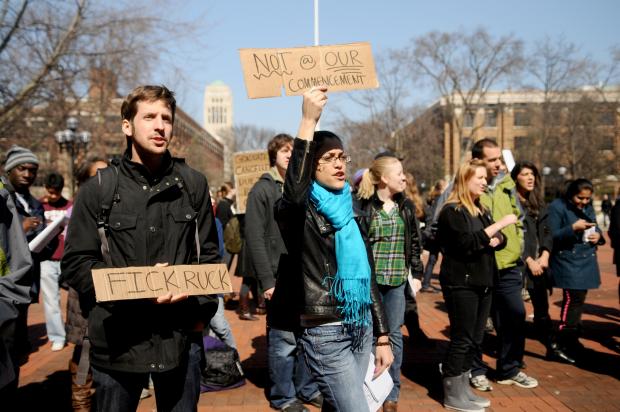
commencement protest


When is it okay to invite a controversial current or former public office holder to speak at a college commencement (graduation) ceremony, and when does issuing such an invitation imply acceptance and endorsement of that person’s every action and decision whilst in office?

This question is coming up a lot, primarily in the United States, as the ‘old guard’ of politicians and appointed officials who held the reigns of power during the post 9/11 wars in Afghanistan and Iraq, and who were at the helm during the financial crisis and great recession, approach retirement and seek to secure an income in retirement while simultaneously shaping their legacies.

Earlier this month it was former US Secretary of State Condoleezza Rice in the headlines, pressured to withdraw from her engagement giving the commencement speech at the Rutgers University commencement ceremony after extensive student pushback at her selection, culminating in a sit-in protest. Her offence was to have been a member of the second Bush administration, and her public advocacy for the Iraq war. But now the forces of retroactive censorship have claimed a new victim – Christine Lagarde, head of the IMF.

Olivia Nuzzi at The Daily Beast reports:

Christine Lagarde, head of the International Monetary Fund, has decided not to serve as commencement speaker for Smith College’s May 18, 2014 graduation, after students started a petition protesting her selection.

The petition—which boasts 483 signatures (less than half of their goal of 1,000)—states that although they “do not wish to disregard all of Ms. Lagarde’s accomplishments” and they “recognize that she is just a good person working in a corrupt system” they do not want to “encourage the values and ideals that the IMF fosters.” 

While falling over themselves to add caveats and backhanded praise for Lagarde, the activists make clear that her particular views had become unpopular and were not to be heard at their institution. Never mind the prestige of hosting a high-profile guest and never mind those students who were perfectly happy to hear from her – the vocal, outraged activists successfully manage to parry away a threatened intrusion from the nasty world of realpolitik.

These developments – and the two mentioned here are only the most recent – raise some important questions about the polarising of America along political and cultural lines, academic censorship and the ability of the current generation to listen to alternative viewpoints.

In the case of Condoleezza Rice, her viewpoint – in favour of war, supportive of the Bush administration – was commonplace in America for the majority of the Bush presidency. Are all those who once thought as Rice thought now persona non grata at Rutgers University? Or perhaps it is just those who could be considered ‘thought leaders’, those who influenced and shaped the public debate at the time who are to be singled out. In which case, how far removed does one have to be from the centre of decision-making to avoid being rendered untouchable by America’s universities?

The case of Christine Lagarde is even more perplexing. As head of the International Monetary Fund, she clearly represents the ideals and goals of that organisation. But so do a solid majority of mainstream politicians from both parties, including some very popular ones in academic circles – such as Bill Clinton or Barack Obama – who would be welcomed with open arms and festooned with honorary degrees.

MassLive adds some detail about the petition-signers:

“Utterly disgusted that Smith has chosen to host someone from the IMF, an organization that has proven itself to be nothing but imperialistic, ineffective, and oppressive,” wrote one woman who signed the online petition.

Another woman who identified herself as a graduating senior wrote: “It was in a Smith classroom that I first learned about the problems that the IMF has wrought on the Global South, and how those problems have affected women’s lives for the worse.”

And here’s the problem. The activists disagree – strongly and sincerely – with the policies and worldview of the speaker. Fair enough. But somewhere along the way they have been led to believe that they have the right to filter out any views or opinions that they find objectionable, causing them to turn their displeasure into calls for the speakers to be banished.

At one time, student activists would have relished the opportunity to see their nemeses take the stage at a high profile event on their campus, perhaps taking the opportunity to hold an inventive protest or at least to offer up a choice heckle or two. Are today’s millennials really so precious and coddled that they cannot even tolerate the presence of dissenting opinion, devoid of the ability or drive to engage with contradictory viewpoints when they appear?

This attitude – and the howls of the “how dare you invite someone who disagrees with me politically to speak at my graduation” – resembles nothing less than the Facebook-isation of academia and the real world, where people with different or troublesome views can simply be blocked, defriended or “disliked” until they fall off the collective radar and cease being a nuisance on our newsfeeds.

But what is possible in the world of social media is not necessarily desirable in the real world of bricks-and-mortar educational establishments. Academia requires debate and argument in order to thrive, and by so publicly banning many of the past decade’s movers and shakers, the student bodies and faculties concerned are cutting themselves off from the possibility of benefiting from the insight of these recent historical figures. Simultaneously, they are doing nothing to help counter accusations from the American right that elite universities are inherently hostile to conservatives and conservative thinking.

Sometimes the arguments against hearing from the big beasts of the past are more persuasive and complex. Take the case of former Vice President Dick Cheney, desperate to cement his hawkish neo-conservative legacy in a positive light and willing to do whatever it takes to make that happen. The always-astute Andrew Sullivan keeps a close watch on Cheney’s continued public and media briefings since leaving office and is convinced that the likes of Cheney are engaged in a deliberate effort to recast their horrific actions and decisions in a positive light. In such cases, an argument could be made that it is best to invite such people to speak only in the context of debates (where other participants with opposing views could question and challenge the speaker, and vice versa) rather than bestowing the prestige and carte blanche of a commencement address invitation.

Ultimately, when considering whether to invite a controversial figure from the past – whether it’s a peddler of discredited economic theories, a proud and unapologetic torturer and warmonger or anything else in between – a balance has to be struck between ensuring that the purpose of the event will not be disrupted, that something of interest will be said, and that issuing the invitation will not play into the hands of any ulterior motive that the invitee may have. This type of sober and reasoned discussion does not lend itself to an emotionally manipulative e-petition or Facebook campaign.

No one is asking Condoleezza Rice or Christine Lagarde to hand out the best picture statuette at the next Academy Awards. If, through their own actions, politicians and public figures make themselves pariahs at the hip parties of Hollywood or the parlours of Washington D.C., that is their unfortunate lot and they can take it up with George Clooney.

But it is worrying that many of our students and academic institutions are so eager to impose their own layer of self-administered moral censorship on top.