MSNBC Goes To Flint, Learns Nothing

Flint Michigan - Chris Hayes - Michael Moore


The Establishment Left’s strangely non-diminishing sense of entitlement was on full display in Flint, Michigan

Today, Chris Hayes of MSNBC broadcast a special live town hall from Flint, Michigan, the place made famous by the poisoning of its water supply and the near-criminal incompetence of some of the people responsible for the public’s safety. Left-wing filmmaker Michael Moore has also made the Flint story a personal cause of his, and today both he and Chris Hayes were together, live before a local audience, to talk about national politics viewed through the prism of this beleaguered town.

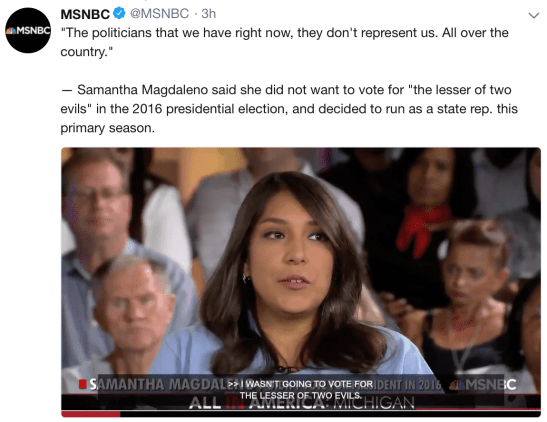
At one point in the panel discussion, Hayes introduced a number of local people who were non-voters; people who either did not vote at all in the 2016 general election or who voted for down-ballot candidates but refused to cast a vote for either Donald Trump or Hillary Clinton for president.

Almost to a person, these non-voters talked about the fact that despite having been Obama voters in 2008 and 2012, they could not bring themselves to vote in 2016 when the Democrats offered no “inspiring” candidate. One got the sense that many of them may have gladly voted for Bernie Sanders, had the Clinton and Democratic Party machines not unfairly muscled the Vermont senator out of the race, though this was not explicitly stated by anyone during the segment.

For the life of him, Chris Hayes simply could not understand this position. It did not compute. At one point, he told one of the non-voting interviewees that MSNBC viewers were likely “throwing things at their televisions” in reaction to what he was saying. Hayes interrogated each guest as to how they could possibly have abstained from voting for Hillary Clinton when a Republican governor had presided over the poisoning of their town’s water supply. He implied that their desire for an “inspirational” presidential candidate was childish and irrational, and that the obvious choice would have been to swallow any misgivings and vote for the Democratic Party presidential nominee.

This exchange highlighted as clearly as anything else the divide within the American Left – the establishment, coastal Left and the once solid-Democrat heartland left-behinds, if you will. The likes of Chris Hayes (and that mainstream brand of left-wing thinking for which he is a mouthpiece) simply cannot understand why a rational voter would spurn the boring, uninspiring technocrat put forward by the Democrats when the consequence of not voting was the election of Donald Trump. Despite having heard testimony from many people about the long-standing issues and decline facing the town – issues which ate away at the community throughout President Obama’s two terms – Hayes was seemingly unable to understand that another continuity technocrat offering more of the same was the last thing that this community wanted or needed.

Michael Moore cut to the heart of the issue:

Why did people stay home knowing that the result was going to be possibly Donald J. Trump? That’s some serious anger at what the system has done to fail this city.


Like most people, I have my issues with Michael Moore. But credit where it is due – Moore was warning about the dangerous complacency of the Democrats and the visceral anger against the status quo in many communities at a time when establishment leftists were rolling out the grand coronation of Hillary Clinton, oblivious of (or unconcerned by) her utter lack of popularity among people who were sufficiently left-wing and non-racist to cast their prior votes for Barack Obama.

Nobody of any significance on the mainstream Left heeded Michael Moore’s warning to take the Donald Trump threat seriously before the election, and the past two years have been their reward. And even now, in the middle of a pilgrimage to a part of middle America which shrugged its shoulders and abandoned the Democratic Party in 2016, still the chief attitude is one of incredulity that people could have been so stupid / naive / selfish / childish / utopian (delete as applicable) as to demand a Democratic candidate in possession of a clear set of guiding principles and an understanding that globalization has been eating away at towns like Flint as surely as is their contaminated water.

Technocracy is not always a bad thing – at a time when regulations and systems of government are infinitely more complex through necessity, experts are needed to administer the system and keep the machinery of state running effectively. However, technocracy is not well-suited to navigating through periods of disruptive change or crisis. What works well when the economy is in steady-state and there are no significant changes afoot in society or industry does not work well when the economy is in difficulty or when huge realignments are taking place on the national and international level.

Conservative scaremongering about her supposed extreme socialism aside, Hillary Clinton was the quintessential technocratic candidate at a time when the people of Michigan and elsewhere needed a candidate who recognized that for them, the status quo was not something to celebrate and build upon; that the structural changes which had delivered nothing but good things for the likes of Chris Hayes and many of us “coastal elites” were not necessarily anything to celebrate in places like Flint.

More than one of the people interviewed on MSNBC who did not vote in the 2016 presidential election have themselves run for public office in the months since. There is no crisis of political engagement or motivation here. There was only a crisis of ignorance and arrogance among a party hierarchy which believed it could impose their preferred candidate and have people like the inhabitants of Flint, Michigan swallow their distaste and offer up their vote.

And after spending a day in Flint in the company of Michael Moore, I am not sure that Chris Hayes, his core audience or anyone within the Democratic Party leadership are any closer to grasping this essential fact.


Michael Moore - Chris Hayes - Flint

Support Semi-Partisan Politics with a one-time or recurring donation:

Agree with this article? Violently disagree? Scroll down to leave a comment.

Follow Semi-Partisan Politics on TwitterFacebook and Medium.

Sandi Toksvig, Gender Martyr

Sandi Toksvig - Womens Equality Party - Gender Pay Gap - QI - Stephen Fry


It is a far, far better thing that she does…

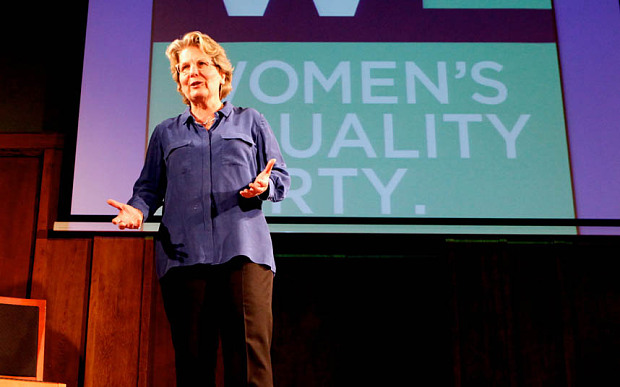
High drama in Britain, as vaguely-known personality Sandi Toksvig reveals – at a meeting of the Women’s Equality Party – that she is not being paid the same as her predecessor, the much more widely known Stephen Fry, to host a television quiz show.

From ITV News:

QI host Sandi Toksvig has revealed she is paid 40% of what the programme’s former host Stephen Fry used to earn for his work on the comedy panel show.

The 60-year-old took over from Fry in October 2016 and her third series as host is set to begin on Monday.

Toksvig was asked a question about her QI salary by an audience member at the Women’s Equality Party conference, where she gave a speech on feminist economics.

She said: “I have recently discovered I get 40% of what Stephen used to get. And I get the same pay as Alan Davies, who is not the host.

“I temper this with the fact that I love the show and I’m the first woman to host such a show.”

What a long-suffering, patient martyr Toksvig is, bravely accepting her lower salary and taking stoic comfort in the fact that at least the evil patriarchal conspiracy allowed her to host the show in the first place.

Naturally, cue lots of outrage from the usual voices on social media:


No, there was a “huge gasp” in the room as hundreds of assembled idiots tried to grapple with the fiendishly complex idea that Sandi Toksvig’s market value is not the same as Stephen Fry’s.

Like him or not, Stephen Fry has led a long and varied career as an author, actor, television presenter, and radio host. He played a character in one of the recent Hobbit movies, because presumably the film’s producers thought that his unique characteristics and talents would make their project more successful.

Sandi Toksvig is a supposed comedian and writer too, but her public profile is nowhere near as large. While Stephen Fry’s reach transcends the narrow London-centric intelligentsia, Toksvig largely leans into this niche, her gig on QI notwithstanding. Unlike Fry, Sandi Toksvig was not invited to be in the Hobbit movie because nobody outside Britain would know who she is.

And this latest confected outrage is the entire problem with artificial, upper-middle class moralistic projects like the Women’s Equality Party. In the age of identity politics, when being able to portray oneself as the victim of historic and present injustices confers an enormous degree of power on those with the education and articulateness to wield it, moaning that one is not being paid as much as one’s far more famous predecessor and suggesting that the reason is rooted in gender rather than talent is very lucrative. But it is also intellectually lazy and shamefully exploitative of those contemporary struggles for justice and equality which are actually worthy of attention and support.

Those who gasped when Sandi Toksvig announced a fact as banal and unsurprising as me announcing that I do not command the same fee as Martha Argerich for a Kennedy Center piano recital are engaged in campaign which has less to do with equality and justice and more to do with assuaging middle-class boredom. It feels good to imagine that despite being a well-off person living in a rich country during the age of universal suffrage (and a minimal gender pay gap, once the appropriate variables are factored in rather than disingenuously ignored), one still happens to be one of life’s great victims; that despite being the kind of person who can easily spend the money and time traipsing from the leafy Home Counties into London to spend a weekend commiserating their shared misfortunes with other wealthy white fourth-wave feminists, you are actually engaged in a life-or-death struggle for dignity and freedom.

It might feel good, but that doesn’t make it true.

Remember, too, that these are the brand of feminists who are apparently willing to die on a hill defending Sandi Toksvig’s right to be paid as much as Stephen Fry, but who also furiously protest, hashtag and campaign to eliminate the jobs of less economically privileged women whose line of work does not meet with their fastidious approval. Ask the Formula 1 grid girls or the walk-on women in darts whether Sandi Toksvig’s overbearing, maternalistic brand of feminism has worked well for them.

But then of course this movement was never intended to work for the benefit of all women – just to cement the power and influence of those well-versed in its highly specific nomenclature and its cynical, myopically-focused agenda.


Sandi Toksvig WEP

Support Semi-Partisan Politics with a one-time or recurring donation:

Agree with this article? Violently disagree? Scroll down to leave a comment.

Follow Semi-Partisan Politics on TwitterFacebook and Medium.

Architects Push Back Against Cultural Appropriation Concept Creep

Safe Space architecture diversity


While some professions seem to be capitulating to the mores of millennial fragility and safe space culture without a shot being firedincluding some of the industries once thought least likely to go soft – it is good to see at least one group pushing back.

Sensing a looming threat from a Guardian Op-Ed which seemed to suggest that every irritating aspect of modern buildings is due to a lack of diversity in the profession, editorial director Paul Finch responded in Architects’ Journal:

If, therefore, it is ‘inappropriate’ for a non-Latino person, let alone a non-Puerto Rican, to take a singing role in West Side Story, how long will it be before we are told that only architects with a particular nationality, or better still ethnicity, should design buildings in certain places? A foretaste of possible debate to come appeared in The Guardian recently, where Christine Murray speculated as to whether cities would be better if they were designed by mothers. Not just women, but women with children.

Finch rightly distinguishes between the need to criticism and improve obviously bad and inconsiderate design, which is still prevalent in many new buildings, with the idea that the only people qualified to do so are those who personally possess the specific physical characteristic which needs to be accommodated:

There are all too may example of this, where architecture is commissioned to satisfy one particular group, possibly or sometimes inevitably at the expense of others. Thus, shopping centre design is skewed towards retailers not shoppers; hospitals are designed for doctors, not patients and visitors; and office design focuses on corporate tenants, not office workers.

This happens where clients are mentally lazy and/or their architects are not up to the job. It is about quality of thought and little else. That is why it is a meaningless question to ask whether cities would be better if mothers designed them: it would depend not on their being mothers, but on being good designers.

Finch’s conclusion:

A plague on the houses of the cultural appropriation brigade, with their increasingly shrill and unpleasant zealotry. In the world of architecture, borrowing, stealing, inspiration and design miscegenation have been an essential part of its evolution for millennia. Long may this continue.

A hearty amen to that, but one wonders if it is wise for someone of any prominence within the creative industries to push back against progressive dogma so publicly. Brave, certainly, but also risky. Watch this space for the likely groveling apology and hasty retraction to come…

Safe Space Concept Creep Reaches The Military-Industrial Complex

screen-shot-2018-09-06-at-22-54-08.png


When you think of safe spaces, the image which now most often comes to mind is that of infantilized, artificially fragile undergraduates huddled in a room with soft toys, Play-Doh and puppy dog videos, weeping because someone slightly to the right of Bernie Sanders set foot on their college campus.

You are less likely to conjure this image, painted for us in DefenseNews:

A Trump administration official wants to create a “safe space” for international defense-industrial base cooperation.

As China’s military modernization strategy bridges its civil-military divide and the U.S. National Defense Strategy emphasizes the American industrial base, the Pentagon must protect and encourage America’s international partnerships, according to Eric Chewning, the Pentagon’s deputy assistant secretary of defense for industrial policy.

“As China articulates a civil-military fusion doctrine where they are intentionally blurring the lines between their developments on the military side and the commercial side, we need to work with our allies to create a safe space where we can work collaboratively to do that,” Chewning said Wednesday at the Defense News Conference.

My emphasis in bold.

I’m not quite sure what this looks like – four star generals, Boeing executives and NATO military attachés using crayons to excitedly draw their conception of mind control ray guns bolted onto the next generation of 787 airliners?

In reality I am sure the idea is a serious and worthy one, rooted in long-term strategic thinking. But it is interesting – and slightly  concerning – to note that even the people whose solemn task it is to come up with deadly new ways of waging war are anxious to carve out safe spaces for themselves to operate free from harassment.

And interesting too, that the metastasizing of this concept out of the college campus and into grown-up world is taking place under an administration whose supporters love nothing more than to rail against liberal “snowflakes”.

Dispatch From Washington

img_6215

Nothing much to report here

I’m writing this from the desk in my study, where right now just four blocks away in the White House a president whose daily conduct raises legitimate questions about his fitness to govern is raging in helpless impotence. Why? Because some faux-patriot within his dumpster fire of an administration decided to hint to the New York Times about just how bad things have become – supposedly out of civic duty – yet lacked the courage to give the accusation real weight by putting his name to the anonymous OpEd. All this is just today’s drama; no doubt tomorrow there will be some new unprecedented scandal to bump this story down the news agenda.

These are interesting times to be living in Washington, D.C. I must admit that I have not yet gotten over the novelty of watching the bottom of the Washington monument appear in the background of a live TV broadcast, then looking out the window of my study and seeing the top of the same structure mere minutes away. In British terms, our new home is within close earshot of Big Ben and the Palace of Westminster. This means a constant stream of noisy motorcades carrying second-tier officials down the next road, and regular glimpses of Marine One as it ferries President Trump back and forth as he escapes the city to play golf.

It is strange to be living in the modern equivalent of Ancient Rome at the height of its power (or perhaps shortly into its terminal decline), the seat of government of what is effectively the most powerful empire in the world. Many of the buildings here are built in conscious acknowledgement of the torch that was passed from Ancient Greece to Rome, and so on through Britain to the New World. I find myself walking amid the classical architecture in this planned city and wondering what future historians or tourists will say as they pick over the ruins or buried past of this metropolis, many centuries in the future.

Highlights have to include the Lincoln Memorial. Abraham Lincoln has been a particular interest and inspiration of mine since I was a teenager, and since then I have devoured enough books on the 16th American president to comfortably fill a bookshelf. Standing inside that immense marble memorial and reading the inscription above Lincoln’s statue – “In this temple as in the hearts of the people for whom he saved the union, the memory of Abraham Lincoln is enshrined forever” – is a moving experience. Even when full of screaming children and selfie-happy tourists, there is a sense of power and dignity in that place. While there, it is also hard not to dwell on just how far we have fallen from that ideal in recent years.

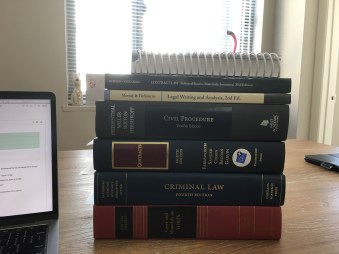
Law school has started well. You must forgive me for the lack of blog posts over the last month; road-tripping half way across the country from Texas, establishing a new home in DC and going through law school induction took up all of my spare time, and even now I have thirty pages of Criminal Law reading which I should be tending to this evening. However, for my own mental health and diversion if nothing else, the blog will continue, albeit maybe somewhat more sporadically than before.

Being back on a university campus as someone with a record of speaking out forcefully against the excesses of identity politics has been interesting – I can confirm that all of the warnings I have been giving over the past few years were prescient and on point. There have been no stand-out incidents yet which lead me to believe that my institution is faring worse than any other, but it only takes one supposedly “controversial” speaker invite or student society activity to create havoc and endless protests, so we shall see how things develop. Halloween will likely be a good indicator, given recent controversies elsewhere and the growing conviction that “cultural appropriation” is a harmful, negative phenomenon. Today was the law student organization fair, and reflecting my semipartisan nature I added my email to the law school chapters of both the ACLU and the Federalist Society. I agree with neither organization entirely, but look forward to some interesting debates.

Adjusting to student life has been challenging, but frequently fun. Though I am a graduate student I am still on the generic university email list, so have been receiving helpful daily missives about how to do my laundry and accomplish other tasks now commonly known as “adulting”. On the flip side, there is nothing like living in close proximity to a bunch of eighteen-year-old undergraduates to make you feel your age, and there has been more than one occasion when I look from all these young whippersnappers with their lives ahead of them to myself and wonder momentarily what it is that I am doing, making this mid-life career course correction. Fortunately these moments never last long – I came here with a purpose, albeit a somewhat inchoate one, and many of my classmates have impressive and inspiring backgrounds.

Intellectually I feel like I am holding my own thus far, though the annoying habit of American law schools whereby the first real feedback only arrives in the form of all-or-nothing final exams in December means that I won’t really know precisely where I stand for awhile. Mostly it is just a relief to have made a start, after having done so much preparation and read so many conflicting pieces of advice about how to succeed at law school. There is a satisfaction when the reasoning behind some obscure rule or legal concept finally clicks into place – it is good to be learning again. Growing, hopefully.

We have some pretty eminent academics who teach here, people whom I knew and respected before the thought of going to law school even occurred to me. One Supreme Court justice teaches a constitutional law seminar here, and another is coming to speak next week. Mostly I am awed by a sense of vast new possibility – the law is not really one career, it is a gateway to a myriad of different sub-vocations, almost as different from one another as it is possible to be. And while I can pre-emptively rule out certain options – it is pretty safe to say that I will not be becoming a small-town lawyer or one of those personal injury kings with their face on a billboard above the freeway – the possibilities remain varied.

Anyhow, this will likely be the longest thing that I write for some time outside of law school. Necessity dictates that I will at last have to do what I have often threatened to do on this blog but never quite succeeded at, namely trying to adopt a “little and often” approach to commenting and reacting on stories of interest. At this point you all know what I think about the big issues anyway, and I can always link back to those longer-form pieces when necessary. Time constraints now mean that if I want to say anything at all – and keep the blog ticking over – I had better find a way to condense my opinions into a paragraph or two. It will be good practice; Lord knows that much of what I have written the past six years would have benefitted enormously from an editor’s red pen anyway, if not the shredder.

Finally, while it may be somewhat cheeky to mention this when I haven’t published anything new for a month, I am now technically an impoverished student once again and without a regular income, so any donations to the instant ramen noodle fund are most gratefully received.


img_6228

Support Semi-Partisan Politics with a one-time or recurring donation:

Agree with this article? Violently disagree? Scroll down to leave a comment.

Follow Semi-Partisan Politics on TwitterFacebook and Medium.