The ‘Tolerant’ Millennials Who Hate Free Speech

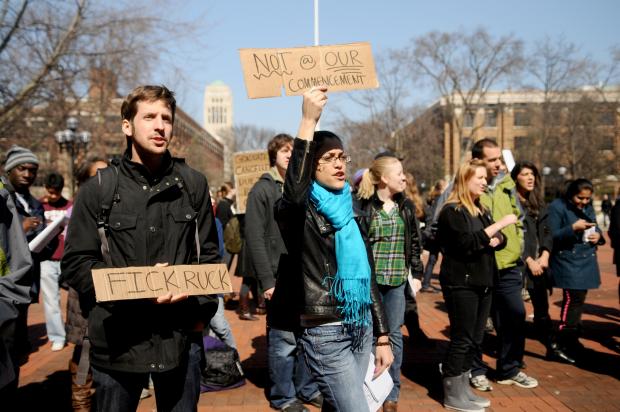
commencement protest


When is it okay to invite a controversial current or former public office holder to speak at a college commencement (graduation) ceremony, and when does issuing such an invitation imply acceptance and endorsement of that person’s every action and decision whilst in office?

This question is coming up a lot, primarily in the United States, as the ‘old guard’ of politicians and appointed officials who held the reigns of power during the post 9/11 wars in Afghanistan and Iraq, and who were at the helm during the financial crisis and great recession, approach retirement and seek to secure an income in retirement while simultaneously shaping their legacies.

Earlier this month it was former US Secretary of State Condoleezza Rice in the headlines, pressured to withdraw from her engagement giving the commencement speech at the Rutgers University commencement ceremony after extensive student pushback at her selection, culminating in a sit-in protest. Her offence was to have been a member of the second Bush administration, and her public advocacy for the Iraq war. But now the forces of retroactive censorship have claimed a new victim – Christine Lagarde, head of the IMF.

Olivia Nuzzi at The Daily Beast reports:

Christine Lagarde, head of the International Monetary Fund, has decided not to serve as commencement speaker for Smith College’s May 18, 2014 graduation, after students started a petition protesting her selection.

The petition—which boasts 483 signatures (less than half of their goal of 1,000)—states that although they “do not wish to disregard all of Ms. Lagarde’s accomplishments” and they “recognize that she is just a good person working in a corrupt system” they do not want to “encourage the values and ideals that the IMF fosters.” 

While falling over themselves to add caveats and backhanded praise for Lagarde, the activists make clear that her particular views had become unpopular and were not to be heard at their institution. Never mind the prestige of hosting a high-profile guest and never mind those students who were perfectly happy to hear from her – the vocal, outraged activists successfully manage to parry away a threatened intrusion from the nasty world of realpolitik.

These developments – and the two mentioned here are only the most recent – raise some important questions about the polarising of America along political and cultural lines, academic censorship and the ability of the current generation to listen to alternative viewpoints.

In the case of Condoleezza Rice, her viewpoint – in favour of war, supportive of the Bush administration – was commonplace in America for the majority of the Bush presidency. Are all those who once thought as Rice thought now persona non grata at Rutgers University? Or perhaps it is just those who could be considered ‘thought leaders’, those who influenced and shaped the public debate at the time who are to be singled out. In which case, how far removed does one have to be from the centre of decision-making to avoid being rendered untouchable by America’s universities?

The case of Christine Lagarde is even more perplexing. As head of the International Monetary Fund, she clearly represents the ideals and goals of that organisation. But so do a solid majority of mainstream politicians from both parties, including some very popular ones in academic circles – such as Bill Clinton or Barack Obama – who would be welcomed with open arms and festooned with honorary degrees.

MassLive adds some detail about the petition-signers:

“Utterly disgusted that Smith has chosen to host someone from the IMF, an organization that has proven itself to be nothing but imperialistic, ineffective, and oppressive,” wrote one woman who signed the online petition.

Another woman who identified herself as a graduating senior wrote: “It was in a Smith classroom that I first learned about the problems that the IMF has wrought on the Global South, and how those problems have affected women’s lives for the worse.”

And here’s the problem. The activists disagree – strongly and sincerely – with the policies and worldview of the speaker. Fair enough. But somewhere along the way they have been led to believe that they have the right to filter out any views or opinions that they find objectionable, causing them to turn their displeasure into calls for the speakers to be banished.

At one time, student activists would have relished the opportunity to see their nemeses take the stage at a high profile event on their campus, perhaps taking the opportunity to hold an inventive protest or at least to offer up a choice heckle or two. Are today’s millennials really so precious and coddled that they cannot even tolerate the presence of dissenting opinion, devoid of the ability or drive to engage with contradictory viewpoints when they appear?

This attitude – and the howls of the “how dare you invite someone who disagrees with me politically to speak at my graduation” – resembles nothing less than the Facebook-isation of academia and the real world, where people with different or troublesome views can simply be blocked, defriended or “disliked” until they fall off the collective radar and cease being a nuisance on our newsfeeds.

But what is possible in the world of social media is not necessarily desirable in the real world of bricks-and-mortar educational establishments. Academia requires debate and argument in order to thrive, and by so publicly banning many of the past decade’s movers and shakers, the student bodies and faculties concerned are cutting themselves off from the possibility of benefiting from the insight of these recent historical figures. Simultaneously, they are doing nothing to help counter accusations from the American right that elite universities are inherently hostile to conservatives and conservative thinking.

Sometimes the arguments against hearing from the big beasts of the past are more persuasive and complex. Take the case of former Vice President Dick Cheney, desperate to cement his hawkish neo-conservative legacy in a positive light and willing to do whatever it takes to make that happen. The always-astute Andrew Sullivan keeps a close watch on Cheney’s continued public and media briefings since leaving office and is convinced that the likes of Cheney are engaged in a deliberate effort to recast their horrific actions and decisions in a positive light. In such cases, an argument could be made that it is best to invite such people to speak only in the context of debates (where other participants with opposing views could question and challenge the speaker, and vice versa) rather than bestowing the prestige and carte blanche of a commencement address invitation.

Ultimately, when considering whether to invite a controversial figure from the past – whether it’s a peddler of discredited economic theories, a proud and unapologetic torturer and warmonger or anything else in between – a balance has to be struck between ensuring that the purpose of the event will not be disrupted, that something of interest will be said, and that issuing the invitation will not play into the hands of any ulterior motive that the invitee may have. This type of sober and reasoned discussion does not lend itself to an emotionally manipulative e-petition or Facebook campaign.

No one is asking Condoleezza Rice or Christine Lagarde to hand out the best picture statuette at the next Academy Awards. If, through their own actions, politicians and public figures make themselves pariahs at the hip parties of Hollywood or the parlours of Washington D.C., that is their unfortunate lot and they can take it up with George Clooney.

But it is worrying that many of our students and academic institutions are so eager to impose their own layer of self-administered moral censorship on top.

Music For The Day

The first two movements of “Five Piano Pieces”, Op. 3, by Richard Strauss, performed here by Glenn Gould:

Some beautiful stillness and reflection for a Wednesday afternoon.

The Other European Election


EU British flags

You may not realise it, but there’s an election campaign in full swing at the moment.

No, not the one in the news where everyone screams about immigration and take turns accusing one other of being either fascists or traitors – that campaign is certainly happening, but it’s an exclusively British affair. The rest of Europe, on the other hand, is engrossed in quite a different campaign, focused on the policies and initiatives to be pursued by the European Union.

There’s a cuddly-looking German chap named Martin Schulz running for José Manuel Barroso’s soon-to-be-vacated job as President of the European Commission – in fact, Schulz is quite likely to win. He has been busily campaigning for the job, holding events in cities throughout Europe, but you won’t see him talking to prospective voters anywhere in Britain. People here would be bemused to see him even if he came, failing to understand the significance of the role he seeks or the details of his specific policies (such as they are).

In short – Britain is continuing its introspective (and perpetually unresolved) debate over whether or not to remain a member of the European Union, while the the twenty-seven other member states discuss how to shape and influence European policy, having already decided (or resigned themselves) to their secure place within the EU club. Guess whose voices are heeded and turned into tangible actions, and whose voice is either politely ignored or never heard at all?

He's running for President of something...
He’s running for President of something…


There is plenty of blame to go around for this wretched and depressingly familiar state of affairs.

The lions share of the blame must rest with successive British governments and prime ministers who failed to check back with the British people as the European Community (which won 66% approval in the 1975 referendum) slowly morphed into something much grander and more far-reaching than the common market that so appealed to the voters in Harold Wilson’s day. Each subsequent treaty and tightening of the ever-closer union served only to increase the disquiet and pushback against what was happening, and rather than hold a fresh debate over Britain’s membership or make ratification of the new treaties subject to a national referendum, the British government cut the people out of the loop on fundamental matters of sovereignty.

There is plenty of blame to be lavished on the europhiles, too. For decades now, their mantra has been that “of course Europe needs reform”, but that this can only be achieved with Britain as an active and participating member, not as a surly observer from the sidelines. Unfortunately, by continually fighting the eurosceptics to a draw, Britain’s negotiating stance has barely budged in all that time – we neither became deeply committed members at the vanguard of European policymaking, but neither did we leave our continental neighbours to their own devices.

But there is also blame for the eurosceptic movement, whose chief advocates have often been their own worst enemy when it comes to advancing their agenda. Doom-laden apocalyptic predictions of Britain’s demise within a suffocating EU were revealed time and again to be overblown. The EU was certainly a drag on economic growth and job creation, but  it was not the nail in the coffin of the UK as an independent entity that some insisted it would be.

More recently, eurosceptics – particularly UKIP – have been at fault for focusing so much of the debate on immigration, specifically the number of economic migrants entering the UK from eastern Europe in order to work. In their effort to ride the tiger of British anti-immigration sentiment, UKIP has become a lightning-rod for criticism about their real motivations (read: accusations of racism) and the immigration debate has drowned out many of the other eurosceptic points about loss of sovereignty, burden of regulation and misspent money.

In all of these failings, the British media have been complicit. Given the choice between explaining the technical workings of a byzantine EU organisation structure and policy debates or playing exciting footage of Nick Clegg and Nigel Farage ripping chunks out of each other in a televised debate, the press has consistently taken the low road, abdicating any real responsibility to inform and educate.

And so it is that with the European Parliament up for election and powerful EU positions also in play, the campaign in Britain is being fought almost exclusively along domestic political lines. If you like the Labour Party and plan to vote for them in the concurrent local council elections, chances are you will vote the same way when you fill in the European election ballot paper. Complex issues such as regulation or taxation of financial transactions, and other contentious policy debates that will occupy Europe in the months ahead, are covered only from the topmost level of detail (regulation good / regulation bad) with none of the detail and nuance that makes for informed decision-making.

This blog is unabashedly eurosceptic, appreciating what the EU has done to forge links between the nations of Europe and prevent further twentieth century bloodshed, but balking at the fact that the goals of ‘ever-closer union’ and the creation of a supra-national and undemocratically accountable superstate are being so vigorously pursued without the full cognisance or permission of the people of Europe. Nonetheless, given the extent to which EU laws, regulations and institutions are currently intertwined with the fabric of Britain, on balance it could well be better for Britain to enthusiastically embrace the EU than to maintain the current harmful ‘half-in, half-out’ status quo.

Today we in Britain truly do enjoy the worst of both worlds – subject to all of the rules and requirements of EU membership but only half-committed to the decision making process, and alarmingly ignorant of the European institutions and how they work. While a negotiated and amicable secession would be the best option, better to join France as the EU’s co-head cheerleader than remain dissatisfied on the margins any longer.

This is why David Cameron’s proposition to the electorate – that we vote Conservative in exchange for an in-out referendum in 2017 after certain nebulous ‘concessions’ have been negotiated for Britain – is so unappealing. Putting aside the fact that promises to hold referenda are routinely discarded by politicians without a second thought, endorsing this policy only condemns Britain to two more years of limbo and unnecessarily limited influence over EU policy while any potentially fruitless renegotiation takes place.

There are two parties who proudly distrust the British people to make an informed decision and advocate for continued membership of the European Union, public opinion be damned – but since the Liberal Democrats are likely to be wiped out as an electoral force at these elections based on current polling, Labour is the party to choose if you adhere to this vantage point. And this essentially makes it a two-horse race.

UKIP vs Labour. Amicable secession from the EU vs continued membership and slightly more enthusiastic engagement with Brussels. At this point either option will do. What we cannot, must not do is continue to have the same navel-gazing debate for another wasted decade.

If Britain is to continue going to the trouble and expense of sending elected representatives to Brussels (and Strasbourg), her people deserve a real European election campaign.

UKIP Take The Low Road

UKIP protest


Perhaps it was inevitable, given the relentless barrage of attacks on the party in recent days, but today marks the day that UKIP made a mistake, took a page from the conventional political handbook and played into their opponents hands. Their folly? Allowing three of their European election candidates to go running to the police, demanding that any demonstrators who call them ‘fascists’ or hurl other insults be arrested for committing a hate crime.

The Huffington Post reports:

Ukip has asked police officers to arrest demonstrators for a hate crime if they call their supporters “fascists” at a public meeting held by the party.

Three of the party’s European election candidates said, in a joint statement, that they had asked Sussex Police to arrest “any protestors who call our supporters ‘fascists’, hurl other abuse or any physical assault, for ‘hate crime’ or under the Public Order Act” at the Hove meeting on Tuesday night.

It has become fashionable in left-wing circles to talk about how UKIP represents next great fascist threat to the United Kingdom, and that its leader Nigel Farage is the reincarnation of Oswald Mosley with a sprinkling of Enoch Powell. Such outraged left-wing hysteria is only fuelled by the propensity of organisations that really should know better – such as Unite Against Fascism – to picket and protest UKIP’s political gatherings under the (either incredibly stupid or breathtakingly cynical) pretext that opposition to economic migration automatically equals racism.

That UKIP have been taking fire – often unfairly and excessively – from all sides is incontestable. But by doing what they claim to loathe, running to the government for protection and redress every time they get their feelings hurt in the rough and tumble of British political discourse, UKIP are undermining one of their most endearing aspects – the ‘no nonsense’ individualist approach that scoffs at today’s entitlements culture and the right to live life unoffended and unchallenged.

This impulse to hit back is partly understandable. For months, UKIP and their supporters have been heckled and jeered and accused of unpleasant things by every left-leaning organisation with a megaphone, while mainstream politicians rode the wave of anti-UKIP hysteria and stood in front of television cameras cynically repeating many of the same allegations and unpleasant talking points. For some in the party, used to seeing their own ‘kind’ on the receiving end of police harassment – for skirting too close to the wrong side of the law when speaking about immigration or gay marriage, for example –  it must be cathartic to imagine the police handcuffing and carting away the person who has heckled their every campaign stop or policy launch.

But just as opposing economic migration does not automatically make one a fascist, calling someone a fascist is not close to being a hate crime – fascists not being viewed as an especially sympathetic or endangered minority, for one reason. And if we as a country do decide to expand the (already overly-long) roll call of groups entitled to hate crime protection and the list of words whose utterance will prompt a police visit – to include new additions such as ‘hypocrite’ or ‘idiot’ for example – before long there will be no politicians, journalists or bloggers left.

One of UKIP’s core strengths – the thing that made them a breath of relatively fresh air in the very stale British political system – is the fact that they always pushed back against the growing nanny state-ism that values freedom from being offended over freedom of expression. What’s more, they have done this at a time when the bulk of British elite opinion has trended strongly in the other direction, almost sanctifying the ‘right’ of the individual to coast through life without ever being shocked or offended or insulted. Their motives for supporting free speech have not always been pure, but this is yet another indictment of the major political parties – the fact that it has often been left to a strident outlier party to speak out in defence of such a core British value.

At present, UKIP remain well placed to triumph at the upcoming European elections, but the result will be close and even the smallest missteps or scandals could tip the balance. If Nigel Farage’s party choose to surrender their successful and appealing ‘happy warrior’ image and replace it with the outraged snarl of the perpetually wronged victim, the danger is that they will start to resemble the very thing that their opponents accuse them of being – a sort of British National Party Lite, full of little-Englanders nursing a grudge.

UKIP have come too far – and enliven the British political debate too much – to allow this to happen.

The N-Word

N word


One special word has been trending heavily in the British media over the past week, but you are unlikely to have seen it spelled out in print or on screen. Like the character Lord Voldemort from the Harry Potter series, prevailing opinion and political correctness (albeit of the most well-intentioned kind) decree that it shall not be uttered, but only alluded to or heavily disguised for fear of the harm that it may do in its raw form.

Lord Voldemort burst back into the British news this time when popular television host, columnist and author Jeremy Clarkson (of Top Gear fame) had to plead for his job after being caught uttering the word while reciting a rhyme. Such was the frenzied speculation over whether Clarkson had indeed said the word that the Daily Mirror, in possession of the video clip, hired forensic audio experts to analyse the soundtrack in an attempt to decipher the contentious mumbled phrase. In the event, Clarkson apologised as he has never apologised before (rightly so), and lives to offend another day.

But as usually happens when making policy based on political correctness and overwhelming fear of public opprobrium rather than sound reason, the application tends to be panicked, sporadic and contradictory. So it was that after the A-list Jeremy Clarkson was let off the hook with a ‘final warning’ from the BBC and allowed to keep his position despite actually saying the word out loud with his own mouth, the decidedly C-list David Lowe, a provincial radio DJ, was peremptorily asked by the Corporation to resign for unwittingly playing a song containing the same word.

(BBC policy apparently decrees that as you move up the fame hierarchy you can earn the right to skate closer to explicitly saying the word in public without being fired. If the BBC’s top ten stars banded together and offered up their annual vacation allowance and overtime, presumably they could sing the word in the style of a four-part Bach fugue at the start of the Nine O’Clock News.)

What is more concerning than a BBC television star’s casual utterance of the word or the network’s inconsistent treatment of those who fall foul of the complex web of unwritten rules that govern its use, though, is the craven way that the media, almost without exception, voluntarily choose to censor themselves when reporting these stories. Somewhere along the way it was decided that not only is it wrong to say the word in anger (quite rightly – no decent person should), neither is it okay to write or speak the word in the course of a dispassionate news broadcast. And so news consumers are patronised with that childish and awkward compromise, the N-word.

Make no mistake: the word-that-shall-not-be-named is a hateful thing. It brings forth horrible echoes of enslavement, beatings, lynchings and repression, the worst that humanity can do to its own kind. And within some people’s living memory it evokes painful recollections of segregation, discrimination, bullying, voter disenfranchisement and domestic terrorism. But driving the word out of the public discourse completely cannot undo any of these wrongs – the main effect is only to spare us from having to face up to the brutal connotations that come along with it. We may claim to disguise the word for fear of causing offence, but it is just as much an evasion to spare ourselves from feeling discomfort.

The comedian and great observer of human nature, Louis CK, captures this evasion-disguised-as-concern perfectly in his stand-up HBO special comedy routine, “Chewed Up”:

Everybody has different words that offend them, different things that they hear that they get offended by… To me, the thing that offends me the most, is every time that I hear “the N-word.” Not “nigger” by the way. I mean “the N-word.” Literally, whenever a white lady on CNN with nice hair says, “The N-word,” that’s just white people getting away with saying “nigger,” that’s all that is. They found a way to say “nigger.” “N-word!” It’s bullshit ’cause when you say “the N-word” you put the word “nigger” in the listener’s head. That’s what saying a word is. You say “the N-word” and I go “Oh, she means ‘nigger’.” You’re making me say it in my head! Why don’t you fuckin’ say it instead and take responsibility, with the shitty words you wanna say.

CK is right inasmuch as that journalists are not really letting themselves off the hook by referring to the ‘N-word’ rather than its expanded form. Since journalists are effectively planting the word in peoples heads when they refer to the ‘N Word’ in a story, all that refusing to spell or speak the word out in full does is imbue that specific arrangement of letters with some nonexistent, mythical power that must be feared and respected.

The media’s unwritten policy would be slightly more understandable if it applied equally to other racially derogatory terms, but this is not the case. When three football supporters were charged with racial aggravation for chanting the word “yid” at two football matches, the BBC reported on the story and included the word “yid” in the headline. And several years ago BBC Four broadcast a documentary entitled “Kike Like Me”, in which the film maker “goes on a personal journey to find out what it means to be Jewish in the modern world”. But no matter how clinical or non-aggressive the context may be, the word occupies an exalted place among the racial slurs requiring it alone to be diluted before publication.

Yes, the word ‘nigger’ is about as deeply unpleasant a word as can be said. Used as a derogatory term, it has an abiding power to hurt – your blogger speaks from occasional painful experience on the receiving end. But because the word is so hateful, let those in the business of reporting the news show the word’s use in anger to be the outrageous and insensitive thing that it is – by repeating it, straight-faced and in all of it’s ugliness, not by sugar-coating it in the form of a child’s euphemism.

If, in the year 2014, someone in a position of prominence still decides to use the word ‘nigger’ in a derogatory or throwaway manner, we shouldn’t report it euphemistically as though we were embarrassed children tattling about a schoolyard transgression or other act of naughtiness to a teacher – “he said the F-word, she said the C-word!” – we should report it with the honest and brutal simplicity that the facts dictate.

This isn’t school. We are all grown-ups here. So let’s reflect that in our journalism, and put the N-word to bed.