In this week’s thrilling Game of Thrones season finale, there was a moment when the great wall separating the barbarian wastelands from the civilised world seemed sure to be breached. Disheartened and battle weary, the leader of the wall’s depleted guard crossed enemy lines to negotiate the terms of their surrender to the wildling force besieging them. There was no other way out – when suddenly a saviour rode into view, a king from the south with thousands of armed men galloping behind him.
Trade the fictional land of Westeros for the realpolitik of Westminster, and David Cameron’s Conservative Party are not in quite as bad a shape as the ragtag Night’s Watch army on the wall, holding back the tide of socialism but leaderless and in desperate need of rescue by stronger and more organised forces – at least not yet. But this is largely thanks to the Liberal Democrat implosion and Ed Miliband’s pioneering work in the field of political self-immolation.
Were it not for this hugely favourable climate, the Tories would certainly be on the ropes with less than a year to go until election day. That the conservatives are under siege is evidenced by the fact that they have all the unpopularity of a losing team despite having successfully achieved almost none of their policy goals such as eliminating the budget deficit, rolling back the state or pushing back against antidemocratic EU interference from Brussels.
For British conservatives, libertarians and classical liberals, the heroes riding to the rescue were decked out in workaday business attire rather than the resplendent suits of armour seen in Game of Thrones, but they were no less welcome a sight for that when they arrived at London’s Guildhall to participate in the first annual Margaret Thatcher Conference on Liberty, organised by the think tank Thatcher founded with Sir Keith Joseph 40 years ago.
British advocates of individual liberty and a small state have endured long years in the wilderness – the fading days of the Major government, thirteen years of gradual state encroachment under the benevolent grin of Tony Blair (then the angry fist of Gordon Brown), and four years of conservative-in-name-only meandering under David Cameron’s coalition with Nick Clegg. Aside from the misty-eyed retrospectives following Margaret Thatcher’s death, talk of personal freedom, liberty and unapologetic pride and optimism in Britain have been missing in action from mainstream political discourse, presumed dead.
Before you cry ‘hyperbole!’, think on it for a moment: The main political mantras of the period 2010 to 2014 have been “The Big Society”, “We’re all in this together” and “Paying their fair share” (fairness, of course, remaining conveniently and forever undefined). All are collectivist tropes designed to soothe and placate natural Labour voters, not the principled words of liberty befitting the heirs to Thatcher.
The Big Society was meant to serve as rear-guard cover as the Conservative-led coalition sought to stem the rise in government spending and enlist volunteer groups to pick up the slack, but its architects forgot that a sudden burst of civic-mindedness and philanthropy was unlikely to come to pass if the government did not reduce its ominous presence in everything else that we do.
“We’re all in this together” was always a phrase better left to the teenage cast of Disney’s “High School Musical”, because it sounds both patronising and wooden coming from the mouths of politicians like David Cameron and his Chancellor of the Exchequer. George Osborne & co. are quite clearly not suffering the effects of austerity in the same ruinous way as families who have been deliberately led down the road to government dependence through Labour tax credits and allowances, and stranded there to suffer in the great recession. Suggesting that we are all suffering equally has opened the door to ridicule and Labour’s inevitable counterattack of ‘class warfare!’ as they seek to distract attention from their awful record in office.
And the less said about “paying your fair share” the better; suffice it to note that we now live in a country where any reduction in benefits granted to an individual by the state is not only indignantly referred to by opponents as a ‘tax increase’, phrases such as ‘the bedroom tax’ are unquestioningly adopted by the media without the slightest hint of irony.
As this blog noted yesterday, these are not auspicious times for those Britons who believe in a smaller government and more power for the individual.
But this only made the words spoken and the ideas expressed at the Margaret Thatcher Conference on Liberty all the more heartening for those beleaguered souls who think Thatcher was right, and that we need to embrace rather than repudiate her vision of a modern, capitalist Britain.
From start to finish there were powerful speeches on important topics such as re-emphasising national sovereignty, promoting free markets, tax reform, foreign policy, immigration and defence. Sometimes the ideas discussed were almost startling because they clashed so violently with the centrist orthodoxy that now predominates.
Take the panels on economics and fiscal policy. With Art Laffer in attendance there was no pulling of punches as he restated his timeless keys to success for any national economy: “A low-rate, broad-based flat tax, spending restraint, sound money, free trade and sane, limited regulation”. It cannot go unnoticed that the Conservatives have ceded some of this ground to UKIP in the past few years, but while policies such as a flat tax may be something of a pipe dream, Laffer’s contribution to the debate could be what is needed to help the Tories rediscover their footing on tax policy.
Also looming large in the discussion was growing cosiness between big business and big government, be it through lobbying at the national and EU level (more than 15,000 lobbyists and counting, noted Conservative MEP Daniel Hannan) or direct collusion on matters such as government surveillance. Perhaps surprisingly, given the circumstances, the delegates still considered big government a bigger threat than big business by a margin of 79% to 21%. Art Laffer summed up this sentiment, saying “big or small business is irrelevant – what matters is efficiency and competency”.
The discussions on national sovereignty and the need to stand firm in support of the nation state as the best guarantor of individual liberty were particularly refreshing, as they stood in such stark contrast to the pessimism and declinism which inevitably colour the attitudes of the pro-Europeans and those who have lost the ability to distinguish between patriotism and nationalist xenophobia.
Daniel Hannan argued that the EU should become “a free trade area in the model of NAFTA”, a nice idea, but given the fact that the European project has taken on a life of its own with the EU’s own interests now superseding those of its member states, there was too little discussion of how best to effect a British exit. Indeed, when the time came to vote on whether the EU can realistically be reformed, attendees voted 43% yes (wishful thinking) but a solid 57% no.
One of the most concrete areas of policy development was on tax, with the launch at the conference of the very SEO-friendly #ThePolicy. This proposed tax reform calls for the total abolition of capital gains and corporation tax for small businesses, giving them a shot in the arm to expand and create more jobs. The negative impact on the Treasury would be offset by the falling welfare bill, together with increases in PAYE and National Insurance contributions from the newly employed. While the policy needs further analysis and costing, it seems a lot more solid than Labour’s various hare-brained schemes to achieve full employment by levying yet another one-time tax on ‘the bankers’.
Underpinning all of these conversations on the economy was the imperative to rescue the reputation of capitalism, which has been tarnished partly through its own fault but mostly by left wing saboteurs, crony capitalism and poor government regulation. Charles Moore, Margaret Thatcher’s biographer, posed the question: “How can capitalism work for people who don’t have capital?”. It is certainly the prevailing view, and has too often been the case, that capitalism has not worked well for too many people as implemented by their governments. Changing this negative impression of capitalism, and the element of truth behind it, will be key if the Conservatives are to rebuild the winning coalition of working and middle classes that Thatcher forged in 1979.
This discussion naturally led to the importance of preventing distortions in the market, and the observation that “gifts through the tax code and obscure regulatory benefits” are no less than corporate welfare, and should be discouraged in order to salvage capitalism’s reputation. And in another nod to the importance of semantics, it was reinforced that “libertarians, Thatcherites and other pro-capitalism sympathisers need to speak of being ‘pro-market’, not ‘pro-business’ in order to avoid being associated with harmful crony capitalism.”
There were several interesting debates on the media, with Guido Fawkes blogger Paul Staines and the National Review’s Jonah Goldberg hosting an interesting Google Hangout on the future of news media, the opportunities presented by online journalism and the disruptive impact on existing revenue models – a topic which could have been a day conference in itself. And it was perhaps unsurprising that 70% of delegates were against continued full state subsidisation of the BBC.
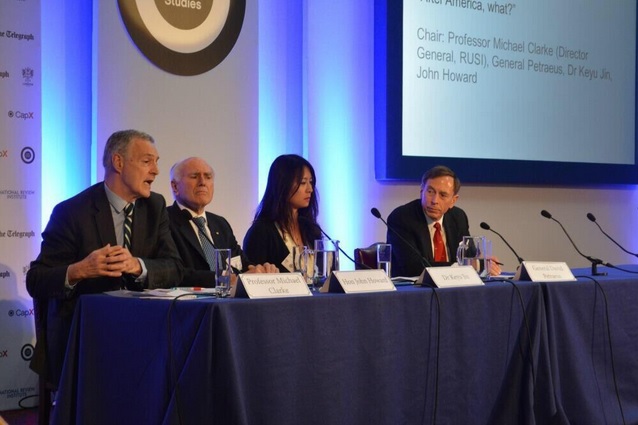
On national identity and culture (or what has become known here as the #BritishValues debate), former Australian prime minister John Howard attempted to reframe the argument, describing himself as a “multiracialist, not a multiculturalist”. In doing so, Howard explained that conservatives should be welcoming to immigrants regardless of their race and ethnicity, but hold everyone to the same standards of behaviour and observance of the law – a call to assimilate which many on the left are too timid to echo.
John Howard also had timely words of warning on winning elections, a topic where David Cameron could use advice from a someone with a track record. Howard warned: “The worst way to try to win office is to pretend you’re not too different from your opponents”.
Cameron is limited in what he can do in government by his Liberal Democrat coalition partners, but when the starting gun is fired on the 2015 general election campaign, this will no longer be the case. The Conservative Party – if they are willing and courageous enough to do so – will be able to clearly articulate their policies and present a radically different blueprint for Britain than that offered by Ed Miliband’s dystopian “One Nation” vision.
The centrist status quo was challenged on almost every issue, even if some topics (such as immigration, where delegates from North America and Europe found themselves talking at cross purposes for much of the time because of their differing experiences) were not convincingly resolved.
The only question remaining now the conference is over: Is today’s Conservative Party still receptive to what the small government free-marketeers have to say? Will the Tories reach out and take the help and advice being offered?
In Game of Thrones, those who guard the wall are a motley crew of misfits, idealists and outcasts. Anyone who has ever made the mistake of expressing support for conservatism or (heresy of heresies) admiration for Lady Thatcher at a Hampstead dinner party or northern England working men’s club could immediately identify with their plight.
But despite the prevailing atmosphere of scepticism, the happy warriors at the 2014 Margaret Thatcher Conference on Liberty did something important in defence of the realm the likes of which we have not seen on such a scale since their not-so-ancient order was founded by Sir Keith Joseph and Margaret Thatcher in 1974 – they came together and boldly, unapologetically proclaimed the principles of small government and individual empowerment that saved Britain once and can do so again.
By contrast, Ed Miliband addresses crowds of the Labour faithful (nobody else listens to him now) and – with a straight face – proclaims that his disproven, tired old formula of tax hikes and renationalisation represents “the new politics” that Britain so desperately needs, if only we realised.
Consequently, the 2015 general election could end up being a battle between two recycled political ideologies. And we will have a choice to make: Shall we choose the one that inevitably leads to the four-day working week, rolling blackouts, industrial unrest, punitive taxation, the brain drain, the politics of envy and ‘managed decline’, or the one that puts its trust in the people, liberating them to make Britain great again through their own efforts?
With the Margaret Thatcher Conference on Liberty, Thatcher’s peers, friends and successors made a surprisingly forceful show of strength on the side of freedom.