The Daily Smackdown: David Cameron’s Transparent EU Posturing

David Cameron - Angela Merkel - Francois Hollande - EU Renegotiation - Brexit

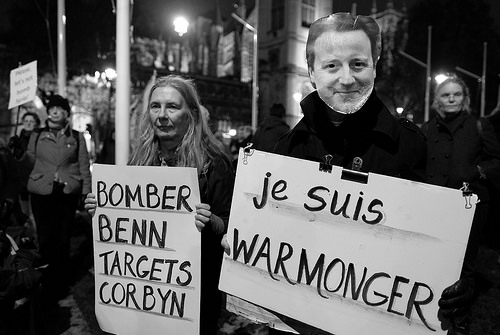
David Cameron has no respect for our intelligence if he thinks we will be fooled by claims that he is seriously considering campaigning for Brexit

Like this blog, the Times instantly saw through the prime minister’s latest desperate, amateurish attempt at brinksmanship and the dissemination of information by an often credulous media.

When David Cameron’s allies leaked that the prime minister was seriously considering recommending a Leave vote in the referendum if his renegotiation continues to be “theatrically spurned” by his EU partners, the story seemed too transparently false to be true. And it is.

The Times commented:

“It is patently clear that [David Cameron] cannot and will not become the man who tossed aside Britain’s EU membership. The hints from his allies that he might do so were a desperate negotiating tactic that has rightly backfired. This sort of melodrama is more likely to make negotiating partners giggle than give way.”

Absolutely. Every one of Cameron’s actions since he reluctantly promised the referendum as a too-little-too-late anti-UKIP defence has reeked of his desperate desire to keep Britain in the European Union at all costs.

As this blog pointed out yesterday:

Anybody with even one foot rooted in reality should be able to tell that this latest court gossip is nothing but spin. Having (unsurprisingly) gotten nowhere with his renegotiation efforts thus far, David Cameron needs to appear tough and resolute for the home audience. After all, it is pretty embarrassing that the leader of a global power and the world’s fifth largest economy has achieved precisely nothing, despite having embarked on a well-publicised begging tour of Europe. When begging and pleading with the Czechs for permission to change UK welfare rules yields no fruit, some kind of strong public stance is essential to preserve any kind of dignity.

The prime minister has never been able to force the words “Brexit” or any other specific phrase about Britain leaving the EU from his lips, and only on rare occasions has he even alluded to the fact that “nothing is off the table” if he judges the results of his renegotiation to be unsatisfactory.

Of course, since Cameron went into the British renegotiation carrying no demands at all – a point worth emphasising, and well made by Richard North at eureferendum.com – he is hardly likely to find his own efforts wanting. Who, given the chance to mark their own homework, would give themselves an F?

And when it comes to nothing being off the table in the event of failure, it remains easier to imagine the prime minister succumbing to a tearful, foot-stamping tantrum on live television than it is to picture David Cameron addressing the nation and declaring that Britain’s national interest would be better served by being outside the European Union.

EU Democracy - Brexit

Agree with this article? Violently disagree? Scroll down to leave a comment.

Follow Semi-Partisan Politics on TwitterFacebook and Medium.

Just Build The Damn Runway

heathrow-airport-third-runway-aviation-policy

This article was first published at Conservatives for Liberty

Build the third runway at Heathrow airport. And a fourth. Build new runways at London’s Gatwick and Stansted airports too. And then build a helipad directly on top of the homes and gardens of all the selfish, hand-wringing, growth-averse NIMBY naysayers who think that their decision to live by an airport gives them veto rights over Britain’s economic future

Chicago’s O’Hare international airport has seven runways. Count ’em. Seven. Five of these runways run east-west and the other two run diagonally. So long as your aircraft possesses an engine and wheels, there is almost certainly a runway at O’Hare suitable for landing without the need to circle in a never-ending holding pattern before eventually lining up for approach and touching down an hour after actually arriving above the city.

You can fly in and out of Chicago quickly, efficiently and cheaply because generations of local political leaders – for all their many other faults – have understood that aviation provides a huge boost to the economy, and that a city which makes access and connection quick and convenient for all types of traveller will surely reap the economic rewards.

Nine hours away in London, this common-sense attitude is sorely lacking. Despite the fact that no new full-length runway has been constructed in London or the south-east of England since the 1940s – when we were still digging ourselves out of the rubble of the Blitz – Britain is wasting time, energy and precious economic opportunities debating whether or not to increase airport capacity at any one of several implausible choices in south-eastern England beside the obvious option of committing to London’s Heathrow Airport, the largest and most popular.

Anyone thinking that the release of the Airports Commission report by Sir Howard Davies (summary: we should probably expand Heathrow, but Gatwick will do in a pinch) would bring this debate to a timely end were deluding themselves. David Cameron’s shrewd political radar is matched only by his lack of political courage – the Tories are terrified of angering neighbouring voters by giving the green light for more noise pollution and traffic congestion around Heathrow.

Worse still, although the Tories are hardly seen as a party of tree-hugging eco warriors their likely candidate to replace Boris “Island” Johnson as Mayor of London, Zac Goldsmith, is also dead set against the idea of expanding Heathrow despite the overwhelming logic behind committing to the major hub airport.

The never-ending question of whether or not to do the obvious and expand Heathrow airport is typical of Britain’s ridiculous approach to important decisions about critical national infrastructure. First we deny the existence of a problem or need. Then we delude ourselves that we have plenty of time to consider the issue from all angles, while better governed countries leapfrog us left, right and centre. Then we establish a time-wasting commission which seeks – in that peculiarly British way – to avoid angering anyone, while actually enraging everyone with its equivocation. And finally, twenty years later, we come to a tortuous decision – at which point anything we reluctantly build is woefully inadequate to current demand.

Not content with fighting the expansion of Heathrow airport tooth and nail, others are opening a new front in the war on aviation with a sanctimonious new attack on frequent fliers, who many left-wingers see not as vital contributors to global business and tourism but rather as parasitic city-hoppers guilty of overconsumption and leaving deadly trails of CO2 in their wake.

Looking wistfully back at the time when an Icelandic volcano eruption grounded flights between Europe and America, the Guardian opines:

The loss of the global economy’s airborne arteries could have been a death knell for business. But, the world didn’t end and people adapted astonishingly quickly in ways that had other environmental benefits.

There was an upward spike in the use of video-conferencing facilities saving business travellers time, money and fatigue […]

What’s more, stranded people turned to each other for help. The Swedish carpool movement spread its horizons, setting up a new Facebook group called Carpool Europe to share cars and rides. Twitter came into its own with hashtags like #putmeup and #getmehome.

You know when else the British people came together to make the best of a bad situation and relied on the kindness of strangers to get by? The Blitz. But no-one is proposing that we invite the Luftwaffe back for a second crack at carpet-bombing our major cities, because although disruptive and traumatic events do force us to come up with inventive ways to survive and keep the wheels turning, it would usually be far better if the negative situation occurred at all.

This is especially true of self-inflicted economic wounds like the proposed frequent flyer tax or the stubborn failure to expand and upgrade key national infrastructure out of genuine (or cynical) concern for the environment. If we continue to starve London of connections to the expanding markets of countries like China, the world will not end. But we will be overtaken by other, better governed European countries and we will all be immeasurably poorer in the long term.

There are times when we absolutely should put the conservation of our planet and natural environment at the forefront of government decision making and planning. But there are also times when our commitment to human progress and building a more prosperous society full of material abundance should be our single-minded goal. The tedious, seemingly never-ending debate about whether or not to build one solitary new runway in Britain falls firmly into the second category.

When formulating government policy or making critical decisions about our national infrastructure, we should subject our thought processes to one key test: does the proposal look to the past or the future? And if the proposal looks to the past – making use of outdated technology, serving a saturated market or simply mollifying people who are scared of progress and change – we should kill it in the crib.

For example, we should not be rushing to build new coal-fired power stations to meet our future energy needs, no matter what spurious claims ‘clean coal’ may make for itself. Rather, we should invest heavily in nuclear power and renewables (home grown where possible) to ensure Britain’s long-term energy independence and national security interests.

Local interests and feelings are important, but there are times when we must think and act as one country, with important national needs and challenges to be faced together. And yes, sometimes this will mean bulldozing over the objections of those blinkered, parsimonious campaigners who seem to find an objection to just about any form of pleasure or economic activity.

Air travel is great. It takes rich tourists from wealthy countries and brings them to poorer countries where they boost the local economy with their money. It keeps the wheels of business turning, from the CEO flying from New York to London for a meeting, the office worker commuting to Berlin every week for a project, to doctors and scientists gathering for international conferences.

Air travel bridges the distance between our towns and cities and helps knit the planet together through a web of far-flung family members, friendships and business relationships. And in doing so, the aviation industry helps to foster trust and understanding, bridging cultural divides and doing more to affirm our common humanity than any third-sector institution or political movement.

And yet we seem intent on attacking aviation, thwarting its growth and choking the life out of the industry with punishing airport taxes and insurmountable barriers to expansion. And for what? So that human beings can creep meekly across the surface of the planet, apologising for our very existence and ostentatiously offsetting the carbon dioxide we emit whenever we open our mouths?

When it comes to coal, by all means let Britain keep it in the ground and in the twentieth century, where it belongs. Regulate the life out of the fracking industry too, if you must, so long as you are willing to explain to the unemployed man why your environmentalist convictions should trump his right to work.

But for heaven’s sake, let’s not continue to suppress Britain’s aviation industry – which is so important and contributes so much – just to burnish our green credentials.

Conservatives for Liberty Logo

This article was first published at Conservatives for Liberty

Agree with this article? Violently disagree? Scroll down to leave a comment.

Follow Semi-Partisan Politics on TwitterFacebook and Medium.

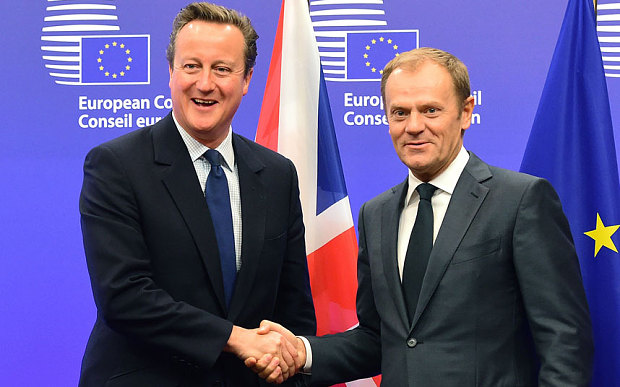
Credulous Media Swallow David Cameron’s EU Renegotiation Myths

David Cameron - Donald Tusk - EU Renegotiation - European Union - Brexit

Nobody in their right mind seriously believes that David Cameron will campaign for Britain to leave the European Union. But that didn’t stop the media from earnestly reporting Number 10’s Brexit bluster

David Cameron is about as far from being a eurosceptic as a Conservative prime minister could possibly be. Sure, he was forced by the rise of UKIP into pledging a referendum on Britain’s EU membership – despite having previously stated that he didn’t think a referendum was appropriate – but this was only ever a matter of political expediency, not heartfelt desire for Brexit or deep conviction that the people should have the right to decide their own destiny.

But this has not stopped the media from willingly and credulously lapping up the latest spin emanating from Number 10 Downing Street – the risible idea that if David Cameron’s EU partners continue to treat him like the pesky kid at the adult’s table, he might seriously campaign for Brexit.

From the Telegraph:

David Cameron has privately conceded he will have to campaign to leave the European Union if he continues to be “completely ignored” by Brussels, the Daily Telegraph has learned.

[..] It has now emerged that Mr Cameron is telling senior figures in his party that he will be willing to campaign for a British exit if EU leaders do not back down over his key reform plans.

“He has said that if he is completely ignored or if they give him nothing he will campaign to leave,” the source said. “He has made that clear.”

Anybody with even one foot rooted in reality should be able to tell that this latest court gossip is nothing but spin. Having (unsurprisingly) gotten nowhere with his renegotiation efforts thus far, David Cameron needs to appear tough and resolute for the home audience. After all, it is pretty embarrassing that the leader of a global power and the world’s fifth largest economy has achieved precisely nothing, despite having embarked on a well-publicised begging tour of Europe. When begging and pleading with the Czechs for permission to change UK welfare rules yields no fruit, some kind of strong public stance is essential to preserve any kind of dignity.

And let’s be frank – the Telegraph didn’t so much “learn” that Cameron is considering campaigning for Brexit through canny investigative journalism, but rather they probably received a tip-off authorised by the Conservative Party hierarchy to place that narrative into the news cycle.

And what a successful stunt it has been. Now we are duly talking about how the prime minister feels so frustrated with the progress of his renegotiation that he is considering this drastic step, when deep down they (and most of us) know that David Cameron would sooner leave his daughter unattended in Nigel Farage’s local pub than recommend to the British people that they vote to leave the EU.

The truth, of course, is that this was always a sham renegotiation. David Cameron didn’t even bother to consult with the British people as to what they wanted out of any new settlement with Europe before jetting off to Brussels to set out his puny demands, so how could he claim to be representing the public’s real concerns?

This whole exercise has been about starting with the outcome of a “Remain” vote and then working backwards to determine the least possible number of concessions required from the EU to deliver that goal, rather than starting with a hard-headed assessment of Britain’s own national interest or public sentiment. And such a back-to-front renegotiation was never going to bear fruit.

As Mark Wallace points out in Conservative Home:

The conventional wisdom is that the Prime Minister has cut back his list of renegotiation demands in order to reach a swift agreement, in which he can claim victory and then hold an early referendum. That probably was his hope; it would certainly make political sense. Unfortunately for him, each aspect of that plan is foundering while the clock ticks down.

With every day that this supposed renegotiation goes on, Britain looks more and more like the weak supplicant nation asking its superiors for scraps from the table – and being rebuffed. This would be humiliating enough, but it is also self-reinforcing. The fact that our EU partners have already seen Cameron going cap-in-hand around the capitals of Europe begging for concessions (rather than boldly stating the UK’s national interest or presenting a radically different vision of EU membership) means that they are emboldened to give away fewer concessions when he comes knocking again.

Right now, the EU has bigger fish to fry than the Brexit question. And with immigration and terrorism top of the agenda, EU leaders feel confident in pushing our renegotiation way down the list of priorities because they know – even if our credulous media claims not to know – that David Cameron will campaign for a “Remain” vote, come what may.

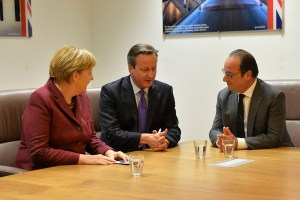
France and Germany are both diplomatically canny countries. If they suspected for a moment that their treatment of David Cameron might seriously cause him to snap and embrace the Brexit cause then they would immediately start making more conciliatory noises. Secretly they might be glad to be rid of Britain, but they know that Brexit would be a stunning, unacceptable repudiation of their vision for Europe. Thus the fact that there is no diplomatic panic in Berlin or Paris is proof that Angela Merkel and Francois Hollande know that their British counterpart remains utterly pliable and sickeningly eager to please.

David Cameron can continue to authorise leaks suggesting that he is contemplating campaigning for Brexit, if it makes him feel better when he is politely ignored by the leaders of other countries a fraction of our size and power. He can promise all the table-thumping rows in the world, too.

But the one thing he cannot do is convince those of us who see through his cheap tricks that he is a real eurosceptic, or that he would ever allow his name to go down in the history books as the man who led Britain out of the European Union.

David Cameron - Angela Merkel - Francois Hollande - EU Renegotiation - Brexit

Agree with this article? Violently disagree? Scroll down to leave a comment.

Follow Semi-Partisan Politics on TwitterFacebook and Medium.

The Daily Toast: Glenn Greenwald On Succeeding In Journalism

Glenn Greenwald


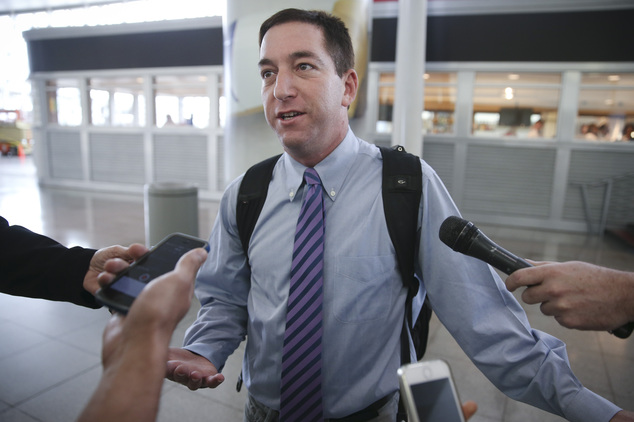
Glenn Greenwald gives an interview to Dillon Baker in The Freelancer, and offers his thoughts on succeeding in online journalism:

I think the most important thing is to avoid being a generalist. Don’t be willing to write about every single topic, because no person can be well-versed in every topic. If you write about stuff in which you are not well-versed and you don’t really have expertise, you’re just going to turn out mediocre product. And that’s going to affect how you’re perceived in the long run.

It’s so critical to figure out what you’re really passionately interested in. Because there’s a market for everything. There’s a huge Internet out there. Topics that seem really obscure can definitely, if you do it the right way, generate enough attention and interest to sustain you, and maybe even push you beyond that. It’s critical to just pick a few topics of which you have a great deal of passion, and develop genuine expertise in those so that what you’re producing can’t be found anywhere else except with you.

Wise words, which this blog will continue to strive to observe. This blog has long admired Glenn Greenwald for the passion and urgency behind his writing, and his principled stance against the secret surveillance state.

So what is the purpose of this blog?

Semi-Partisan Politics will continue to campaign – loudly and unapologetically – for the following goals and ideals:


Brexit: freedom from the European Union

Democracy and national sovereignty

Constitutional reform and a federal UK

Separation of church and state

Smaller, smarter government

Free speech, without restriction

Fighting timid centrism on the Right

Fighting empty virtue-signalling on the Left


If you agree with these objectives and have enjoyed this blog’s coverage over the past year, please do consider using the PayPal tip jar to make a small contribution:


Any donations will 1) be an ego boost, and 2) help me to do more original reporting, like the successful live blog of this year’s UKIP annual conference.

But most of all, please continue to click, like and share those articles that you enjoy with your family and friends. My loyal readers help keep me fighting the good fight.


Follow Semi-Partisan Politics on TwitterFacebook and Medium.

Arrogant MPs Want To Turn Political Debate Into Their Own Safe Space

Syria Vote - Trolling - Online Abuse - MPs - 3


Being heckled and pilloried by obnoxious online trolls is a regrettable part of the job description for any 21st century MP. But the right answer is to ignore the idiots and move on, not to impose draconian codes of conduct or prison sentences for insulting speech

When Britain is in the midst of debating great issues of war and peace, it is frankly astounding that much of the media seems more concerned with the hurt feelings of Labour MPs threatened with deselection by angry constituents than the consequences of British military action in Syria.

In the aftermath of the Syria vote in parliament, I saw one newspaper headline in particular that represented such an unhinged piece of self-aggrandising hyperbole that it made me do a double-take:

Jeremy Corbyn has made us targets for jihadists - shadow cabinet - Syria vote - ISIS.jpg

Apparently, by failing to assume direct control of the hearts and minds of every single one of his supporters – and physically preventing them from blowing off steam in the aftermath of the Syria air strikes vote in Parliament – Jeremy Corbyn is personally responsible for endangering the lives of those MPs who voted with the government for military action:

Jeremy Corbyn has made his MPs targets for home-grown jihadists in the wake of the vote to back Syrian air strikes, a shadow cabinet minister has warned.

The accusation that MPs are being left open to revenge attacks came as a backbencher made a formal complaint to Labour’s chief whip over Mr Corbyn’s “despicable and deliberate” threats over the Syria vote which he said will lead to “personal violence” against MPs.

In the immediate aftermath of the vote, which saw 66 MPs defy Mr Corbyn to back David Cameron’s plans for military action, Labour Unity, a hard-left organisation linked to the party leader, released a “traitor list” of backbenchers who should be targeted for de-selection.

Mr Corbyn and his allies have been directly accused of “aiding and abetting” the intimidation of Labour MPs by leaking the names of MPs preparing to back the Government in recent days.

This is not a joke. A member of the Labour Party shadow cabinet – a fully grown adult with an important constitutional role to play in our democracy – serious believes that by expressing his scepticism about air strikes on Syria, Jeremy Corbyn has made dissenting MPs vulnerable to terrorist attack. They believed it strongly enough – or hated Corbyn enough – to give these quotes to a national newspaper.

First of all, Jeremy Corbyn needs to identify who this self-aggrandising crybaby is, and kick them so hard out of his shadow cabinet that they end up back in local government debating bin collections and street lighting. Such brazen disrespect of the leader is absolutely intolerable in a serious political party.

Jeremy Corbyn, of course, tolerates self-important asides from whiny, self-entitled members of his own shadow cabinet every single day, which suggests that he has the patience of a saint, whatever his many other flaws. But no leader should expect to be confronted with daily leaks and insubordination of this kind from their own shadow cabinet, particularly scurrilous juvenile fantasies that he is somehow endangering the lives of his colleagues simply by disagreeing with them.

This blog agrees with almost none of Jeremy Corbyn’s socialist platform, but this open defiance of the leader has to stop if the Labour Party ever hope to be taken seriously as a cohesive force in British politics. Right now, the only hope for the Labour centrists is that Corbyn proves himself to be so unelectable in the London mayoral, local and devolved assembly elections that real momentum builds for him to be replaced.

By constantly snarking and running to their media sources in the media every time Corbyn’s leadership style hurts their pwecious wittle feewings, Corbyn will be able to point to all of this insubordination later on, when he is on the ropes, and say that he is failing not due to a popular rejection of his policies but thanks to disloyalty from his own shadow cabinet. This is the last thing that the centrists should want, but in typical myopic fashion they are totally incapable of looking more than one step ahead.

Syria Vote - Trolling - Online Abuse - MPs

But it’s not just the fifth column within Jeremy Corbyn’s shadow cabinet who are at fault. An increasing number of MPs from all parties (but particularly Labour) are speaking out, claiming that robust and sometimes distasteful criticism of their political views and voting records is somehow tantamount to “bullying”.

This has now reached the point where even expressing the view that your MP is doing a bad job and should be deselected as their party’s candidate at the next general election is also being described as “bullying” by some self-entitled and wobbly-lipped MPs.

The BBC reports:

Ann Coffey, who has represented Stockport since 1992 was told: “Get behind the leader or kindly go.”

In response, she said she will “await the assassins to come out of the shadows”.

Assassins? What Ann Coffey is referring to is the great fear now stalking the Parliamentary Labour Party – deselection.

While the Metro reports on the party establishment’s hurt response:

Shadow home secretary Andy Burnham, who voted against air strikes, called on Mr Corbyn to show ‘no tolerance’ of abusive behaviour within the party and said a code of conduct was needed for members’ use of social media.

He was particularly disappointed with the treatment colleague Ann Coffey had received after voting for the strikes.

‘She has served Stockport, her constituents and our party for many years with distinction, and people need to have a look at themselves before they go around throwing threats at people like that,’ he told BBC2’s Victoria Derbyshire Show.

Whether Ann Coffey has served her constituents and her party well or not is beside the point – it is not for Andy Burnham, a fellow MP, to decide on behalf of Coffey’s constituents whether or not she should continue to be their Labour Party candidate, nor to shield her from public criticism.

Syria Vote - Trolling - Online Abuse - MPs - 2

This is a ludicrous state of affairs. MPs are grown adults, serious people who should be capable of participating in the rough and tumble of democratic debate without needing some higher authority to step in and moderate the debate to spare their delicate sensitivities.

Spiked’s Tom Slater agrees, writing:

Let’s get a few things straight. First of all, if you’re over 16 – let alone a prominent politician – you’ve got no right to claim you’re being bullied. Bullying is what happens in the playground. And most kids put up with far worse than a few nasty emails. It’s pathetic. Secondly, being called a ‘baby killer’ isn’t nice, but it’s not abuse or intimidation. It’s political critique – asinine, sixth-formerish, idiotic political critique, but it’s political critique nonetheless. And as for those who have claimed to have received death threats, they’re just not credible. Neil Coyle MP contacted the police, all because someone tweeted three knife emojis to him. Jesus wept.

[..] This is bad news for politics. The war on trolling, we were told, was all about protecting poor, vulnerable people from being hounded out of the public square. Now, 40-plus politicians are using the same language to protect themselves from criticism. In these strange political times, we need more conflict, more argument and, yes, more abuse-hurling. Politicians crying foul when someone disagrees with them – that’s what the ‘kinder, gentler’ politics looks like.

It is bad enough that our universities – supposedly places of intellectual rigour and ‘no holds barred’ debate – are turning into soft cornered safe spaces where delicate snowflake students insist on being protected from ever having to encounter a dissenting or provocative opinion. But apparently the disease has not been contained and has spilled over the borders of academia into the very heart of our democracy, the political sphere.

This is exceedingly dangerous. Angry, safe space-dwelling students are proving themselves more than capable of stifling debate, changing whole curricula and agitating for decent staff to be fired, despite having almost no formal power in the university hierarchy system. How much more damage, then, can elected MPs do to our already-weakened free speech rights when they are the ones setting the political agenda and making the laws that we must follow?

Enough is enough. Being told that one has blood on one’s hands because of a vote for military action may be jarring, unsettling and nasty. But MPs should be able to separate the wheat from the chaff, and engage with those constituents who engage with them respectfully, whilst either ignoring or belittling those who are rude or aggressive.

In fact, Labour MP Stella Creasy herself – usually leading the charge to criminalise Twitter abuse – inadvertently demonstrated how best to handle mean Twitter insults in the aftermath of the Syria vote when she responded to a member of the public who swore at her and called her a witch:

Syria Vote - Trolling - Online Abuse - MPs - Stella Creasy - Twitter - 2

Highlight the idiocy, publicly smack it down and move on. Or simply ignore the haters altogether. That’s all an MP has to do.

This should be the model which all MPs follow, all the time. Engage with the genuine constituents, especially when they are legitimately angry. Ignore those who are gratuitously mean, insulting or belligerent. But only report to the police those who make serious and credible threats of physical harm.

This is how anyone who has ever worked in a private sector customer service job would handle their interactions with the public every single day. Ask any London bus driver if they call the police every time they are demeaned, insulted or “bullied” while at work, and they would laugh in your face. When you work in a tough job like that, you grow a thick skin.

We should expect no less maturity (in the face of occasional public immaturity) from our elected representatives in Parliament.

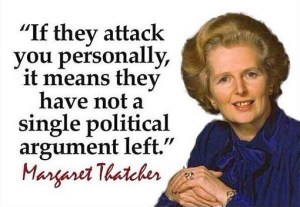
Margaret Thatcher - Internet Trolling

Agree with this article? Violently disagree? Scroll down to leave a comment.

Follow Semi-Partisan Politics on TwitterFacebook and Medium.