CCHQ Should Not Automatically Protect Tory MPs From Deselection

Conservatives Tories start candidate selection process early - mandatory reselection - deselection of rebels

A seat in the House of Commons is not a job for life. And just as the Parliamentary Labour Party should not be encumbered with MPs increasingly at odds with their local constituency parties, so Tory MPs should not be immune from deselection if they repeatedly ignore the priorities and concerns of grassroots Conservative Party members

Try as I might, I simply cannot get myself worked up about the government’s “shock” defeat over the amendment to the EU Withdrawal Bill. While the legislative drama seems to have Hard Brexiteers up in arms and Remainers parading their newfound (and one suspects rather less than genuine) love and respect for Parliamentary sovereignty, I don’t see that these machinations will have any real bearing on the eventual outcome.

So Parliament gets to have a “meaningful” vote on the terms of the UK-EU agreement? Fine, so be it – though I have always held that the people, not Parliament, should be sovereign, and that no government should be able to divest itself of fundamentally important powers or seek to repatriate such powers without an explicit and specific mandate from the people. Of course, if we had a written constitution then such things would likely be enshrined automatically rather than be up for furious debate as new issues and obstacles are encountered along the road. But then if we had a written constitution we likely would never have ceded so much sovereignty to the European Union in the first place and would not now be in this position, making it all a rather moot point.

Of far more interest to me is the fact that talk of deselection of MPs has bubbled up again. We saw this last year as Jeremy Corbyn and his supporters sought to cement their control of the Parliamentary Labour Party, and for democratic reasons I supported the idea of mandatory reselection in principle. And now there are new calls to deselect sitting MPs, this time from Conservative politicians and activists angry at what they see as the Tory rebels’ deliberate undermining of the prime minister and the country’s negotiating position with the EU:

On this occasion I do not share the Tory Brexiteer outrage, but their case is every bit as compelling as was that of the Corbynite leftists who wanted to rid their party of centrist MPs who do not reflect the values and priorities of their local associations. While I personally find it hard to work myself into a spittle-flecked fury at the antics of Dominic Grieve or Heidi Allen, if it is the case that these MPs represent Leave-voting constituencies and a majority of local party activists find their voting record objectionable then I see no reason why they should be protected and continually re-imposed on an unwilling local party organisation.

Of course, CCHQ and the Tory Party machinery vehemently disagrees. Reflexively opposed to any notion that grassroots activists or local constituency associations should have any input as to the direction, policies or running of the party, CCHQ sees individual conservatives as little more than indentured servants campaign material distributors at election time, to be put to work when necessary and then roundly ignored the rest of the cycle.

Nick Timothy, Theresa May’s intellectual bloodbank-in-exile, makes it perfectly clear that the present Conservative leadership remains determined to run the party (if not the entire country) as their personal private fiefdom, and that local constituency associations should shut up and do as they are told, whether they like the candidate or MP chosen for them or not. Timothy unapologetically and shamelessly spelled out as much on Twitter today:

https://twitter.com/NickJTimothy/status/941254029488873472

This is an open admission that Theresa May, the prime minister and leader of the Conservative Party, saw fit to interfere in local constituency business and keep an unwanted MP foisted on an unwilling local party.

But what the hell business should it be of the prime minister who gets to stand as a Conservative candidate in a local constituency? This is everything that is wrong with the current Tory party – overcentralised and overbearing, with CCHQ pig-headedly declaring that it knows best while confidently marching us all to ruin. Given the litany of gaffes, unforced errors, scandals and bad judgements which have emanated from Theresa May’s cabinet, I would sooner entrust a panel of ten individuals randomly selected from the phone book to choose good Tory candidates than I would have Theresa May make the judgement call.

Of course, there is a counter-argument to all this, as a reader pointed out on Twitter:

We certainly don’t want a situation where conscientious, independent-minded MPs are peremptorily driven from office or from their political party because they fail to toe the hardest of hard lines demanded by their activists. We have recently witnessed just such a phenomenon lead the Republican Party to ruin (at best Pyrrhic victory) in America, where a succession of primary challenges and forced retirements saw an influx of ideologically uncompromising Tea Party politicians into Congress, hard-liners who thwarted any attempt at sane governance in the second term of Barack Obama, rendered the Republican congressional caucus unmanageable and ineffective and set the stage for Donald Trump’s hostile takeover of the GOP.

In actual fact we need both of these opposing forces – greater responsiveness to grassroots opinion and a cool, dispassionate process to adjudicate in the event of rogue or underperforming MPs – to be in balance. We need a far greater measure of accountability of MPs to their local party associations, and a more meritocratic system of selection (preferably primaries) which draws more people into the political process and prevents the mediocre-but-well-connected from leveraging their connection to CCHQ to be shortlisted or ultimately foisted on a constituency.

But we also need to build safeguards into the system so that the bar for triggering deselection is high but achievable – the recourseshould only become available at the time of a general election or by-election, so that MPs are judged on the body of their work and their voting record throughout a Parliament and not on the basis of any one single contentious vote.

Ultimately, the resurgent argument about deselection of MPs reminds us that Brexit is a necessary but not a sufficient condition for meaningful democratic renewal in Britain. Brexit was never going to be a cure-all no matter what some cynical Brexiteers may have implied, and we must all now recognise this fact. Achieving Brexit only to return power to the hands of the same MPs who negligently frittered it away in the first place, and who think so little of the people who campaign to put them in office that they seek to be made immune from their judgement, will not solve anything.

To this extent, the worries of Hard Brexiteers that the EFTA/EEA route may be used as cover by some Remainers in order to thwart Brexit entirely are quite valid. When there are so few penalties or recourses available to voters when politicians betray their own supporters, the trust required to sustain a well-functioning democracy is inevitably corroded.

But the real tragedy is that when we should be discussing how to respond to the period of disruption and discontinuity facing Britain, developing bold new mutually-reinforcing policies to tackle 21st century challenges, instead the Conservative Party is bickering about process and thwarting any attempts to clear out the intellectual deadwood and bring in some new ideas and personalities. Constitutional and electoral reform is important and eventually necessary, but there are pressing issues facing Britain which cannot be put on the back burner while we argue about the rules of play. Unfortunately, we seem less interested in these big debates and more interested in arguing about process stories.

When the Conservative Party fails to stand for anything – and Lord knows that under the rootless leadership of Theresa May, the Tories stand for little more than surviving the day at hand – it has plenty of time to devote to juvenile, internecine spats like the one playing out over the EU Withdrawal Bill rebels.

This is highly entertaining for the political media and a gift for Jeremy Corbyn and the Labour Party, but very bad indeed for everyone else.

Conservative Party Logo - Torch Liberty - Tree

Support Semi-Partisan Politics with a one-time or recurring donation:

Agree with this article? Violently disagree? Scroll down to leave a comment.

Follow Semi-Partisan Politics on TwitterFacebook and Medium.

Upset An MP On Social Media? Prepare To Lose Your Voting Rights

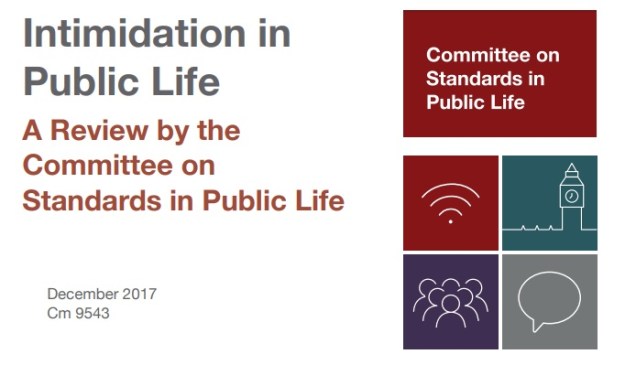
Intimidation in Public Life report - Committee on Standards in Public life - Parliament - Britain - UK - online social media abuse

Hurt an MP’s feelings and lose your civil rights. This could be a reality in the prissy, authoritarian, neo-puritanical Britain we inhabit

Having learned nothing from the past three years of populist insurgency, rather than facing up to their shortcomings and accepting the validity of justified criticism (and the inevitability of unjustified criticism) the political class is instead preparing to further insulate itself from public accountability.

A new report published by the Committee on Standards in Public Life proposes punishments such as barring people from voting or removing them from the electoral register as suitable punishments for the “new electoral offence of intimidating
Parliamentary candidates and party campaigners during an election” – which if enforced with the same arbitrary capriciousness as all other UK speech laws would inevitably see many people unjustly stripped of their basic civil rights while other, worse “offenders” who happen to hold officially sanctioned opinions go unmolested.

We in Britain now have a government which would give convicted prisoners the right to vote while stripping the franchise from certain free citizens who commit vague and loosely-defined acts of speechcrime – including hurting the feelings of an MP or Parliamentary candidate.

The report (prefaced with a quote from the late Jo Cox MP, so as to imbue the document with an air of incontestable wisdom and grace) graciously concedes that the existing restrictive framework of draconian anti-free speech laws does not need augmenting to protect the feelings of MPs at this time, but then immediately ventures the possibility of unprecedented new punishments for those accused of speechcrime:

Electoral law can overlap with and complement the criminal law, such that offences with criminal sanctions can also involve sanctions under electoral law. These sanctions are specific to the election process, such as being barred from voting for a certain period, or removal from the electoral register. Such sanctions recognise that these offences, such as undue influence or electoral fraud, are offences against the integrity of the electoral process, and that it is therefore appropriate that individuals face sanctions relating to their own privileges within that process.

[…] However, the Committee considers that the issue of intimidation is of particular significance because of the threat that it poses to the integrity of public service and the democratic process.

During an election period, it would therefore be appropriate to have specific electoral sanctions that reflect the threat that intimidation of Parliamentary candidates and their supporters poses to the integrity of elections. Any such offence in electoral law should be tightly defined, to capture intimidatory behaviour that is directed towards an individual specifically in their capacity as a Parliamentary candidate or party campaigner, which intends unduly to influence the result of the election (for example, by affecting their candidature or inhibiting their campaigning).

[..] the introduction of a distinct electoral offence will serve to highlight the seriousness of the threat of intimidation of Parliamentary candidates to the integrity of public life and of the electoral process, and will result in more appropriate sanctions. We believe that specific electoral offences will also serve as an effective deterrent to those who are specifically targeting Parliamentary candidates and their supporters.

The Committee on Standards in Public Life, a body whose intended purpose was to ensure that elected and non-elected officials uphold standards of behaviour appropriate to those who serve the public in high office, now seems far more interested in passing haughty judgment on whether members of the public are abiding by the new speech codes dictated by our puritanical, thin-skinned rulers.

I would be interested to know which of the Seven Principles of Public Life the committee believes it is defending by proposing new speechcrime punishments which attack so fundamental a civic right as voting – particularly as each of these principles sets a standard specifically for “holders of public office” and not private citizens. The only tenuous link offered in the entire report is this throwaway sentence:

[..] the Committee considers that the issue of intimidation is of particular significance because of the threat that it poses to the integrity of public service and the democratic process.

Ah, that’s okay then. So because the rowdy public is supposedly threatening “the integrity of public service” (presumably by scaring people away from getting involved in politics, because those who are already inclined to get involved in politics of course tend to be shy fauns who take fright at verbal hostility) the Committee on Standards in Public Life can use this as an excuse to regulate the behaviour not of people in positions of power, but of those who seek to express their feelings about people in power.

Of course, MPs are not the only people to find themselves at the receiving end of vitriol on social media, as anybody with even a semi-public profile or the desire to talk about politics on Facebook or Twitter can attest. Twice in recent months I have been at the receiving end of such a barrage, first when a “comedian” chose to misrepresent one of my tweets to his baying audience of pro-EU Remain supporters and again when an SNP MP sicced his Twitter supporters on me for daring to write about the office of Scottish First Minister in less than worshipful terms. None of the hate I received (on those occasions) amounted to the level of death threats, but other private citizens have suffered far worse.

Yet the political class seem to want to carve out a special protection in terms of exempting themselves from harsh criticism while doing nothing for anybody else. As Members of Parliament they already occupy a high-status, well-remunerated position in society, are generally endowed with a level of intelligence which enables them to articulate their priorities and concerns and be taken seriously, and make laws and decisions which impact our present reality and future happiness. Yet many of these same people now seem determined to portray themselves as shrinking violets, vulnerable victims-in-waiting, a discriminated against minority group who require the special and proactive additional protection of the law. This is absurd and insulting to the citizenry they notionally represent.

But in addition to protecting the powerful from the masses, these puritanical proposals also fundamentally misunderstand the problem. As even many victims of social media harassment would likely agree, the really damaging part of online abuse is not the individual insults but their combined, collective effect. One person insulting or mocking you can be laughed off or brushed aside, but this is not so easily done when one’s notifications fill up with a constant wall of such derogatory, negative messages. Indeed, when under attack on social media, at times it can be difficult to step back and remember that the strident opinions of social media moralisers is not reflective of the feelings of the country or society as a whole. At times, I myself have momentarily allowed hate and derision on social media to interfere with my self-esteem, despite my fairly thick skin.

The answer to online trolling and abuse (whether directed at politicians or private citizens) is not to criminalise individual acts of strident, unpleasant or insulting speech, let alone to curtail the fundamental civil rights of individual citizens as punishment for (or deterrence of) something which is in large part a swarm effect, an unpleasant but distastefully necessarily defensible part of our society’s commitment to free speech.

To do so would be akin to criminalising the act of gathering together in crowds because of the risk that somebody might be crushed or trampled, punishing individuals for what in itself is often a very small contribution to a larger group effect. No single individual is usually responsible for a stampede, just as very few individuals commit specific acts on social media which alone trigger substantial distress, and barring such people from voting (one wonders what offence merits losing the franchise while retaining one’s liberty) will not deal with the vast bulk of abuse on social media and consequently the vast bulk of suffering resulting from it.

The issues addressed by the report are real, worthy of discussion, and are already being debated at length. There is no lack of editorialising or scholarship on the impact of social media on public political discourse, and the way in which the semi-anonymity of interacting online brings out a far more vicious side of human nature than is usually visible during face-to-face interactions. These are problems which we need to face up to as a society at a time when we are learning on the go. But the solution is not to announce further new restrictions on freedom of expression, as though filling in gaps in the statute books will in any way compensate for filling in the mental and spiritual void which turns some people (including the highly educated and outwardly successful) into social media trolls.

Furthermore, at a time when the yawning disconnect between the ruling class and many of the people they represent is growing wider and fuelling all kind of populist outbursts (some welcome and others far less so) it is the height of irresponsibility for those in power to publicly toy with the notion of punishing the plebs for insulting their masters by stripping them of their voting rights.

The Committee on Standards in Public Life should cast their haughty, disapproving gaze back where it belongs – on those who debase their political offices or abuse the public trust. Now more than ever is a time for humility and introspection from the ruling class, not a whinnying list of grievances about those who fail to sing their praises.


By election - ballot box - Democracy

Support Semi-Partisan Politics with a one-time or recurring donation:

Agree with this article? Violently disagree? Scroll down to leave a comment.

Follow Semi-Partisan Politics on TwitterFacebook and Medium.