Hate Speech / Free Speech

Earlier this month I had the privilege of attending an event organised by Spiked, entitled “A New Intolerance On Campus”.

The final panel of the day focused on the question “Is hate speech free speech?”, and while it was a little unbalanced (Dan Hodges was due to provide the counterpoint opinion but was unfortunately unable to attend) there were eloquent arguments in favour of unrestricted free speech from Brendan O’Neill, Maryam Namazie and particularly Douglas Murray.

While the arguments expressed here will be familiar to anyone who closely follows the debate on free speech and the climate of censorship on university campuses – particularly those who have read Mick Hume’s worthwhile book “Trigger Warning: Is The Fear Of Being Offensive Killing Free Speech” – the video is still worth a watch.

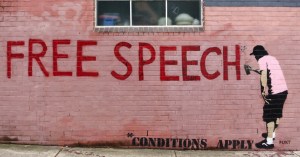
Free Speech - Conditions Apply - Graffiti

Agree with this article? Violently disagree? Scroll down to leave a comment.

Follow Semi-Partisan Politics on TwitterFacebook and Medium.

OscarsSoWhite: The Self-Flagellating, Social Justice Academy Awards

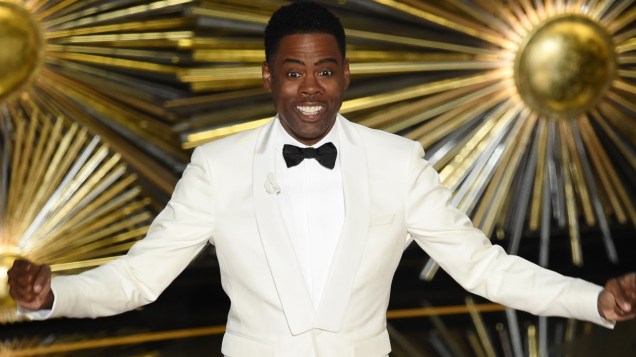
Chris Rock - Oscars Monologue - OscarsSoWhite

Chris Rock’s opening monologue was brilliant – but bombarding Oscars viewers with four hours of social justice preaching was too much, and served the messengers far more than the causes they promoted

At the opening of Chris Rock’s excellent hosting of the 88th Academy Awards in Hollywood, the comedian made a joke which sets some very important and much-needed context for the #OscarsSoWhite and social justice-obsessed debate leading up to the star-studded ceremony.

From the New York Times transcript of Chris Rock’s remarks:

It’s the 88th Academy Awards. It’s the 88th Academy Awards, which means this whole no black nominees thing has happened at least 71 other times. O.K.?

You gotta figure that it happened in the 50s, in the 60s — you know, in the 60s, one of those years Sidney didn’t put out a movie. I’m sure there were no black nominees some of those years. Say ‘62 or ‘63, and black people did not protest.

Why? Because we had real things to protest at the time, you know? We had real things to protest; you know, we’re too busy being raped and lynched to care about who won best cinematographer.

You know, when your grandmother’s swinging from a tree, it’s really hard to care about best documentary foreign short.

It is great to see Chris Rock – incidentally, one of the many high profile comedians who now refuse to perform on American college campuses because of the stultifying and censorious climate created by Social Justice Warrior (SJW) activists – making this point, which frequently gets lost in our climate of perpetual outrage.

(Though sadly, because everything and everyone is “problematic” these daysand because Social Justice Warriors ruin everythingthe bien pensant criticism of Rock’s monologue is already gathering steam).

Is it perhaps unfortunate that there were no black nominees among the various acting categories? Maybe so – although it was hardly statistically unlikely, given the fact that African Americans make up just thirteen per cent of the US population. But the mere fact that we are now arguing about whether black actors (Hispanics and other minorities seemed to do quite well in terms of winning awards) are being systematically excluded from the ultimate expression of Hollywood elitism shows in itself just how far we have come.

This is not to negate the very real discrimination against black people which still exists, particularly in the criminal justice system and law enforcement – notably several high profile killings of unarmed black suspects by the police. This blog covered the Michael Brown shooting in Ferguson, Missouri and I offered my own sympathetic perspective from having spent many months and years visiting the St. Louis area.

But one has to go back only a few short decades to encounter a time when the threat to “black bodies” (a strange term which is increasingly fetishised in the media – particularly through use by writers such as Ta-Nehisi Coates, whom I greatly admire even when we disagree) was far more universal, and not primarily the concern of black teenagers murdered while committing a minor misdemeanor, or black actors shunned by the movie industry.

What became increasingly concerning as the Oscars wore on, though, was the fact that Chris Rock’s excellent, light-hearted but pointed acknowledgement of the controversy and the shortcomings of Hollywood, was only the first salvo in a barrage of social justice virtue-signalling and white guilt self-flagellation which ultimately consumed the entire ceremony. Every segment between awards seemed to have to involve conspicuous references to the #OscarsSoWhite drama, which became grating and unnecessary after awhile.

Some people were quick to sanctimoniously declare that this was deserved:

https://twitter.com/gmgannon/status/699455425633243137

Because not only does every occasion now have to be a teaching moment for the social justice agenda, the point must be laboured again and again. Not because it does anything to actually improve the availability of good roles for black actors in Hollywood, but because each presenter who touched on the theme was then able to imbue themselves with the same “I’m part of the solution, not the problem aura”.

This reached a heady climax when Vice President Joe Biden made a surprise appearance on stage to introduce Lady Gaga and plug his campaign against sexual assaults at college. While every decent person should be able to get behind the idea that nobody should be raped while studying at university, or indeed at any other time, this was then followed by the pernicious idea that “It’s on us” (i.e. perfectly innocent members of the public) to prevent rape.

The organisation promoted by Vice President Biden, ItsOnUs.org, asks us to take the following actions in our own lives:

To RECOGNIZE that non-consensual sex is sexual assault.

To IDENTIFY situations in which sexual assault may occur.

To INTERVENE in situations where consent has not or cannot be given.

To CREATE an environment in which sexual assault is unacceptable and survivors are supported.

The first pledge seems perfectly reasonable. But the remainder seek to transform us into perpetually vigilant informants and secret police agents, scanning crowds and charging to intervene in situations where we are uncertain that consent has been given, even when we lack critical context.

The idea that the average person will ever have the opportunity to “intervene in situations where consent has not or cannot be given” is particularly ludicrous – but these days, one can quite easily imagine squads of purse-lipped student “consent educators” roaming popular nightspots and breathalysing couples leaving bars and clubs to ensure that sexual relations do not follow the consumption of beer (heaven forfend).

But scroll to the end of the ItsOnUs website and you’ll see the only possible tangible outcome of the campaign – the ability to superimpose the organisation’s logo on to your social media profile picture, thus allowing those who take the pledge to ostentatiously parade their “I, too, am not a rapist” credentials before their equally vapid friends.
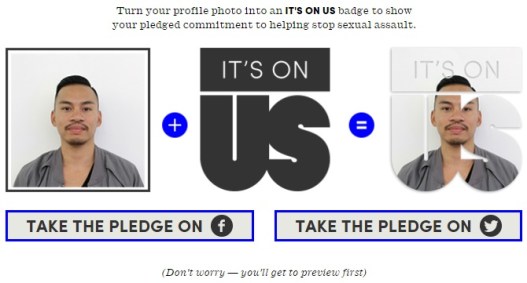
It's On Us - Rape Culture - Sexual Consent - Oscars - Joe Biden

The idea that college campus rape can be prevented by mandatory sexual consent workshops, “raising awareness” or taking online pledges in a blaze of self-promotion is utterly ludicrous. Nobody who has been raised since childhood to disrespect women or act in a sexually entitled and bullying way is going to be reformed or turned away from committing rape by being lectured by an earnest Social Justice Warrior. The revolution which must happen is in our homes, our morals and our family life, and will not be accomplished through lectures from the stage of the Dolby Theatre in Los Angeles.

But words are very much the SJW tool of choice, and the extent to which language is being weaponised in furtherance of a certain narrow agenda again became much clear later in the Oscars ceremony.

The BBC reported:

And oh, were there causes! A whole smorgasboard of enlightened liberal issues, as if everyone thought they had to live up to the tone of noble chastisement set by the diversity issue. Lady Gaga, seated at a starkly lit white piano, sang ’Til It Happens to You, the song she wrote for the campus-rape documentary The Hunting Ground, and though it’s a lugubrious number, her goggle-eyed manner seemed like an attack on the audience.

The movement for transgender rights was propped up by several mentions of the forward-thinking phrase “gender confirmation surgery”.

This, of course, is in relation to the film “The Danish Girl”, the biographical portrayal of the life of Lili Elbe, one of the first recipients of sex change surgery, who transitioned from male to female.

Eddie Redmayne’s Oscar nominated performance was by all accounts outstanding, and the issues raised about the prejudice, discrimination and abuse suffered by many transgender people are real and worthy of serious discussion. But this cannot come at the expense of our language and our shared perception of reality, and unfortunately the attempt to shoe-horn the new phrase “gender confirmation surgery” (as opposed to gender reassignment surgery) into the Oscars ceremony does just that.

You may recall attempts in the more conservative, right-wing media over the past decade to re-name suicide bombings as “homicide bombings”. This seemed to stem from the feeling that to focus on the suicide of the perpetrator gave undue prominence to the terrorist and detracted from the victims, which was of particular concern to conservative news outlets covering terrorist attacks against Israel and the West.

Unfortunately, the phrase “homicide bombings” also sows confusion, obfuscates reporting and makes it much harder for people to understand what has taken place. All bombings (or all successful ones, anyway) are homicide bombings by definition, since their purpose is to kill people. But not all bombings also involve the deliberate suicide of the perpetrator in the explosion. This is a characteristic unique to suicide bombing, and is what makes it distinct from, say, the IRA’s bombing of the 1984 Conservative Party conference in Brighton, England, where the bomber set the explosive device a month prior to the attack and was well out of harm’s way when it took place.

Regular bombing versus suicide bombing – an important distinction in terms of terrorist tactics is mirrored and emphasised by a difference in language. In the case of suicide bombing, the language rightly calls our attention to the unique aspect of that style of attack. Calling it “homicide bombing” makes such attacks indistinguishable from any other terrorist attack, and actively decreases our understanding. Some conservatives believe that this mangling of language is nonetheless desirable in order to express our particular disapproval of suicide bombing. Most sensible people would scoff at such a fatuous and superficial idea.

And this is exactly what we saw take place on stage at the Oscars last night. Not a suicide bombing, thank God. But an attempt to forcibly change the language we use, stripping away the most descriptive part of a commonly used phrase like “gender reassignment surgery” by substituting the word “confirming” instead, in order to bestow our further approval on the act.

Prevailing sentiment dictates – quite probably correctly – that transgender people are born into the wrong bodies, and that surgery which physically changes their genitalia and appearance is therefore merely correcting a mismatch between physical reality and mentally experienced reality. But now, it is no longer politically correct to talk about somebody changing their gender through means of surgery, because that sounds too drastic. Now we must say that the surgery merely “confirms” their existing, mentally experienced gender. Surgically removing a penis and creating an artificial vagina can no longer be described truthfully as a medically significant and life-changing physical alteration, but merely a “confirmation” of someone’s inner being.

Regardless of one’s thoughts about transgender issues, there should be no disputing that forcibly mutilating our shared language just to signal our approval or disapproval of an act – at the expense of clear meaning – is not merely an act of wishful thinking, trying to conjure a new reality by stating it loudly enough, but is also a bleakly totalitarian way to approach the issue. And yet this, too, was preached to us during the Oscars ceremony.

All in all, it was quite an evening.

White privilege-shaming in nearly every segment. Sexual consent shaming from no lessa figure than the Vice President. All capped off with a deliberate attempt to wrest control of the English language, bending it away from reality and toward to the will of the Social Justice Warriors and their remarkably intolerant form of tolerance.

And this is just Hollywood – that bastion of progressive opinion – talking to itself, preaching fervently to the choir.

If this is what they are prepared to inflict on themselves, God only knows what forms of indoctrination, shaming and corrective punishment lie in store for the rest of us.


OscarsSoWhite - Academy Awards - Social Justice - Virtue Signalling - 2

Agree with this article? Violently disagree? Scroll down to leave a comment.

Follow Semi-Partisan Politics on TwitterFacebook and Medium.

The SNP Government Is Unilaterally Creating Its Own Foreign Policy

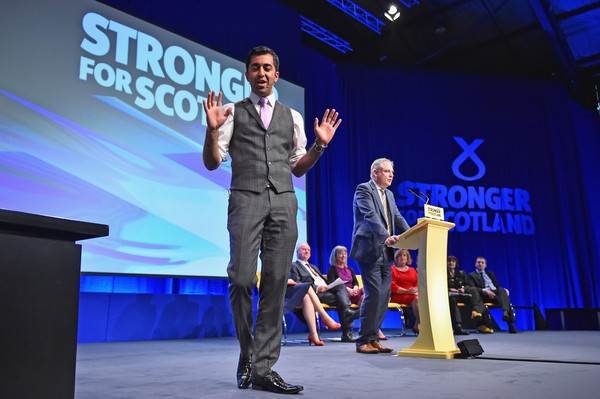
Humza Yousaf - Scottish National Party - SNP - Foreign Policy

Grandstanding SNP politicians do not have the right to unilaterally set British foreign policy

In a concerning report by the Herald Scotland, it transpires that the SNP government north of the border is attempting to create its own mini foreign policy, not aligned with nor cleared through the Foreign and Commonwealth Office in Westminster.

More concerning still, the fact that the Foreign Office quite rightly asked the Scottish government to cease and desist from this irresponsible behaviour is being portrayed as the real scandal, rather than Nicola Sturgeon’s back-of-an-envelope attempt at statecraft.

From the report:

The Foreign Office in Westminster is demanding to vet Scottish Government dealings with other countries on human rights, according to correspondence seen by the Sunday Herald.

The UK foreign minister, James Duddridge, has asked the Scottish international development minister, Humza Yousaf, to clear all his letters to foreign governments with the UK government before raising concerns about human rights infringements and other matters.

The move has infuriated Yousaf. “It beggars belief that the Tories – who are in the midst of scrapping the Human Rights Act – want to vet the Scottish Government’s letters raising human rights concerns abroad,” he said.

“I am proud of the SNP raising concerns about human rights without fear or favour – and certainly will take no lessons from the Tories on this,” he added.

“Whilst we are happy to share correspondence with Westminster, as we have done to date as a matter of courtesy, we certainly will not be asking or seeking permission before raising legitimate concerns about human rights.”

And for context:

Yousaf wrote to Duddridge and the Malawian High Commission, Kena Mphonda, on December 16 2015 raising concerns about the arrest of two Malawian nationals, Cuthbert Kulemela and Kelvin Gonani, for alleged homosexual offences.

Duddridge replied on January 7 2016, saying that following representations from the UK government, charges against the two men had been dropped. “You mention that you have written to the Malawian High Commissioner on this matter,” he wrote.

“While it may be useful that the Malawi High Commission is aware of your concern about this issue, I would be grateful if correspondence with governments on human rights and other reserved matters be cleared through this department.”

There is no grey area or room for interpretation here – this was a completely irresponsible act on the part of the devolved Scottish government. Foreign and defence matters are reserved to the UK government and Westminster parliament as you would expect in any country even remotely based on the principle of subsidiarity. It is not the job of any of the devolved assemblies – in Wales, Scotland, Northern Ireland or indeed England, if there was one – to enter into sensitive diplomatic correspondence with other sovereign nations.

Imagine for a moment that one day California or Texas decided to start acting as an independent agent on the world stage, raising all manner of issues with foreign governments, and maybe even negotiating their own trade deals or bilateral arrangements. The federal government in Washington, D.C. would rightly never tolerate such an arrangement, as it would undermine the very sovereignty and credibility of the United States. The same goes for Scotland.

Whether the SNP government had a point is immaterial. In this case, the SNP and their buccaneering international development minister Humza Yousaf (again, a role which should not exist in a Scotland which remains part of the UK) are probably on the right side of the issue. Malawi has a very concerning record on LGBT rights and the persecution of individuals, and the concerns raised were valid. But being right on this one occasion does not validate the wholly offensive principle of Scotland creating its own mini foreign policy behind the UK’s back.

In typical virtue-signalling SNP fashion, Yousaf tries to fold this issue into their pitched battle against the Heartless Evil Tories in Westminster, saying he will “take no lessons from the Tories” on human rights. But this isn’t about human rights. It is about the structure and proper running of our country. If we now establish the principle that self-regarding Scottish politicians can make interventions like this with foreign countries, what is to say that they cannot one day scupper a sensitive trade, security or intelligence negotiation by blundering onto the scene and undermining the UK’s position?

Even if the Scottish government happens to be right, any differences of opinion on foreign policy matters should be discussed and settled behind the scenes, so that the UK government can speak with one voice. Anything else will see the UK mercilessly divided and conquered by our foreign negotiating partners.

The Scottish people voted in 2014 to remain part of the United Kingdom on the understanding that certain additional domestic powers would be devolved from Westminster. Whether or not you believe that the UK government has delivered on those pledges, at no time was the idea of an alternative Scottish foreign policy raised for debate. There was no expectation that the Scottish government should be an independent actor on the world stage any more than the governor of Iowa or Texas can sign treaties with North Korea.

But as with so many other matters, a repeat of instances like this can only be prevented if we decide once and for all what kind of country we want to live in, and how the various parts of it should work together. And that means holding a constitutional convention as soon as possible. Given the approaching EU referendum, some time shortly after 23 June would seem to be a good time.

If we are to truly resolve the roiling questions about the future of the United Kingdom and our democracy and settle these issues for a generation or more, we need to collectively agree a fair and equitable devolution of powers to the four home nations on an equal basis. The question of whether England is treated as a home nation or a group of regions is of secondary importance, though this blog strongly believes that for true parity, England must be treated as a single entity just like Scotland. But this discussion must take place soon, within the wider context of a full constitutional convention.

Such a convention would give us the opportunity to debate and agree which powers should properly reside at each level – the federal UK government in Westminster, the devolved assemblies in the home nations, and county and town councils. We can simultaneously reform our legislature, ideally making the House of Lords democratically elected and ejecting the Lords Spiritual so that Britain no longer ranks alongside Iran as the most prominent technical theocracy in the world.

If this all seems ambitious and unlikely, then this is only a failure of our imagination. There is no good reason why we should not have such a debate (well, there is one reason – the future of the monarchy – which will be discussed in a future blog post). And as Pete North argues, why should we not be ambitious in terms of the future governance of our country?

Do nothing, and we can be sure that more of these instances will occur in the future, with ambitious Scottish politicians looking to make a name for themselves and burnish their human rights, national security or trade credentials by taking advantage of our lack of a written constitution and designing their own far-reaching roles on the world stage, with no oversight and no accountability.

Enough. No more SNP diplomacy by numbers. Whether they happen to be right or wrong on a given issue, for so long as Scotland is part of the United Kingdom, diplomacy and foreign policy should be a reserved matter for our shared government in Westminster and not hijacked by the Scottish nationalists.

That is the settlement which the people of Scotland signed up for in the 2014 referendum, and that is what they should now get.

UK Scotland Flags

Agree with this article? Violently disagree? Scroll down to leave a comment.

Follow Semi-Partisan Politics on TwitterFacebook and Medium.

Brexit: How Much Democracy Would You Sacrifice To Reduce Uncertainty?

Brexit - European Union - Democracy - Uncertainty - 3

How much democracy would you give away in the hope of greater short term stability?

Our glorious leader has taken to the pages of the Sunday Telegraph today to offer his standard stump speech, talking down Britain’s prospects as an independent country.

Focusing exclusively on the (mostly) short term costs of Brexit whilst determinedly overlooking the costs of remaining in a relentlessly integrating political union, David Cameron warns:

A year ago, the Conservative election manifesto contained a clear commitment: security at every stage of your life. Britain is doing well. Our economy is growing; unemployment is falling to record lows.

We need to be absolutely sure, if we are to put all that at risk, that the future would be better for our country outside the EU than it is today.

There is no doubt in my mind that the only certainty of exit is uncertainty; that leaving Europe is fraught with risk. Risk to our economy, because the dislocation could put pressure on the pound, on interest rates and on growth. Risk to our cooperation on crime and security matters. And risk to our reputation as a strong country at the heart of the world’s most important institutions.

And in other utterly astounding and headline-worthy news, a group of finance ministers from the world’s leading economies released a statement yesterday, sombrely declaring that Britain leaving the European Union would represent an economic shock.

Or as the Telegraph tells it:

The global economy will suffer “a shock” if Britain votes to leave the European Union, the world’s 20 leading nations have warned.

In a joint statement, finance ministers from the G20 group of major economies unanimously agreed that the risk of “Brexit” posed dangers for international stability.

George Osborne, who is attending the meeting of central bankers and ministers in China, said the danger of a Leave vote on June 23 would represent one of the gravest threats of 2016.

In what will be seen as a coded attack on Boris Johnson, who is campaigning to leave, he added that the leaving the EU would not be “some amusing adventure” but a serious threat to Britain and the world.

Well, that’s it then. Quest for democracy and self-governance cancelled. Call off the referendum and put away all those naive thoughts of Brexit, because the world financial markets don’t like the idea very much, and what’s best for an American hedge fund manager automatically trumps your right to self determination.

Why, oh why do those awful eurosceptics and Brexiteers persist with their alarming and selfish calls for an end to undemocratic, unaccountable, supra-national government? Can’t they see that they are creating economic uncertainty? Won’t somebody please think of the children?

This, by the way, is the same George Osborne who insisted that “we rule nothing out” when it came to possibly campaigning for Britain to leave the EU, until the conclusion of the so-called renegotiation. This opens up the hilarious thesis that while the Chancellor of the Exchequer believes that Brexit would be unspeakably traumatic for Britain and for the world economy, he was nonetheless prepared to recommend that we quit the EU and flirt with so-called disaster, had Britain not secured that precious reminder that we are already under no obligation to adopt the euro (one of our renegotiation “victories”).

If George Osborne is so desperate to warn us that Brexit would not be an amusing adventure, why was he willing to publicly countenance Britain leaving the EU in the event that he and David Cameron failed to win their puny basket of concessions from Brussels? If Britain leaving the EU would inevitably be such a disruptive and traumatic event, why did they insist that nothing was off the table if they didn’t get what they wanted?

But put all of that to one side. The more fundamental question we have to ask ourselves is whether we are happy for every key decision about our civic life to be determined purely by economic forecasts. And not necessarily detailed or well researched forecasts at that, but rather by unverifiable assertions about fickle market sentiment – which inevitably prioritises the short term over the long term, and which can put a price on risk but not on democracy.

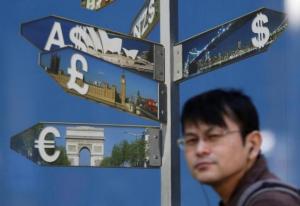
A man walks past various currency signs outside a brokerage in Tokyo
The EU apologists in the Remain camp will throw their hands up in mock horror at this statement, but it is true: some things – like democracy – are more important than money.

In fact, you can tell a lot by observing the times when EU apologists and left-wingers earnestly listen to the voice of big business and the far more frequent occasions when they demonise the “greedy” corporate world. To point out the naked confirmation bias at play here is hardly necessary.

As this blog commented some time ago, when HSBC was making dark murmurings about potentially upping sticks and leaving Britain in the event of Brexit:

Isn’t it funny how the voice of big business – usually the object of scorn and hatred from the left – suddenly becomes wise and sagacious when the short term interests of the large corporations happen to coincide with those of the Labour Party?

Labour have been hammering “the corporations” relentlessly since losing power in 2010, accusing them of immoral (if not illegal) behaviour for such transgressions such as not paying enough tax, not paying employees enough money, paying employees too much money and a host of other sins. In Labour’s eyes, the words of a bank executive were valued beneath junk bond status – until now, when suddenly they have become far-sighted and wise AAA-rated pronouncements, just because they have come out in support of Britain remaining in the EU.

The ability of the British people to determine their own future does not appear as a line item on any company’s balance sheet or P&L account, so of course large corporations – as represented by the minority of FTSE 100 chief executives who recently signed a letter arguing against Brexit – do not care whether the people in their home country live in a functional democracy.

Most businesses are just as happy to make money from operating in oppressive autocracies as it is in free democratic countries; nobody is investing in China out of admiration for that dictatorship’s record on human rights. And indeed it is not the job of corporations to make such value judgements, or to safeguard the constitutional frameworks that hold this or any other country together.

That job falls to our politicians, people who should be able to distinguish corporate self interest from the national interest. And who should be able to distinguish between serious macroeconomic upheavals based on a fundamentally worsening economic outlook and short-term macroeconomic shocks based on spooked markets and jittery investors.

Of course Brexit might cause shock waves and be disruptive in the short term. One of the largest and most influential countries in the world would be leaving the most prominent supra-national political union in the world, and it would be concerning if such an event took place without causing a ripple of attention. But potential economic uncertainty is not the point, and neither is it a sufficient reason to fearfully remain in the EU in perpetuity while overlooking the profound and irredeemably anti-democratic nature of the club.

In fact, one can go further and argue that it is the tremulous fear of uncertainty – and our apparent preference for technocratic risk-minimisation at every turn and in every aspect of our lives – which has sucked the ideological contrast out of our contemporary politics and done so much to encourage voter apathy.

Pete North picks up on this point in an excellent blog post, in which he argues that a little uncertainty might actually be a very welcome development:

This is why the EU sucks. We can have any government of any stripe so long as it performs within a set of predefined parameters and does as it is told. How very dull. In dispensing with democracy we have dispensed with politics and in place of politics we have civic administration where everything is merely about the allocation of resources. Where’s the big idea?

We have heard from every politician the same vague promises about returning power to the people and restoring localism, but we’ve heard it from ardent europhiles who do not see the inherent contradiction in their empty words.

By excluding the people from decision making we have killed off social innovation and enterprise, we have beaten the life out of our education system and where our health system works it is more through luck and the application of cash than actual managerial skill. It is little wonder that business looks overseas for skilled individuals in that our schools are micromanaged to the point of insanity, beating the vitality out of teachers so that children are neither engaged nor educated.

Put simply, there is no longer any uncertainty in politics. The corporates have got their own way. They keep saying if we leave the EU, it will cause uncertainty but that’s actually exactly what we need. We do need some uncertainty that causes to re-engage in politics and to learn more about civic participation and steer decision making. We need some political risk taking so that we can innovate. It might mean a lot improves and it might mean some things break down. But wouldn’t that be more tolerable than the interminable beigeness of modern, post-democracy Britain?

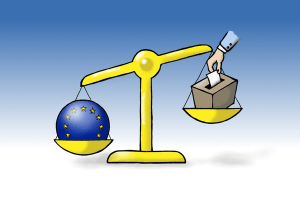
And ultimately, it comes down to that one question: what price does the Remain camp put on democracy?

If the EU is frustrating and imperfect (as all but the most starry-eyed europhiles concede) but leaving would simply be too great a risk, where then is the tipping point? At what point do the negative consequences of gradually but relentlessly losing control over the decisions which affect our lives outweigh a brief wobble in the FTSE 100 or a few sleepless nights for central bankers? And if we have not already reached this tipping point, those who argue for us to stay in the EU have a moral responsibility to tell us where they do draw the line.

Europhiles, particularly those on the political Left, love to portray themselves as progressive and enlightened warriors, fighting for freedom and security for the little guy. Well, here is a blazing example of them doing exactly the opposite in real life.

Given the choice in this referendum to stand up for the right of the poorest and most disadvantaged citizen to exert some limited measure of control over their government by campaigning for Brexit and repatriating sovereignty from Brussels, instead the EU apologists would condemn us to yet more political union with Europe. And all because to do otherwise would go against the wishes of finance ministers, central bankers and certain chief executives. Way to fight for the average citizen!

Risk and uncertainty are not dirty words. And while our prime minister seems to believe that we are a nation of frightened children who are terrified of making important decisions and who instinctively run away from the slightest risk, I choose to hope that there are still enough of us who realise that the EU’s anti-democratic status quo is not the best option for Britain’s future, that David Cameron’s sham renegotiation has done nothing to change that basic calculus, and that a brighter and more democratic future could await us if we dare to ignore the many vested interests and take bold action.

David Cameron went to the country at the general election last year offering a Big Government, nanny state “plan for every stage of your life”. He now asks us to trust that the future he has carefully planned out for us – one of sheltered irrelevance, tucked away in an anachronistic 1950s regional political union – is the best that modern Britain can hope for.

This referendum provides the opportunity for British citizens to show that we hold our country in much higher regard than does our own prime minister – and to help consign David Cameron, together with our EU membership, to the dustbin of political history.


EU Democracy - Brexit

Agree with this article? Violently disagree? Scroll down to leave a comment.

Follow Semi-Partisan Politics on TwitterFacebook and Medium.

Can I Get A Prescription For My Chronic Europhobia On The NHS?

Europhobia - Euroscepticism - EU Referendum - European Union - Leave Campaign - Stereotypes

When will they invent a cure for euroscepticism?

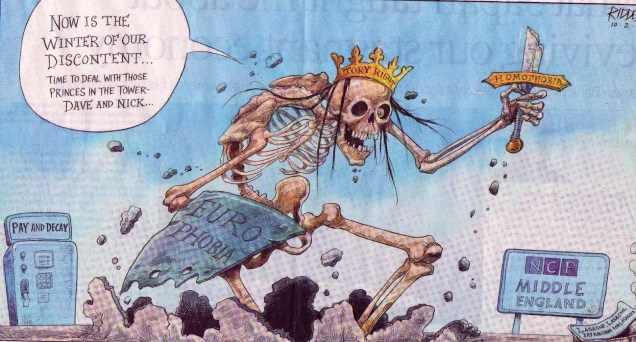
Well, it’s official. Caring about democracy, taking an interest in how we choose to govern ourselves and thinking like an engaged citizen rather than a terrified consumer are symptoms of madness, or a highly contagious disease of some kind.

Dan Hodges laments:

Boris Johnson is mayor of the world’s greatest capital city. He is currently the bookies favourite to be next prime minister of the United Kingdom. And yet the madness has claimed him too.

As it must claim anyone who signs up to the Out campaign’s cause. Because insanity is not a by-product of the Out campaign. It is at the core of its offer.

For Out to win they know they must first destroy reason. They must convince a majority of mature, rational British adults that we should withdraw from our largest, most profitable trading block just at the very moment the world is teetering on the brink of another global recession. They know they must convince them of the wisdom of turning our back on our most important diplomatic partnerships just as Vladimir Putin is casting his malign eye westwards. They know they must convince them the Britain should attempt to face – in isolation – the most significant refugee crisis and terror threat since the war.

And so to do that, they are trying to spread the contagion. Not though rational argument. No[t], actually, through fear. But simply by trying to drag an entire nation through the looking glass. To convince us all to see the same upside down world they see whenever the hear the name “Europe”.

And concludes, hopefully:

This is what this debate is doing to otherwise sane, intelligent people. It is literally making them incapable of confronting the realities of the world we face in 2016. They are being forced to flee through time, back to the windswept beaches of France, or the dusty hilltop forts of the Raj.

And there, huddled round their camp fires, belting out another lusty rendition the Eton Boating song, they will lose. The voters are hardly enamoured of Europe. They are concerned by immigration, and creeping ECHR restrictions. They have a healthy lack of respect for Euro officialdom. A few still hanker for a prawn cocktail crisp.

But they look at the Out campaign, and they know. They look at those advocating withdrawal, and they can sense it. An inflection in the voice. A glint in the eye. They can see they are afflicted with The Fever.

Soon it will be over. Britain will vote. Britain will vote to remain In the European Union. And then, hopefully, our friends will be returned to us.

I’m going to do something I almost never do, and let this one pass without comment. Because although I profoundly disagree with Dan’s view of Brexit, when it comes to the way the major Leave campaigns jostling for official designation are conducting themselves, there is absolutely nothing I can say in their defence.

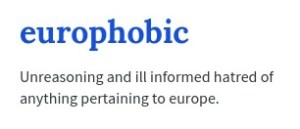
It is hard to fight back against the trope that dissenting from European political union by stealth is equivalent to the pathology of “Europhobia” when some people – either losing sight of the grand prize or never having understood it in the first place – are determined to live up to their own worst stereotypes.

One quick suggestion, though. If we are indeed to remain “friends” once this bitterly contested referendum is over, it might be wise for those on the Remain side to stop pathologising their opponents.

Europhobic - Europhobia - Brexit - European Union - EU Referendum

Euro - European Union Flag

Agree with this article? Violently disagree? Scroll down to leave a comment.

Follow Semi-Partisan Politics on TwitterFacebook and Medium.