UKIP’s Weakness, Brutally Exposed

matt adams bike


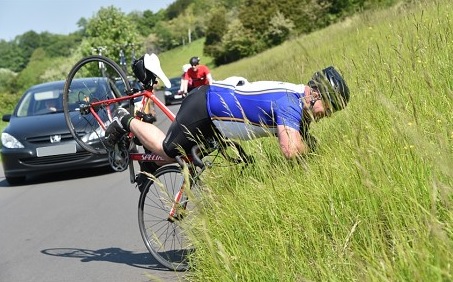
The Telegraph has been carrying the amusing but unfortunate story of charity cyclist Matt Adams, who swerved off the road and dived head-first into the long grass after taking his hands off the handlebars of his bike to strike a victory pose for a photographer. There could be no better analogy for UKIP’s fortunes over the past five days, with the long asphalt road representing the election campaign and the wayward bicycle as the party’s newfound trajectory following a series of stunning self-inflicted wounds.

Conventional wisdom has it that following his contentious interview on LBC radio last week in which he made sweeping and deeply unpleasant generalisations about Romanian immigrants, Nigel Farage has lit a long fuse to the dynamite underneath his political career. The interview – which Farage’s chief aide tried at one point to halt – can be seen in its entirety here:


The blowback, even from fellow eurosceptics and normally reliable media sympathisers, has been intense and unrelenting, with even The Sun publishing an editorial denouncing Farage’s comments as ‘racist’. The nation’s opinion columnists cannot agree on precisely how soon UKIP will founder, but a strong consensus says that it is only a matter of time.

For this, neither Nigel Farage nor the party he leads deserve sympathy. Such is the degree of euroscepticism within the country, the level of pent-up rage against the political establishment and the smug deafness of the main political parties that a strong showing for UKIP in the coming elections was all but assured – and, until recently, deserved.

In fact, because few voters pay attention to LBC radio interviews or the post-game coverage in the wider press, the party may actually avoid facing the real consequences until after Thursday’s European and local council elections, by which time the narrative could have changed in their favour. But when reality finally catches up with UKIP, no one will be able to say that it was undeserved.

Up until now, normal, non-racist UKIP sympathisers have largely been able to cling on to the narrative that while there may be some unpleasant and noisy individuals at the margins of the party, their principles remain solid and the leadership strong. But Nigel Farage’s image of calm, steady leadership has taken a justifiable beating over the weekend, and while UKIP supporters may abide instances of nastiness or foolishness coming from isolated candidates at the fringe, it is asking a lot to expect them to look the other way when the very same misdeeds are being committed at the top.

Nigel Farage’s “car crash” interview has effectively combined with the antics of the fruitcake fringe to trap UKIP’s more moderate supporters – fervent eurosceptics or libertarians without a racist bone in their bodies – in a pincer movement, and they now find themselves very exposed to the blanket charges of racism and xenophobia emanating from hostile media outlets such as the Guardian and the Huffington Post.

The sad thing is that Farage & co. have been here before, but clearly failed to learn the lessons from their last foot-shooting extravaganza.

At UKIP’s last party conference in September 2013, delegates were enjoying buoyant poll numbers and a period of unexpectedly benign press coverage when one rogue MEP, Godfrey Bloom, managed to spoil it all for everyone by making sexist comments at a fringe event, and then hitting a journalist over the head with a conference booklet while making his escape from the scene.

Instantly, the tone of the press coverage changed and any conceivable bounce from the conference was lost. No-one summed up the feeling of frustration within the party at the time better than Nigel Farage himself, who said in his closing speech:

There have been once or two incidents today … There is no media coverage of this conference. It’s gone. It’s dead. It’s all about Godfrey hitting a journalist and using an unpleasant four-letter word. It’s gone. And we can’t – put – up – with – it. And I said to you earlier, we cannot have any one individual – however fun or flamboyant or entertaining or amusing they are – we cannot have any one individual destroying UKIP’s national conference, and that is what he’s done today, and I’m sad about that, but we can’t tolerate it and we have to act.

The anger and frustration was real and visceral then:


Strong words, and yet Nigel Farage has effectively managed to equal Godfrey Bloom’s feat of self-sabotage a mere eight months later, and just days away from what could be UKIP’s pivotal moment. Will Farage now turn that same withering, critical analysis on himself?

UKIP does not have a deep bench of political talent from which they can draw in times of emergency or turmoil. They have no one else as charismatic as Nigel Farage, no one cannier with the press, no one better at putting out (or genially dismissing) the various fires that the party’s lesser candidates so frequently start. But can UKIP abide this eleventh-hour implosion from their leader?

The media’s coverage of UKIP, like the political establishment’s attitude toward the party, was never anything close to being fair and balanced. But the slurs and accusations that UKIPers complained about just last week are nothing compared to what comes now. As far as getting any kind of message out via the mainstream media goes now, it’s game over. UKIP is a racist party. Euroscepticism is just racism repackaged. Libertarians are in bed with racists. It has already started.

UKIP may yet emerge from this latest self-inflicted crisis relatively unscathed. There may be too little time between Farage’s gaffe and polling day for the impact to feed through to peoples’ voting intentions. UKIP could yet win the European election, in which case the narrative and news agenda will completely change, allowing UKIP to find their feet – until the next campaign, when the video and audio footage will be unearthed by every hostile journalist in the country.

Even in this best-case scenario for UKIP, the LBC interview is an urgent reminder that they simply cannot go on existing in the public consciousness as a one-man party, where Nigel Farage alone serves as chief executive, chief political strategist, chief policy architect, chief salesman and chief damage repair technician.

This twenty minute radio interview, this “car crash”, also reminds us that some of UKIP’s principles – euroscepticism, libertarianism, that fervent anti-establishment spirit – are too important to be entrusted to any one single person, even the leader.

The British voters deserve a eurosceptic, libertarian party that they can vote for in good conscience and without fear of unintentionally consorting with or abetting racists, while moderate UKIP supporters deserve to be able to watch the evening news without constant fear or trepidation of the next scandal about to beset them.

Whether Thursday’s elections bring triumph or disappointment for UKIP, there are now many serious questions to be answered. The party’s weaknesses have been brutally exposed under the unceasing glare of media scrutiny and through calamitous self-inflicted crises. And without new faces and the immediate jettisoning of the party’s nasty rhetoric on immigration (and the block of undesirable votes that come with it), things will only get worse.

When the cyclist Matt Adams plunged headfirst from his bicycle off the road and into the verge, he hopped back on the seat and continued riding, thinking that he had “got away with it” – until he crossed the finish line and realised that he had become a minor internet celebrity. The internet always remembers. People always remember. And the electorate will remember how nasty UKIP managed to make themselves look over the course of the past week, not just when they vote on Thursday but also when the more important general election takes place in 2015.

Whatever the result of Thursday’s European elections, UKIP – and respectable British euroscepticism – will now be stuck in damage control mode for many months to come.

EU’s Google Ruling Undermines Freedom Of Information

Google ECJ data ruling

The European Court of Justice, in another inspired ruling, has effectively declared that EU citizens have the right to request that Google delete undesirable search results which may portray them in a negative light.

With astonishing disregard for freedom of information and a troglodyte’s grasp of modern technology and its administration, the court held that there are certain circumstances when an individual may petition Google (and presumably other search engines) to delete links to various sites which contain information deemed false, obsolete or irrelevant.

Supporters of this backward and anti-democratic move might argue that Google search results function in a similar way to road signs, and that just as a city has a responsibility to remove road signs that point to closed routes or demolished visitor attractions, so a responsible search engine should prune its records to remove links to outdated information. And this neat analogy almost holds together.

Nearly, but not quite. The difference, of course, is that Google search results point to information on the internet that is still very much in existence and potentially of great importance. Forcing Google to remove search engine results is akin to a city deciding that a prominent building should be removed from local maps because it has fallen into disrepair and become an eyesore. The building remains, and it is in the interests of many people that its whereabouts remain public knowledge, whether or not it causes embarrassment for the city council or town planners.

Already a growing list of people with shady pasts are coming forward with petitions to Google, in the hope of wiping the digital slate clean of their past misdeeds, as the Telegraph reports:

Since it was introduced, more than 1,000 people have asked Google to remove links to unfavourable stories. They include a former MP seeking re-election, a man convicted of possessing child abuse images and 20 convicted criminals.

But more concerning than the granting people the ability to falsely curate the digital history of their lives for potentially nefarious purposes, the court’s decision places a human being at Google – or wherever the decision over which records should be removed is ultimately taken – in the role of moral arbiter of what information is still ‘accurate’ or ‘current’, and what information the public has a right to know. No human being or committee should be vested with such power, least of all one that hears petitions from people or institutions with overriding personal reasons to meddle with the perception of their past.

(Even the publication of false information, after all, becomes a matter of historical fact when it takes place, potentially an important one – such as cases of libel or political misstatement – which should be preserved for easy reference by future scholars, historians or lawyers.)

Furthermore, the court’s ruling shows complete and utter contempt for the ability of human beings to filter good information from bad, and accurate data from the misleading. Even if it were the case that erroneous information about a person’s criminal past or business dealings existed online, people are equipped with the mental faculties to check and verify the information before acting on it. The court’s opinion holds the human capacity to reason in such scant regard that it effectively decides it must be the job of someone – Google, the courts, the Truth Committee, anyone – to filter our reality before we observe it, lest we find ourselves being mislead.

Mark Weinstein forcefully sums up the argument against the ruling in the Huffington Post:

No company or entity should be able to build an online persona about us from the privacy of our actions and searches. Nor should anyone be able to erase legally documented history just because they find certain information unflattering. This is separate from the absolutely needed right to be able to remove my own personal posts or tagged photos of me posted by others.

One might expect that a ruling of this magnitude might prompt a response from the Prime Minister, but as is so often the case with matters of principle, David Cameron disappoints:

Asked by the Telegraph whether the ruling had any implications on freedom of speech, Mr Cameron replied: “I haven’t actually had a lot of time to look at this issue, so maybe I will have to get back to you on that.

“The basic principal that your information belongs to you is a good one, but I haven’t had a careful look at this, so I have to give you a considered answer another time.”

He added: “There you go – a politician who doesn’t know all the answers.”

It should not require many long nights spent poring over philosophical treatises and legal documents in order to form an opinion about the ECJ’s regressive ruling, but at least David Cameron is able to make a joke out of his total lack of conviction. For this blog, by contrast, the matter is quite clear-cut.

Our shared ideal of freedom and democracy requires as its aspiration (albeit never fully realised) the free and unfettered access to information on which to base our opinions and decisions. Establishing a precedent which says we cannot be trusted to distinguish current information from the obsolete, the relevant from the irrelevant, the true from the false, and setting up an intermediary system to do the job for us – which is what the European Court of Justice has so outrageously done – places the ECJ on the same morally repugnant ground as the internet censors of North Korea and the architects of the Great Firewall of China.

The people of Europe do not need the European Court of Justice, Google or anyone else to limit the scope of their information world. The justices wildly overstepped the mark, and should be condemned in the strongest possible terms.

Note: The Guardian has a good explainer on the case which can be read here.

More Reasons For UKIP’s Popularity

Winston Churchill Texas

The commentariat class continue to scratch their heads in puzzlement as to how UKIP’s support is not melting away in the face of wall-to-wall attacks from the media and the political establishment, and this blog continues to patiently explain why this is the case.

Well, for those who obstinately refuse to learn, here is yet another reason – Labour and the Conservative Party have given a clear demonstration of their ideological muddle by both hiring former Obama campaign officials to help with their respective 2015 general election messaging efforts.

First Labour (whose rollout of former Obama senior adviser Axelrod went hilariously badly):

Ed Miliband hailed the appointment as “excellent news” and predicted the strategist would be a “huge asset to our campaign as we work to show the British people how we can change our country for the better”.

Mr Axelrod said he had been struck by the power of the Labour leader’s ideas and the “strength of his vision”.

He drew a comparison between Mr Miliband’s economic policies and the arguments articulated by Mr Obama in 2008, saying both have at their core “the experience of everyday people”.

And then the Conservatives:

The Conservatives have also recruited another former adviser to Barack Obama, his ex-campaign manager Jim Messina, to work on their 2015 election team.

As with Mr Axelrod, Mr Messina is not leading the campaign on the ground but remains in the US, reporting to the Conservatives’ senior management team.

It is common knowledge that the Britain sits well to the left of the United States on the political spectrum, so in one sense it is not surprising that an American Democrat such as Axelrod might still find common cause with Britain’s centre-right party (he wouldn’t be caught consorting with a Republican in a million years).

But in another sense, it is a terrible indictment of the British political system that both main political parties – our two ‘polar opposites’, the alpha and the omega of our choices come election day – are either so intellectually bankrupt or coldly calculating that they can both recruit from same same American political talent pool and still present themselves to the British public as though they are different as chalk and cheese.

Intellectually bankrupt or coldly calculating. In truth, there is a fair measure of both at work in the Labour and Conservative parties. Both have followed the example of ‘triangulation’ pioneered so successfully by Bill Clinton, in order to win over the undecided middle while hanging on to just enough of their restive core voters to make it over the finish line.

Tony Blair’s New Labour certainly took the triangulation strategy and moulded it into a political work of art. But make no mistake, the Conservatives are at it, too. Even when accounting for the fact that they have governed only in coalition since 2010, the fact that they have allowed harmful defence cuts and continued encroachments on civil liberties while largely tolerating Labour’s legacy of tax hikes and fiscal drag shows that they, too, see more value in playing to the woolly undecided voters in the middle than making a convincing ideological case for their core principles.

Which brings us back to Nigel Farage and UKIP.

Say whatever else you like about them, but here is a party that has a set of core beliefs and is unafraid to articulate them plainly and simply. (If you are reading this and thinking “but surely all UKIP stand for is leaving the EU, with a portion of racism on the side” then you have been indoctrinated well by the media who have slavishly served the interests of the main political parties – but UKIP do actually have a broadly libertarian policy platform that can be easily researched).

Leaving aside the coming European elections on Thursday 22 May, UKIP’s increasing (and surprisingly solid) popularity is not just a function of the British people having nowhere else to meaningfully express their euroscepticism or their dislike of politicians in general (the protest vote). It is driven also by the fact that conviction politics is all but dead in Britain, leaving many thoughtful and politically aware people with no one who speaks their language, but a host of politicians willing to patronise and double-cross them to gain votes, before discarding them once they are delivered into power.

Tony Benn and Margaret Thatcher are no longer with us, and British politics is suffering the absence of them and their kind. The few conviction politicians left in the House of Commons tend to be curmudgeonly old men and women (think Glenda Jackson or John Redwood) whose prime days are behind them and who will never be brought back in from the margins. And this leaves the political future to be shaped by the oily likes of Ed Miliband in the labour party (with young guns such as Chuka Umunna or Gloria de Piero to look forward to when he is inevitably deposed), and Cameron-Osborne for the Tories.

So forget about the European Union and the Newark by-election. Forget about the mudslinging and accusations of racism from one side and intimidation from the other. In many ways, it’s all just noise, the kind of nonsense we are left to argue about when there is so little left to distinguish the three main political parties from each other when it comes to real life policy.

When Labour and the Conservatives are so indistinguishable that they both instinctively look to buy Barack Obama’s 2008 message of “hope and change” from across the Atlantic, is it any wonder that the only party with an authentic, home-grown message is reaping the rewards in the polls?


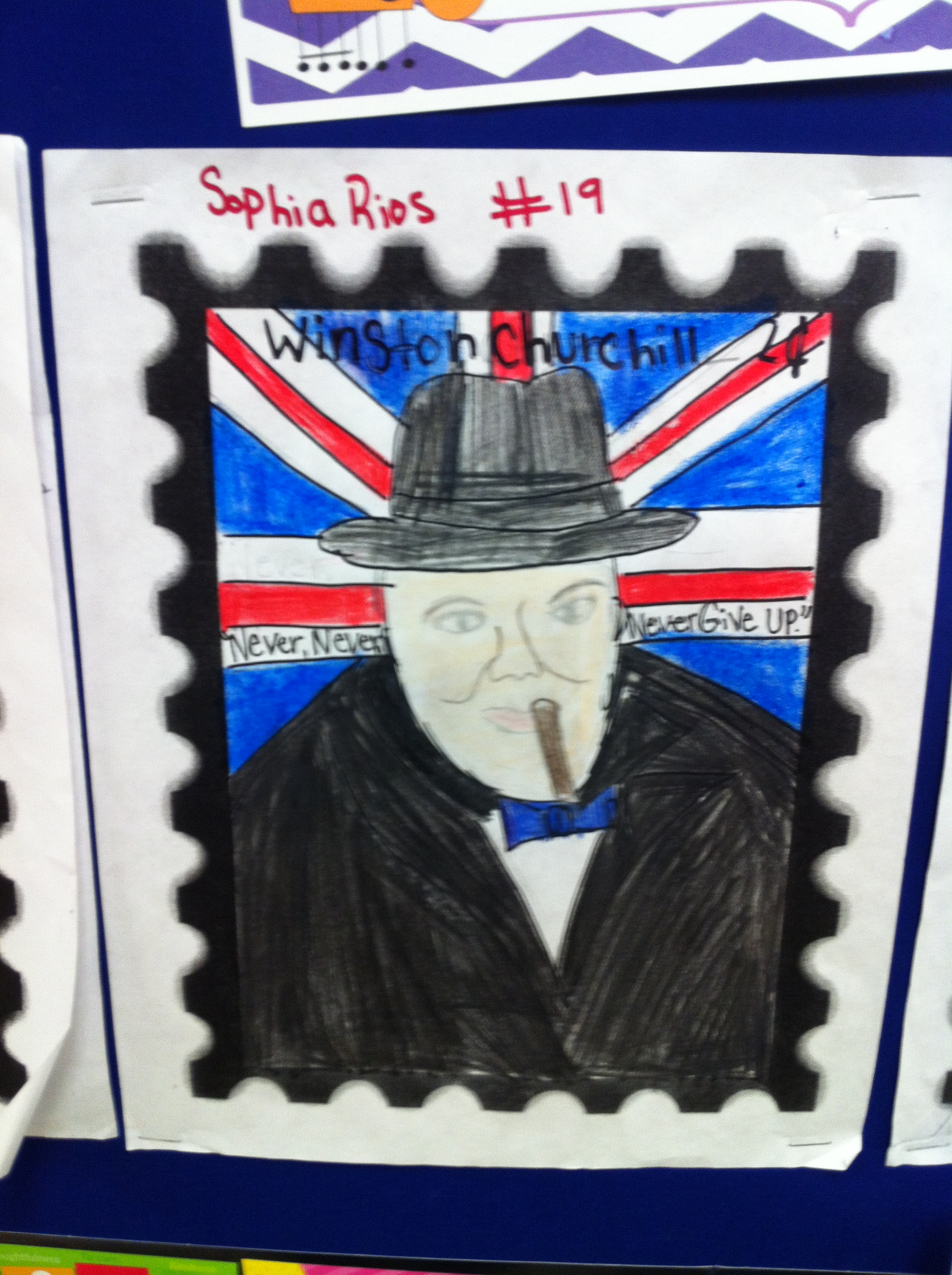
Picture: Student drawing from an elementary school in Texas

Gunning For UKIP

Guardian UKIP attack


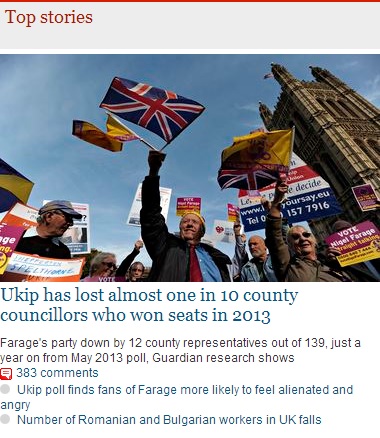
This is a screenshot of the Guardian’s top political stories taken from their website at 00.54 on Thursday 15 May, one week before election day.

All three leaders are attacks on UKIP in one guise or another. The first article points out that UKIP has experienced an unusually high degree of defections and resignations from the ranks of its 2013 intake of local councillors. The second basically suggests that UKIP supporters are paranoid and ignorant hillbillies to the last man, while the third deconstructs UKIP’s talking points on immigration from Romania and Bulgaria.

The concern is not that the Guardian’s stories necessarily lack truth or validity. But it is glaringly apparent from the choice and placement of the stories on the homepage – to the total exclusion of any other coverage – that there is a concerted effort underway at the newspaper to chip away at UKIP’s credibility and support. Given the dearth of articles analysing Conservative, Labour or Liberal Democrat policies it is clear that the newsroom’s finite resources are being used disproportionately to undermine the insurgent party, whilst allowing the established parties (even the hated Tories) almost completely off the hook.

Note also what is entirely absent from The Guardian’s political coverage of the local and European elections, not just tonight but over the course of the campaign as a whole:

No coverage of the latest polling numbers and UKIP’s strength vis-a-vis the established political parties.

No probing or questioning of the Labour and Liberal Democrat stance, which is to refuse the British people a referendum on continued membership of the European Union, despite the widespread public support for such an in/out debate.

No discussion of the ‘state of the union’, i.e. the budget, the misuse of EU funds, the incidences of corruption and the increasingly pervasive influence of corporate lobbyists in Brussels.

No discussion of proposed EU-wide financial transactions taxes, their pros and cons and their likely impact on the City of London and the overall UK economy.

No discussion for the parallel campaign for the presidency of the powerful European Commission.

A visitor to the Guardian’s website might reasonably conclude that the main three national political parties in Britain have inexplicably gone into hibernation, and that UKIP have been given the run of the house. But while it is certainly the case that UKIP have consistently provided the most attention-grabbing stories (thanks in large part to policies with grassroots appeal and a leader who doesn’t have to practice looking genuine in front of the mirror every morning), it is unforgivable for a national newspaper to so thoroughly abdicate its responsibility to cover the also-rans.

The Guardian prides itself on having a readership that is a cut above the rest in terms of book smarts, education and general worldliness. But even accounting for their audience’s generally left leaning stance – let’s not deny anyone their political biases and preferences – you would think that among these luminaries there might be some basic level of curiosity about what the other parties (you know, the ones who actually have MPs and win elections) are up to this election season.

Not that this lack of curiosity provides an excuse – even in its apparent total absence, a political editor might think to include an article or two on the policies and strategic positioning of the other parties, just as a byproduct of doing their job properly. And yet the Guardian (and many others) are content to follow the heard and serve up a constant stream of anti-UKIP sentiment to the exclusion of everything else.

For anyone still wondering, this right here is the reason why UKIP remain in contention this election season, despite the unremitting volley of negative press coverage (yes, some of it self-inflicted) and attacks from all sides of the political spectrum:

The Guardian – not to mention the leaders of the three main political parties – seem to have forgotten two rather endearing truths about the British people for whom they claim to work and speak. Firstly, the British cannot abide a bully, and anyone with even a modicum of sympathy for any of UKIP’s positions is likely to feel that the party has been unfairly singled out for criticism.

But secondly and most importantly, we British love an underdog. You can sense Nigel Farage’s frustration and impatience every time one of his improperly-vetted candidates or publicity-seeking spokespeople says something outrageous or defects in a blaze of negative publicity. One gets the impression that UKIP’s leader is fighting a solitary David and Goliath-style battle against the establishment and against the odds, very much alone. And as the immature party apparatus creaks and groans around him as it tries to fight a national campaign, one catches oneself rooting for the man. Or at least, 31% of the voters do.

When the European elections have taken place and the dust settles, much will be written and wondered aloud about how UKIP performed as well as they did given the unified forces ranged against them. Responsibility will be parcelled out, to the great recession for making people dissatisfied, to the expenses scandal for making people distrustful of mainstream politicians, to the people themselves for being credulous fools with borderline racist tendencies.

In short, the blame will be placed everywhere but the one place that it most belongs – at the feet of the smug, left-liberal bloc and their terrified counterparts on the right, who are witnessing a groundswell of legitimate dissatisfaction and demand for change from the British people, but see only a pesky political mosquito to be swatted out of existence.

The ‘Tolerant’ Millennials Who Hate Free Speech

commencement protest


When is it okay to invite a controversial current or former public office holder to speak at a college commencement (graduation) ceremony, and when does issuing such an invitation imply acceptance and endorsement of that person’s every action and decision whilst in office?

This question is coming up a lot, primarily in the United States, as the ‘old guard’ of politicians and appointed officials who held the reigns of power during the post 9/11 wars in Afghanistan and Iraq, and who were at the helm during the financial crisis and great recession, approach retirement and seek to secure an income in retirement while simultaneously shaping their legacies.

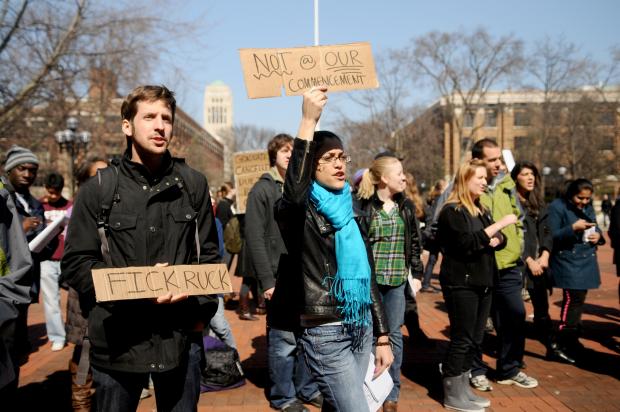
Earlier this month it was former US Secretary of State Condoleezza Rice in the headlines, pressured to withdraw from her engagement giving the commencement speech at the Rutgers University commencement ceremony after extensive student pushback at her selection, culminating in a sit-in protest. Her offence was to have been a member of the second Bush administration, and her public advocacy for the Iraq war. But now the forces of retroactive censorship have claimed a new victim – Christine Lagarde, head of the IMF.

Olivia Nuzzi at The Daily Beast reports:

Christine Lagarde, head of the International Monetary Fund, has decided not to serve as commencement speaker for Smith College’s May 18, 2014 graduation, after students started a petition protesting her selection.

The petition—which boasts 483 signatures (less than half of their goal of 1,000)—states that although they “do not wish to disregard all of Ms. Lagarde’s accomplishments” and they “recognize that she is just a good person working in a corrupt system” they do not want to “encourage the values and ideals that the IMF fosters.” 

While falling over themselves to add caveats and backhanded praise for Lagarde, the activists make clear that her particular views had become unpopular and were not to be heard at their institution. Never mind the prestige of hosting a high-profile guest and never mind those students who were perfectly happy to hear from her – the vocal, outraged activists successfully manage to parry away a threatened intrusion from the nasty world of realpolitik.

These developments – and the two mentioned here are only the most recent – raise some important questions about the polarising of America along political and cultural lines, academic censorship and the ability of the current generation to listen to alternative viewpoints.

In the case of Condoleezza Rice, her viewpoint – in favour of war, supportive of the Bush administration – was commonplace in America for the majority of the Bush presidency. Are all those who once thought as Rice thought now persona non grata at Rutgers University? Or perhaps it is just those who could be considered ‘thought leaders’, those who influenced and shaped the public debate at the time who are to be singled out. In which case, how far removed does one have to be from the centre of decision-making to avoid being rendered untouchable by America’s universities?

The case of Christine Lagarde is even more perplexing. As head of the International Monetary Fund, she clearly represents the ideals and goals of that organisation. But so do a solid majority of mainstream politicians from both parties, including some very popular ones in academic circles – such as Bill Clinton or Barack Obama – who would be welcomed with open arms and festooned with honorary degrees.

MassLive adds some detail about the petition-signers:

“Utterly disgusted that Smith has chosen to host someone from the IMF, an organization that has proven itself to be nothing but imperialistic, ineffective, and oppressive,” wrote one woman who signed the online petition.

Another woman who identified herself as a graduating senior wrote: “It was in a Smith classroom that I first learned about the problems that the IMF has wrought on the Global South, and how those problems have affected women’s lives for the worse.”

And here’s the problem. The activists disagree – strongly and sincerely – with the policies and worldview of the speaker. Fair enough. But somewhere along the way they have been led to believe that they have the right to filter out any views or opinions that they find objectionable, causing them to turn their displeasure into calls for the speakers to be banished.

At one time, student activists would have relished the opportunity to see their nemeses take the stage at a high profile event on their campus, perhaps taking the opportunity to hold an inventive protest or at least to offer up a choice heckle or two. Are today’s millennials really so precious and coddled that they cannot even tolerate the presence of dissenting opinion, devoid of the ability or drive to engage with contradictory viewpoints when they appear?

This attitude – and the howls of the “how dare you invite someone who disagrees with me politically to speak at my graduation” – resembles nothing less than the Facebook-isation of academia and the real world, where people with different or troublesome views can simply be blocked, defriended or “disliked” until they fall off the collective radar and cease being a nuisance on our newsfeeds.

But what is possible in the world of social media is not necessarily desirable in the real world of bricks-and-mortar educational establishments. Academia requires debate and argument in order to thrive, and by so publicly banning many of the past decade’s movers and shakers, the student bodies and faculties concerned are cutting themselves off from the possibility of benefiting from the insight of these recent historical figures. Simultaneously, they are doing nothing to help counter accusations from the American right that elite universities are inherently hostile to conservatives and conservative thinking.

Sometimes the arguments against hearing from the big beasts of the past are more persuasive and complex. Take the case of former Vice President Dick Cheney, desperate to cement his hawkish neo-conservative legacy in a positive light and willing to do whatever it takes to make that happen. The always-astute Andrew Sullivan keeps a close watch on Cheney’s continued public and media briefings since leaving office and is convinced that the likes of Cheney are engaged in a deliberate effort to recast their horrific actions and decisions in a positive light. In such cases, an argument could be made that it is best to invite such people to speak only in the context of debates (where other participants with opposing views could question and challenge the speaker, and vice versa) rather than bestowing the prestige and carte blanche of a commencement address invitation.

Ultimately, when considering whether to invite a controversial figure from the past – whether it’s a peddler of discredited economic theories, a proud and unapologetic torturer and warmonger or anything else in between – a balance has to be struck between ensuring that the purpose of the event will not be disrupted, that something of interest will be said, and that issuing the invitation will not play into the hands of any ulterior motive that the invitee may have. This type of sober and reasoned discussion does not lend itself to an emotionally manipulative e-petition or Facebook campaign.

No one is asking Condoleezza Rice or Christine Lagarde to hand out the best picture statuette at the next Academy Awards. If, through their own actions, politicians and public figures make themselves pariahs at the hip parties of Hollywood or the parlours of Washington D.C., that is their unfortunate lot and they can take it up with George Clooney.

But it is worrying that many of our students and academic institutions are so eager to impose their own layer of self-administered moral censorship on top.