On Dissent In The Mainstream Media

Not in Abby Martin's name
Not in Abby Martin’s name


Glenn Greenwald, now writing for The Intercept, makes a very good point about journalistic integrity in the context of the ongoing Russian invasion and occupation of Crimea.

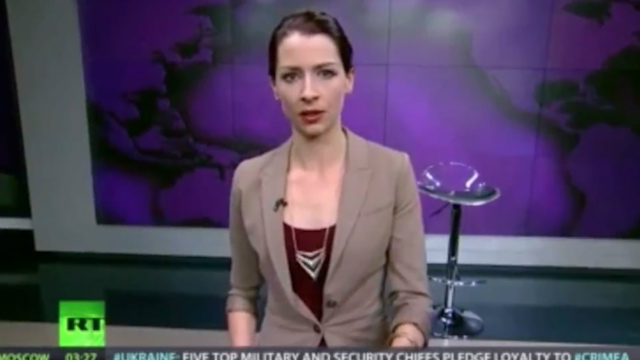
In the midst of this developing story, one of the anchors at Russia Today, the Kremlin-funded English-language news channel presenting a Russian perspective on the world, made news of her own by denouncing Russia’s actions at the end of her segment. The clip is available to view here:


The money quote is this:

I can’t stress enough how strongly I am against any state intervention in a sovereign nation’s affairs. What Russia did is wrong. I admittedly don’t know as much as I should about Ukraine’s history or the cultural dynamics of the region, but what I do know is that military intervention is never the answer. And I will not sit here and apologise or defend military aggression.

Greenwald wonders aloud how so many of those voices condemning Russia for invading a sovereign country can do so with a straight face when they themselves agitated for, or were apologists for the US-led war in Iraq:

Enthusiastic supporters of a wide range of other U.S. interventions in sovereign states, both past and present and in and out of government, are equally righteous in their newfound contempt for invasions – when done by Russia. Secretary of State John Kerry – who stood on the Senate floor in 2002 and voted to authorize the invasion of Iraq because “Saddam Hussein [is] sitting in Baghdad with an arsenal of weapons of mass destruction” and there is “little doubt that Saddam Hussein wants to retain his arsenal of weapons of mass destruction” – told Face the Nation on Sunday: “You just don’t in the 21st Century behave in 19th Century fashion by invading another country on completely trumped-up pretext.” The supremely sycophantic Face the Nation host Bob Schieffer – as he demanded to know how Russia would be punished – never once bothered Kerry (or his other Iraq-war-advocating guests, including Defense Secretary Chuck Hagel and Washington Post columnist David Ignatius) by asking about any of that unpleasantness (is it hard at all for you to sermonize against invasions of sovereign countries given, you know, how often you yourself support them?)

This is just as true for the press as it is for television talking heads or armchair generals. As Greenwald shows by quoting the example of CBS’s Bob Schieffer, the implicit assumption in many questions asked by television news hosts in America (and indeed in Britain) is that the invasion is unprecedented, wrong and contrary to international law. And while the invasion is indeed all of these things, this same level of proper journalistic scepticism was mysteriously missing when we were the aggressor.

Indeed, those few brave American media personalities who did speak out against the impending invasion of Iraq, and who dared to question the legitimacy of the Bush Administration’s every unconstitutional action, soon found themselves banished to the western journalistic equivalent of Siberia. Well known journalists or personalities such as MSNBC’s Phil Donohue and Ashleigh Banfield certainly felt the consequences, as Greenwald points out in an addendum to his piece:

Both Donahue and Arnett were fired because of their opposition to the U.S. war. Arnett was fired instantly by NBC after he made critical comments about the war effort on Iraqi television, while a memo from MSNBC executives made clear they were firing Donahue despite his show being the network’s highest-rated program because he would be “a difficult public face for NBC in a time of war”.

During that same time, MSNBC’s rising star Ashleigh Banfield was demoted and then fired after she delivered a stinging rebuke of misleading pro-war TV coverage by U.S. outlets, while Jessica Yellin, at MSNBC during the time of the war, admitted in 2008 that “the press corps was under enormous pressure from corporate executives, frankly, to make sure that this was a war that was presented in a way that was consistent with the patriotic fever in the nation and the president’s high approval ratings” and that executives would change stories to make them more pro-war.

While it is too soon to determine the medium-longer term impact of Abby Martin’s words on her career at RT, the contrast between this act of journalistic independence on a news channel so close to the Kremlin and the recent history of the American (and British) news media is sobering and discomforting. Though the post-PATRIOT Act consensus is finally starting to fray given the recent NSA scandals and revelations, at a crucial period in American history significant dissent or journalistic scepticism was almost entirely absent from the domestic press.

That is not to say that press freedom in America/Britain and Russia are in any way comparable – despite a worrying background noise of increasing official encroachments, regulation and intimidation, the press is far more free in America than in Russia, and any sane journalist would wish to operate in the former climate rather than the latter.

But while infinitely preferable to homogenised Russian state propaganda, western media has shown itself capable of being bullied into self-censorship on occasions, be it the panicked urge to appear ‘acceptably’ pro-war and support the policies of George W. Bush in 2003 or the far more recent insidious suggestion by David Gregory in 2013 that journalists who report on leaked classified information should consider themselves co-conspirators.

As always, before climbing atop the highest parapet and waving the Stars and Stripes or the Union Jack, we would do well to re-examine our own recent, tarnished history – be it our history of military intervention abroad or journalistic coverage of those adventures.

Doing so will not make Russia’s egregious actions in Crimea any more palatable or legitimate, but it will at least allow us to look Russia in the eye as we denounce them.

The Middle Class Needs Relief Too

Too many people paying too much.


David Skelton, director of the campaign group Renewal, has penned a provocative article for The Telegraph in which he dares to suggest that the 40% rate of income tax should be scrapped because it punishes the hard-working middle class rather than skimming off superfluous income almost unnoticed from the ultra-rich.

This is a bold move given that most of the political focus is currently on helping the lowest-income earners by increasing the tax-free allowance again and again. And while the current approach certainly has merits, it is undeniable that the middle class has received far less support.

It may have been quite right to begin means-testing child benefit – this blog certainly thinks so, as the first step toward ending universal benefits which simply should not exist. But actions such as this, while correcting discrepancies, anomalies and moral wrongs in the tax code, were not accompanied by countervailing efforts to lower the overall tax burden. This is where Skelton’s proposal shows its value.

Skelton writes:

It is also important for the Government to help middle income earners who have played such a big role in making sacrifices during the recession and in reducing the budget deficit. George Osborne should take a major step to unwind the undesirable drift towards an ever higher proportion of the working population paying higher rate tax. In doing so he could relieve the pressure on the squeezed middle, so many of whom have borne the burden of paying for Labour’s profligacy.

His proposal would see more than two million people taken out of the higher rate tax band:

A number of Tory MPs have argued that the Chancellor should look to raise the higher rate threshold to £44,000. Our proposal at Renewal would go much further, taking many more people out of paying the 40p rate while simplifying the tax system. We believe he should scrap the 40p rate and start the 45p rate at a much higher level of income. 

Potentially, this could take more than two million people out of higher rate tax, giving a significant tax cut to the squeezed middle.

The retention of the punitively high 45% top rate of income tax is the only unwelcome part of the proposal, but was clearly included to keep the break-even point at what was considered a politically palatable level. But aside from this regrettable acceptance of Gordon Brown’ final act of economic vandalism before being kicked out of office, Skelton’s proposal is very strong.

It is long past time to address the fact that the 40% tax band now includes a very different sort of person to the type envisaged when the rate was set by chancellor Nigel Lawson. As Skelton rightly notes:

More and more people on middle incomes have been dragged into paying the 40 per cent rate of tax over the past decade. That includes teachers, nurses, bricklayers, police officers and Tube drivers. These are not people who should be in the higher rate tax bracket but are because the threshold at which it is paid has been repeatedly frozen. 

The number of people paying 40p tax has risen steadily from just over 1.7 million in 1993/4 to 4.4 million in the current tax year. That is a staggering one in six of taxpayers, up from one in 20 when Nigel Lawson was Chancellor.

Quite right. A person on around £40,000 a year in the early 1980s was far more affluent than someone on that same salary today. But cowardly government after cowardly government have deliberately chosen not to increase the tax rate threshold in line with inflation, bringing this whole new cast of characters into a tax realm originally intended for those who were genuinely, comparatively rich.

The chances of this proposal becoming concrete policy remain slim, however. As James Kirkup notes in the Telegraph, the increasingly boisterous and assertive Liberal Democrats are intent on defending the laser-like focus on raising the minimum tax threshold above all other ideas:

Increasing the basic threshold has been driven by the Liberal Democrats and the party’s Danny Alexander, the Chief Secretary to the Treasury, defended the focus on lower-paid workers. 

He said he “understood the argument” around 40 per cent tax, but insisted that lower-paid workers had to come first. “I think it’s right that we have a policy that is focused particularly at that part of the population.”

More worryingly still, the Conservative leadership also appears slow to embrace the idea – perhaps because it is a good piece of economic policy that originated somewhere other than Number 11 Downing Street. The Daily Mail reports:

In a major speech on the economy, the Prime Minister promised that further savings from public spending would be used to fund tax cuts.

But Mr Cameron, who confirmed the Government would accept a rise in the minimum wage to £6.50 an hour, appeared to indicate that any future tax cuts would be targeted at the low-paid.

He made no reference to raising the starting point for paying 40p tax, which is emerging as a key Budget demand among Conservative MPs.

Whether the Conservatives have any fire left in their belly to enact a genuinely useful tax cut in the face of this opposition and distraction remains to be seen, and go some way toward showing whether there really is any conservatism left in this coalition government at all.

If they do find the courage, it will be a major victory for middle class earners and for common sense.

Who Really Wants A Free Press?

MapRSF


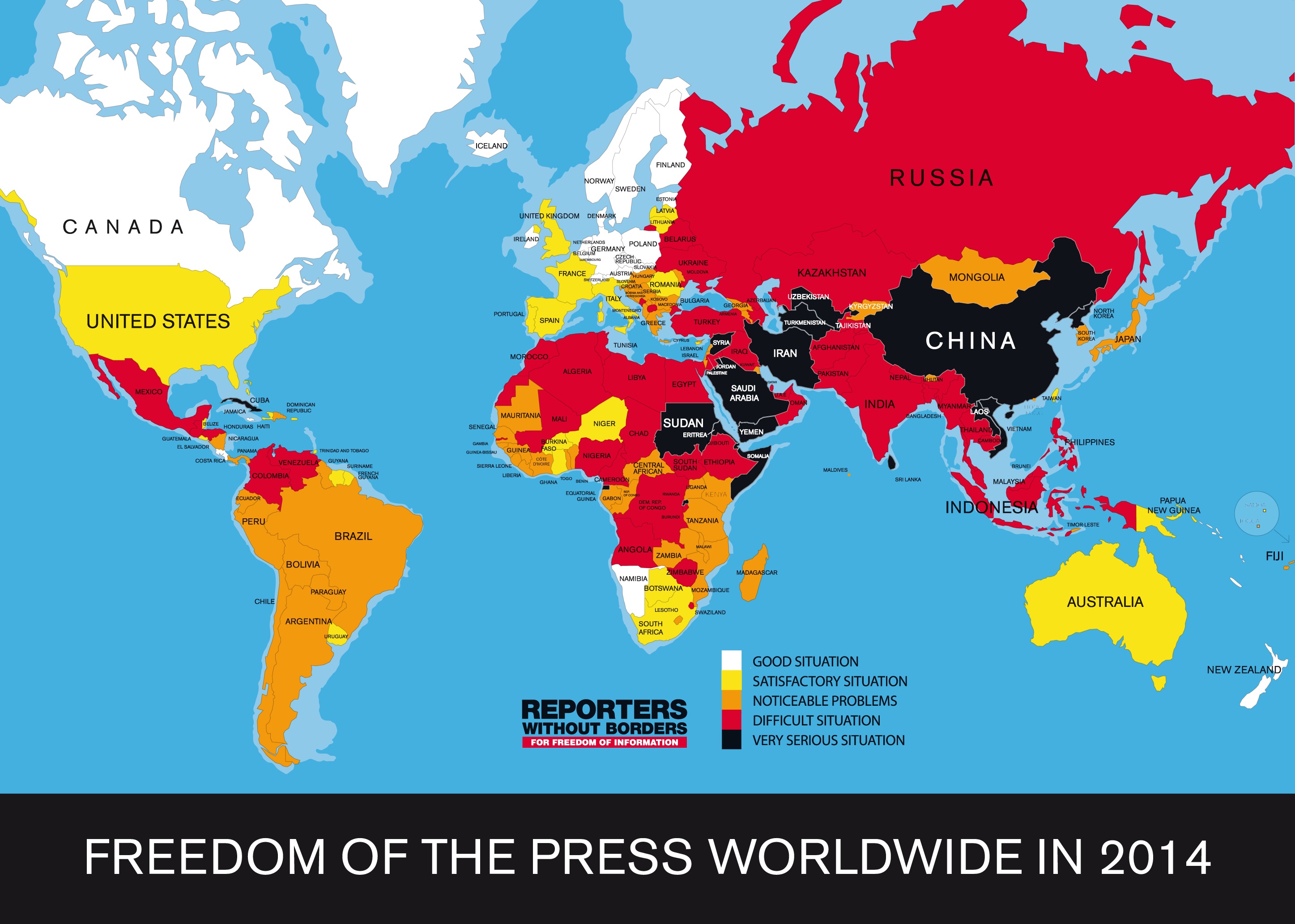
The United Kingdom has fallen from 29th to 33rd in the world in the World Press Freedoms Index 2014.

The report, compiled annually by Reporters Without Borders (RSF) is scrupulous in methodology and incorporates both qualitative and quantitative data. And for a country like Britain, which likes nothing more than to strut around the world proclaiming its comparative virtues, it makes for some dismal reading.

RSF’s summary of Britain is dominated by the British government’s chilling and bullying treatment of the Guardian newspaper as it sought to suppress the publication of information based on the NSA leaks by Edward Snowden, as well as the fallout from the Leveson Enquiry into the press behaviour and the prospect for further stultifying regulation of the industry:

In the United Kingdom, the government sent officials to The Guardian’s basement to supervise destruction of the newspaper’s computer hard disks containing information from whistleblower Edward Snowden about the practices of GCHQ, Britain’s signals intelligence agency. Shortly thereafter, the partner of Glenn Greenwald, the former Guardian star reporter who had worked closely with Snowden, was held at Heathrow Airport for nine hours under the Terrorism Act. By identifying journalism with terrorism with such disturbing ease, the UK authorities are following one of the most widespread practices of authoritarian regimes. Against this backdrop, civil society could only be alarmed by a Royal Charter for regulating the press. Adopted in response to the outcry about the News of the World tabloid’s scandalous phone hacking, its impact on freedom of information in the UK will be assessed in the next index.

Britain isn’t always called out by name, but there can be little doubt which European country was the intended target of this particularly barbed comment:

These developments showed that, while freedom of information has an excellent legal framework and is exercised in a relatively satisfactory manner overall in the European Union, it is put to a severe test in some member countries including those that most pride themselves on respecting civil liberties.

How true this is. Britain has long been (and has long considered itself) a stalwart defender of free speech, but the recent thuggish attempt to use anti-terrorism laws to detain a relative of a journalist and to threaten a national newspaper with closure unless it destroyed information which had the potential to embarrass the government are more worthy of Vladimir Putin’s Russia than the land of Magna Carta.

The New York Times, on the other hand, looks at the same report and seems to take succour from it, which is very surprising given the fact that their journalists have worked so closely with their beleaguered colleagues at The Guardian.

Their editorial board is celebrating the 50th anniversary of the landmark New York Times vs. Sullivan case, which set the bar for winning libel or defamation claims much higher than in Europe and thus created a bulwark protecting press freedom in the United States. This excerpt from the majority opinion in that case should be mandatory reading for all British politicians and those involved in public life, who are often all too keen to clamp down on free speech at the first sign of discord:

The Supreme Court voted unanimously to overturn that verdict. The country’s founders believed, Justice William Brennan Jr. wrote, quoting an earlier decision, “that public discussion is a political duty, and that this should be a fundamental principle of the American government.” Such discussion, he added, must be “uninhibited, robust, and wide-open,” and “may well include vehement, caustic, and sometimes unpleasantly sharp attacks on government and public officials.”

While the New York Times is absolutely right to recall and celebrate this landmark victory – libel laws in many other countries, especially Britain, are far too plaintiff-friendly – they seem all too willing to ignore the negative actions that have chipped away at this victory in the intervening half century, the various acts of craven self-censorship or collusion with imperial government overreach or the undermining of factfinding by the ongoing war on whistleblowers.

This selective amnesia leads to the following self-congratulatory pronouncement by the Times editorial board:

Still, American press freedoms rank among the broadest in the world. Citizens and media organizations in countries from China to India to Britain do not enjoy the same protections. In many parts of the world, journalists are censored, harassed, imprisoned and worse, simply for doing their jobs and challenging or criticizing government officials. In this area of the law, at least, the United States remains a laudable example.

The only problem with this statement? The United States ranks thirteen places behind the United Kingdom, at 46th in the world.

Fortunately for the New York Times and the reputation of the American press, the RSF world press freedom index does not take quality of journalism into account, only the ability of the journalist to practice their trade freely – otherwise they could have found themselves docked another few positions for that howler of an America-must-be-best presumption.

The truth is that neither Britain or America have anything to be proud of faced with this latest report. In an ideal world, David Cameron and Barack Obama would be held to account and hauled over the coals for presiding over such a poor performance. A backbench MP looking to bolster his or her civil liberties credentials could do worse than to ask the prime minister to defend or account for his government’s performance on press freedom at Prime Minister’s Questions this coming Wednesday.

But regrettably, a place in the mid-low 30s ranking is exactly where David Cameron, Barack Obama and many of those in power in Britain and America want their respective countries to sit. It allows for a press that is boisterous and noisy in all of the areas that don’t really matter (and so showing every outward appearance of being free), but that meekly tows the line when it comes to critical issues such as national security, civil liberties and holding those in power to account for their actions.

We in Britain or America may not think of countries such as Finland, Norway, Luxembourg or Liechtenstein as shining role models to emulate, if indeed we ever think about them at all. But in some key aspects, it is they who now carry the torch for freedom of speech and the free press, not the traditional Anglo-American partnership who held it aloft so dutifully for so long.

On Responding To Russian Aggression


Not necessarily something to be proud of, but this blog may have finally found common ground with Senator Lindsey Graham.

Politico reports that Graham has told President Obama to stop the idle threats about “costs” and “consequences”, and to regain some credibility by taking real, tangible action in the face of Russia’s invasion of Ukraine:

Sen. Lindsey Graham said on Sunday that President Barack Obama needs to “stop going on television and trying to threaten thugs and dictators.”

“It is not your strong suit. Every time the president goes on national television and threatens [Russian leader Vladimir] Putin or anyone like Putin, everyone’s eyes roll, including mine,” the South Carolina Republican said on CNN’s “State of the Union.”

Graham’s own starter for ten:

“President Obama needs to do something,” Graham said. “How about this: Suspend Russian membership in the G-8 and the G-20 at least for a year, starting right now and every day they stay in Crimea after the suspension. Do something.”

This intervention is just a condensed version of the critique and suggestions made earlier by Florida Senator Marco Rubio, who also places the emphasis on concrete actions rather than new ways to scold from the sidelines:

This is a critical moment in world history. The credibility of the alliances and security assurances that have preserved the international order is at stake. If Putin’s illegal actions are allowed to stand unpunished, it will usher in a dark and dangerous era in world affairs.

To his credit, President Obama has taken some of this advice – John Kerry is being dispatched to Kiev as an initial show of solidarity. William Hague is heading there too. That’s a good start. But it is the more tangible displays of disapproval that are now required most, from Britain, America and everyone else.

That means boycotting the Paralympic Games, freezing the overseas assets of Russian regime officials, and booting the country out of all international organisations such as the WTO and the G8. Revoking some visas and cancelling all intergovernmental cooperation on everything would also go some way to showing that Russia cannot behave in this way and expect to remain a respected part of the international community.

And if Putin retaliates by turning off the gas supply? Well, maybe the governments of Britain and Europe should have paid more attention to their energy security.