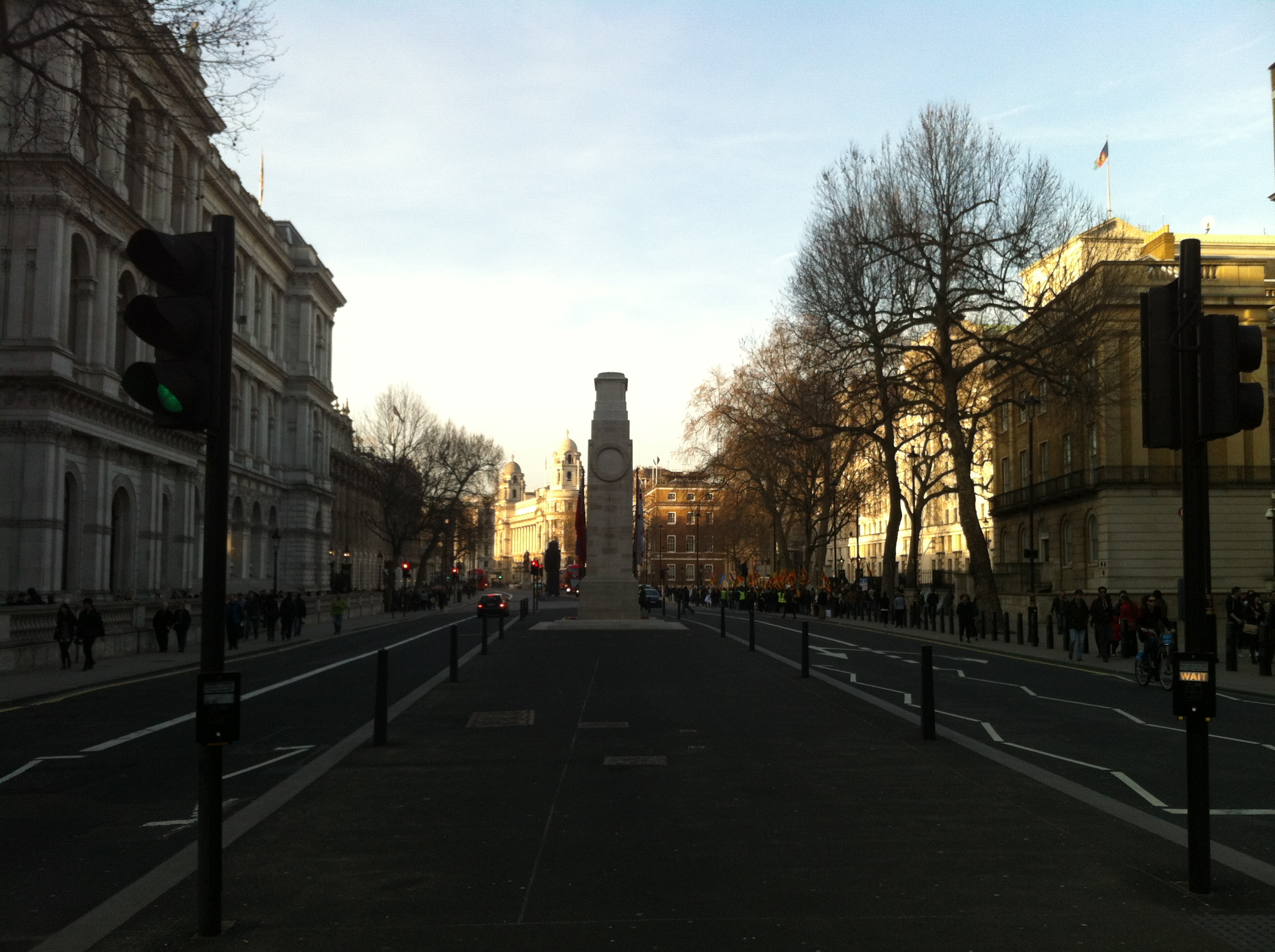
Whitehall, Westminster, London
Whitehall, Westminster, London

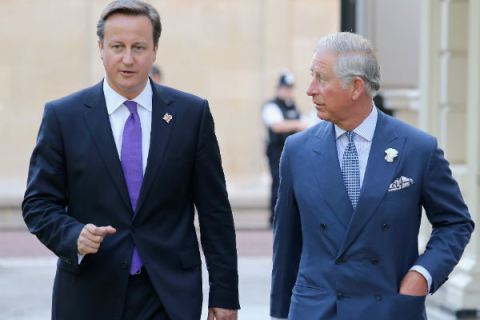
Today has seen a rare victory in the fight for government transparency and public access to information, as a judicial review ruled that the Attorney General was wrong to veto the publication of Prince Charles’ voluminous correspondence with ministers – known as the ‘black spider letters’ – and ordered that they be disclosed.
The British government fought this development every step of the way. Dominic Grieve, the Attorney General, had used his veto to keep the letters secret after a previous ruling from an independent tribunal also ruled in favour of the public interest. However, at long last the time may have come for British citizens to read what the heir to the throne really thinks about all number of government policies and positions.
The Guardian – who waged a nine year campaign for access to the letters – report on their triumph:
Grieve had said that a cornerstone of the British constitution was that the monarch could not be seen to be favouring one political party over another. But he had said that any perception that Charles had disagreed with Tony Blair’s government “would be seriously damaging to his role as future monarch because, if he forfeits his position of political neutrality as heir to the throne, he cannot easily recover it when he is king”.
The 27 pieces of correspondence between Charles and ministers in seven government departments between September 2004 and April 2005 “are in many cases particularly frank”, according to Grieve.
Dominic Grieve and the rest of the cabinet clearly take the British people for fools. Only an idiot might think that Prince Charles is politically neutral. He has pungent and forceful views across a whole spectrum of topics from climate change to modern architecture, and his PR people take every opportunity to see that these are widely reported by anyone who will listen.
Rather than treating the British people with kid gloves as though we were sensitive little children liable to burst into tears at the sight of our parents arguing, Grieve should drop his ludicrous opposition and let us finally see what the future King thinks of his government of the people.
As the Guardian notes, the prince has taken an active interest in political matters for almost as long as Prime Minister David Cameron has been alive:
The freedom of information tribunal heard that he had been writing to ministers as long ago as 1969, when he expressed concern to the then prime minister, Harold Wilson, about the fate of Atlantic salmon.
The obvious danger is that Prince Charles’s concerns – the things that make him toss and turn at night – may well have changed and grown in the intervening forty-five years, as the number of government departments that he has corresponded with would seem to attest:
The letters concerned involve ministers in the Cabinet Office and the departments responsible for business, health, schools, environment, culture and Northern Ireland.
Worrying about salmon stocks in the north Atlantic is one thing; idly musing or ranting to ministers about Britain’s energy policy or nuclear deterrent, for example, would be another matter entirely. And one gets the strong suspicion that salmon have not remained the prince’s abiding focus.
Unfortunately, the Attorney General seems in no mood to compromise or listen to the overwhelming consensus of logic and legal opinion, and plans to appeal to the Supreme Court:
A spokesman for the attorney general said: “We are very disappointed by the decision of the court. We will be pursuing an appeal to the supreme court in order to protect the important principles which are at stake in this case.”
What important principles are these, exactly, other than the right of an unelected man to bully and intimidate junior government ministers into bending their policies and actions to his will? Should this really be the top priority for Dominic Grieve and his government office?
And why is the Attorney General going to battle to protect and enshrine the ability of society’s elites – be they financial, political, media or monarchical – to not only get their way, but then to have all record of them ever having tilted the playing field in their favour sealed from public view?
Dominic Grieve may serve as a minister in Her Majesty’s Government, but he was elected to represent we the people. Like the Guardian, I want to know how much money the government has spent on legal fees fighting to thwart the will and the interests of the people who elected them.

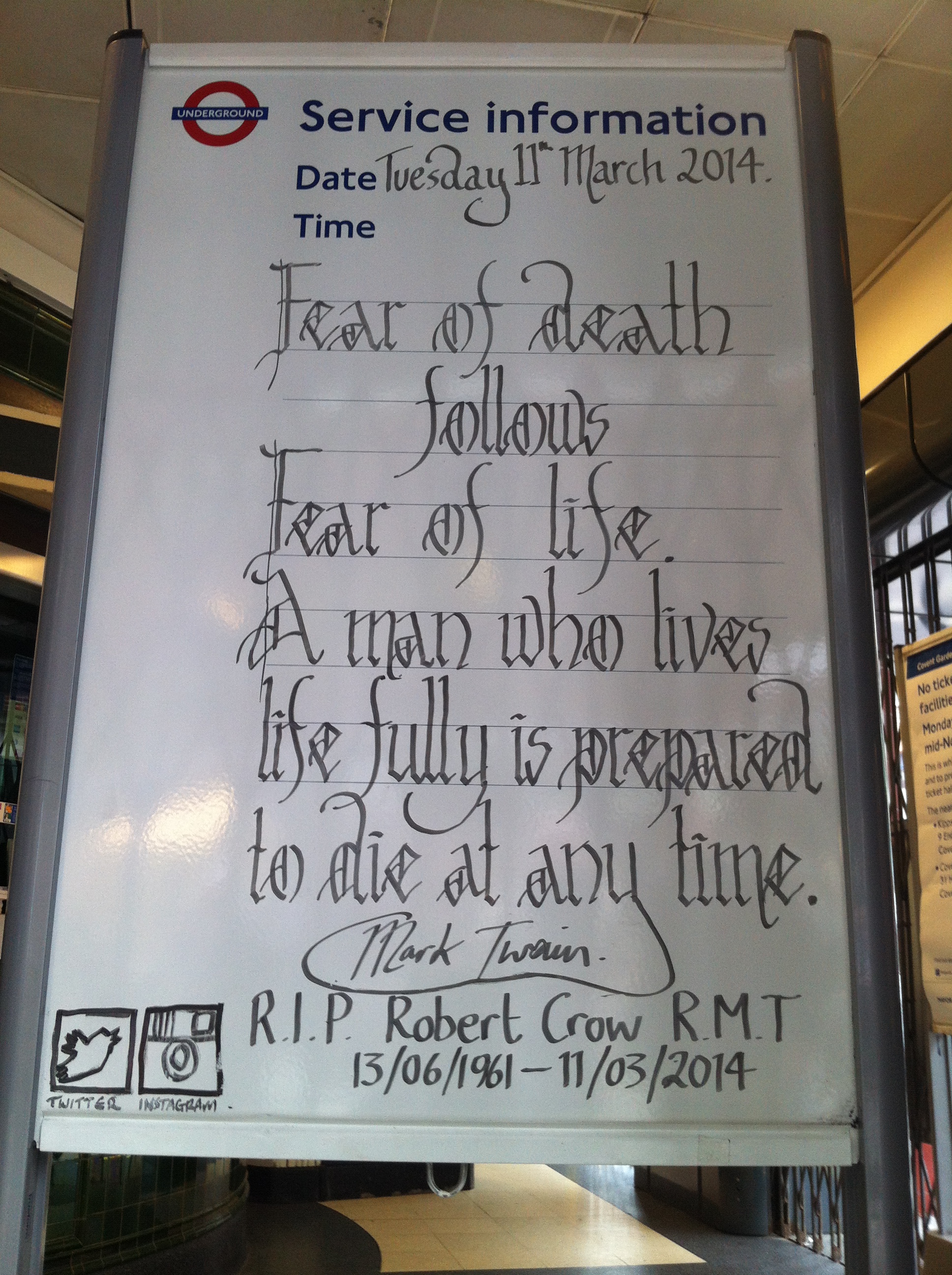
Covent Garden, London

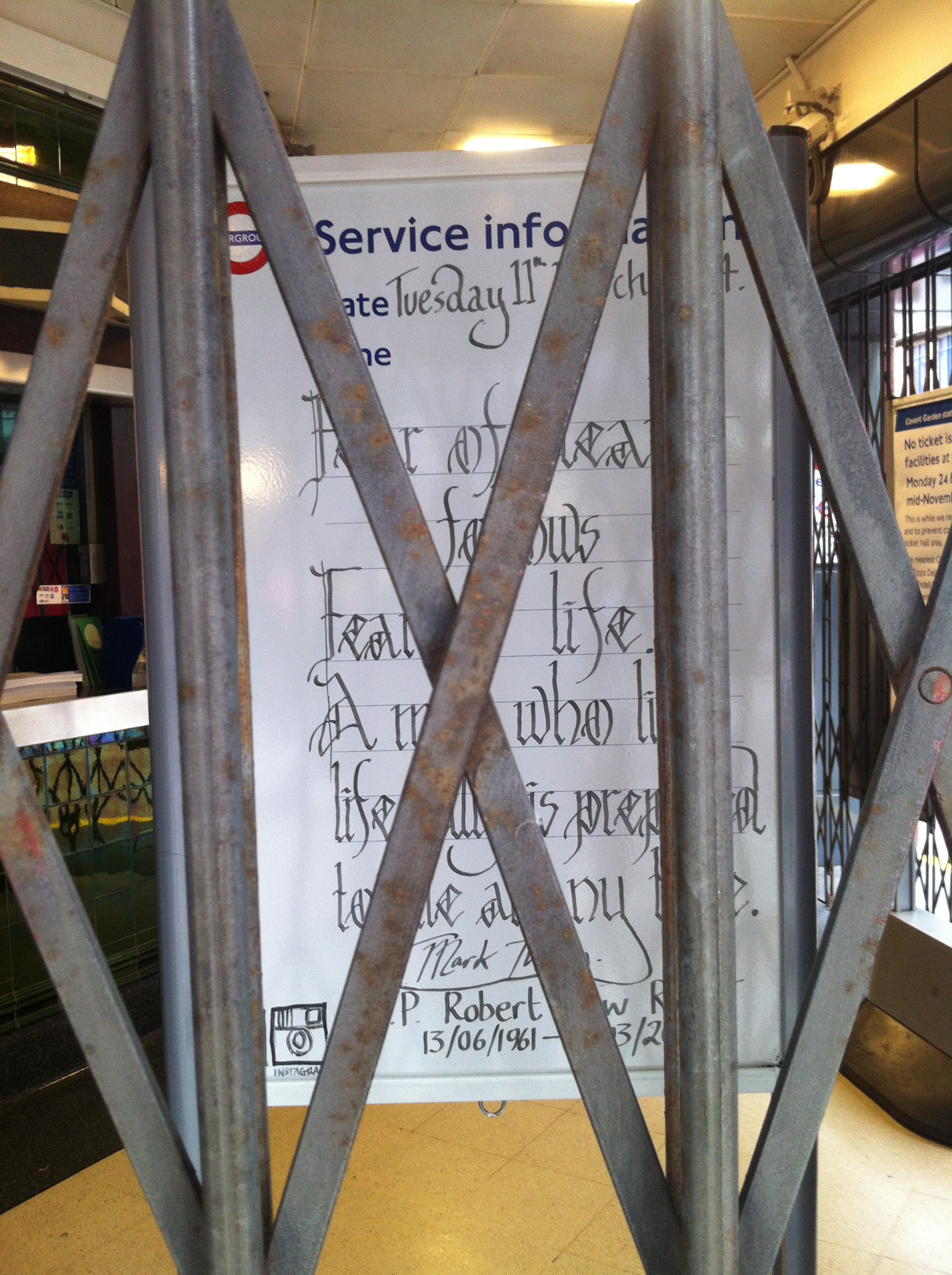
Thus the Bob Crow era came to an abrupt and unexpected end, with the death of the Rail, Maritime and Transport union’s general secretary at the tragically early age of 52.
Bob Crow inspired strong feelings in many people, this blog included, but today is not the day to revisit those battles – Crow leaves behind a wife and four children, as well as countless devastated friends and admirers.
Indeed, regardless of what one may think of Crow’s ideology and tactics, the fact that he did good by his members (at least in the short-medium term) is indisputable. Tube drivers earn more than twice the starting salary of a new teacher, a remarkable if somewhat galling fact. RMT members’ loyalty to and trust in Bob Crow was well earned.
But what is likely to happen now that the gates have closed on the era of Bob Crow? Despite the efforts of a few other pretenders here and there, there does not seem to be the same appetite for the repeating, predictable, militant industrial action strategy that he rigorously followed.
And so as the RMT head office staff return to work tomorrow, the burning question will be whether the union chooses another leader willing to exploit the fact that he has London commuters gripped by the unmentionables to continue showering their members with terms and concessions that others can only dream of, or if they will decide to quit while they are ahead?
There is a compelling argument that Bob Crow’s tenure will come to be viewed as the high watermark of what activist, militant unionism can achieve for semi-skilled workers. The RMT’s most recent victory over Transport for London in the recent tube strikes was just as much a result of the abysmal strategy and negotiating tactics of TfL, and London mayor Boris Johnson’s dithering, than it was a Bob Crow triumph. A less hapless guardian of the public purse might have not allowed the RMT to get away with so many concessions.
This, ultimately, was the paradox that Bob Crow created for his members: with each passing victory, each benchmark-busting pay increase or working practices concession flaunted in the face of other workers and the general British public, the RMT only served to make the case for altering the people-to-technology ratio even further against employing real human beings.
Many lines on the London Underground are already highly automated. Indeed, the Docklands Light Railway is entirely driverless. As purchasing decisions for new rolling stock and signalling technology come around, a climate of industrial unrest – or the weary “what will they demand of us this time” mentality that it has created – can only make the case for maximum automation more compelling.
The cost of all of the RMT’s industrial relations victories – and they are short and medium term triumphs only – has been to make labour so expensive in relation to capital that the simple solution of exchanging the unreliable (labour) for the reliable (capital) has become a no-brainer. Boris Johnson, exasperated at the impact of unpredictable strikes on his mayoralty, is known to be interested. And contrary to what the RMT might say, or however they seek to misuse the memory of 7/7, most Londoners will be much happier to be whisked from A to Z under the streets of London at the hands of a computerised train than by an excessively remunerated humanoid with a tendency to go AWOL around Christmas or major international football tournaments.
Another side note of interest is the fact that Ed Miliband was so cautious in his praise of the RMT’s late leader, as the Guardian reports:
The Labour leader, Ed Miliband, said: “Bob Crow was a major figure in the labour movement and was loved and deeply respected by his members.
“I didn’t always agree with him politically but I always respected his tireless commitment to fighting for the men and women in his union. He did what he was elected to do, was not afraid of controversy and was always out supporting his members across the country.”
How far Ed Miliband has seemingly come since the days when he willingly leaped on stage with anti-austerity protesters and a cast of characters from all over the left wing political spectrum.
Could it be that so soon after Bob Crow’s latest triumph over the hapless Transport for London negotiating team and reconfirmation that public sector workers are being paid more than their private sector counterparts – at the height of his power – Crow had become somewhat politically toxic?
And so, when Robert Crow of Woodford Green is buried, dead at the height of his influence, his legacy is far from being set in stone. Mourned by his trades union colleagues, and his RMT members most of all, Crow’s ambition and determination helped them to prosper in recent years, while many other workers did not.
But, when we are all zipping around London in efficient driverless trains at 3AM on a bank holiday, will they still be so grateful to his memory?
The text of the impromptu memorial to Bob Crow at Covent Garden Underground station, written on the Service Information board:
“Fear of death follows fear of life. A man who lives life fully is prepared to die at any time” – Mark Twain
R.I.P. Robert Crow RMT
13/06/1961 – 11/03/2014

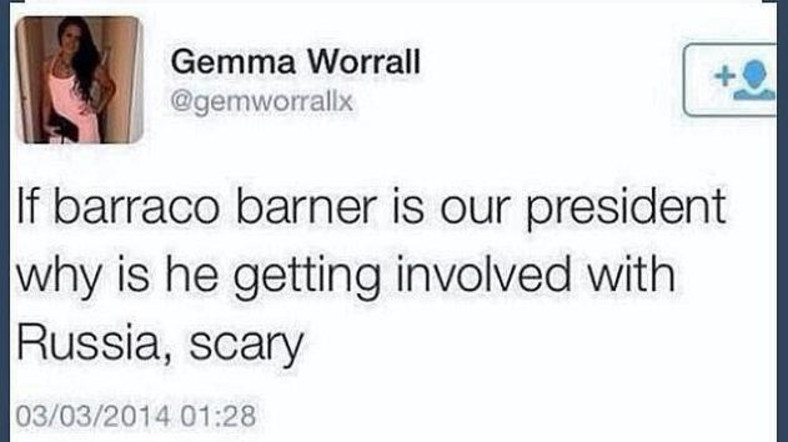
It began with a simple tweet.
Gemma Worrall, a 20-year-old receptionist from Blackpool, picked the wrong day to start following the news. She became confused while watching a television report on the geopolitical chess game underway between Russia, Ukraine and the West, and by sharing her own two cents on Twitter she did more to tarnish the image of British education in a mere second than a whole years worth of falling national examination results could ever do on their own.
Misunderstanding President Barack Obama’s job specification (and grotesquely, if comically, mangling his name), she posed the rhetorical question:
If barraco barner is our president why is he getting involved with Russia, scary
We can all count the ways that this is embarrassing, cringeworthy, depressing. Failing to grasp that Barack Obama is not “our” president. Getting Obama’s name so terribly wrong (a Damn You Autocorrect fail for the ages, if her excuse is to be believed). Not understanding that in carrying out their duties as heads of state or government, leaders “get involved” with other countries as a matter of course. Et cetera.
The ridicule was predictable, and it came. Seven thousand retweets, numerous mean-spirited comments and the usual smattering of death threats from the trolls. This was unfortunate and unseemly, particularly because the author of the offending tweet seems to have no malice about her at all, unlike many of her detractors.
There was no need for the more hateful reactions to the beautician’s blunder, nor even for the snide and scornful ones, because in truth, there is a little bit of Gemma Worrall in us all.
Take the Daily Mail for instance, one of many national newspapers to jump on their story. They and their readers may look down at Worrall for her geopolitical ignorance, but in the same article they feel it necessary to gently explain to their geriatric readership what it is to ‘hashtag’ or ‘retweet’ a statement on Twitter:
Within just 12 hours, her comment had been retweeted (where people send on your tweet for others to read again) almost 7,000 times and screenshots of her words were appearing on television news programmes as far afield as Australia, Canada and America.
A solid argument could probably be made (though not proposed by this blog) that it is actually far more useful to know the intricacies of social media and the workings of smartphones than it is to be up to speed on world leaders and foreign policy, especially given the degree to which technical and IT savvy have become such important prerequisites for employment and the equal degree to which foreign policy is conducted on behalf of us all by those who presume to know best but never deign to ask our opinions.
Rather more concerning is the low esteem in which the supposedly patriotic Daily Mail clearly holds our country in relation to the United States:
It’s a corker of a gaffe by anyone’s standards. Making the most powerful man in the world sound more like the fizzy vitamin supplement Berocca is one thing. Demoting him to leader of the UK is quite another.
Maybe Paul Dacre can order the Daily Mail to publish its definitive ranking of countries so that we can see just how much of a ‘demotion’ it is to go from President of the United States to Prime Minister of the United Kingdom. It is rather astonishing that a major British daily newspaper should hold such an inferiority complex, previously hidden and apparently deeply suppressed, with regard to another country. But this revealing morsel of information and potential area for debate will also no doubt be lost amid the swell of outrage at Gemma Worrall’s personal ignorance – an ignorance from which none of us are entirely free.
Grace Dent, writing in The Independent, hammers home this fact and points out (albeit somewhat condescendingly) that while it is extremely hard to monetise a good layman’s knowledge of geopolitics, Worrall quite probably has other more practical skills that will stand her in much better stead throughout life:
Gemma has a skill. Gemma will most probably have a thorough understanding of Shellac nail procedures and skin exfoliation. She’ll probably know how to remove excess upper-lip hair, push back cuticles and spray a Fantasy tan without missing elbows or staining knees. So, yes, Gemma seemingly can’t spell Barack Obama. But she will always be in employment.
Meanwhile, the clever person with an arts BA Hons 2.2 who can spell Angela Merkel first time without googling it will be sat at home writing petulant blogs to David Cameron about why the Government hasn’t furnished them with a job as a medieval art curator. We deride the differently skilled and slap down the not quite as sharp, but the country’s cogs turn via the energies of people not quite as bookish as you.
While Dent probably cuts Worrall a little too much slack (inferring in their article that her principle error was the misspelling of ‘Barack Obama’ and not her ignorance of the leadership of her own country), there is surely some degree of truth to her conclusion:
As access to the internet makes many of us feel cleverer, more connected, more omniscient, more infallible, it’s tempting to write off all the people “left behind”.
All those little unthinking people without university degrees who shape our nails, or clean our houses, or mend our toilets, or rewire our kitchens, and can’t even spell a president’s name without messing it up.
But the fact is, they might not know where Ukraine is, and they might not know why Germany doesn’t favour sanctions against Russia, but when the lights go out in your house, they know where the fuse box is and which wires to fiddle with to mend it. And right at that moment that’s a damn sight less stupid than you.
Dent labours the point, but it is an important one. Knowledge and skill come in many forms, and it is quite unreasonable to expect everyone’s spheres of knowledge to coincide with our own – though a basic level of fundamental civics awareness really should not be reaching for the stars.
Fraser Nelson, writing in The Spectator, makes a similar point, but while his critique of the Westminster set is dead-on, his excusing of fundamental ignorance is not:
The Spectator’s great coalition of readers include those who think poetry is more important than politics. Those who buy us just for Jeremy Clarke and cartoons are certainly getting their money’s worth (just £1 a week, by the way, sign up here).
If you decide that life’s too short to follow the Westminster tragicomedy, it emphatically does not make you stupid. The societies which tend to make a fuss about the bloke in power tend to be the societies in which you don’t want like to live. The freer the country, the less the need to know who is running the government. That’s why Ms Worrall’s tweet can be seen a sign of something going right, rather than wrong, in Britain today.
But what should be of infinitely more concern to everyone than how many minutes of national and international news Gemma Worrall consumes every evening after she finishes work is the fact that a young woman with a seemingly solid and respectable school education has seemingly emerged from twelve years of compulsory education with next to no knowledge of how her own country operates and is governed.
The Daily Mail informs us that Worrall is not stupid on paper, and has the qualifications to back it up:
While Gemma might not be signing up for Mensa any day soon, she’s certainly no Jade Goody. Softly spoken and articulate, she was educated at a local Catholic school and insists that she has 17 GCSEs — an extraordinary number, as most people obtain 11 at most — in subjects including English, Business Studies, Religious Education, Textiles, Technology and Media Studies, all with passes of grade C and above. She also says she has two A-levels, in Travel and Tourism.
Worrall is educated to A-level standard, and yet she is sorely in need of the type of introductory civics lesson that an American child might reasonably expect to receive by the age of eight. And this blogger has extensive personal anecdotal evidence that Worrall is far from alone in her want for basic knowledge.
How is it possible to gain numerous GCSEs (even if the reported figure of seventeen turns out to be inaccurate) and A-Levels and not pick up some civics knowledge along the way?
More pressingly, perhaps especially today with the need to assimilate immigrants and their children, why is civics – the nuts and bolts of British society, citizenship, law and government – not one of the very few mandatory and inescapable classes for all British children?
Michael Gove, Ed Balls, Alan Johnson, Ruth Kelly, Charles Clarke, Estelle Morris, David Blunkett, Gillian Shephard, John Patten and Kenneth Clarke: please stand up. Would you care to explain yourselves?

 Semi-Partisan Politics