
Sometimes help comes from the most unlikely places. That was certainly the case today when Ed Miliband used his speech at the Hugo Young memorial lecture to call for major changes to the oversight of Britain’s intelligence and security agencies.
The Guardian reports:
A major overhaul of the oversight of Britain’s intelligence agencies, which could lead to an opposition politician chairing parliament’s intelligence and security committee and reform of the intelligence commissioners, needs to be introduced, Ed Miliband has said.
The Labour leader praised Barack Obama for starting an “important debate” in the US – after the White House appointed a panel in the wake of the Edward Snowden leaks – and called for a similar debate in Britain.
In some of his most extensive comments on the NSA leaks, Miliband told a Guardian audience that reforming the oversight of GCHQ, MI5 and MI6 was “definitely” part of his campaign to challenge “unaccountable power”.
Though the details remain sketchy, it appears that Miliband envisions quite a far-reaching review, looking not just at the methods used by the security services but also the degree to which the agencies are funded, the scope of their responsibilities and the granting of a more formal role in oversight to the main opposition party:
Miliband made clear that his challenge to “unaccountable power” would include Britain’s intelligence agencies as he said that reform should focus on two areas. These are parliament’s all party intelligence and security committee, which is always chaired by a senior MP from the governing party, and the commissioners who oversee the intelligence agencies.
The Labour leader said: “I already believe, and this is what my Labour colleagues have been saying, that there are clearly changes that are going to need to be made in relation to the intelligence and security committee and the oversight it provides.
“That is everything from the resources they have at their disposal, who chairs the committee and whether it should be somebody from the government party or the opposition party, their power to compel witnesses – a range of issues.
While this may warm the heart of many a weary libertarian, it must be noted that Miliband has barely scratched the surface in terms of confronting the growth of the British national security apparatus – after all, even miracles have their limits.
Miliband praises US President Barack Obama for starting what he calls an “important debate” but neglects to mention that Obama would have quite happily allowed the NSA to continue to violate the privacy of US and world citizens in secrecy and in perpetuity, and that he is actively seeking to extradite the person who really started the debate – Edward Snowden – back to America to face charges of treason. Thus restated in the proper context, Obama’s carefully cultivated philosopher-king image begins to lose some of its sheen, as does Miliband’s boyish admiration of him.
It should also be noted that Miliband sees the answer to concerns about privacy and civil liberties very much in terms of incremental changes to the existing framework, and certainly not in creating cast-iron rules about powers that the government should rightly have and those which should be reserved by the people. In particular, he sees the fact of ministerial oversight and sign-off of interception requests by the security agencies as a good thing and a solid check on power, rather than the rubber stamp that it really is:
On the ministerial oversight of interception, he said: “It is worth saying also that there is in this country … ministerial sign off when intercept and so on takes place. That is a very, very important safeguard. I do believe the intelligence services do important work. But I absolutely endorse the idea that there are important issues of liberty and liberty is an important part of Labour’s agenda.”
Perhaps Miliband (or indeed David Cameron or Theresa May) would care to set out a scenario – any scenario at all – where the British intelligence services might approach the government to get sign-off for a communication intercept on a surveillance target and actually be rebuffed by a skeptical minister. It simply would never happen.
Elected politicians, weighing the likely fallout of two different courses of action, are almost always going to follow the path that chips away at civil liberties by approving the intercept request rather than defending privacy and denying the request on grounds of insufficient evidence, and later being implicated in a security failure. Decisions on the authorisation of communications intercepts should rest with the judiciary, not the executive.
It is certainly true that public opinion in Britain has not swelled with outrage at the revelations of NSA and GCHQ collaboration in collecting and viewing private communications data with no reason for suspicion and no warrant.
And so Miliband’s contribution to the British debate on privacy and (remarkably) constraints on the power of the state – a very muted, anaemic debate compared to that now taking place in many other countries – is welcome, and very important. In America, politicians from both main parties and of all temperaments have spoken out in condemnation of secret government surveillance, raising public awareness and, in some cases, making continued support for these draconian surveillance measures an electoral liability. Meanwhile, the British political establishment has largely closed ranks in defence of the national security complex, and against the people.
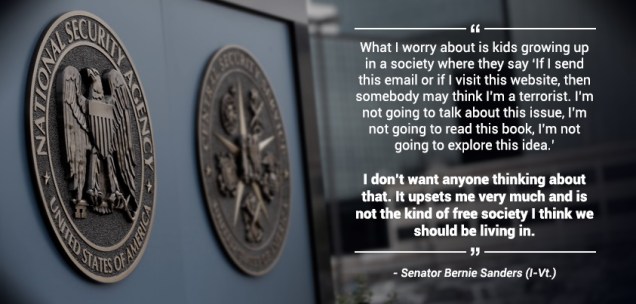
Contrast this quote from the independent Vermont Senator, Bernie Sanders, with Prime Minister David Cameron’s dismissive and aloof response to concerns about the practices of MI5, MI6 and GCHQ:
“We have very good rules in this country. If a telephone call is going to be listened in to, that has to be signed off by the Home Secretary personally. There are very good safeguards in place,” Cameron told ITV’s The Agenda. “You get asked, ‘What are the rules’? I’m satisfied we have pretty strong safeguards. I thought part of the reaction to the The Guardian story was – big surprise, spies learn to spy…it’s to help keep us safe.”
Does the fact that Ed Miliband took the first tentative step in support of civil liberties and dared to suggest the state should not be all-powerful over us mean that the torch has been passed to a new generation of leaders on the issue? Of course not. Miliband seems to place his complete faith in the power of the state to accomplish a whole range of other matters relating to the personal and private lives of the British people, and it is far from certain a this early stage that he is not simply using his Hugo Young lecture to score a few cheap political points with no intention of pursuing the matter any further.
But for perhaps the first time in his senior political career, Miliband spoke out in favour of the private citizen over the government, when the issue of government surveillance has been met with nothing more than dismissal and condescension by Number 10 Downing Street and the rest of the government. And for that action, he must be given some credit.
Today, February 11th 2014, has been labelled The Day We Fight Back against mass surveillance. Numerous websites are carrying links to the organisation, which is supported by more than 360 organisations in 70 countries, and which plans to petition lawmakers in these countries to take action on the serious issue of government surveillance and constitutional overreach.
The Day We Fight Back has been well-marked in the United States, with many prominent politicians adding their voices to the chorus of protest. In the UK, on the other hand, there has been a deadly silence. The focus of the British news media and the political class remains fixed on the issues of flooding in southern England, with elected politicians falling over themselves to be seen in photo opportunities surveying the damage and taking decisive action. Taking any kind of action in support of our right to privacy and freedom from government oversight is far down the list of priorities, where it even features at all.
Former Texas Congressman Ron Paul is not right about everything, but his warning about the loss of liberty, echoing Franklin, is pertinent and timeless:

People in Britain who truly appreciate the importance of the right to privacy and the need to place constraints of any kind on government seem to be few and far between, and consequently we must look for allies in unlikely corners.
Ed Miliband’s is certainly the very unlikeliest of corners. But perhaps the Labour leader’s taking a stand for civil liberties will shame others – those who should have been holding this issue aloft all along, and warning of the dangers of an omniscient, omnipotent government – into finally doing the same.
Concerned readers can visit The Day We Fight Back website and add their name to a petition here.








 Semi-Partisan Politics