The referendum has not yet taken place, but already Alex Salmond seeks to dictate terms to the United Kingdom
The nationalist separatist cause espoused by the SNP and Alex Salmond has always had more basis in fairy tale and wishful thinking than in any kind of reality, and Salmond has always been among the most deluded of its proponents.
Leaving the United Kingdom yet sharing a Head of State. Leaving the United Kingdom and yet sharing the UK’s currency. Leaving the United Kingdom and expecting a warm and swift embrace from the European Union. The leader of the Scottish Nationalist Party has asserted all of these risible ideas at one time or another, and many more besides. And yet not content with already living very publicly in cloud cuckoo land, Salmond felt the need to go further still.
In the latest story to be filed away with his other preposterous ideas, Alex Salmond now imagines himself the leader of a newly independent Scotland, and deigns to dictate to the remainder of the United Kingdom the terms on which Scotland would assume a portion of the UK’s current national debt on secession.
In his first major speech on independence in weeks Mr Salmond accused London-based ministers of “lecturing” the Scottish people.
Offering a “deconstruction” of Mr Osborne’s argument, Mr Salmond said: “If there is no legal basis for Scotland having a share of the public asset of the Bank of England, then there is equally no legal basis for Scotland accepting a share of the public liability of the national debt.”
One thing needs to be made absolutely clear, not just to Alex Salmond but to all supporters of Scottish independence, so that they are able to make an informed decision at the ballot box when the time comes: assuming a proportionate amount of the United Kingdom’s sovereign debt upon secession from the UK is not negotiable, and is not something that can be opted out of. Neither, crucially, is it dependent on the UK agreeing to share its currency with the newly independent country.
The Scots may choose to leave the United Kingdom, and if they are foolish enough to do so then that is now their right, to be exercised in the referendum this September. But whether an independent Scotland keeps the pound, joins the euro or – as one commentator suggests, inaugurating a new currency, the Salmond – they must assume their fair proportion of the national debt. Scotland may choose to flounce out of the United Kingdom, but it cannot walk away from sovereign debt.
Whether the Scottish people end up using euros, doubloons or monopoly money in the event of independence, they will be required to make payment to the United Kingdom for their share of the debt. George Osborne and his counterparts in the Labour and Liberal Democrat parties need to make this absolutely clear to Salmond, just as they unequivocally stood together to make clear that an independent Scotland will not share a currency with the UK.
Salmond and his allies in the “Yes to Independence” campaign may continue to throw accusations of bullying and intimidation when well-meaning people point out the impossibility of their public stances, but this should not dissuade anyone from doing so.
The goal of these continued rebuttals, of course, is not to change the mind of Salmond – he is far too gone, far beyond help. But when he makes blatantly false assertions about an independent Scotland’s ability to choose a currency other than its own, or to walk away from sovereign debt obligations, he is misleading his supporters and ensuring that the votes they may cast for Scottish independence are for a very different kind of independence than that which he promises and they have in mind.
For that reason alone – to maintain the integrity of the referendum campaign in the face of sleazy salesmanship, sleight of hand and craven dishonesty from Alex Salmond and the SNP – the media’s truth and plausibility-o-meter must remain firmly pointed at the nationalists.
Two very different approaches to the same piece of music today – Keyboard Concerto no. 7 in G Minor, BWV 1058, by Johann Sebastian Bach.
Firstly in a recording with Harpsichord solo, performed by Trevor Pinnock with the English Concert Orchestra (second movement only):
And secondly, as interpreted by Glenn Gould on the piano in a performance with the Toronto Symphony Orchestra under the direction of Vladimir Golschmann (full performance):
My preference lies with the latter recording, perhaps unsurprisingly given the fact that I am on record as considering Gould to be my favourite pianist and best interpreter of Bach. I am not one to stubbornly insist that the modern piano is an inappropriate instrument for the performance of Bach, believing (as did Gould himself) that the composer was always looking to test and push the boundaries of what was possible, and would have embraced the modern concert grand piano had it been available in his time.
And while I enjoy the fruits of the period instrument movement to a point, I firmly believe that the evolution in the modern symphony orchestra, as with individual instruments, is not something that need be shied away from or apologised for. The shortcomings of “historically informed performance” are set out very well in this essay from the Arts Journal.
However, setting my preference aside, there is a wonderful musicality to the harpsichord performance, and pleasure to be had in listening to both with an open and receptive ear.
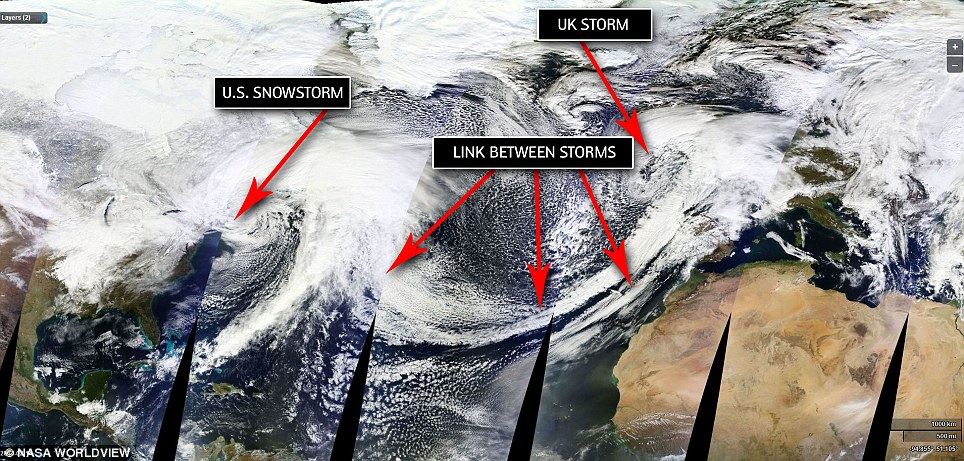
Those Brits who needlessly fret about the strength of the Special Relationship between the United Kingdom and the United States of America can finally rest easy – for so powerful is the bond between our two countries that we now apparently share a common weather system.
For so great is the rapport between our countries that it is now reflected in the heavens themselves.
And at a more human level, fans of the British actor Benedict Cumberbatch hoping to catch a glimpse of him at this evening’s BAFTA award ceremony in Covent Garden, London were left disappointed when our mutual storm stranded him at JFK airport in New York.
The overhyped emotional appeal (to some) of Scottish independence is finally running smack into the wall of cold, hard reality and common sense. This is a good thing for those people who want to preserve our Union, not just because it is heartening to see the nationalist pipe dream suffering a setback, but because it has thrown two important arguments against Scottish independence into sharper focus.
The first of these is the fact that the pro-independence movement, led by Alex Salmond and the Scottish National Party, really haven’t fleshed out any detail as to how a newly independent Scotland would engage with the rest of the world. The very first issue that would be confronted by a future Scottish Foreign Secretary would be the question of how to normalise relations with the rest of the United Kingdom and the European Union, with whom the new nation would now share a land border.
Scotland historically leans further to the left than England, and as a very small country would almost certainly want to preserve membership of the EU. But it is now clear that this will almost certainly not happen, as The Guardian reports:
It would be “difficult, if not impossible” for an independent Scotland to become a member of the European Union, the European commission president, José Manuel Barroso, has said.
The statement will be seen as a blow to the hopes of the Scottish Nationalists who claim the country would join the EU in the event of a yes vote in September’s referendum.
Barroso told the Andrew Marr Show that member states seeking to prevent their own semi-autonomous regions from seceding would almost certainly block Scotland’s membership. He said Scotland would have to apply for EU membership in the usual way.
“It will be extremely difficult to get the approval of all the other member states to have a new member coming from one member state,” he said.
This is a good point. Various other European Union member states wrestle with problems relating to semi-autonomous regions of their own. Seeing Scotland secede from the United Kingdom and accede to the EU as a separate country would set an alarming precedent for them, and the only way to send a strong message to their own restive would-be breakaway regions would be to make an example of Scotland by leaving them in the wilderness and denying them membership.
The counterargument by the SNP – that Scotland’s case is very different to that of other newly-separated countries such as Kosovo, the recognition of which has been opposed by Spain – is correct, but irrelevant. Scotland is already a part of the European Union by virtue of being part of the UK. This means that the laws, customs and processes of Scotland are already in alignment with EU norms, which would make the harmonisation process much easier, if not nonexistent. Aside from agreeing Scottish monetary contributions to the EU and rearranging Scotland’s representation in the European Parliament, there are precious few complex steps toward membership that spring to mind. Scotland as an independent nation would instinctively be much more at home within the EU than is the United Kingdom. Precisely none of which would matter once Scotland’s membership is vetoed. Fantasy – meet reality.
Given this somewhat counterintuitive reality, and given the looming deadline of the independence referendum, it is no longer sufficient for Alex Salmond and the SNP to continue to publicly stick to Plan A and assume that the European Union would welcome an independent Scotland into its fold. The Scottish people deserve to hear the fallback plan, since that is the one most likely to become reality.
Is Plan B an individually negotiated free trade agreement with the EU? A series of bilateral treaties and trade agreements with other nations? Either way, New Scotland would likely quickly realise the pitfalls of being a minnow of a country negotiating with giants. The argument sometimes falsely leveled at the UK – that we are somehow a small country incapable of punching our weight and negotiating favourable terms with other countries – actually applies to Scotland quite strikingly.
Scotland would also wrestle with Small Country Syndrome in the matter of her currency, as it has now been made abundantly clear that there is no appetite within the main UK political parties to share the pound. The BBC reports:
[Chancellor of the Exchequer George] Osborne said: “The pound isn’t an asset to be divided up between two countries after a break-up like a CD collection.
“If Scotland walks away from the UK, it walks away from the UK pound.”
He went on: “There’s no legal reason why the rest of the UK would need to share its currency with Scotland.
“So when the Nationalists say the pound is as much ours as the rest of the UK’s, are they really saying that an independent Scotland could insist that taxpayers in a nation it had just voted to leave had to continue to back the currency of this new, foreign country?”
The SNP is desperately trying to spin this refusal as an act of bullying by Westminster, but that is not the case. It is true that the announcements from the three main parties – the Conservatives, Labour and the Liberal Democrats – were coordinated, but this was for purely party political tactical purposes, and the necessity to avoid muddying the debate through separate interventions in the debate.
George Osborne summarised the reasons against allowing an independent Scotland to continue to use the pound in his Edinburgh speech. By default, a national currency should remain with the remaining bulk of a fracturing country, and not the small breakaway entity – that much is self evident. So why then should the rump of the UK agree to continue sharing the pound?
The one sole advantage is quite important and quite obvious – the fact that it would be a nightmare to have two currencies operating on what is geographically a very small island. Those living on the land border would find it especially difficult and would be beset with new currency exchange transaction costs, as would all businesses trading both north and south of the border.
The disadvantages are not so immediately tangible, but they are many, and together they outweigh the sole advantage of sharing a currency (avoiding increased transaction costs). Since the Scottish electorate sits somewhat to the left of the English on the political spectrum, it is reasonable to expect that there would be quite radically divergent economic policies operating north and south of the border soon after independence. Certainly, the SNP would favour more government spending on virtually everything that moves, and higher taxes to help pay for it all.
Whether or not you think that such an economic policy would lead to greater economic growth and prosperity – and it won’t – it must be understood that hugely divergent fiscal and government spending policies cannot sit under a common monetary policy without causing tremendous strain. You need look no further than the comparative experiences of Greece and Germany within the eurozone for proof of this fact. If a future independent Scottish government wants to essentially pick up where Gordon Brown left off in Westminster, spending hand over fist without a care for the consequences, why should the 53 million people of England, the 3 million people of Wales and the 2 million people of Northern Ireland be on the hook as the ultimate guarantor for Holyrood’s spending spree?
It is not a case of bullying when George Osborne and his shadow counterparts refuse outright to entertain the idea of sharing the British pound with an independent Scotland. Rather, it is the only prudent and responsible decision that could be taken in protection of the best interests of the remainder of the United Kingdom.
Spending decisions made here by an independent Scotland should not be underwritten by the rest of the UK
It can be argued that both of these twin setbacks suffered by the Scottish nationalists – being denied the pound and being rebuffed by the EU – are unfair. They are certainly keen to make this argument, at every opportunity and to anybody who will listen. And they have a point. Having two currencies operating in the British Isles would be immensely awkward, and the costs to the UK of not sharing the pound with Scotland are not inconsiderable. Though the announcement made by the main Westminster parties is doubtless the correct decision, a detailed feasibility study weighing the potential risk and costs of a badly managed Scottish economy harming the remaining United Kingdom in a currency union scenario against the costs to the economy of the 5.25 million people at the top of the British Isles using a different currency would have given solid credibility to the statement.
The case of Scotland’s future EU membership can also be seen as unfair. All things being equal, it would probably be in the interests of both an independent Scotland and the EU for membership negotiations to be quick and painless, and so it is regrettable that the accession of an independent Scotland would likely be blocked by other member states. Regrettable but highly likely and easily predictable.
So in these two key aspects of the debate, the aspirations of the Scottish nationalists bump up against obstacles that can be seen as unfair. But sadly, that’s just life. It would be nice if countries like Spain would not veto an independent Scotland’s membership of the EU for domestic reasons, but they probably still would. And it would be nice (for Scotland) if the rejected rump of the United Kingdom would simply roll over and allow the seceded Scotland to continue sharing the currency of it’s southern neighbours, thus making them also share in the economic risks incurred by the socialist experiment north of the border. It might be nice, but it won’t (and we now know isn’t going to) happen.
Once the SNP’s bleating about unfairness dies down, the awkward silence will urgently demand to be filled with details of their Plan B. The SNP and the Yes to Independence crowd don’t like to talk about a Plan B because it involves grappling with the the United Kingdom and the world as they are, not as they would like them to be. But, hemmed in by George Osborne, Ed Balls, Danny Alexander and now José Manuel Barroso, they no longer have a choice in the matter.
So, Alex Salmond: What does your independent, non-EU aligned, non-sterling based Scotland look like? Paint us a word picture. More importantly, describe it in detail to the people of Scotland so that they can make an informed decision based on the facts, not on nationalist wishful thinking.








 Semi-Partisan Politics