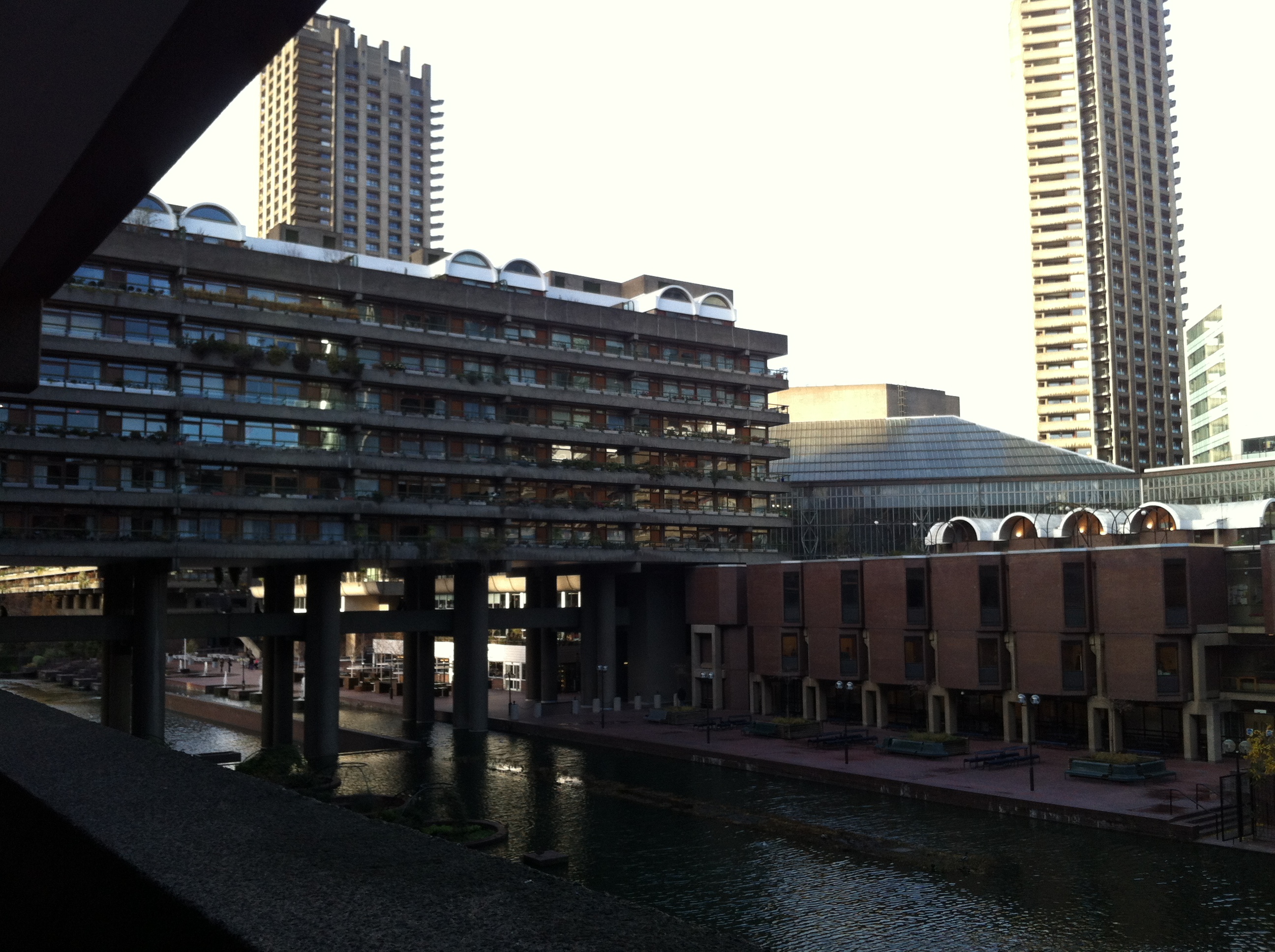
The Guildhall School of Music and Barbican Centre, London
The Guildhall School of Music and Barbican Centre, London


–
Seumas Milne rides to battle against the United States
It must be a slow news day, because Seumas Milne has taken to his Guardian column to denounce the presence of US military bases on British soil. You might think that resuscitating a dusty old left-wing fall-back piece like this might at least warrant some new angle on the story, or at least be based on some recent newsworthy transgression by the American military that we host here. You might think so, but you would be disappointed. Milne apparently just got out of bed feeling vaguely smug and anti-American, and decided to repeat the same predictable talking points, namely:
1. They came to help fight Nazi Germany in 1942 and the war ended a long time ago, so what can they possibly still be doing here?
2. America has dragged us into unnecessary and failed wars (Iraq was clearly a calamitous mistake, but why this warrants booting 10,000 US servicemen from our shores is never explained by Milne, unless it is supposed to simply be an act of vengeance) but we can absolve ourselves of these sins by closing down their bases here.
3. The British security elite are desperate to maintain a lopsided special relationship with the US, and only tolerate their bases on our soil as the price of achieving this goal.
4. Being so chummy with the Americans makes us less safe. Rather than being proud of our alliance with a country that symbolises democracy and individual freedom (however self-tarnished this image is becoming as a result of the unconstitutional activities of their national security complex), we should actively disown them to curry favour with fundamentalist theocracies who foment terrorism.
The column is not worth quoting at length, but here is an excerpt:
But whose interests are actually served by such a role? No doubt arms contractors are delighted, but it’s hard to argue that it benefits the British people – let alone those on the receiving end of the US and British military. Politicians and securocrats claim it gives them influence over US policy, but they struggle to produce the evidence on the rare occasions they’re asked to explain how. “The foreign policy elite still have a strong idea,” as the Chatham House analyst James de Waal puts it, that intervention based on “values” is an “innate part of what the UK is all about”. In fact, what successive governments have done is mortgaged Britain’s security and independence to a foreign power – and placed its armed forces, territory and weaponry at the disposal of a system of global domination and privilege, now clearly past its peak.
Milne wonders what the Americans would think if we had a military base on their home soil. Aside from the fact that British officers and military personnel routinely serve alongside their American counterparts both at home and in the field, I think that the Americans would be only too happy to see British military spending increased to such a level where we could afford more overseasbases (though whether this itself would be desirable is another matter). The reason for the lack of RAF bases in North Dakota is not that the British are the victims of some one-sided game in which the US gets to play and we have to sit on the sidelines, but everything to do with the fact that we choose to deprioritise defence in sacrifice for other goals, and all the other things that our caring government does for us. And look how that’s working out.
But this is where Milne really reveals his argument for what it is:
Britain’s fake patriots who bleat about the power of the European Commission are more than happy to subordinate the country’s foreign policy to the Pentagon and allow its forces permanent bases on British soil.
Firstly, our foreign policy clearly is not subordinate to the whims of the Pentagon, as the British parliamentary vote against taking military action in Syria made abundantly clear. Try as he might to build a convincing narrative of the British being led by the nose, two conflicts (Afghanistan and Iraq) over thirteen years are not enough to establish the damaging precedent that he wants to portray.
And secondly, I strenuously object to being labelled a fake patriot by Milne, but so bankrupt is his argument that insults are likely the only weapon left in his arsenal. Fake in relation to what, Milne’s more enlightened, cerebral left-wing patriotism? What Milne carefully chooses not to see is the fact that British government policy and the day-to-day experience of British life are influenced far more by the goings-on in the corrupt, undemocratic European Commission than they are by the garrisons of American military personnel on our soil – troops, incidentally, who are there to underwrite our common security objectives. If anything, it is an indictment of the European Union that Milne slavishly and unquestioningly adores that they punch more weight in this country by undemocratic diktat than do the “hostile American occupiers” against whom he childishly rages.
I’m sure that Milne thinks himself terribly persuasive in his closing paragraph:
But the withdrawal of British troops from Germany and this year’s planned renewal of the US-British defence agreement offer a chance to have a real debate on the US military relationship – and demand some transparency and accountability in the process. There is no case for maintaining foreign military bases to defend the country against a non-existent enemy. They should be closed. Instead of a craven “partnership” with a still powerful, but declining empire, Britain could start to have an independent relationship with the rest of the world.
But why should these two things be mutually exclusive? In Milne’s crazed imagination, the fact that we enjoy such a close alliance with a great country like America is shutting us off from good relations with other countries, or, as he puts it, having an “independent relationship with the rest of the world. This would probably come as a great surprise to the British ambassadors representing our country in foreign capitals across the globe, and to everyone working at the Foreign & Commonwealth Office in London toward the same ends. Exactly what relationship with the rest of the world does Milne think we are missing out on by failing to snub and humiliate our closest ally in the way that he proposes? Which are the countries in whose bad graces we currently dwell, who will suddenly warm to us if we send the Americans packing? North Korea? Venezuela? Iran?
I propose to Seumas Milne that he is trying to make an argument in reverse. He is clearly upset about British-American military cooperation and about our alliance in general. He would doubtless prefer to see us much closer to Europe, and have us actively working to further undermine American hegemony. But the American military bases and other visible manifestations of our close alliance are not a cause but an effect. In the case of Britain and America, an alliance such as ours is what you inevitably see when two countries, one larger and one smaller, have so much in common in terms of culture, economic ties and global interests. If Milne wants the US bases to close, he is making the wrong argument. Rather than bleating about Iraq and Afghanistan, he needs to begin convincing us that we are a different country than the one we think we are.
I don’t fancy his chances.

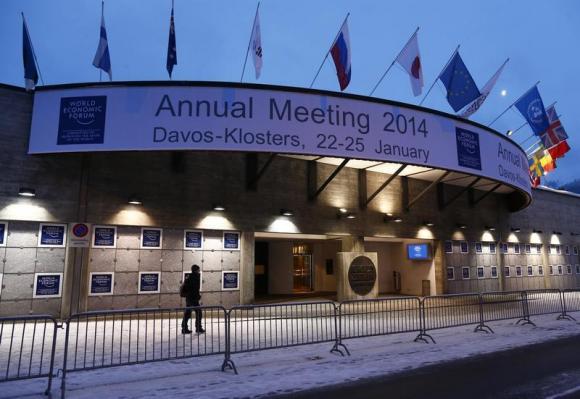
What do Bono, Eric Schmidt, Matt Damon, Jamie Dimon and David Cameron all have in common?
No, U2 are not auditioning for a new band member. The answer is even more thrilling – the World Economic Forum 2014 is convening for their annual gathering in Davos, Switzerland. The tired, the poor and the huddled masses can rest easy because these luminaries, together with Benjamin Netanyahu, the CEO of Wal-Mart and the King and Queen of Belgium have arrived in full pomp and splendour, to do…whatever it is exactly that they do there every year.
From the WEF homepage:
Profound political, economic, social and, above all, technological forces are transforming our lives, communities and institutions. Rapidly crossing geographic, gender and generational boundaries, they are shifting power from traditional hierarchies to networked heterarchies. Yet the international community remains focused on crisis rather than strategically driven in the face of the trends, drivers and opportunities pushing global, regional and industry transformation.
“The Reshaping of the World: Consequences for Society, Politics and Business” is therefore the thematic focus of the World Economic Forum Annual Meeting 2014. Our aim is to develop the insights, initiatives and actions necessary to respond to current and emerging challenges.
If this sounds to you like something you might hear in a second-tier business school lecture or the opening paragraphs of a particularly bad Tom Friedman column, you would be forgiven your mistake. It’s the year 2014 and our moral, intellectual and financial betters have apparently only just come to the realisation that technological forces are transforming our lives, communities and institutions.
Thank goodness for the sagacity of these wise men (and they still mostly are men), who alone among us have perceived that some kind of shift has taken place in our national economies and personal behavioural patterns since the internet and these fancy cell phones popped into being. It is astounding to witness how some of the brightest, busiest and most successful businesspeople, politicians and artists can sit and listen to so much meaningless garbage, and then come back a year later under the powerful spell of collective amnesia to do it all over again.
And seriously – “networked heterarchies”? All outward evidence suggests that there is but one solitary networked heterarchy that has gained and consolidated power in recent years, and that is the one currently booked into a Swiss convention centre to discuss just how wonderful networked heterarchies are, and to divide up the spoils of another bumper year.
In sessions with meaningless titles such as “The New Digital Context”, the world will be put to rights in Davos 2014 – and any outstanding items from the Bilderberg 2013 agenda will no doubt followed up and neatly resolved by those people privileged to be invited to both.
Here’s Klaus Schwab (what better name could there be for the leader of such an event?), the Founder and Executive Chairman of the WEF, welcoming the distinguished delegates to the annual shindig. And yes, he does have a symphony orchestra on the stage behind him. Pity them.
At least Schwab has the decency to admit at around the 1 minute 20 second mark that the whole affair is really about providing an opportunity for the global super-elite to relax, do business deals and network. He puts it somewhat more prettily than this, but the meaning is quite clear. This alpine convocation is like a gold-plated version of LinkedIn, with extra snow.
Cardinal Peter Turkson of the Pontifical Council for Peace and Justice also traveled to Davos, and read aloud a message from Pope Francis. Given the Pope’s well known thoughts about conspicuous displays of wealth and false displays of public piety, one must wonder whether poor Cardinal Turkson found himself having to ditch his prepared remarks and speak extemporaneously for fear of being run out of town for speaking truth to power.
On a personal level, I just don’t quite get it. For most of my career I have worked as a management consultant and project manager. But when I went on vacation, I left my work and all the trappings of my professional life behind at home. I didn’t walk the streets of Paris or the hills of the Lake District pretending to still be running IT projects or anything else to do with my line of work. And so if the shining people in Davos wants to have a good shindig in snowy Switzerland, I would have a lot more respect for them if they would just say so, and spend their time skiing rather than propagating the farcical myth that they are bringing their unique professional skills to bear on the problems of the world.
And yet every year we go through this worn-out pretense that the greatest minds of our generation are sequestering themselves in the mountains to hatch new plans to save the world, when really we all know they are there to slap themselves on the back for another successful year, drink glühwein and try to avoid being isolated in a corner and engaged in interminable, pious conversation by Gordon Brown.
So I have a proposal. Let’s test the mettle of these great, good and benevolent people who claim to care so much for us small folk. Let’s hold the World Economic Forum 2015 somewhere different, somewhere cheaper, calculate the difference in cost and give that sum of money to a front-line charity picked at random from a hat.
Let’s hold the World Economic Forum 2015 in my hometown of Harlow, Essex.


I’ll see you there!


Coming soon to a British town square near you: trigger-happy and power-corrupted police officers, newly armed with water cannon, ready to hose you down with a cooling blast of high powered icy water if the authorities do not approve of the cause or tone of your protest.
The Association of Chief Police Officers, or ACPO, is submitting a request to the Home Secretary, Theresa May, to authorise the use of water cannon in any town or city across England and Wales. They are doing this, they insist, to bolster their ability to control anticipated protests from what they call “ongoing and potential future austerity measures”.
The Guardian reports on this unprecedented move against the public:
The Association of Chief Police Officers says that the need to control continued protests “from ongoing and potential future austerity measures” justifies the introduction of water cannon across Britain for the first time.
The London mayor, Boris Johnson, has already announced a consultation on the introduction of water cannon on to the streets of London ready for use by this summer.
A new Acpo/College of Policing briefing paper makes clear that chief constables across England and Wales have also been asked to discuss water cannon with their police and crime commissioners and “it is anticipated that the home secretary will be approached in early 2014 in respect of water cannon authorisation”.
This attempt by ACPO to raise the spectre of an implausible large-scale breakdown in public order is complete and utter nonsense, a risible and transparent excuse to bring draconian tools of crowd control to the streets of a generally calm and peaceful liberal democracy.
This is not Ukraine or Greece. And even if we were, like Ukraine, in the grip of large-scale civil disturbances, there is every chance that the fault would rest primarily with the fictitious government and not the fictitious protesters; so why further tilt the odds even further in favour of government power to suppress dissent by arming the police with water cannon?
But the really chilling disclosure comes next:
The police envisage using their water cannon to “exert control from a distance and critically to provide a graduated and flexible application of force ranging from spray to forceful water jets. The mere presence of water cannon can have a deterrent effect and experience from Northern Ireland demonstrates that water cannon are often deployed without being employed.”
Behold the power of the deterrent effect on freedom of speech and assembly. The ACPO will make it widely known that they are purchasing some new, state-of-the-art water cannon, weapons capable of blasting 9000 litres of water into a crowd in just five minutes at potentially deadly force, and sit back and watch the anticipated protests about this or that suddenly fail to materialise – or so the theory goes. But here the enemies of civil liberties may have underestimated the level of public opposition to their scheme.
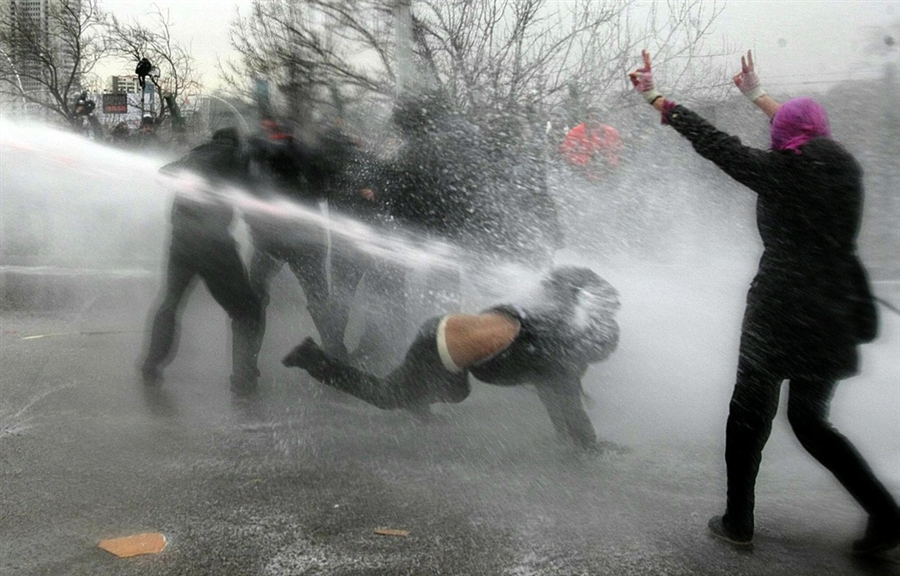
We may rarely give a second thought to the scenes of plucky, unfortunate foreign demonstrators being blasted off their feet by high power jets of water often shown in television news reports from overseas, but if such a thing were to begin happening in Trafalgar Square or in the shadow of Parliament it would be another matter entirely. The British people will not abide a bully.
Scraping the barrel for recent examples of civil disorder to justify their unprecedented request, the chief police constables produced three very weak cases:
[David Shaw, West Mercia Chief Constable] cites three occasions in the past 10 years when police commanders would have considered using water cannon on the streets of London had they been available.
He names them as the Countryside Alliance demonstration in Parliament Square in 2010, the Gaza demonstrations against the Israeli embassy in 2008-09 and “potentially” the student protests of 2010, when specific locations were targeted.
They would also have been considered during the August riots of 2011 but he concedes they would have had only limited impact on the “fast, agile disorder” seen then.
So apparently farmers and bolshy students number among the most grave threats to law and order currently on the radar of the British police. How heartening it is to know that police chiefs up and down the country are so in tune with the fears and concerns of the communities that they purportedly serve.
More ridiculous still, ACPO themselves admit that water cannon would have been entirely useless in confronting the most recent case of serious civil disturbance in Britain, the August 2011 riots, because the looting and damaging was too fleet-footed and agile. It turns out that people intent on smashing and grabbing merchandise from the windows of electronic goods stores tend not to stand still at the scene of their crime, link arms and form orderly ranks so as to be efficiently mowed down by a hastily-scrambled water cannon.
So what is this really all about? One explanation could be that ACPO are politically agitating, and trying to send a message of their disapproval of coalition austerity policies to the public and their elected representatives, essentially saying “we told you that cutting government spending would lead to chaos and disorder and we were right; now we have to take the draconian step of procuring water cannon to prevent the country from sliding into anarchy”.
This is one plausible possibility – as we have seen only too recently with the Andrew Mitchell “plebgate” scandal, there are those in the police force with very hardened agendas who would stop at nothing to discredit or cast doubt on the performance of Conservative ministers.
But in truth, a more convincing explanation is that the police just really fancy having these new toys to scare and intimidate people, that they have decided that building good community relations with the public and doing the hard work of policing large scale events just isn’t worth the effort when they can just bully the public into cowed obedience much more easily.
They likely pursued this strategy in the belief that vague and nebulous references to potential future instances of moderate civil disorder would be sufficient prompting for Theresa May to roll over and grant their wish in her desire to appear tough on the issue of law and order. The British public can only hope that she has the political courage and commitment to civil liberties to tell ACPO to back off – but based on her record, the signs are not encouraging.
The saving grace of this worrying affair will be the newly-created police and crime commissioners, now in place throughout many parts of the country – officials whose primary job it is to advocate for the local population, highlight their concerns and see them addressed by the police forces.
This brazen move by ACPO will be a good early test of the new commissioners. Do they have real teeth, and the strength to dig in their heels and make the police chiefs focus on local priorities rather than their own private Orwellian ambitions, or will they merely act as a fawning rubber stamp to power?
We may soon find out.

I know it is not nice to laugh at the misfortune of others. But when people bring misfortune upon themselves by showering themselves with boiling water in a cack-handed attempt to emulate demonstrations by television weather reporters, and their tribulations are documented in a series of videos on YouTube, I think we are all absolved from blame:
Q. “That was really cool! Did you burn yourself?”
A. “A little bit, yeah”.
Of course, new videos are already emerging, making fun of those who have injured themselves in the name of science:
Best Thing Of The Day.

 Semi-Partisan Politics