Evidently given prior notice of the dissatisfaction that was certain to fall on his head should he fail to announce any substantive changes to the bulk telephony data collection programme that flourished under his administration, President Obama triangulated and managed to set out a plan that included the illusion of substantive changes. It may prove enough to fool the trusting and the credulous, but there are precious few of those sorts of people left to be fobbed off.
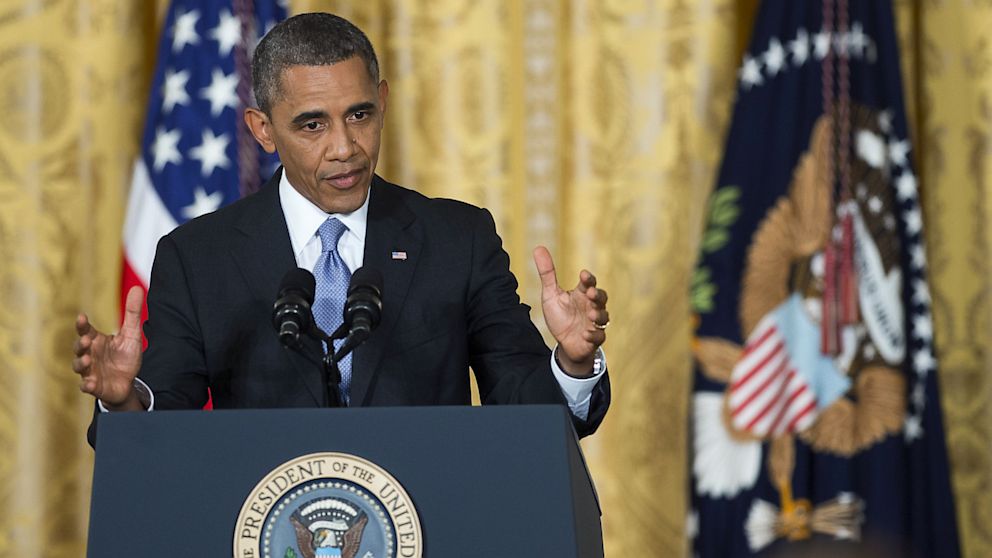
The New York Times gives a good overview:
President Obama, declaring that advances in technology had made it harder “to both defend our nation and uphold our civil liberties,” announced carefully calculated changes to surveillance policies on Friday, saying he would restrict the ability of intelligence agencies to gain access to telephone data, and would ultimately move that data out of the hands of the government.
But Mr. Obama left in place significant elements of the broad surveillance net assembled by the National Security Agency, and left the implementation of many of his changes up to Congress and the intelligence agencies themselves.
The one announcement not earlier anticipated by the New York Times was the fact that the president may be slightly more amenable to the idea of telecommunications companies or as-yet unspecified third parties holding the unconstitutionally-gotten telephony metadata, rather than the NSA itself. The Times reports:
On the question of which entity will hold the storehouse of phone metadata, the president said Mr. Holder would make recommendations in 60 days. Privacy advocates have called for telecommunications providers to keep the data, though many of the companies are resisting it.
And resist they should. Due to the sensitive and highly politically charged nature of the data being held, why would a private firm wish to open itself to potential liability from lawsuits by hosting the data? Furthermore, unsavoury and unconstitutional though it may be for the government to be collating this data, it is probably more secure in the hands of the paranoid and capable people at the NSA than it would be in some corporate data centre.
But all of this is beside the point – it is not the question of where the data is hosted that upsets civil libertarians. If someone robbed banks for a living, the main concern of the public would not be where the robber is hiding the stolen cash before laundering it, it would be the fact that he is robbing banks in the first place. Similarly, the point of contention here is not whether the US government or private telecommunications companies holds vast troves of data about the telephone calls made by US and foreign citizens – it is the fact that the government seeks to monitor and check this information without a warrant to do so in the first place.
It is hard to listen to anything that Obama says on the issue of national security and privacy without remembering that he wouldn’t be saying anything at all had his clandestine spying apparatus not been revealed to the world by Edward Snowden, and that the debate that he now seeks to claim credit for starting would, if he had his way, be held only between competing interests in government, well out of the view or input of the public.
Glenn Greenwald is of the same viewpoint, seeing right through the sham:
The crux of this tactic is that US political leaders pretend to validate and even channel public anger by acknowledging that there are “serious questions that have been raised”. They vow changes to fix the system and ensure these problems never happen again. And they then set out, with their actions, to do exactly the opposite: to make the system prettier and more politically palatable with empty, cosmetic “reforms” so as to placate public anger while leaving the system fundamentally unchanged, even more immune than before to serious challenge.
And how cosmetic these proposed “reforms” really are. Caught in the act of carrying out unconstitutional searches and intrusions into the private communications of US citizens, the president’s response is not to admit any fault, but to utter meaningless platitudes about the importance of “America’s values” while changing nothing of any substance at all:
And now we have the spectacle of President Obama reciting paeans to the values of individual privacy and the pressing need for NSA safeguards. “Individual freedom is the wellspring of human progress,” he gushed with an impressively straight face. “One thing I’m certain of, this debate will make us stronger,” he pronounced, while still seeking to imprison for decades the whistleblower who enabled that debate. The bottom line, he said, is this: “I believe we need a new approach.”
I have just finished reading the excellent essay by George Orwell, “Politics and the English Language”. As well as helping me to realise just how pretentious and cumbersome my own writing can sometimes be on this blog (for which I can only apologise and pledge to try harder), it furnished me with this gem, this eternal truth:
If you simplify your English, you are freed from the worst follies of orthodoxy. You cannot speak any of the necessary dialects, and when you make a stupid remark its stupidity will be obvious, even to yourself. Political language – and with variations this is true of all political parties, from Conservatives to Anarchists – is designed to make lies sound truthful and murder respectable, and to give an appearance of solidity to pure wind.
And this one:
In our time, political speech and writing are largely the defence of the indefensible … Thus political language has to consist largely of euphamism, question-begging and sheer cloudy vagueness. Defenceless villages are bombarded from the air, the inhabitants driven out into the countryside, the cattle machine-gunned, the huts set on fire with incendiary bullets: this is called pacification. Millions of peasants are robbed of their farms and sent trudging along the roads with no more than they can carry: this is called transfer of population or rectification of frontiers … Such phraseology is needed if one wants to name things without calling up mental pictures of them.
President Obama, justifying the intrustive actions of the NSA and seeking to cast his proposed cosmetic reforms in a favourable light, and himself as a champion of individual liberty, said this:
“In an extraordinarily difficult job — one in which actions are second-guessed, success is unreported, and failure can be catastrophic — the men and women of the intelligence community, including the NSA, consistently follow protocols designed to protect the privacy of ordinary people,” he declared. “What sustains those who work at NSA and our other intelligence agencies through all these pressures is the knowledge that their professionalism and dedication play a central role in the defense of our nation.”
And this:
And yet, in our rush to respond to very real and novel threats, the risks of government overreach – the possibility that we lose some of our core liberties in pursuit of security – became more pronounced. We saw, in the immediate aftermath of 9/11, our government engaged in enhanced interrogation techniques that contradicted our values. As a Senator, I was critical of several practices, such as warrantless wiretaps. And all too often new authorities were instituted without adequate public debate.
Through a combination of action by the courts, increased congressional oversight, and adjustments by the previous Administration, some of the worst excesses that emerged after 9/11 were curbed by the time I took office. But a variety of factors have continued to complicate America’s efforts to both defend our nation and uphold our civil liberties.
The “worst excesses” to which Obama refers? Torture. Extraordinary rendition. Illegal search and invasion of privacy. But “techniques that contradicted our values” sounds so much better, so much more clinical and so much less descriptive of what happened.
This isn’t good, is it?

 Semi-Partisan Politics