The Daily Toast: Don’t Exploit The Paris Attacks To Increase Surveillance

Surveillance State - Britain - UK - Paris Attacks

Demands for more government surveillance in response to the Paris terror attacks are crass, opportunistic and pointless

It’s very rare for this blog to agree with a Guardian editorial, but the newspaper’s stance on the proper response to the latest terrorist atrocity in Paris contains a lot of sense*.

For a start, there is none of the Western self-flagellation that grips too much of the Corbynite Left, and the absence of this equivocation is refreshing in itself (but then ever since their decision to back Yvette Cooper over Jeremy Corbyn in the Labour leadership election, the Guardian’s left wing idealism has seemed more affected than deeply held).

And on the need to avoid using the Paris attacks as permission to ratchet up the surveillance state, the Guardian is absolutely correct:

In Britain, there will be some who see Theresa May’s new investigatory powers bill in a more urgent light after Paris. But unless and until the evidence shows that bulk surveillance would have made a difference in that dreadful scenario, the argument remains where it was. And our starting point is still that mass surveillance of all of us is neither necessary nor effective.

When the intelligence agencies are looking for a needle in a haystack, they shouldn’t be adding more hay. When they need to spy on an individual or group, they should seek – and they will usually get – the legal warrant to do so. And, in case it needs repeating, European societies do not defend their values when they turn on their Muslim fellow citizens – on the contrary, they violate those values.

This is exactly right, and a welcome counternote to the blind panic currently spilling from the keyboards of other commentators such as Dan Hodges. While one can understand individuals – particularly those actually caught up in the attacks – being led by emotion and willingly sacrificing everything for the false promise of greater security, those people who make public policy or influence public opinion should be more careful with their thoughts and words.

As the Guardian rightly points out, it is for the intelligence services (and their willing cheerleaders in the media) to conclusively prove that harvesting more bulk data would have prevented the Paris attacks from happening. If they really want to shift the status quo and treat every citizen as guilty until proving innocent by keeping a record of their communications, they must prove that the lack of this data is what allowed the eight attackers to slip through the net. And they can prove no such thing, because even if some of their communications were swept up in bulk collection along with everyone else’s, they cannot prove – or even plausibly claim – that they would have known to look for that data in the giant haystack of data.

The problem with our current national security state is not that it lacks sufficient powers over us, but that we lack sufficient power over it. Citing “national security concerns” now seems to be enough to win the argument for more surveillance on its own, and the intelligence services have grown both lazy and entitled, expecting governments to grant their every request even when they fail to construct a convincing case for them. Just as President Eisenhower presciently warned of the military-industrial complex, so we must be wary of the national security state – which has now become so big that it has taken on a life of its own, with priorities and ambitions that go beyond their original, limited remit.

This would be bad enough if it worked, but the awkward truth is that we will never achieve the perfectly secure state. Realising this, we must understand that responding to every new barbaric terrorist attack by ratcheting up the same surveillance state which failed to prevent it represents a colossal failure of imagination on our part. Glenn Greenwald likes to make the comparison with road safety – we do not insist on draconian new road safety legislation such as a 20mph speed limit every time we see a road fatality, because we accept that a degree of risk comes with the freedom to drive.

As this blog commented after the Charlie Hebdo massacre, warning of the dangers of government overreaction:

The harms that would be inflicted in order to achieve absolute safety are the very same harms that David Cameron intends to inflict upon Britain in his panicked, servile submission to the demands of the national security and intelligence chiefs. The only way to achieve absolute safety is through absolute surveillance – and zero privacy. Stepping out onto a London street totally certain in the knowledge that you will come to no harm would require us to become North Korea.

Ultimately, the only way to make us safer is to reduce the number of people living among us or dwelling overseas who wish to rain death and destruction upon us. That does not – repeat, does not – mean appeasing them, admitting that they have a point, or accepting the legitimacy of their sick and evil ideology. But it does mean accepting some fundamental truths that we prefer to overlook in our righteous fury, as I pointed out after Charlie Hebdo.

Those who think that the way to prevent the next attack is by granting government yet more power to spy on our actions and regulate what we say would apparently be content to live in a society where a small, nihilistic minority hate us and wish us harm, but whose attempts to kill us are always thwarted by an omnipotent security and intelligence apparatus. I do not wish to live in such a state, and nor do I think that such a scenario should be our highest aspiration. We can do better than that.

In the shocked aftermath of these reprehensible terrorist attacks in Paris, some would have the authorities start to construct their very own North Korea right here in England’s green and pleasant land. They are motivated by an understandable fear, but our country will not be best served by acting on their gut instinct. Even when the advocates of the surveillance state mean well, we must oppose them.

* That’s not to say that the Guardian gets everything right. Determined to push their pro-EU agenda at all times, the article keeps banging on about “European values” as though our common revulsion at the killing and maiming of innocent people in Paris somehow means that the national cultures of Britain, France, Portugal, Greece and Poland are more or less identical, and ripe for further political integration. This much is nonsense, but does not detract from the overall thrust of the piece.

President Dwight Eisenhower - Military Industrial Complex

Agree with this article? Violently disagree? Scroll down to leave a comment.

Follow Semi-Partisan Politics on TwitterFacebook and Medium.

Will The Anti-Corbyn Backlash Change Labour’s Attitude To Capitalism?

Capitalism Isn't Working Banner - Jonathan Jones - Socialism - Jeremy Corbyn

If Jeremy Corbyn is not the answer to the Labour Party’s creeping irrelevance, the party must make peace with capitalism and free markets once and for all – and then decide what it stands for.

Is Guardian columnist Jonathan Jones the great new hope of the British Left?

No, of course not. This is still the same odious man who poured scorn on the Tower of London poppy display and who thinks that the Union flag – our national flag – is ‘provocative’ and offensive. But between the usual self aggrandisement and marvelling at his own peerless ethical virtue, a small but noteworthy sliver of realisation crept into Jones’ latest column.

Jonathan Jones is a committed Labour centrist, you see, and it is driving him absolutely crazy to watch Jeremy Corbyn’s acolytes seize the mantle of principled socialism for themselves, leaving him looking like just another rootless, ideologically compromised member of the establishment.

All of which led to this mini tantrum in the Guardian:

I can’t listen any more to rhetoric that contrasts the idealism of Corbyn’s supporters with the supposed cynicism, hollowed-out power worship and futile pragmatism of the centre-left. I am a Labour centrist supporter not out of cynicism but out of principle, because I believe the only ethical politics of the left today has to be moderate, reasoning, and sceptical. I am Labour, but I am not a socialist any more.

But it’s what Jones writes next which is really interesting:

Continue reading

The Guardian’s Endorsement Of Yvette Cooper Is A Failure Of Political Courage

Yvette Cooper - Labour Leadership - The Guardian Endorsement - Jeremy Corbyn

The Guardian has spent the past five years excoriating the Tories for their supposed persecution of the poor and the sick. And yet when it comes to the Labour leadership, they have endorsed a nonentity of a candidate on the basis that she is best placed to win back votes from a party it considers to be evil.

It is telling that most of the Guardian’s decidedly lukewarm endorsement of Yvette Cooper was devoted to discussing Jeremy Corbyn.

The fact that Corbyn looms so large in the campaigns of the other candidates says a lot about the state of the Labour leadership race, but it says even more about the Guardian-reading Left, and the gulf between their Tory-hating rhetoric and their desperate lack of imagination in coming up with an alternative policy agenda.

Here’s where the Guardian’s endorsement of Cooper really falls apart:

Labour is not a debating society; it was founded to represent the interests of working people at the pinnacle of power. This engagement in politics, this new excitement, must be channelled towards government. The brute lesson of May is that Labour cannot get there without first winning back significant numbers of Tory voters. Mr Corbyn will not do that. Those searching for an election winner must look elsewhere.

Yes, Labour will need to win over a number of Tory voters if they ever want to taste power again. But there are two ways to win the vote of someone who currently supports another political party.

First, you can move your political party so close to theirs in ideological and policy terms that it becomes possible to coax voters across by promising to be just a little bit more competent, or a touch more compassionate. This is what most of the Labour leadership candidates, including Yvette Cooper, are currently doing – largely accepting the centrist Tory narrative on a range of issues, but promising to implement the same agenda with a caring smile.

Continue reading

Gunning For UKIP

Guardian UKIP attack


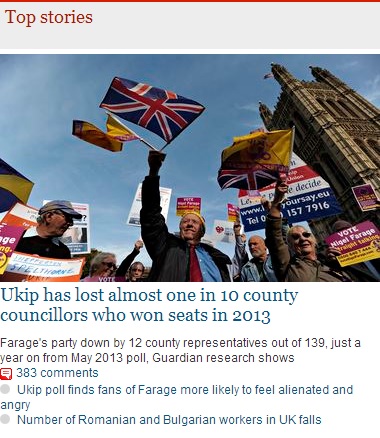
This is a screenshot of the Guardian’s top political stories taken from their website at 00.54 on Thursday 15 May, one week before election day.

All three leaders are attacks on UKIP in one guise or another. The first article points out that UKIP has experienced an unusually high degree of defections and resignations from the ranks of its 2013 intake of local councillors. The second basically suggests that UKIP supporters are paranoid and ignorant hillbillies to the last man, while the third deconstructs UKIP’s talking points on immigration from Romania and Bulgaria.

The concern is not that the Guardian’s stories necessarily lack truth or validity. But it is glaringly apparent from the choice and placement of the stories on the homepage – to the total exclusion of any other coverage – that there is a concerted effort underway at the newspaper to chip away at UKIP’s credibility and support. Given the dearth of articles analysing Conservative, Labour or Liberal Democrat policies it is clear that the newsroom’s finite resources are being used disproportionately to undermine the insurgent party, whilst allowing the established parties (even the hated Tories) almost completely off the hook.

Note also what is entirely absent from The Guardian’s political coverage of the local and European elections, not just tonight but over the course of the campaign as a whole:

No coverage of the latest polling numbers and UKIP’s strength vis-a-vis the established political parties.

No probing or questioning of the Labour and Liberal Democrat stance, which is to refuse the British people a referendum on continued membership of the European Union, despite the widespread public support for such an in/out debate.

No discussion of the ‘state of the union’, i.e. the budget, the misuse of EU funds, the incidences of corruption and the increasingly pervasive influence of corporate lobbyists in Brussels.

No discussion of proposed EU-wide financial transactions taxes, their pros and cons and their likely impact on the City of London and the overall UK economy.

No discussion for the parallel campaign for the presidency of the powerful European Commission.

A visitor to the Guardian’s website might reasonably conclude that the main three national political parties in Britain have inexplicably gone into hibernation, and that UKIP have been given the run of the house. But while it is certainly the case that UKIP have consistently provided the most attention-grabbing stories (thanks in large part to policies with grassroots appeal and a leader who doesn’t have to practice looking genuine in front of the mirror every morning), it is unforgivable for a national newspaper to so thoroughly abdicate its responsibility to cover the also-rans.

The Guardian prides itself on having a readership that is a cut above the rest in terms of book smarts, education and general worldliness. But even accounting for their audience’s generally left leaning stance – let’s not deny anyone their political biases and preferences – you would think that among these luminaries there might be some basic level of curiosity about what the other parties (you know, the ones who actually have MPs and win elections) are up to this election season.

Not that this lack of curiosity provides an excuse – even in its apparent total absence, a political editor might think to include an article or two on the policies and strategic positioning of the other parties, just as a byproduct of doing their job properly. And yet the Guardian (and many others) are content to follow the heard and serve up a constant stream of anti-UKIP sentiment to the exclusion of everything else.

For anyone still wondering, this right here is the reason why UKIP remain in contention this election season, despite the unremitting volley of negative press coverage (yes, some of it self-inflicted) and attacks from all sides of the political spectrum:

The Guardian – not to mention the leaders of the three main political parties – seem to have forgotten two rather endearing truths about the British people for whom they claim to work and speak. Firstly, the British cannot abide a bully, and anyone with even a modicum of sympathy for any of UKIP’s positions is likely to feel that the party has been unfairly singled out for criticism.

But secondly and most importantly, we British love an underdog. You can sense Nigel Farage’s frustration and impatience every time one of his improperly-vetted candidates or publicity-seeking spokespeople says something outrageous or defects in a blaze of negative publicity. One gets the impression that UKIP’s leader is fighting a solitary David and Goliath-style battle against the establishment and against the odds, very much alone. And as the immature party apparatus creaks and groans around him as it tries to fight a national campaign, one catches oneself rooting for the man. Or at least, 31% of the voters do.

When the European elections have taken place and the dust settles, much will be written and wondered aloud about how UKIP performed as well as they did given the unified forces ranged against them. Responsibility will be parcelled out, to the great recession for making people dissatisfied, to the expenses scandal for making people distrustful of mainstream politicians, to the people themselves for being credulous fools with borderline racist tendencies.

In short, the blame will be placed everywhere but the one place that it most belongs – at the feet of the smug, left-liberal bloc and their terrified counterparts on the right, who are witnessing a groundswell of legitimate dissatisfaction and demand for change from the British people, but see only a pesky political mosquito to be swatted out of existence.

Prince Charles, Nearly Exposed

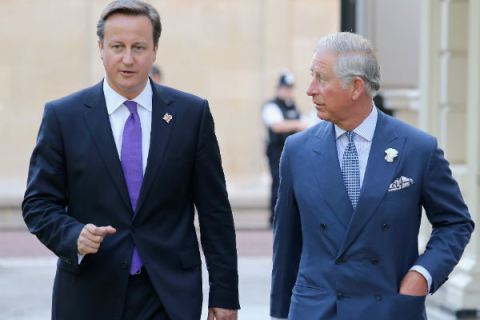
Who really gives David Cameron his marching orders?


Today has seen a rare victory in the fight for government transparency and public access to information, as a judicial review ruled that the Attorney General was wrong to veto the publication of Prince Charles’ voluminous correspondence with ministers – known as the ‘black spider letters’ – and ordered that they be disclosed.

The British government fought this development every step of the way. Dominic Grieve, the Attorney General, had used his veto to keep the letters secret after a previous ruling from an independent tribunal also ruled in favour of the public interest. However, at long last the time may have come for British citizens to read what the heir to the throne really thinks about all number of government policies and positions.

The Guardian – who waged a nine year campaign for access to the letters – report on their triumph:

Grieve had said that a cornerstone of the British constitution was that the monarch could not be seen to be favouring one political party over another. But he had said that any perception that Charles had disagreed with Tony Blair’s government “would be seriously damaging to his role as future monarch because, if he forfeits his position of political neutrality as heir to the throne, he cannot easily recover it when he is king”.

The 27 pieces of correspondence between Charles and ministers in seven government departments between September 2004 and April 2005 “are in many cases particularly frank”, according to Grieve.

Dominic Grieve and the rest of the cabinet clearly take the British people for fools. Only an idiot might think that Prince Charles is politically neutral. He has pungent and forceful views across a whole spectrum of topics from climate change to modern architecture, and his PR people take every opportunity to see that these are widely reported by anyone who will listen.

Rather than treating the British people with kid gloves as though we were sensitive little children liable to burst into tears at the sight of our parents arguing, Grieve should drop his ludicrous opposition and let us finally see what the future King thinks of his government of the people.

As the Guardian notes, the prince has taken an active interest in political matters for almost as long as Prime Minister David Cameron has been alive:

The freedom of information tribunal heard that he had been writing to ministers as long ago as 1969, when he expressed concern to the then prime minister, Harold Wilson, about the fate of Atlantic salmon.

The obvious danger is that Prince Charles’s concerns – the things that make him toss and turn at night – may well have changed and grown in the intervening forty-five years, as the number of government departments that he has corresponded with would seem to attest:

The letters concerned involve ministers in the Cabinet Office and the departments responsible for business, health, schools, environment, culture and Northern Ireland.

Worrying about salmon stocks in the north Atlantic is one thing; idly musing or ranting to ministers about Britain’s energy policy or nuclear deterrent, for example, would be another matter entirely. And one gets the strong suspicion that salmon have not remained the prince’s abiding focus.

Unfortunately, the Attorney General seems in no mood to compromise or listen to the overwhelming consensus of logic and legal opinion, and plans to appeal to the Supreme Court:

A spokesman for the attorney general said: “We are very disappointed by the decision of the court. We will be pursuing an appeal to the supreme court in order to protect the important principles which are at stake in this case.”

What important principles are these, exactly, other than the right of an unelected man to bully and intimidate junior government ministers into bending their policies and actions to his will? Should this really be the top priority for Dominic Grieve and his government office?

And why is the Attorney General going to battle to protect and enshrine the ability of society’s elites – be they financial, political, media or monarchical – to not only get their way, but then to have all record of them ever having tilted the playing field in their favour sealed from public view?

Dominic Grieve may serve as a minister in Her Majesty’s Government, but he was elected to represent we the people. Like the Guardian, I want to know how much money the government has spent on legal fees fighting to thwart the will and the interests of the people who elected them.