–
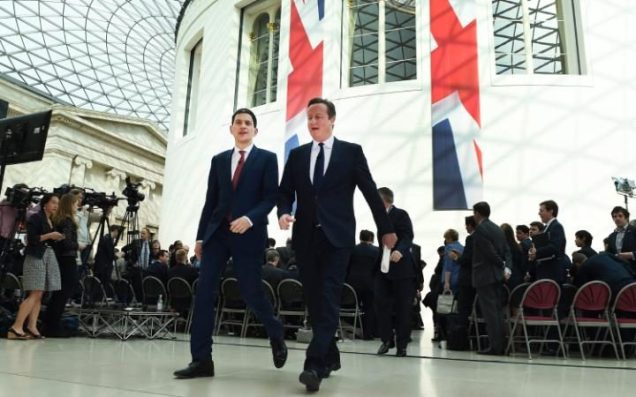
David Cameron thinks that Britain owes its limited greatness to the coiffured prancing of One Direction. This is a man who doesn’t know how to begin thinking like a patriot because he doesn’t appreciate the first thing about what makes Britain truly great
David Cameron spent much of his 20-minute grilling in last night’s damp squib of a television “debate” with Nigel Farage waffling on in the vaguest possible terms about patriotism.
Specifically, the prime minister wheeled out almost the identical meaningless phrases that he always uses when he finds himself scrambling to recover his footing – like when he failed to win an outright parliamentary majority in 2010, and when faced with worrying poll numbers in the 2014 Scottish independence referendum.
He then advanced the rather surprising argument that the way in which we might best show our patriotism and love of country is to vote for its continued subsummation into that giant self-help group for countries who have lost their mojo known as the European Union.
The Daily Mail summarises Cameron’s basic pitch:
The Prime Minister acknowledged that sometimes the EU “can drive me mad, it is a bureaucracy, it is frustrating” but “walking away, quitting, would reduce our national influence, would reduce our economy, would reduce our say in the world and as a result would damage our country”.
He told the audience: “You hear a lot of talk about patriotism in this referendum. As far as I’m concerned I love this country with a passion, I think we are an amazing country and I say if you love your country then you don’t damage its economy, you don’t restrict opportunities for young people, you don’t actually isolate your country and reduce its influence in the world.”
Warning that Brexit could lead to Scotland separating from the UK he said: “You don’t strengthen your country by leading to its break-up. So I’m deeply patriotic, but I think this is a case for a bigger, greater Britain inside a European Union.”
Urging voters to think of the next generation he said: “I hope that when people go to vote on June 23 they think about their children and grandchildren, they think about the jobs and the opportunities they want for them, the sort of country we want to build together and they vote to say ‘we don’t want the little England of Nigel Farage’, we want to be Great Britain and we are great if we stay in these organisations and fight for the values we believe in.”
He added: “Leaving is quitting and I don’t think Britain, I don’t think we are quitters, I think we are fighters. We fight in these organisations for what we think is right.”
This blog’s response to being labelled a “quitter” for wanting to leave the European Union is here.
Meanwhile, Tony Edwards of The Brexit Door blog picks up on the cognitive dissonance which must necessarily be involved in thinking that fearfully remaining in a stultifying regional political union rather than engaging with the world in the same way as every other advanced country on the planet outside of Europe is somehow the “patriotic” thing to do.
Edwards writes:
The Prime Minister is losing the debate on the EU – and so yesterday (7th June) he missed the funeral of Cecil Parkinson to attend a hurriedly arranged press conference in the run up to his appearance with Nigel Farage on ITV.
It’s not the first time we have heard this rather fatuous appeal to patriotism, this form of words first appeared late last week, but it is the polling that has driven this level of rather empty rhetoric. If you leave the EU, he says, you are a “Quitter” who doesn’t “love the UK”.
This was always the inevitable end for this campaign, this descent into pure nonsense. The trigger for the press conference was no doubt a mixture of things – the polling across the weekend, the Newsnight programme on Monday, and the recent articles in the Telegraph by both Allister Heath and Ambrose Evans Pritchard which have been very optimistic on the EEA/EFTA route out of the EU. This has been allied with the reporting of the BBC that civil servants are already planning for Brexit via this route, something that the Prime Minister has often denied, but we have heard talk of since the beginning of the year.
While there is an honourable and intellectually coherent case made for staying in the European Union and deepening our commitment to join the EU in its ultimate journey toward common statehood, this is not a debate which is ever heard in Britain. Most of our politicians, recognising that publicly suggesting that Britain join France and Germany on their long-established path to common statehood would go down like a bucket of cold sick, are unsurprisingly reticent to talk about the EU in these terms.
And so in Britain those who wish us to Remain in the EU argue from a purely fear-based economic perspective, which makes the sudden attempt to portray this as the “patriotic” choice sound especially contrived false, as Tony points out:
On the pro EU side, there is an honourable argument to be made for travel towards a single European state. On the mainland, this is a debate that actually breaks into the open. Many on the continent wish for an EU that is totally federal, and challenges the USA as the world’s leading business superpower. Some wish it to have a similar military strength, and others wish to see the elevation of large block political entities as a step towards a ‘Star Trek’ ideal of a single world government. All of these are laudable aims, but they have never been expressed in the UK debate by those who wish to remain in the EU. The argument here is always about trade, economics and migration – the short term issues.
And Tony’s brilliant conclusion:
Democracy has hardly had a word uttered about it in this debate. The EU is the beginning of the end of the rather short democratic experiment in Western Europe. For most of us, full suffrage is just less than a century old – the first truly democratic election general election in the UK was in 1929, an election which returned Ramsey MacDonald to power as the first Labour PM of a functioning Labour government. By 1961, our politicians were already looking to remove the power of the people by exporting it to the newly formed EEC, fully aware that its design was for a technocratic Europe rather than a democratic one.
So the experiment in the UK lasted no more than 32 years before politicians tried to unravel it. That is something that bears serious thought. Do we prise democracy above all else, or do we simply want a life in which the big questions are not asked of us as a people, so we are left untroubled by them?
That is the real issue at stake in this referendum, and judging by many of the responses I have seen, especially from younger people, there is a lack of willingness to engage with the deeper issues, something mirrored by the political class which plays only to the gallery.
Precisely so. The deeper question facing us is do we even want to be informed and engaged citizens any more? Are we willing to educate ourselves as to the issues, participate in our democracy and bear our share of responsibility for the resulting triumphs, disasters and (more usually) bland stalemates? Or are we happier being passive consumers of goods and public services, occasionally bleating our outrage when we don’t get what we want but otherwise content for others to do the dull work of running the country (or continent) while we devote ourselves to watching re-runs of Britain’s Animals Got Strictly Come Bake-Off On Ice?
Citizens or consumers? That is the deeper choice facing us in this EU referendum debate. Are we willing to put in the work which comes with being the former in exchange for the reward of greater control over our lives, or are we willing to wave away the responsibility in the hope that doing so keeps mortgage rates and the price of Chinese flat-screen TVs that little bit lower?
So how would a patriot act? I think it is now clear which side represents the strivers and which side the quitters. In any case, one can normally take a good cue from the words and deeds of those currently in power, and David Cameron sets a shining example for us all.
The lesson for would-be patriots, therefore, is this: speak and behave in the polar opposite manner to David “don’t be a quitter” Cameron and you won’t go far wrong.
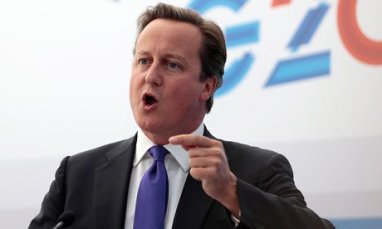
David Cameron – a prime minister whose esteem and ambition for his own country is so pathetically small that when given an open-goal to sell Britain’s evident greatness to the world he fell back on delivering a weak impression of Hugh Grant in the film “Love Actually”:

–
Top Image: Telegraph
Bottom Image: Guardian
–
Agree with this article? Violently disagree? Scroll down to leave a comment.
Follow Semi-Partisan Politics on Twitter, Facebook and Medium.

 Semi-Partisan Politics