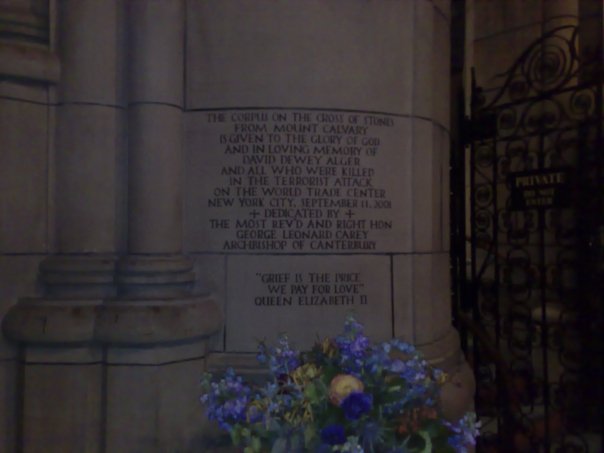
“But nothing that can be said can begin to take away the anguish and the pain of these moments. Grief is the price we pay for love.”
– Queen Elizabeth II
Queen Elizabeth II offered these words in a message read by British Ambassador to the United States, Sir Christopher Meyer, at a memorial service in New York City on 22 September 2001
The media has rightly devoted a lot of time and attention today to the fact that David Cameron’s authority was challenged by over 90 Conservative backbenchers who supported an amendment to the Immigration bill to make it harder for foreign criminals to avoid deportation by appealing to the European Court of Human Rights on the grounds that their right to a family life would be infringed.
Foreign criminals can stay; British citizens merely suspected of terror offences to lose their citizenship.
The BBC’s Nick Robinson does a good job of unpacking the ludicrous exercise in Game Theory that led the various Conservative, Labour and Liberal Democrat factions to adopt their particular stances:
The home secretary believes that a proposal to give her stronger powers to deport foreign criminals is illegal, unworkable and may, in fact, lead to fewer deportations.
So, Conservative ministers have been ordered by the prime minister not to oppose it.
Yes, you read that right.
Despite all of the above David Cameron has told his troops to abstain rather than face headlines about a massive Tory revolt. He is said to be sympathetic to the aims of the backbench rebels who have refused to back down.
I personally fail to see why the Home Secretary or any elected politician should be personally involved in deciding deportation cases, in much the same way that I find it bizarre that they can determine whether or not to release prisoners serving life sentences. These matters should be non-political and sit with the judiciary, and while I am in favour of deporting foreign criminals I would much rather achieve this end by empowering judges and allowing them to apply clear legislation stating that criminal conviction of a non-citizen would result in the rescinding of the right to reside in the UK than by conferring even more powers on the Home Secretary to make life-and-death decisions over individual cases. But this is by the by.
The chicanery and slapstick attempts by the Home Secretary Theresa May and the party leadership to first outmanoeuver and then placate the rebellious backbenchers, some of which I personally witnessed from the public gallery of the House of Commons, are certainly newsworthy. But there is a real danger that the story will be framed as being primarily about Cameron’s leadership, or the potential impact of intraparty fighting on the Conservatives’ prospects at the next election, when something much more fundamental is also taken place. Namely, the fact that the bill, as it stands, would give government the power to strip a naturalised British citizen of their citizenship on the mere suspicion of being engaged in terrorist conspiracy.
[Deputy Prime Minister Nick] Clegg said he supported the home secretary’s proposal to strip naturalised British citizens of their citizenship if they are judged to present a threat to national security. It would even apply to those who have no other citizenship, rendering them stateless.
He said the current laws had become a “passport for endless games in the courts to prevent people being deported that should be.
“We are tightening up the way the courts can interpret article 8, the right to a family life, so it cannot became an excuse for unjustified legal procrastination.”
Speaking on LBC’s Call Clegg, he added he knew the plan to make some naturalised British citizens stateless was controversial, but justifiable in a very small number of cases. He said the revocation of British citizenship “would apply in cases where individuals pose a real threat to the security of this country”.
“Judged” to present a threat to national security, but not convicted of any crime by a jury to back up the allegation. Perhaps this is just the inevitable next step given the fact that the British government for a long time also advocated control orders to keep terrorism suspects in a state of legal and personal limbo without giving them full legal due process.
Of course, Nick Clegg is eager to assure us that any cases of citizenship revocation will be extremely rare and only conducted in the gravest of circumstances – but since those circumstances would always be opaque to the general public, any words that he utters in support of this draconian and inhumane measure can be distilled into the much shorter phrase “just trust me”. He has given the British public no good reason to do so. And if the number of cases is really so small, what exactly is the compelling reason that they cannot have their day in court to determine their guilt or innocence of conspiring to commit terrorist acts? By Clegg’s own admission it certainly can’t be concern for the workload of the courts.
Fortunately the ever-watchful eye of Liberty, the National Council for Civil Liberties, picked up on what is happening and issued a stern public rebuke to the government, for what little good it will do:
Shami Chakrabarti, director of Liberty, said: “Liberty always said that terror suspects should be charged and tried. First politicians avoided trials for foreign nationals; now they seek the same for their own citizens.
“This move is as irresponsible as it is unjust. It would allow British governments to dump dangerous people on the international community, but equally to punish potential innocent political dissenters without charge or trial. There is the edge of populist madness and then the abyss.”
It is tragically ironic that, if the bill passes in its current form, the law will grant a convicted foreign criminal the right to remain in the UK and avoid deportation because of a fictitious invented “human right” to remain with their family in a country not their own, while a legal, naturalised British citizen merely suspected of a terrorism offence stands to have their British citizenship revoked, potentially rendering them stateless.
Surely this is one civil liberty infringement and constitutional idiosyncrasy too far, even for our increasingly draconian, secretive national security State?
Note – The BBC’s Mark D’Arcy has an excellent explanation of the parliamentary rules and procedures which influenced the outcome of today’s parliamentary antics. The bill is currently at Report stage, the only opportunity for the entire House of Commons to debate the bill in detail and propose amendments, and at this stage it is essentially left to the whim of the Speaker, John Bercow, to determine which amendments are debated and vote on in the limited time available. If this doesn’t seem to you like quite the best way to scrutinise and amend new legislation, you are not alone in your thinking.
Sometimes they can’t help themselves. Politicians latch on to a word or a concept that is (often rightly) repugnant to almost everyone, and then, with great fanfare, roll out a new law supposedly desired to prevent said thing, or at least to impose tougher penalties on those people who do the Bad Thing.
He’s had another idea.
The Bad Thing in this case is training to be a terrorist (or undertaking “terrorism training” as the Guardian reports), the penalty for which is due to increase from a current maximum sentence of 14 years to a life sentence under the new proposals.
The maximum sentence for a range of terrorist offences, including weapons training, will be increased, under plans being drawn up by security officials.
Current laws allow such offenders to be jailed for 14 years. The new regime will allow judges to impose life terms.
Significantly, that would also mean extremists would be subject to additional monitoring when they are eventually released.
And as with most tinkerings to existing laws in Britain, this one is so riddled with generalisations, non sequiturs and loopholes that there is more daylight than content in the proposals. As we have also come to expect, we see the additional empowering of the police and security services to monitor and meddle in a person’s life for evermore, long after they have completed their punishment and served their time. Here are a few of the more obvious flaws, off the top of my head:
1. In the marginal case, how do you tell the difference between someone who has gone to another country and undertaken weapons training of some kind with no real intent to cause carnage back home in Britain or elsewhere, and one who has attended a bona fide “terrorism training camp”? The last time I checked, there was no formal accreditation of terrorist training institutions against which MI6 can cross-check, or formal evidence of graduation given to successful students. Certainly, we can all picture in our minds the images of masked men with guns and suicide vests running through obstacle courses, but the reality is probably somewhat less clear-cut. Who will be the final arbiter of these too-close-to-call decisions?
2. How will anyone accused of this crime ever receive a fair trial? If it is alleged by the prosecution that they have attended a terrorist training camp, it is highly likely that the evidence required to convict them will be of a secret nature, which if made public would jeopardise the foreign intelligence that Britain is collecting. Scenarios such as these tend to lead to secret trials without juries, where the life and liberty of the accused is decided by a solitary judge behind closed doors, with no public scrutiny.
3. Someone who has acquired skills which could – and only could – be used to harm the general population has yet to really commit any offence against British society or soil. Yes, the fact that a person has gone to a “dangerous” country and spent time in the company of other people holding “extremist” views may greatly increase the probability that they plan to turn knowledge into action (and so, perhaps, warrant greater monitoring of their actions by the security services), but until they actually make concrete plans to do so, arresting and imprisoning them for any length of time sits far too squarely in the category of punishing thought-crime for my liking.
4. It is entirely possible (as has been proven multiple times) to inflict massive damage and loss of life in a terrorist act without ever actually having left Britain to receive training elsewhere. It may seem remarkable that British laws and public policy are still being drafted in 2014 which do not account for the reality of the internet, but here we have just such a case. What is the real difference between a person downloading instructions to make and place a bomb from a source on the internet, and going to another country to receive that same tuition face-to-face? Why does the government seek to punish one more than the other? And how do we distinguish between someone who idly (or accidentally) downloads instructions for making a bomb with no malicious intent, and one who intends to put the knowledge to immediate use?
Why, indeed, does the government seek to do any of the things that these new measures will allow it to do?
Very little of it truly has to do with improving public safety. That is done (rightly or wrongly) mostly behind the scenes, in terms of adequately funding the security services and giving them sufficient remit to do their work. What this is about is not protecting the public, but rather being seen to be doing something. Chris Grayling, the Justice Secretary, is able to look busy and important, and taking firm action at just the time when many of what the Telegraph describes as “radicals jailed after the September 11, 2001, attacks” are approaching the end of their custodial sentences.
That is not to dismiss the real problem facing the government, which the Telegraph rightly lays out:
Security sources estimate that more than 100 British nationals have fought in Syria, backing rebel groups linked to al-Qaeda.
British nationals are also said to be involved in extremist activity in countries including Somalia and Yemen.
These are thorny problems with grave implications if they are not properly met. And in some cases, changes to the laws and sentencing guidelines may well be valid. But the current package being put forward by the government, as outlined so far in the press, appears to be fundamentally unserious. Why is the focus on criminalising the acquisition of the knowledge of terrorism rather than its practice, as manifested either by helping terrorist groups in other countries or conspiring to commit terrorism at home in Britain? These offences would not only be much easier to recognise and prove in court, but also take us away from the path toward thought-crime down which legislation such as that proposed inevitably leads us.
Last-minute lawmaking on the fly. Draconian new powers that are justified using unassailably valid examples, but which could equally be applied to much less clear-cut cases. Government desperate to be seen to be taking bold, decisive action rather than calmly contemplating the best course of action.
Ruth Marcus from the Washington Post and Glenn Greenwald from the Guardian went head-to-head on CNN this Monday, discussing the recent New York Times editorial calling for clemency for US whistleblower Edward Snowden. As the New York Times rightly concluded in their editorial:
When someone reveals that government officials have routinely and deliberately broken the law, that person should not face life in prison at the hands of the same government.
This was not the view of Ruth Marcus, who, showing much in common with the self-serving elitists and power fetishists who festoon Washington D.C., seems to swoon at government overreach and seeks to protect her own kind from any kind of scrutiny or consequences of their actions, whilst happily throwing the little guy or the outsider under the bus at the first opportunity:
Snowden … is seized with infuriating certitude about the righteousness of his cause. Not for Snowden any anxiety about the implications for national security of his theft of government secrets, any regrets about his violations of a duty of secrecy.
Quite how she knows that Snowden has no anxiety about these things is not entirely clear, but since she has never met Snowden I think it would be fair to surmise that she made this statement up. It would harm her cause, cheerleading for the Obama administration and the national security apparatus, if she acknowledged the fact that Snowden may have wrestled with his decision to divulge what he knew, that he had to weigh up the pros and cons of his actions.
It’s never good when experienced, professional commentators seek to drag George Orwell into their arguments, but Marcus indulges herself:
George Orwell himself would have told Snowden to chill — and the author of “Animal Farm” surely would have shown more recognition of the irony of Snowden’s sojourn in Vladimir Putin’s Russia. Does a man whose life is conducted so much online really believe that Putin’s spies are not cyber-peering over his shoulder?
I believe that the irony, such as it is, is that a man from a supposedly free society has more liberty hiding out in Putin’s oppressive Russia than he would in his own native land, for doing nothing more than exposing the secret and unlawful actions of his government. That fact doesn’t make a mockery of Snowden, but it does make the United States look rather bad.
But it is on her next point that Marcus really overreaches:
On behavior, if Snowden is such a believer in the Constitution, why didn’t he stick around to test the system the Constitution created and deal with the consequences of his actions?
And here is where it gets good, because when CNN host Jake Tapper asked Glenn Greenwald to comment on Marcus’ position, he gave it to her with both barrels:
Temporarily putting aside the correctness of Greenwald’s position, the real money quote, and the thing that really gets to the rub of the matter is this:
I think Ruth Marcus’ argument exemplifies everything that’s really horrible about the D.C. media … People in Washington continuously make excuses for those in power when they break the law.
Yes, we see this time and again, and Greenwald has himself addressed this topic at length in his excellent book “With Liberty and Justice for Some”.
But in terms of refuting Marcus’ fatuous and glib suggestion that if Snowden really valued the US. Constitution he should have been willing to surrender himself and submit himself to the American legal system in order to advance his cause and win his case in the court of public opinion, Greenwald correctly states:
“If he had stayed in the United States, as Daniel Elsberg (widely considered to be a hero by most Americans) argued in the Washington Post, he would have been barred from making the very argument that she just said he should have made. Under the Espionage Act, you’re not allowed to come into court and say “I was justified in disclosing this information”, there is no whistleblower exception in the Espionage Act which is why whistleblowers don’t get justice in the United States.”
May this once and forever do away with the misleading assertion by national security fanatics and civil liberty deniers that Edward Snowden ever had – and spurned – a realistic chance of making his case to the public whilst remaining in the United States, or that his flight to Russia is in any way ironic or detracting from the validity and strength of his arguments. This is not the case.
Mediaite also provides a good summary of the exchange here.
Two stories in the media this afternoon, each quite different in nature but both pointing toward the same dark, disturbing and authoritarian shift that continues unabated in Britain today.
The officer is heard to say, “we’ll nick you now and I will make your day a living hell, ‘cos you’ll be in that cell all day. What I’ll probably do is I will ask for you to be remanded in custody and I will put you before the magistrate.”
He added: “You’re lucky that I didn’t knock you out. I swore at you, yeah. It got your attention, though, didn’t it?”
Because apparently taking pictures or video of the aftermath of a road accident is now illegal in our country, as is showing anything but the most fawning and servile deference and adulation to the most power-crazed and high-handed officers in the police force.
The second article is chilling on an altogether different level, and chronicles the process by which the UK’s anti-terrorist police decided that it would be in any way appropriate and proportional to haul a twelve year old boy out of his class at school to question him about an event that he had organised on Facebook to protest the planned closure of his local youth club:
Wishart said that after the school was contacted by anti-terrorist officers, he was taken out of his English class on Tuesday afternoon and interviewed by a Thames Valley officer at the school in the presence of his head of year. During the interview, Wishart says that the officer told him that if any public disorder took place at the event he would be held responsible and arrested.
Speaking to the Guardian, Nicky Wishart said: “In my lesson, [a school secretary] came and said my head of year wanted to talk to me. She was in her office with a police officer who wanted to talk to me about the protest. He said, ‘if a riot breaks out we will arrest people and if anything happens you will get arrested because you are the organiser’.
The event was organised in the Prime Minister’s home constituency of Witney in Oxfordshire, but in what possible dark, dystopian world is it okay for the police to make a mountain out of a truly tiny molehill and question the intentions of a young boy who was doing nothing but being an engaged and activist citizen? Our country would be vastly better off if there were more children like Nicky Wishart, who actually care about local issues enough to take a stand rather than festering away in front of the television for hours on end.
But it is the next quote attributed to the police that is truly terrifying:
“He said even if I didn’t turn up I would be arrested and he also said that if David Cameron was in, his armed officers will be there ‘so if anything out of line happens …’ and then he stopped.”
If anything out of line happens, the armed officers will do what, exactly? Shoot a twelve year old boy as some kind of sadistic punishment? What reason is there to mention the potential presence of armed officers, other than to imply that they might do the one thing that regular police officers do not?
The truly scary thing is that we don’t even have to worry about our politicians using their power and influence to get the security services to intimidate and threaten the population on their behalf – the security services seem perfectly willing to proactively do so of their own volition!
We must also ask why it was the anti-terrorist police (who apparently have no real serious threats to the nation on their agenda at the moment to be wasting time on routine public intimidation work, for which I suppose we can all breathe a sigh of relief), of all the many branches of our national law enforcement apparatus, who seemingly felt it necessary to bully a small child about his planned political protest. Has GCHQ intercepted terrorist chatter that Al Qaeda intends to infiltrate local community action groups in order to launch their next attack? Whatever next – fears of ricin or anthrax being baked into scones at a Women’s Institute cake sale, and elderly ladies being detained in their kitchens?
The police make the predictable but ludicrous claim that their intention was not to cause distress or to intimidate Wishart, but was simply part of their standard community outreach efforts:
“On Tuesday 7 December, our schools officer for west Oxfordshire attended the school in Eynsham and spoke to a 12-year-old boy in the company of the pupil’s head of year, about a planned protest. This was not with the intention of dissuading him from organising it, but to obtain information regarding the protest to ensure his and others’ safety. As with any demonstration, we always aim to facilitate a peaceful protest.”
Perhaps the police need to apply the “ordinary person” test and reconsider the likely effect of being yanked out of class and spoken to by police in the presence of a senior teacher with no parents or legal representatives present, on the psyche of a young boy. Is doing what they did more likely to “facilitate a peaceful protest” or to stamp out a potential protest before it ever sees the light of day?
David Cameron needs to send a very clear message to the nation in response to this outrage, as a matter of urgency. And through the locally elected police commissioners, he needs to publicly rebuke and call off the police attack dogs currently biting at the ankles of the British citizenry. Cameron and the commissioners must make clear that individual police officers will curry no favour with their superiors by overzealously applying extreme interpretations of public order laws, and that those higher in the law enforcement hierarchy will receive no special favour from their political masters by using their extensive powers to bully and silence any protest that could be politically embarrassing.
Semi-Partisan Sam is quite unequivocal on this matter. The apology from the police to the family concerned is all well and good, but it is quite insufficient. It is high time that the British police are brought to heel once and for all.





 Semi-Partisan Politics