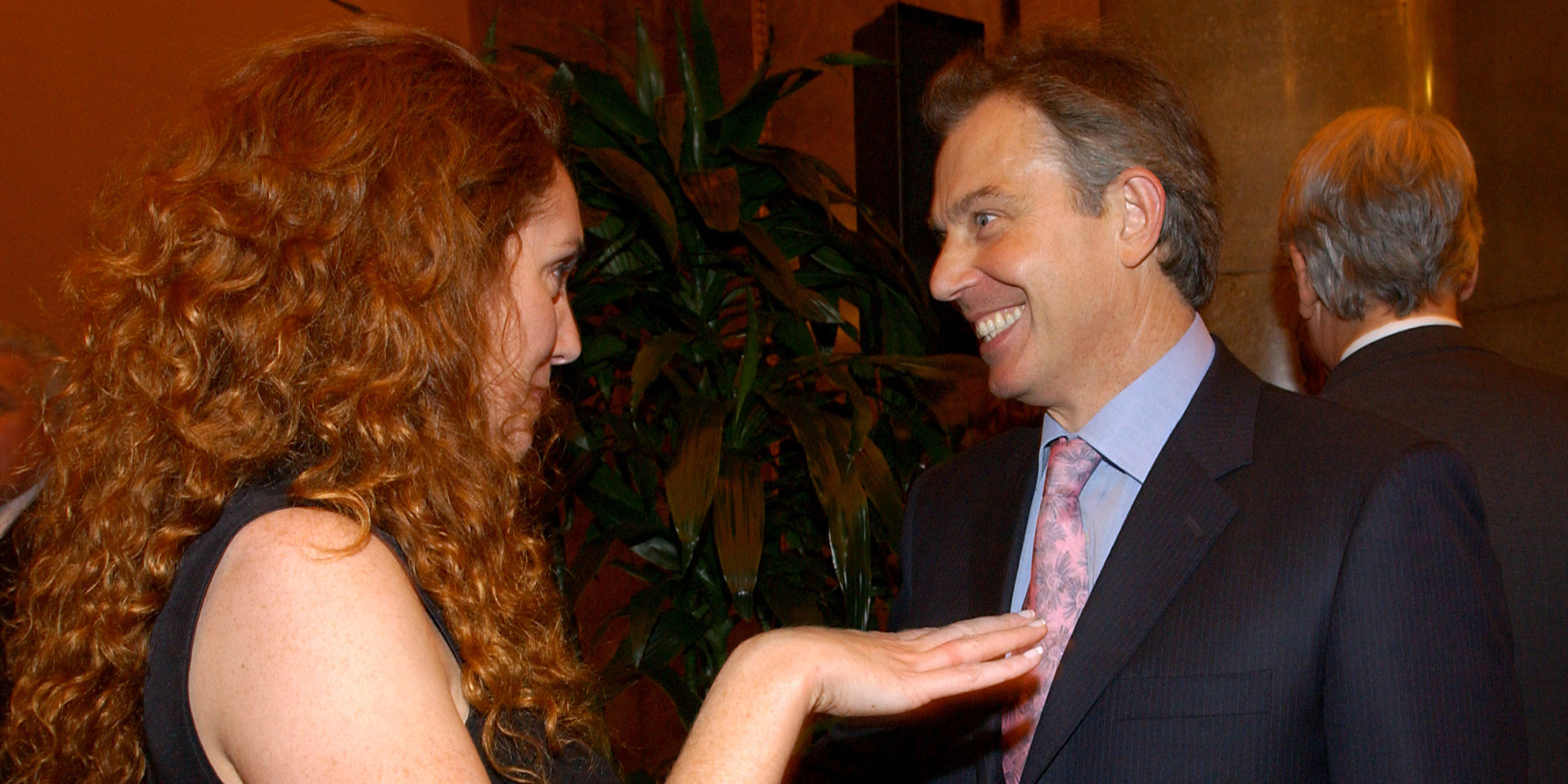
Tony and Rebekah, Sitting In A Tree


Democracy cannot survive without a free press willing and able to act as a check on government power and behaviour.

The relationship between the government and the media should therefore be adversarial – although it was thuggish of David Cameron’s government to dispatch the Cabinet Secretary to the Guardian’s offices to bully them into destroying their computers in the wake of the Edward Snowden scandal, rather this terrible, flagrant abuse of power than the chilling alternative of Sir Jeremy Heywood popping by every single afternoon for tea, chitchat and a list of government-sanctioned news stories for publication.

But it is this latter, far more insidious type of close, symbiotic relationship that has been prevalent between parts of the British media and the politicians on whom they report and are supposed to keep in check.

Former prime minister Tony Blair may no longer occupy Number 10 Downing Street, but the self-evident warmth of his newly revealed correspondence with Rebekah Brooks – former chief executive of News International, now on trial for her alleged role in the phone hacking scandal – shows just how overfamiliar those in power can get to those who lead the publications who supposedly scrutinise them.

The following exchange of text messages between Tony Blair and Brooks on the day after her resignation, reported by The Guardian, really says it all:

Tony Blair: If you’re still going to parliament you should call me. I have experience of these things! Tx

Rebekah Brooks: Definitely depends on the police interview first. I have Stephen Parkinson [a lawyer] here today. I have never met him but people say he is good.

Tony Blair: He’s excellent.

Rebekah Brooks: Great news. Feeling properly terrified. Police are behaving so badly.

Tony Blair: Everyone panics in these situations and they will feel they have their reputation to recover. Assume you have quality QC advice? When’s the interview?

Rebekah Brooks: Sunday probably or Monday. Cms committee. Tuesday. Stephen bringing someone called Emma Hodges and we have QC.

Tony Blair: That’s good. I’m no use on police stuff but call me after that because I may be some help on Commons.

Rebekah Brooks: Great. Will do. X

There are two issues here. The first is the impropriety of a former UK prime minister essentially offering coaching to someone involved in a very current public scandal before they are due to give evidence at a parliamentary committee hearing. While there may be no legal prohibition on this type of interaction, it seems very morally dubious. Were the subject of the hearing about anything else it could perhaps be overlooked, but since it was a hearing of the Culture Select Committee specifically on the allegations of phone hacking and the issues raised about the behaviour of the press, Blair’s offer of counsel and friendly support seems to put him squarely on the side of the alleged perpetrators rather than the victims.

The second issue is the self-evident friendship between the former news executive and the former politician. Friendships such as these are forged over time, some of which was doubtless while Tony Blair was still  prime minister. If Tony Blair’s regard for Rebekah Brooks is such that he was offering her emotional support via text message at the height of the phone hacking scandal, what other acts of friendship was he bestowing upon her while he still occupied Number 10 Downing Street? And how might the publications that Brooks ran have reflected this friendship?

Some might argue that it is unfair to question the nature of this friendship. They are wrong – it is entirely appropriate. Serving as prime minister comes with certain responsibilities and standards of behaviour. It may not be part of the oath of office, but one of those responsibilities is surely to maintain professional relationships with business and the media. If both Tony Blair and Rebekah Brooks were doing their jobs properly during the period of his premiership, this would almost certainly have precluded any meaningful friendship from forming. If, however, they were behaving toward each other then as they apparently do so now, everything suddenly makes a lot more sense.

While the release of Tony Blair and Rebekah Brooks’ text message correspondence doesn’t really tell us anything that we didn’t already know – that our elected leaders are sometimes far too close to the press barons who help to control the news agenda – seeing the evidence in black and white is still unsettling.

Recalling Tony Blair as prime minister and then juxtaposing this new image of “T” sending kiss-laden text messages to the woman who then edited Britain’s most-read newspaper casts that era in a whole new, sordid light. The dirty, illicit feeling that reading these messages evokes would be more at home in the television series “House of Cards” than real-world Britain.

We deserve better from our politicians, and from the news media.

Gove Educates Leveson On Free Speech

I do admire Michael Gove, the UK Education Secretary. When virtually all of the other Conservative cabinet members from David Cameron on downwards have proven themselves to be one disappointment, letdown and betrayal of principle after another, at least Michael Gove has been steadfastly working away at the Department for Education to bring about some real, conservative reforms.

So I was several steps beyond overjoyed when I found out that Gove had been giving evidence to the riveting Leveson Enquiry “into the culture, practices and ethics of the press”.

Suffice it to say that Leveson met his match yesterday:


Bravo! Since our taxpayer money is being frittered away in order that this pompous, self-aggrandising old gasbag Leveson can sit there like some modern-day oracle, cooking up new ways to constrain freedom of speech in our country, I am happy that those of us who disagree with the premise of the whole enquiry in the first place were able to extract some small measure of payback by sending Michael Gove into the fray to make him squirm a bit.

A couple of points to note from this video:

1. Just look at Leveson’s defensive, hunched posture compared to the relaxed, attentive stance of Gove. Leveson is clearly used to being flattered and deferred to almost all the time, and clearly was not ready to have his assumptions – and the preordained outcome of the enquiry – challenged in so articulate a fashion.

2. This is supposed to be an impartial enquiry, remember? So statements like “Don’t you think that the evidence I have heard from at least some of those who have been the subject of press attention can be characterised as rather more than ‘some people are going to be offended some of the time’?” have no place being uttered by Leveson. What does it matter what other evidence he has heard? Michael Gove is on the stand now, giving his opinion, which rightly should be his alone and not influenced by the parade of people who have already taken the stand. I’m not a lawyer, but isn’t that how these things are supposed to work? This is clearly a man who has made up his mind before he has even started deliberating.

The right-wing press in Britain was of course greatly cheered by this turn of events. From David Hughes, writing at The Telegraph:

Throughout the Leveson Inquiry it’s been pretty evident that it was the lawyers who felt they were the smartest guys in the room. Today that changed. Michael Gove, the Education Secretary, gave a virtuoso display of both intellect and guts as he made the case for press freedom. It’s perhaps no surprise that this journalist turned politician should, for the first time, take the argument to the Inquiry and swing it away from its focus on Murdoch and hacking and concentrate its mind on the wider issue of freedom of expression.

Plenty of witnesses have had mini-spats with Robert Jay QC, the counsel for the Inquiry, but no-one has so far tried to lock horns with Lord Leveson himself. Gove did so with brio: “Before the case for regulation is made, there is a case for liberty as well…I am unashamedly on the side of those who say we should think very carefully about regulation. By definition, free speech doesn’t mean anything unless some people are going to be offended some of the time.”

http://blogs.telegraph.co.uk/news/davidhughes/100161393/michael-gove-plays-a-blinder-at-leveson/

Michael Deacon, also writing at The Telegraph, came away similarly impressed:

Mr Gove was once a journalist, and three months ago said the inquiry might have a “chilling” effect on the press. He clearly hadn’t come to roll over. You could see it in his posture: always leaning sharply forward, as if to confront his interrogators. Without embarrassment he described Rupert Murdoch as “one of the most impressive and significant figures of the last 50 years”. He spoke out against the creation of new press regulations, and stressed the importance of free speech.

Perhaps all this makes his performance sound pompous. Yet it wasn’t. Even – or perhaps especially – at his most serious, Mr Gove is drolly camp. There’s more than a whiff of Niles Crane about him.

Lord Leveson didn’t seem amused. “I don’t need to be told the importance of liberty, Mr Gove,” he said frostily. “I really don’t.” Mr Gove didn’t so much as blink.

http://www.telegraph.co.uk/news/uknews/leveson-inquiry/9298341/Leveson-sketch-Michael-Gove-Secretary-of-State-for-Rogets.html

Even the BBC News analysis was quite complimentary:

He is one of the highest profile libertarians in his party and he gave a passionate defence of the right of freedom of speech. But the suggestion that it counted for nothing unless some people were offended some of the time, clearly got under Lord Justice Leveson’s skin.

The long, tense exchange that followed between the two men got to the very heart of the argument that Leveson is wrestling with – whether new laws and regulation will be needed to rein in the press.

The background to all this is a speech Mr Gove made a few months ago when he warned that the Leveson inquiry could have a “chilling” effect on press freedoms.

The education secretary has expressed his concern that the case for liberty could be drowned out by the anger over phone hacking. This performance in the witness box ensures that that argument will be heard and his close relationship with the prime minister means it’s a message that will go right to the top once the inquiry reaches its conclusion.

http://www.bbc.co.uk/news/uk-politics-18257958

Sadly, this excellent exchange is highly unlikely to have any bearing on the outcome of the enquiry, the findings of which Leveson is probably already writing as he still hears evidence. Leveson clearly views himself as the moral arbiter of the media, and will no doubt recommend some new burdensome regulations and oversight to further suppress freedom of expression in the press. The best hope for those on my side of the argument will be that as has been the case with so many other enquiries, the findings will be warmly praised, filed away and never acted upon.

Nonetheless, yesterday was a good day for freedom of expression in Britain, as Michael Gove revealed the faux-concern of the Levesons and other pro-regulation afficionados for the overbearing, control-freakish sham that it is, and sounded a call to arms for the defence of freedom of speech in this country.