The Age Of Trump: As The Republican Party Goes To Its Armageddon

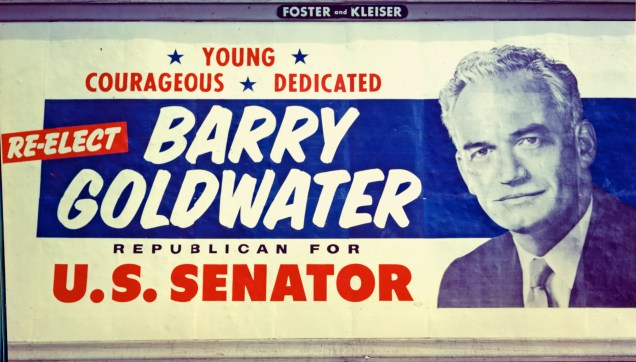
Barry Goldwater - Election Poster

To understand why the Republican Party are on course to lose their third consecutive presidential election, one must look much further back in time than the rise of Donald Trump

It gives no satisfaction to watch any storied political party hurl itself into oblivion – even the US Republican Party, which has frequently infuriated true conservatives with its sanctimonious and hypocritical habit of screeching about the dangers of encroaching socialism under Democratic administrations while themselves consistently cranking up the size and role of the state at every opportunity.

But while it now seems almost certain that the Republicans have thrown away any chance of reclaiming the White House, imploding in a foul-mouthed torrent of bluster and recrimination more worthy of Jerry Springer than a presidential primary campaign, it is worth looking back and asking how the GOP finds itself in this position, and exactly when the seeds of destruction were sown.

I have been reading widely on this, focusing less on the crowing and virtue-signalling Left, and far more on those thoughtful and introspective voices on the Right who are often appalled by the rise of Donald Trump in particular, but often sympathetic to the anti-establishment fervour which fuels his candidacy.

And if I have to pick just one excerpt from one piece to explain the predicament in which the Republican Party currently finds itself, I would encourage my readers to read “I was wrong about Donald Trump” by Daniel McCarthy over at The American Conservative.

In his piece, McCarthy concludes:

Trump succeeds because of more than outsize personality, of course. He attracts some support from everyone who thinks that Conservatism, Inc. and the GOP establishment are self-serving frauds—everyone who feels betrayed by the party and its ideological publicists. Working-class whites know that the Republican Party isn’t their party. Christian conservatives who in the past have supported Mike Huckabee and Ben Carson also know that the GOP won’t deliver for them. Moderates have been steadily alienated from the GOP by movement conservatives, yet hard-right immigration opponents feel marginalized by the party as well. Paleoconservatives and antiwar conservatives have been excommunicated on more than one occasion by the same establishment that’s now losing control to Trump. They can only applaud what Trump’s doing, even if Trump himself is no Pat Buchanan or Ron Paul.

Conservative Republicans™ somehow maneuvered themselves into a position of being too hardline for moderates and non-ideologues, but not hardline or ideological enough for the right. Trump, on the other hand, appeals both to the hard right and to voters whose economic interests would, in decades past, have classed them as moderates of the center-left—lunch-pail voters.

What’s even more remarkable is that movement conservatives, who have been given plenty of warning, ever since 2006, that their formula is exhausted, keep doing the same thing over and over again: they’ll dodge right, in a way that right-wingers find unsatisfactory but that moderates find appalling; then they’ll weave back to the center, in a way that doesn’t fool centrists and only angers the right. Immigration—which was another of George W. Bush’s stumbling blocks, lest we forget—has been the issue that symbolized movement-conservative Republicanism’s futility most poignantly. It’s not even clear that most GOP voters agree with Trump’s rhetorical hard-line on immigration—they just like it better than the two-faced talk of the average Republican politician.

Trump has a plethora of weaknesses, as general election polls amply demonstrate. But just look what he’s up against within the Republican Party: that’s why he’s winning.

I have yet to see the rise of Donald Trump explained as thoughtfully and succinctly as it is in the first three paragraphs quoted above. Sure, McCarthy’s piece does not tackle every aspect of the situation – whole books can and will be written about the causal factors of this huge anti-establishment backlash, which is far bigger than any one political party – but it does explain why the current GOP was so badly positioned to withstand a populist insurgency like Trump’s.

Much like the British Labour Party has become a fractious and increasingly unworkable coalition of idealistic left-wingers, pragmatic centrists and (let’s be frank) soulless political shapeshifters, and much as the historic splits in the Conservative Party are re-emerging following a vacillating 2016 Budget and the party leadership’s betrayal of the activist base on the coming EU referendum, so the Republican Party’s big tent of Reaganites, neo-cons, Evangelicals and social conservatives is collapsing – for those reasons outlined above by McCarthy.

Read the collected output of Rod Dreher too, and this piece by David Brooks, which looks to the future which could yet follow 2016’s rock bottom:

Trump is prompting what Thomas Kuhn, in his theory of scientific revolutions, called a model crisis.

According to Kuhn, intellectual progress is not steady and gradual. It’s marked by sudden paradigm shifts. There’s a period of normal science when everybody embraces a paradigm that seems to be working. Then there’s a period of model drift: As years go by, anomalies accumulate and the model begins to seem creaky and flawed.

Then there’s a model crisis, when the whole thing collapses. Attempts to patch up the model fail. Everybody is in anguish, but nobody knows what to do.

That’s where the Republican Party is right now. Everybody talks about being so depressed about Trump. But Republicans are passive and psychologically defeated. That’s because their conscious and unconscious mental frameworks have just stopped working. Trump has a monopoly on audacity, while everyone else is immobile.

[..] At that point the G.O.P. will enter what Kuhn called the revolution phase. During these moments you get a proliferation of competing approaches, a willingness to try anything. People ask different questions, speak a different language, congregate around a new paradigm that is incommensurate with the last.

That’s where the G.O.P. is heading. So this is a moment of anticipation. The great question is not, Should I vote for Hillary or sit out this campaign? The great question is, How do I prepare now for the post-Trump era?

As Brooks says (perhaps a little naively), this is not necessarily all bad news for conservatives. If we are honest, we have to admit that conservative policies in America and Britain are no longer perfectly calibrated to the challenges of the day as they were in Thatcher and Reagan’s time.

That is not to say that the Left are any better; Lord knows they aren’t. But it does mean we should acknowledge certain facts – like the fact that we still have a stubbornly large permanent underclass, and that for all the irreplaceable benefits of globalisation, there are still those who miss out – and seize the initiative by proposing radical conservative policy solutions to the great challenges of the new century.

In Britain, David Cameron’s Coke Zero Conservative government – or the Ted Heath tribute act, as this blog has taken to calling them – seem to think that One Nation Conservatism means stealing as many of Labour’s left-wing ideas as possible. And in America, Donald Trump’s brand of populist pseudo-conservatism doesn’t believe in One Nation at all, unapologetically carving the country up into winners and losers.

Neither is the correct approach. And as Cameronism and Trumpism run their respective courses, this blog will continue providing commentary and offering suggestions for an alternative conservatism, in Britain and America.


Postscript: This blog has decreased its focus on US politics in the past few years, primarily because I have been London based and fully occupied writing about British political issues. But Semi-Partisan Politics will begin to cover the American presidential election with a little more frequency going forward, partly because I have always remained a close follower of American politics – often more so than the household name journalists dispatched to the States by their newspapers and now portentously reporting back to us as self styled “experts”.

Having lived in America helps – particularly having lived in the American Midwest, not just the coastal enclaves of New York and Washington, D.C. familiar to most British journalists who write about America during election season. And the fact that I am married to a Hillary Clinton-supporting Hispanic Texan helps too. When I write about American politics, I know whereof I speak.

But I am also covering the presidential race because as a conservatarian with one foot firmly planted on either side of the Atlantic (and a heart divided equally between Britain and America), I believe that in my own small way I can bring a perspective to the left/right, authoritarian/libertarian debate that is often missed by those whose thinking and writing is rooted firmly in just one country’s specific conservative tradition.

To borrow an overwrought phrase from the dystopian world of Identity Politics, consider this my contribution to an “intersectional” perspective on conservatism.

They’ll absolutely hate me for that.


Donald Trump Hat - Make America Great Again

Agree with this article? Violently disagree? Scroll down to leave a comment.

Follow Semi-Partisan Politics on TwitterFacebook and Medium.

Preventing People From Attending Donald Trump Rallies Is Undemocratic

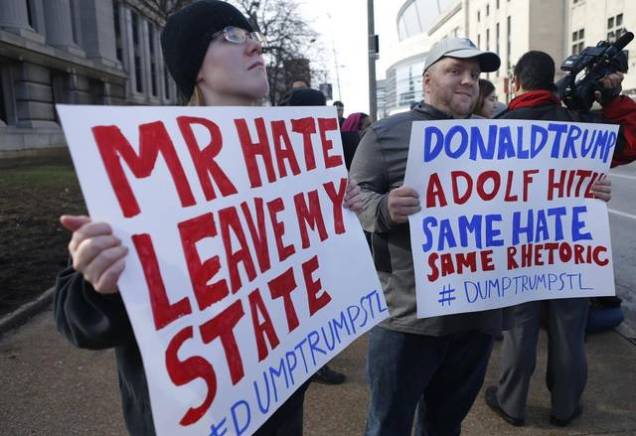
Donald Trump Protesters - St Louis

Shutting down political rallies with the threat of violence and blocking public access to hear a political candidate speak is not behaviour worthy of any citizen of a democracy

People have every right to feel alarmed or even scared about the presidential candidacy of Donald Trump. This blog believes that a Trump presidency, were he to secure the Republican nomination and win the general election, would be jarringly populist at best and economically ruinous at worst, though I dismiss any alarmist talk that Trump is in any way equivalent to the Nazis or other genocidal fascists.

Such hyperbole from anti-Trump activists is thoroughly unhelpful at a time when tempers are already flaring on both sides. After all, if you are a supporter of Donald Trump then having an angry college student yell in your face that you are supporting the new incarnation of Hitler will likely make you quite unreceptive to engaging in further debate and potentially being persuaded to change your views.

But the invective (on both sides) and hand-writing hysteria (primarily from the anti-Trump crowd) are nothing compared to the more blatantly anti-democratic methods by which some liberals are now attempting to shut down Donald Trump’s message rather than take it on in the battle of ideas.

The Huffington Post reports that some demonstrators are now attempting to block public access to Donald Trump rallies to prevent his supporters from hearing him speak, under the banner “Shut Down Trump”:

Protesters on Saturday blocked the roads leading to a Donald Trump rally in Fountain Hills, Arizona.

[..] An ABC 15 anchor reported at least three people had been arrested in connection with the protests. Deputy Joaquin Enriquez, a spokesman for the Maricopa County sheriff’s office, told ABC 15 the arrests were for blocking the road, not protesting.

The roadblock didn’t stop some determined people from getting out of their cars and walking to Trump’s rally.

Tomas Robles, executive director of Living United for Change in Arizona, a workers’ rights organization, told HuffPost that law enforcement was cooperative and treated protesters fairly. He said some Trump supporters “did try to get get aggressive,” but they were not violent.

“It was a peaceful protest, we got our point across, and we showed the nation and our state that just because Arizona at a time has been seen as anti-immigrant and somewhat racist, this is not that state anymore,” he said. “We’re not going to allow people like Trump to spew that rhetoric.”

Note the authoritarian tinge to the words of Tomas Robles, one of the protesters quoted by Huffington Post. Because he and his organisation disagree with Donald Trump, they are “not going to allow” him to air his views in public – at a political rally of all places, that most sacrosanct of venues in terms of the necessity for free speech.

While the rally in question went ahead, the demonstration prevented many Trump supporters from attending and forced others to abandon their cars and walk the rest of the way to the venue:


Hilariously, the Huffington Post – clearly sensing that running a story about liberal activists interfering with a political rally might not sound terribly progressive – felt the need to add the following editor’s note to the end of the article:

Editor‘s note: Donald Trump regularly incites political violence and is a serial liar, rampant xenophobe, racist, misogynist and birther who has repeatedly pledged to ban all Muslims — 1.6 billion members of an entire religion — from entering the U.S.

The obvious implication of this note is that it is perfectly appropriate and justified to stifle and attempt to shut down some forms of speech, and that we shouldn’t think badly of the protesters because they are waging war against a bad person who thinks the wrong things as opposed to a good person, “one of us”, who holds the correct beliefs and whose speech should be protected.

Or in other words: “Don’t worry, Trump and his supporters had it coming. They are bad people”.

The furious liberals outraged at the rise of Donald Trump need to realise that their usual tactic of shouting, screaming and now blockading things that they dislike is actually feeding – not killing – the beast. Maybe they do realise, but simply don’t care. Maybe the opportunity to signal their own moral virtue by ostentatiously raging against Trump is all that they care about.

But until Trump’s most ardent enemies on the Left learn to use their words rather than their fists they will only succeed in undermining free speech and American democracy, making Trump stronger all the while.


Donald Trump Rally

Agree with this article? Violently disagree? Scroll down to leave a comment.

Follow Semi-Partisan Politics on TwitterFacebook and Medium.

The Republican Party’s Cynical, Anti-Obama Hysteria Created The Monster That Is Donald Trump

If you trawl for votes by quietly suggesting to people that their country has been taken over by a socialist, foreign-born, America-hating Muslim, don’t be surprised when they gravitate towards a politician who plays more effectively to those fears

The Republican Party has a lot to answer for when it comes to the rise of Donald Trump.

As a British conservative who has lived in America, knows the country (and not just the coasts) well and is married to a Texan, I have a sense of perspective lacking in many American conservatives. I come from a country with a far more left-wing political climate, in which edifices of the post-war consensus – the welfare state, the NHS – are idolised and often exempted from nearly all meaningful criticism.

I grew up in a culture which is a lot more suspicious of conspicuous success and achievement, more collectivist (though less so than continental Europe) and generally more expectant that government will play a hectoring, overbearing role in our lives. And therefore, when I see Republicans rending their garments wailing and rending their garments about the intolerable left-wingery of Barack Obama, I know exactly how whiny and entitled they are being.

The Republican Party reacted to the election of Barack Obama as though his presidency was going to usher in the end of the Republic. They acted as though a suite of rather workaday centre-left policies were part of a sinister conspiracy to turn America into a socialist country. Needless to say, they barely uttered a peep when their own side was busy ratcheting up the size of the state under the “compassionate conservative” Big Government presidency of George W. Bush, in which massive Medicare expansions – heck, even entire wars – were placed on the national credit card, and fiscal conservatism was put through the shredder. No, it was Obama who represented an un-American step too far, according to this false narrative.

And of course it was all nonsense. As Barack Obama’s second term reaches its end, the size and scope of the federal government is still stubbornly large, but America has by no means transitioned into a Soviet-style planned economy. Even the hated (in right-wing circles) ObamaCare has only tinkered around the margins, funnelling a few million uninsured into some form of health coverage, inconveniently disrupting the existing coverage of a number of other people but otherwise doing nothing to change the private insurance, private provision model of American healthcare. The Second Amendment has not been substantially undermined, let alone repealed. Defence spending may be misaligned but still eclipses the rest of the world, and the US military has not been decimated. In terms of domestic policy, in other words, the world has not ended.

Has America become a libertarian paradise under President Obama? Of course not. But that’s because a Democrat won the White House and focused (as much as he could, given a spineless Democratic congressional caucus and entrenched Republican opposition) on the kind of centre-left priorities you would expect from a Democrat. And crucially, neither has America become a socialist dystopia in that time.

That’s not to say that the Republicans did not often have a point, or that they were perpetually in the wrong – in many cases, their opposition to Obama’s agenda was justified. But at all times this opposition was carried out in a shrill, alarmist and hyperbolic manner – much as British left-wingers are currently mirroring the American Tea Party with their “pass the smelling salts” horror at the thoroughly unexciting, centrist government of David Cameron.

And when you go trawling for low information votes by feeding on prejudice and stoking up concerns about the personal motivations, the loyalty and even the American-ness of the president in a childishly obstructionist scorched earth strategy, you can’t really feign surprise when the sentiments you unleash give rise to a populist demagogue like Donald Trump. And people should call you out for doing so if you even try, as many Republicans are now doing as part of their cynical #NeverTrump movement.

Bill Maher – whose politics I often disagree with, but whose criticism of the Right is usually depressingly accurate – was on to something when he said on a recent episode of Real Time with Bill Maher that Republicans had “made a Faustian bargain with the racist devil years ago”, and are now paying the price.

During the panel discussion on his show, Maher said:

So let’s get right to it – the Republican Party, having an existential crisis. They are very upset that half their voters wanna give nuclear weapons to a guy who gets into Twitter feuds with D-list celebrities, and we understand that. I almost feel bad for them, except I really don’t, because they brought it on themselves. They made a Faustian bargain with the racist devil many years ago, and now those chickens are coming home to roost.

Let me read what Paul Ryan said this week. He said “if a person wants to be the nominee of the Republican Party they must reject any group or cause that is built on bigotry. This party does not prey on people’s prejudices”. LOL.

To which I would say to him: what about voter ID laws? What about once defending the guy who gets shot – the black guy, unarmed – instead of the cop? Y’know, I mean who are they kidding? This is the party they are, and Trump is just the latest.

And then the killer line:

They always say that it’s a big tent. To me it’s more like a house – think of it more like a house. And they let the racists have a room in that house. They didn’t go in that room with all the memorabilia, but they made a very comfortable room in there. And now they took over the house, and the regular Republicans are afraid to go to the kitchen at night to get a snack.

Ouch.

To be clear, while this blog does not support Donald Trump’s candidacy, neither does it subscribe to the idea that Trump or the majority of his supporters are racist. Certainly criticising illegal immigration in America is not racist, despite the cynical attempts by many Democrats and those on the left to suggest otherwise. Building a wall is not the solution, but the idea of properly enforcing the perfectly reasonable existing laws about illegal (the leftists love to leave out the word “illegal”) immigration is entirely defensible. Similarly, Trump’s nationalist, protectionist policies may well also be very counterproductive were they ever implemented, but this does not make them – or him – evil.

(One thing that does put Trump beyond the pale, in the view of this blog, is his lack of commitment to the constitution or to US treaty obligations, including those relating to torture. The First Amendment is not a plaything to be wielded like a weapon and undermined to snuff out criticism of a thin-skinned president, as Trump has suggested doing, and torture and reprisal killings were and are abhorrent and un-American).

As with many of Trump’s left-wing critics, Bill Maher is wrong to make this all about race. But he is quite correct in pointing out that in their desperation to win back the White House, the GOP tolerated all manner of crazy squatters and couch-surfers sleeping under their party’s roof. And while they did not explicitly add these people to the deeds of the house, they certainly left the front door wide open and stood on the street corner beckoning the crazies inside with a wink and a smile.

It is therefore exquisitely hard for me to feel sorry for the modern Republican Party as they are devoured by the very monster they kept as a pet and fed – particularly as I hail from a country which is planted a couple of steps firmly to the left in terms of the political centre ground, and have first-hand experience of the kind of “socialism” that the GOP cynically pretended was about to be unleashed on America.

I don’t want to see Donald Trump become the Republican Party nominee – though I feel much sympathy with many of his supporters – but if it does happen, as now seems increasingly likely, I cannot say that it was undeserved.


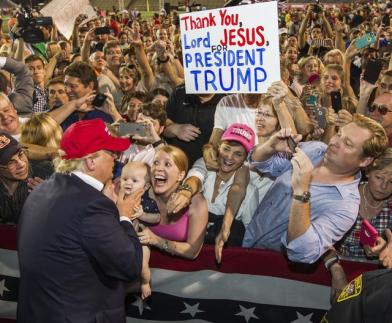
Thank You Lord Jesus for President Trump

Agree with this article? Violently disagree? Scroll down to leave a comment.

Follow Semi-Partisan Politics on TwitterFacebook and Medium.

David Cameron And Donald Trump – Promising Security Over Conservatism

David Cameron - Donald Trump - Conservatism - Conservative Party - Republican - GOP - Ideology - Security

Donald Cameron and David Trump. Or is it the other way around?

In many ways, you couldn’t imagine two politicians more different than Donald Trump and David Cameron.

The British prime minister (despite his best efforts) exudes an air of privileged, private school entitlement at all times, and has a reputation for making withering (if cruel) put-downs of his opponents in the House of Commons. The increasingly presumptive Republican Party presidential nominee, on the other hand, takes pride in being brash and boastful, and his claim to “have the best words” is as laughable as it is factually inaccurate.

Furthermore, David Cameron was quick to weigh in against Donald Trump when Trump made sweeping and inaccurate generalisations about Britain and Muslims, stopping short of the shrieking and hysterical calls for Trump to be banned from entering the UK, but still condemning him in strong words.

And yet, the two politicians – one seasoned in Westminster politics, the other making a virtue of his inexperience in the ways of Washington – are more alike than it first seems.

In seeking to understand the persistent appeal of Donald Trump to a large and broad swathe of the Republican Party base, Einer Elhauge argues that Donald Trump wins because he promises to be The Great Protector, keeping Americans physically safe and financially secure in an uncertain world.

Elhauge writes in the Atlantic:

The message of his Republican opponents has effectively been: We are more faithful to conservative principles. Trump’s message has been entirely different. He essentially says: I will protect you. I’m conservative, but if protecting you requires jettisoning conservative ideology, I will do so. Protecting you is the prime directive. This message has powerful resonance, especially for voters who feel the Republican Party has failed to protect their interests.

You see this pattern in all of Trump’s deviations from conservative orthodoxy. Take the debate over Planned Parenthood. Like all conservatives, Trump opposes abortions. But he stresses he does not want to stop funding their wonderful work protecting women from cervical and breast cancer. The other Republican candidates simply express a desire to destroy Planned Parenthood outright. Trump’s message to voters: The other candidates will adhere rigidly to ideology, even if it needlessly fails to protect millions of women from cancer. I won’t.

[..] Trump’s signature policy is to build a wall to protect his voters’ jobs. What could evoke protection more than building a huge wall? His opponents quibbled about its feasibility but ultimately adopted the same position. Trump’s message to voters: I care about protecting you enough to propose huge historic projects. The other candidates begrudgingly agreed, but their heart is not in it, so they are less likely to follow through.

Free trade is great, Trump says, but it has to be fair. His opponents just adhere to pure free trade, which does increase the economic pie. But economic research shows that free trade harms some subsets of voters, particularly the working-class voters flocking to Trump. The message to his voters: I will favor free trade only to the extent that I can protect you from harm, perhaps by compensating you using the gains of trade. My opponents will favor free trade even if it harms you.

And as it goes for policy, so it goes for style. Trump consistently eschews the hard-headed statements of fidelity to conservative principle or the Constitution which voters hear from Senator Ted Cruz, focusing instead on cultivating the same “your safety first” narrative:

Trump talks endlessly about his polls, because the polls stress that he is strong enough to protect his voters. He speaks extemporaneously and often crassly in a stream-of-consciousness way, which has many pitfalls but emphasizes that his views are unprepared, authentic statements of his views and that he will thus carry out his promises to protect his audience. He responds aggressively to every attack, no matter how minor, conveying the sense that he will also aggressively protect his voters.

It is hard to deny the success of this approach. Many voters, feeling let down by the stewardship of both President Obama and the reactionary Tea Party dominated Congress which followed in 2010, have lost faith in politicians selling explicitly ideological remedies for America’s ills.

Rand Paul, Mike Huckabee and Rick Santorum got nowhere this election cycle, suggesting that the public’s flirtation with Constitutional libertarianism and social conservatism respectively are not the vote-winners they once were. And the same goes on the Left, with Hillary Clinton now pulling clear of Senator Bernie Sanders in the Democratic primary, despite the huge achievements of Sanders’ campaign.

The situation in Britain is strikingly similar. David Cameron’s general election victory – at Labour’s expense and despite the rise of UKIP, the SNP and Green Party on the radical Right and Left – suggests that while a minority of voters (this blog included) crave stronger ideological differences and a move away from consensus politics, a larger number of people looked at the two main parties and went for the option which they believed would deliver them the most security.

Having secured his coveted Conservative majority government in the general election, David Cameron declared in his victorious 2015 party conference speech:

I tell you: our party’s success in growing our economy and winning the economic arguments has never been more vital.

Nothing less than the security of every single family in our country depends on it.

Before concluding:

And now with couples married because of us, working people backed because of us, the NHS safe because of us and children in the poorest parts of the world saved because of us, everyone in this hall can be incredibly proud of our journey – the journey of the modern, compassionate, One Nation Conservative Party.

This was not the speech of a flinty-eyed ideologue yearning to roll back the frontiers of the state. It was the speech of a leader who calls himself a conservative, but is perfectly willing to use the machinery of government to deliver the social and economic outcomes that he wants – in Cameron’s case, building an election-winning coalition by promising physical, social and economic security over and above freedom and individual liberty.

Ed Miliband, to the extent that his weak leadership stood for anything, ran on a platform of fairness and equality, emphasising entitlement over strength and security. And it got him absolutely nowhere.

David Cameron and the Conservatives, by contrast, ran on a platform of stability and security as the only objective. It wasn’t thrilling, inspiring or glamorous, but given the weakness of his opponents, it was enough to deliver a parliamentary majority that almost nobody predicted.

You can argue that David Cameron represents everything that is ideologically vacuous and wrong with modern British conservatism – as this blog does, loudly and often. But what you cannot do is deny the fact that Cameron has hit on a winning electoral strategy.

That’s why David Cameron ran for re-election with a manifesto pledging a creepy, statist “plan for every stage of your life”.

That’s why the Conservative Party talks about creating a strong economy not as an end in itself, but only in the context of generating more taxes to pay for ever more public services.

That’s why there is not an ancient right or civil liberty that David Cameron and Theresa May will not gladly crush in their effort to be seen as strong in the fight against terrorism.

Sure, they may look and sound different – almost complete opposites, in style and temperament. But both Donald Trump and David Cameron are both essentially playing the same trick – or perpetrating the same fraud – on their respective electorates, depending on your outlook.

Donald Trump was once a Democratic Party supporter and donor, talked up his great friendship with the Clintons and held positions which are diametrically opposed to his current conservative stances. David Cameron, meanwhile, calls himself a Conservative but is busily implementing Tony Blair’s fourth term New Labour agenda.

Neither man is what he publicly claims to be. And certainly neither Donald Trump nor David Cameron can fairly be described as small-c conservatives.


Donald Trump - Make America Great Again - Hat

Agree with this article? Violently disagree? Scroll down to leave a comment.

Follow Semi-Partisan Politics on TwitterFacebook and Medium.

Who Is To Blame For The Left’s Stalled Agenda?

The masterminds
The masterminds


If you were wondering exactly how deep goes the rot in the American conservative commentariat in the Age of Obama, you need look no further than the editorial and letters pages of the Wall Street Journal.

When these pages are not screeching warnings of an imagined upcoming Kristalnacht for wealthy Americans to be carried out by the seething, envious masses, they have taken to publishing seemingly highbrow retrospectives on the Obama presidency, paying particular attention to America’s failures and shortcomings under President Obama, whilst brazenly whitewashing the conservative or Republican part in those failures.

Danniel Henninger has the honour of writing the latest of these historically revisionist editorials on the WSJ’s aptly named “Wonder Land” blog – apt because what is written there bears so little resemblance to fact, or reality. In this piece, Henninger asks “The left can win elections. Why can’t it run a government?”

The editorial gets off to a bad start, attempting to link three quite ideologically disparate politicians and use their waning fortunes as evidence of a socialist malaise:

Surveying the fall in support for the governments of Barack Obama, New York City’s progressive Mayor Bill de Blasio and France’s Socialist President François Hollande, a diagnosis of the current crisis begins to emerge: The political left can win elections but it’s unable to govern.

It may have become what now passes for a fact by some on the American right, but in truth – if you look up the dictionary definition or compare his policies to those of previous Democratic presidents – Barack Obama is not a socialist. Therefore, Obama’s troubles have little to do with the travails and setbacks experienced by President Hollande of France, a legitimate socialist whose actual, socialist policies continue to do damage to that country.

Henninger then spends the rest of the article expanding on his cheeky proposition that the political left can win elections, but are unable to govern once in power. He fastidiously examines every possible reason for Obama’s failure to advance his agenda, save the most glaring one – the fact that the Republican opposition have consistently been more interested in token opposition, nihilism, public posturing and pandering to their base than they have bothered to engage in the processes of government while in opposition.

But Henninger is less interested in any kind of introspective analysis of the rights own complicity in America’s current difficulties than in spewing misleading half-truths:

Once in office, the left stumbles from fiasco to fiasco. ObamaCare, enacted without a single vote from the opposition party, is an impossible labyrinth of endless complexity.

The merits and drawbacks of ObamaCare aside, the blanket Republican opposition was more a strategic move to damage the Obama presidency than a principled stance (Republicans having long been content to leave “the best healthcare system in the world” and all it’s flaws untouched and unaddressed), and Henninger conveniently forgets that Anh Joseph Cao of Louisiana provided a solitary GOP vote for the draft version of the health bill.

Henninger’s next exhibit is the world’s response to climate change, an issue which he says has more political support than any other in our time:

No idea in our time has had deeper political support. Al Gore and John Kerry have described disbelievers in global warming as basically idiots—”shoddy scientists” in Mr. Kerry’s words. But somehow, an idea with which “no serious scientist disagrees” has gone nowhere as policy. The collapse of the U.N.’s 2009 Copenhagen climate summit was a meltdown for the ages.

It may or may not be correct to state that global warming is the greatest area of consensus in world politics at the moment, but what is truly laughable is Henninger’s neglect to admit that all of the opposition to taking any action on climate change comes from his own side. In doing so, he really answers his own question, except that it is not so much the left who are terrible at governing, but more that the ideologically inflexible American right are brilliant when it comes to using whatever political power they still wield to throw a spanner in the works and thwart the majority.

Sometimes it may be right to use opposition power in this way, in order to prevent abuse of power by that majority – but using that same tactic over and over in response to every initiative from the governing party is overkill, and the opposite of good governance.

Henninger sums up:

Making the unworkable work by executive decree or court-ordered obedience is one way to rule, and maybe they like it that way. But it isn’t governing.

True – and Henninger can rightly point to numerous cases where the left has taken these shortcuts to governance, especially recently. But he fails to take the next step and ask why President Obama and the Democratic party are behaving as they are, showing a complete unwillingness or inability to examine the GOP’s own role in creating the acrimonious partisan deadlock for which executive orders and court judgements have been the only pressure release valve.

Under the presidency of George W. Bush, the Republican Party had a tight grip on the reigns of power, holding the executive branch and both houses of Congress for a time. And in this time meaningful legislation was passed, sometimes in the face of vociferous opposition from the left and from libertarians. Significant legislation such as the PATRIOT Act, Sarbanes-Oxley and the 2003 Partial-Birth Abortion Ban Act were all shepherded through Congress without Democratic Party histrionics or threat of filibuster.

One can argue that the Republicans’ willingness to remain united as a single block in order to successfully oppose legislation is a sign of strength, and that the Democrats’ tendency to fracture and allow members of their caucus to be picked off in order to garner support for conservative proposals is a sign of weakness. But in that weakness is also the flexibility and willingness to compromise – hell, to acknowledge that some people in America hold a different point of view – that is so utterly lacking in today’s GOP and in much modern conservative thinking.

The American left may sometimes be catastrophically bad at advancing their agenda, framing the debate and winning the now all-important war of words (death panels, death taxes, job-creators) when courting public opinion, but the American right plays a daily role in the left’s emasculation. In many ways, even in opposition the Republicans have seemed like the playground bully who grabs hold of his prey’s wrist and turns his fist against him, all the while asking why the hapless victim likes punching himself so much.

Blanket, unthinking opposition to everything that the governing party tries to do has been effective for the GOP of late. They have successfully stopped President Obama’s legislative agenda in its tracks. The conservative strategy has been proven to work very well, but good responsible governance it is most certainly not.