–
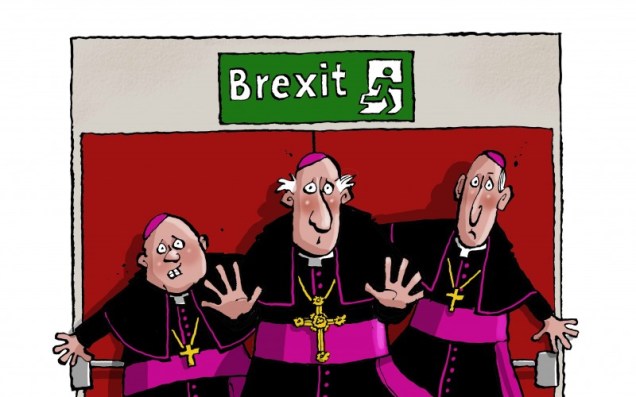
Friendship, cooperation and overblown claims about the EU keeping the peace in Europe do not amount to robust Christian arguments for staying shackled to the European Union
When the Church of England-sponsored Reimagining Europe blog launched last year, I was vaguely hopeful that it might lead to some fruitful discussion about the real Christian case for or against Brexit. Not just the kind of woolly left-wing platitudes which many bishops excel at delivering, but a real granular theological case for why Britain should either remain in the European Union or vote Leave to regain our independence.
Fast forward seven months and the promise of Reimagining Europe remains largely unfulfilled. The only really decent arguments have been those guest posts from Adrian Hilton of the Archbishop Cranmer blog, which have effectively demolished the laziest of the Christian cases for staying in the EU. There have been a few other decent commentaries and a large number of hand-wringing prevarications, but as far as I can tell not one unambiguously argued Christian case for Remain.
This recent blog entry by Guy Brandon is typical of the output in this regard:
At the same time, placing national identity above our identity in Christ should raise a warning flag. Our own legal system might be underpinned by biblical foundations and Christian heritage, but it is not God-given. Sovereignty should not be absolutised, whether the issue is approached from a practical or spiritual direction.
The question mirrors, on the national scale, our view of our own personal autonomy. To what extent do we see ourselves as the architects of our own destiny? We all make personal compromises in the interests of living together. As Freud remarked, ‘civilisation is built on the renunciation of instinct’. For the Christian, there is the added dimension that we have been purchased by Christ’s death (1 Corinthians 6:19-20) and are free – not to do anything we choose, but to ‘serve one another in love’ (Galatians 5:13-15)
So, should we give up a degree of national autonomy in the interests of the common good? As ever, the question is not cut-and-dried. There may be benefits we enjoy, such as guarantees around freedom of religion, which we would no longer have if we withdrew from the EU. Christians might contemplate the risks of withdrawing from such protections, as well as the attractions of being masters of our own destiny.
Immediately there are red flags that this is not a serious analysis, or even reflection.
For a start, the author takes it as a given that the European Union is the “common good”, against which national autonomy is perpetually placed in opposition. But why the European Union (with its dogmatic insistence on representing 28 countries with a single voice of compromise) is in the common good is never explained – and not just in this piece. Over and over again in Christian ruminations on the European Union, the most fundamental europhile assumptions are accepted as Gospel. Of course the European Union represents the common good.
Then we get the old workhorse about the EU guaranteeing freedom of religion, which is problematic in a number of ways. Firstly, it is profoundly antidemocratic in claiming that the British people should have rights imposed on them by others. Of course we should all have freedom of (and from) religion, but we the British people should establish and maintain this right for ourselves – ideally through a written constitution.
The same goes for workers’ rights, which are forever held up by the Remain camp as a scaremongering warning that if we leave the EU, it will be back to seven day working weeks and young children going up the chimneys to earn their keep. Why are so many self-professed Christians so happy for our most fundamental rights to be imposed on us from above, rather than arising organically as the democratic expression of our own hearts and minds?
The Catholic Herald’s recent review of church attitudes toward the EU also reveals an excess of woolly thinking at the top:
Cardinal Nichols is also fervently pro-EU, but his support for it has a less Roman flavour. He is, as I remember from his days as general secretary of the Bishops’ Conference, a man who works through committees and relishes bureaucratic procedure.
His politics bear the stamp of his Liverpudlian upbringing. He favours public expenditure over private enterprise; his speeches employ the vocabulary of the state sector. It’s hard to think of a bishop less in sympathy with Eton-educated Catholic Tory Brexiteers such as Charles Moore and Jacob Rees-Mogg.
The Nichols philosophy embraces the dirigism of Brussels; in this he is typical of the moderate British Left, which changed its mind about the Common Market after Jacques Delors persuaded it that Europe was an indispensable ally against “free-market fundamentalism”.
One suspects that Cardinal Nichols would admire the modus operandi of the European Union even if it had no association with the Church. The same could be said of many bishops of England and Wales.
This instinct to remain in the EU is borne out of fear of change and bureaucratic preference, which are understandable human emotions but about as far as one can get from being sound justification for continuing with the current mode of supranational European government.
As this blog recently concluded:
As a Catholic eurosceptic, it is frustrating to witness so many fellow Christians accepting the pro-EU, pro-Remain position almost by default, without actually engaging their brains or making considered reference to their faith. I’m no theologian myself, but I’ve read my Bible and I know that the New Testament offers little by way of clear instruction or even guidance as to how any entities larger than individuals and faith groups should organise or govern themselves, while much of the Old Testament reads as a “how not to do statecraft” manual.
If we restrict ourselves then to the teachings of Jesus, from where do Christian EU apologists draw their inspiration? The EU is not a democratic entity, nor is it likely to become one any time soon. What is so Christian about defending an organisation which insulates a continent’s leaders from the practical and political consequences of their rule? What is so Christian about sticking one’s fingers in one’s ears and loudly repeating the mantra “the EU is about peace and cooperation, the EU is about peace and cooperation”, while ignoring the known history of European political union and disregarding the fact that fruitful inter-governmental cooperation could take place just as well outside the EU’s supra-national structure?
[..]
Regrettably, I have come to the conclusion that much of the Christian case for Remain rests either on a lazy “agree with the Left by default” mindset, or the desire to virtue-signal generally “progressive” values across the board. I will be happy to be proven wrong, and to be presented with a serious Christian case for the EU based on the argument that staying part of a supranational political union unreplicated in any other part of the world is 1) what Jesus would do, or 2) what is best for Christians in Europe. But I’m not holding out much hope.
And if that’s what this is really about – cheering on the EU because it signals that one holds the “correct” progressive opinions in other areas – then they picked a really lousy time to do it. Our politics is suffering a crisis of legitimacy, and yet many in the Church have taken the decision to cheer on the one entity which best represents the interests of a narrow European elite overriding the interests of ordinary people.
In short, I have yet to see a Christian case for Remain that consists of anything other than woolly, tenuous and unsubstantiated assertions that the EU equals being friendly and co-operating with our neighbours (which, unlike the countries of every other continent in the world, can for some reason only be accomplished in Europe through a supra-national government), and that if we vote to Leave we will essentially be voting for war and the stripping away of religious freedom.
Well I’m sorry, but that facile level of argument is not good enough. I’m still waiting for serious theologians or senior figures in the Church hierarchy to put forward one good reason why Jesus would favour Britain’s participation in a remote and antidemocratic-by-design government of Europe.
If staying in the EU is so goshdarn godly, let’s hear why, without recourse to the fluffy, prevaricating jargon about ecumenism and friendship which Christian EU apologists tend to deploy like chaff to distract us from the paucity of their argument. And let them explain too why they are so desperate for continued political union in Europe, yet utterly blasé about the fact that Asia, Australasia and the Americas get by just fine without such a union.
There is a fight for self-determination and democracy underway right now, and far too many voices within the church are coming down on entirely the wrong side. Those who stay silent or openly advocate for Remain will justifiably find themselves on the hook and personally implicated in every future crisis which befalls the EU, and will bear some responsibility for each incremental unit of economic and political suffering experienced by Britain as a continent glued together by unwanted, inflexible political union slowly begins to rip itself apart.
The clock is ticking, and there is little time left for Christian Remainers to defend or amend their position before they go on to face the judgement of history.

–
Top Cartoon: Christian Adams, Catholic Herald
–
Agree with this article? Violently disagree? Scroll down to leave a comment.
Follow Semi-Partisan Politics on Twitter, Facebook and Medium.









 Semi-Partisan Politics