It has become fashionable of late to say that it’s high time we had a frank, open and honest discussion about immigration.
Never mind that this empty platitude is primarily uttered by the same demagogues who owe their political or media careers to either whipping up excessive fears on the subject, or sweeping it under the rug while smearing dissenters with the toxic charge of racism; that particular irony, though amusing, is beside the point. Zealots on both sides have come to realise that there is political capital to be made in positioning oneself as the straight-talking voice of reason, and pulling off that particular deception in the eyes of the voters requires going on the record saying how terribly important it is that we talk honestly about immigration.
Even casual followers of the news cycle will notice that the most strident calls for this long-awaited symposium on immigration funnily enough happen to coincide with each advance in the polls made by UKIP, or with every time that Nigel Farage contrives to leave the legacy party leaders looking impotent, or worse still, in active collusion with one another. This has led to accusations of cynicism – they’re only calling for a discussion about immigration now because UKIP are breathing down their necks, comes the predictable refrain. But in fact we have been holding a reasonably thorough and robust conversation about immigration for some time now – or, to be more precise, we have all been talking a lot about the subject. Where we have consistently fallen short, though, is the listening part, without which a truly meaningful conversation can never take place.
David Cameron has his fair share of problems, with Nigel Farage’s UKIP nipping at his heels and EU Commission president Jean-Claude Juncker goading him about Britain’s £1.7 billion EU surcharge. Nick Clegg faces a daily battle to fend off irrelevancy and the implosion of his party. But despite their tribulations, I doubt that either man would volunteer to switch places with the hapless Leader of the Opposition, Ed Miliband.
The Labour leader needed a win today. Badly. His poll ratings have dipped to the same level as Gordon Brown’s in 2010, but at least Brown had the excuse of being in a fag-end administration led by a scowling narcissistic tax-junkie.
Indeed. It’s one thing to have terrible personal ratings when you are an establishment figure associated with a party that has been in power for over a decade, but – wait a second, Ed Miliband was all of those things, and still he was installed as the Labour Party leader. The consolation would be that his personal ratings couldn’t possibly fall much further if he did win power and occupy 10 Downing Street, if only the chances of that happy event were not receding quite so rapidly.
Professor Alexis Jay’s report on child sexual abuse in the town of Rotherham contains truths and revelations so shocking and awful, and on such a scale that it is scarcely possible to believe them.
“No one knows the true scale of child sexual exploitation in Rotherham over the years. Our conservative estimate is that approximately 1,400 children were sexually exploited over the full inquiry period, from 1997 to 2013.
It is hard to describe the appalling nature of the abuse that child victims suffered. They were raped by multiple perpetrators, trafficked to other towns and cities in the north of England, abducted, beaten, and intimidated.
There were examples of children who had been doused in petrol and threatened with being set alight, threatened with guns, made to witness brutally violent rapes and threatened they would be next if they told anyone.”
Horrific cases of abuse and neglect going unstopped because of the lethal combination of a failed bureaucracy and individual failings are, of course, nothing new. We see such horror stories only too often, most notably in the death of Baby Peter.
But tragedies such as these are on a far smaller scale than the slow-burning atrocity which took place in Rotherham over a period of sixteen years. The needless death of one child is an abhorrence. The scarring of up to 1500 children’s lives is almost unfathomable.
At times such as this, when we are not too busy breast-beating, it is fashionable to urge calm and wait for the various investigations – 32 of which are already underway in Rotherham – to finish their course. At the other end of the response spectrum, we can expect to see highly emotive calls for the immediate sacking of every public sector worker in the town who was even tangentially connected to the case.
“I categorically call for the resignation of everyone directly and indirectly involved in this case. The Labour council stand accused of deliberately ignoring child sex abuse victims for 16 years. The apologies we have heard are totally insincere and go nowhere near repairing the damage done.
“These resignations should include South Yorkshire’s police and crime commissioner, Shaun Wright. I also call for a criminal investigation by a force not directly linked with this scandal into all those implicated in this scandal. There is no place for these people in public life.”
Fine. This blog will be the last to plead clemency for those at the top who presided over this horror show before moving on to other well-remunerated jobs, especially if their lack of action during the period in question casts doubt on their ability to perform well in their new roles, or to keep the public’s trust. This would certainly include Shaun Wright, the police and crime commissioner.
But the report hints at something far deeper and more insidious which must also be tackled if we are to prevent a recurrence of this scandal, one which is certainly not limited to the Yorkshire town.
The Spectator’s Isabel Hardman, citing Professor Jay’s report, lays it out:
There seemed to be a fear of man rather than of wrongdoing, perhaps even a true definition of political correctness gone mad, that led the council to ‘tiptoe’ around the issue of child sexual exploitation in the Pakistani-heritage community. The report found that there were just two meetings in 15 years about CSE – and they took place in 2011 when the abuse stretched back into the late nineties.
How did this go on for so long? The Jay report is worth reading in full, if only to get a measure of the way apparently well-organised organisations apparently working in a joined-up way managed to fail 1,400 children (at least). But something removed the urgency and made fear of breaking a taboo and being labelled politically incorrect the bigger thing. It was a fear of consequences, of anyone more important and powerful finding out that repeated allegations and internal reports were being ignored and someone being held responsible. ‘An issue or responsibility that belongs to everybody effectively belongs to nobody, and in the case of sexual exploitation of children in Rotherham, accountability was key,’ said the report.
Aside from the usual bureaucratic failures, exercises in self preservation and groupthink which are always offered up as excuses at times like this, it is the apparently terrifying, suffocating fear instilled by a climate of political correctness which emerges as the main culprit in the Rotherham scandal.
When an issue or cultural pathology presents itself in any British community, civic leaders should be able to talk about it directly and work swiftly to address it without fear of reprisal or backlash – though they should also be of sufficient character and moral fibre that they are willing to incur such a backlash. Rotherham, apparently, lacked both attributes – there was a heavily stultifying culture of political correctness which dictated which issues could be examined and tackled, and there was a lack of quality local leadership at any level willing to take on the toxic culture.
This is despite the fact that many people in the local Muslim community were equally outraged by the contents of the report, and declared that they would have willingly participated in efforts to stamp out sexual abuse within their community if only the council had made them aware of the nature and extent of the problem. Once again, the real enemy seems not to be the minority community itself, but rather people within society at large who are trying to curry favour from goodness knows where by wilfully and falsely equating scrutiny with racism.
Consider, by contrast, the lectures and condescension which British politicians are only too happy to dole out to members of Britain’s black community. Echoing similar calls made by President Barack Obama in the United States, David Cameron has been happy to go on record calling for a “responsibility revolution” among black families and black fathers in particular, in order to stem the tide of gun and knife crime in British cities. In these sermons there is no reflection on the socioeconomic circumstances which might lead to higher instances of family breakdown and absentee fathers, just an assignation of blame and a call to do better.
Tumbleweeds gently roll in place of the admonitions that David Cameron and his ministers consistently fail to dole out to other communities facing particularly acute problems of their own. And in the only comparable example, calls by British politicians for the British Muslim community to do more to watch out for and prevent radicalisation and extremism among their disaffected youth, there has been extremely heavy pushback from many prominent people in the media.
This is the insidious power of political correctness gone too far. Often borne out of a genuine desire to be inclusive and avoid giving undue offence, too often it becomes a self-policing dogma that rewards total, unthinking loyalty and the holding of “politically correct” thoughts and positions while punishing and excluding those who are unsure, or who question the status quo.
In these politically correct fiefdoms, groups which enjoy the benefit of politically correct protection are free to live and act unchallenged and unimpeded, while those less astute or well-represented are subject to the laws and rigorous oversight that governs the rest of us. Professor Jay’s report leaves little doubt as to which particular group and community enjoyed de facto immunity from the law in Rotherham.
Of course, the child sexual abuse scandal was not entirely limited to the Pakistani heritage community in Rotherham. And the last thing that anyone should want is to encourage the Britain First-style “Muslim paedos off our streets” marches and battle cries that are becoming increasingly common in the far right community. But where there is a festering problem in any of Britain’s ethnic or religious communities, we need to be able to talk about it frankly and openly without being labelled intolerant or racist. And local authority after local authority, Britain is currently failing this test.
The other most recent example of Britain’s failure to hold all of our diverse religious and ethnic sub-communities to the same standards of behaviour was the Birmingham schools Trojan Horse scandal, which rumbles on and which compromised the educations of thousands of children, who were willfully exposed to some very un-British values at the expense of the taxpayer. As the first concerns were raised and the investigation began, false accusations of racism and Islamophobia not only hampered the work of the Department of Education and thwarted the will of law-abiding non-extremist parents, they also served to sow divisions in the community which persist to this day.
But a compromised education can be repaired. Theocratic teachings and hardline conservative approaches to music, gender inequality and other unwelcome imports from the fifteenth century can, in time, be unlearned. What cannot be undone is the systematic rape and sexual abuse of thousands of British children, some of Pakistani heritage themselves, by malicious adults from their own community – all of which took place under those nose of a local government machine that is big and powerful and only too happy to proactively intervene in citizens’ lives when not constrained by a veto from the forces of political correctness.
Many articles will be written about how this came to happen, and many politicians will say “never again”. But the core enabler of this sexual abuse epidemic is not hard to fathom. The road to Rotherham began when it was made implicitly clear to those in power that political correctness trumps child welfare.
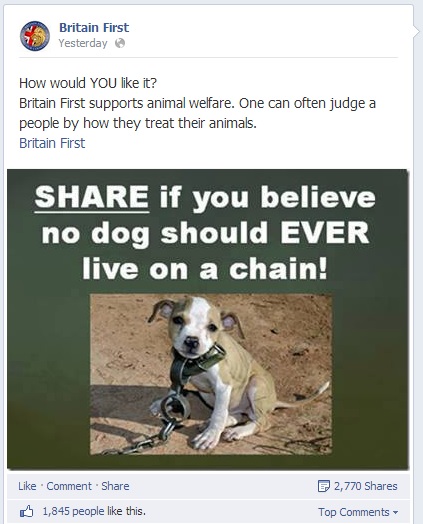
Did you click “like” when you saw that Facebook picture denouncing cruelty to dogs, or share that touching message exhorting us to honour our veterans on the 70th anniversary of the D-Day landings? Did you also notice the little lion and union flag logo tucked away somewhere deep within the post? You didn’t?
Well congratulations. You probably unwittingly played into the hands of the British far-right’s latest viral social media strategy. You are officially on the same level as the caricatured bumbling, resentful, low-information UKIP voter. Hang your head in shame.
But don’t worry, you were not the only one taken in. So many of the commentariat’s dire warnings from the 2014 local and European election campaign are now coming true. “Well, they make a show of being patriotic and decent,” they said, “but it’s all just a mask concealing their despicable racist views”. Or sometimes it was proclaimed that “people support them without really thinking through what they actually stand for; if only they really knew, they wouldn’t like them”.
Wise words – only they were not so descriptive of UKIP (the establishment’s principal target at the time) as they are of Britain’s real-life far right parties, who are alive and well, take themselves very seriously and who charted a course through election season almost entirely undetected and unengaged by the forces of left-wing and popular outrage.
For those who were too busy throwing eggs at Nigel Farage or dismissively equating euroscepticism with little-England xenophobia to notice, there’s a new kid on the block of British far-right organisations. They call themselves Britain First, and describe themselves as a “patriotic political party and street defence organisation” – because a heady mix of strong political views, mob psychology and unapologetic vigilantism couldn’t possibly lead to anything unpleasant.
As the British National Party faced electoral annihilation in the local and European elections, haemorrhaging supporters and losing the two MEPs they gained in 2009, Nick Griffin’s dying organisation seems to have breathed its hate-filled spirit into a new host, Britain First – itself comprised of disgraced and disgruntled former BNP members.
Britain First is prospering where the BNP failed because they grasp the fact that the old foaming-at-the-mouth racist with a grudge to bear approach to political argument has a naturally low ceiling of support, whereas appeals on behalf of animal welfare or generically patriotic feel-good posts on social media are virtually guaranteed positive click-bait.
Vowing to end dog-fighting or encouraging people to “like” a picture of Prince William may not do much to directly further the party’s core goals, but it does allow them to now truthfully claim that theirs is the most popular political party on Facebook.
But as always with political parties, the carefully polished façade presented to the public and the real sentiments and motivations of Britain First’s activists are two very different things. On Facebook, Britain First may be all LOLcats and union flag bunting, but their activists are generally much less cuddly.
Many videos shown on YouTube and the party’s own website give an idea of what Britain First mean when they call themselves a “street defence organisation”. The following video should be all the introduction needed:
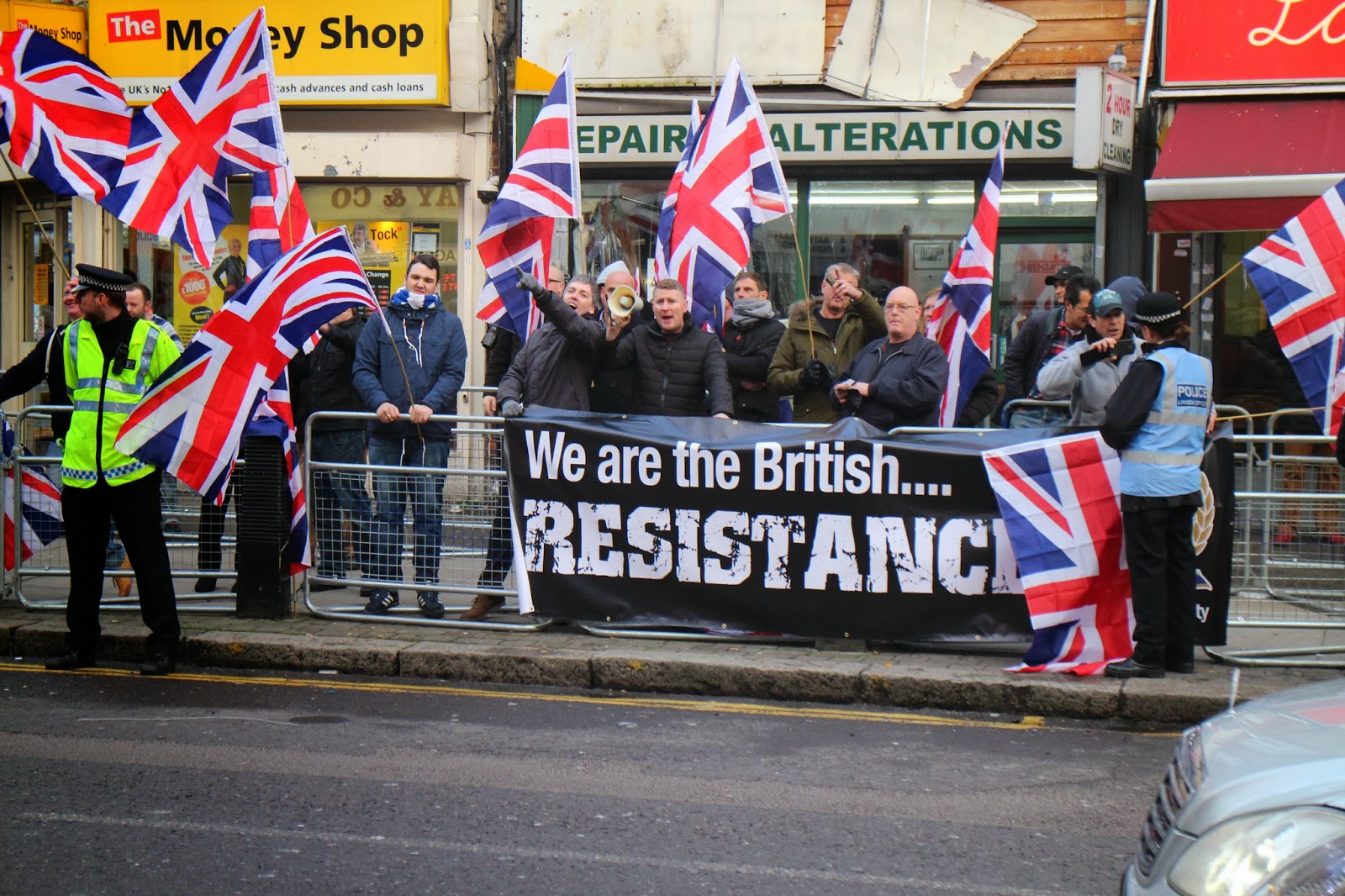
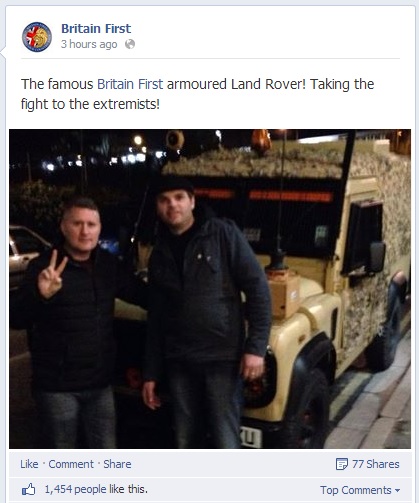
The footage shows a representative sample of the organisation’s work, which largely consists of hitting the streets in a large group, wearing identical quasi-military jackets and berets and holding aloft many union flags, often trailed by one or more decommissioned ex-Army Land Rovers.
Once assembled and decked out in their regalia, the Britain First squads may do one of several things. One of their favourite stunts is the “mosque invasion” whereby a number of squad members (almost all men) burst into a mosque, disregarding the notices to remove their shoes or observe other courtesies, and then start aggressively asking for the imam.
While the imam is being found, Britain First team members berate the bemused-looking worshippers for not acting more decisively to root out what they call “Muslim grooming gangs” or for promoting extremism. They then hand out Britain First literature on the same topic, together with a number of British Army-issue Bibles (this is the visible extent of their piety), exhorting the Muslim worshippers to abandon their “false prophet” and convert to Christianity. Message and literature thus delivered, they depart as rudely as they arrived.
When not invading mosques, Britain First like to assemble to protest in front of the homes of prominent Muslims such as the mayor of Bradford, arriving and standing outside in large numbers (in full uniform, of course) while the leader, Paul Golding either knocks on the door or telephones the victim from the doorstep demanding an audience. When the targets fail to make an appearance, intimidated by the tactics of the Britain First street team, the protesters begin their various chants and make a racket until the police arrive.
Popular chants include “Muslim pedos off our streets!”, “Benefit scroungers off our streets!”, exhortations for various other bogeymen of the paranoid to vacate our streets, and the inevitable battle cry of “Onward, Christian soldiers!”. For you see, theirs is a crusade.
Whatever the activity, the protesters typically film their actions from start to finish and upload them to the Britain First website where they are viewable by members of the public. The production quality is somewhat overwrought, with apocalyptic “Independence Day” style soundtracks suggesting the climax of a Jerry Bruckheimer movie rather than a ragtag group of far-right activists going out on “Christian Patrol” in Bradford.
When interviewed for these in-house videos, activists insist that the British people are “sick to death” of the Muslim grooming gangs that “we’ve all seen in the news”, a preoccupation that eats away at them and which they are convinced is being ignored by communities and local authorities, despite increasing evidence to the contrary. One “defence force” activist added: “English girls are suffering all across the north of England”.
And it’s not just Britain First – there are many other splinter organisations vying for a slice of the far-right nationalist pie. This coming Saturday, the equally unpleasant South East Alliance will be holding a demonstration in Cricklewood, north west London, going up against the Muslim Brotherhood, whose supporters have a presence there – extremism coming face to face with extremism.
There is clearly a real, ever-present and ever-threatening far right element lurking in Britain. Filled with hatred and fuelled by ignorance, these groups acknowledge Britishness only according the narrow criterion of ethnicity, viewing all other races and cultures in Britain with automatic suspicion and fear. Anger and violence are never far from the surface in this xenophobic, nationalistic powder-keg.
The far right was neither dealt a mortal blow by the setbacks of the BNP or invigorated by the rise of UKIP (not a far right party), but it is on the move in Britain once again, only this time aided by a combination of particularly low scruples, social media savvy and viral appeal that the regular political parties can only dream of.
Whose fault is this? The media, the main political parties and those who make it a mission to fight against racism all share a portion of the blame.
Because the establishment – political parties and media alike – expended such huge efforts in their efforts to smear UKIP and halt their advance in the local and European elections, Britain’s actual far right parties have enjoyed a virtual free pass this year. All guns were trained on UKIP, a legitimate party with well-publicised racist bad apples, while the parties that are profoundly and unapologetically racist to the core were scarcely challenged.
When organisations such as Unite Against Fascism temporarily forget their purpose and start actively campaigning against eurosceptics or conflate an opposition to immigration (wrongheaded though it may be) with outright xenophobia and prejudice, they don’t have much left in the tank to take on other groups with really toxic viewpoints when they start to come out of the woodwork.
That’s the problem with crying “racism” every time you encounter a viewpoint that you don’t like or agree with – when you do eventually stumble upon a real life case of racism in action – like Paul Golding’s Britain First organisation – you have already used up all of the warnings and counterarguments in your rhetorical canon, making it impossible to be heard above the noise or to draw attention to the serious cases that we need to tackle.
In one sense, the fact that we collectively took our eye off the ball is not the end of the world – the BNP performed appallingly in the recent election, polling barely above 1% (which was five points down from 2009), while the repackaged Britain First managed just 20,272 votes nationwide, a less than awe-inspiring 0.13% of the national vote.
But to dismiss the far right because of these paltry election results is to miss the point. The fact that BNP and Britain First voters together make up less than the population of Northampton is irrelevant, because they don’t need to win elections to succeed in their goals.
Britain First will never achieve its ultimate aim of turning back the clock and reverting to a bygone time when spotting a non-white face walking around in town is an unusual event worth telling your friends about at the pub, but they don’t have to.
Their ‘street defence volunteers’ are quite happy walking up and down Brick Lane in their quasi-military uniforms with their armoured Land Rover escorts, ‘raiding’ mosques, spreading misinformation, sowing fear, talking apocalyptically about the end of the British people and generally making life miserable for the rest of us. And with their wide range of Britain First branded merchandise available for sale, some of their leaders will likely become quite rich in the process.
This is the type of far-right activism that we can work together to thwart if we are properly focused on eliminating racism and promoting tolerance and respect – not by squashing Britain First’s democratic right to free speech, but through a concerted campaign to inform people that when they share the organisation’s viral Facebook or Twitter messages they are inadvertently helping to spread the word about this BNP offshoot.
Such a “Let’s Unfriend Britain First” campaign could starve the party of the resources and reach needed in order to continue its worrying growth trajectory. The blog Another Angry Voice also lays out good suggestions for fighting back against the group’s manipulative tactics.
The time has also come for some people (they know who they are) to finally take a break from calling UKIP a racist party, desist from the public wailing and rending of garments at the fact that they share a country with such ignorant, backward hillbillies as UKIP supporters, and to admit that there is in fact a vast difference between the radical right and the far right.
Though some may be loathe to give up one of their favourite rhetorical weapons against the political right, they should remember that the marginal wavering UKIP / BNP / Britain First voter has little incentive to select anything other than the most extreme option if even voting UKIP will bring scorn and charges of racism upon them.
(Yes, it is concerning that there are marginal UKIP-BNP voters, but it should be remembered that there are marginal Conservative-BNP and Labour-BNP voters too. All political parties draw some support from the far-right’s natural territory).
In the wake of the local and European elections, the three main political parties are all busy devising strategies to halt the rise of UKIP and stop the erosion of their own support leading up to the 2015 general election. Whatever they ultimately decide to do, it would be encouraging to see passionate anti-racism rhetoric and anti-fascist efforts being launched against the correct targets from now on.
The enemies of fascism and racial hatred – which should be all of us – need to stop using unfounded accusations of racism as a political weapon, get together and identify the real far-right threats in Britain.
Hint: It’s not UKIP.
If you enjoyed reading this article, please take a second to LIKE or SHARE it on social media using the buttons below. Help to spread the word and continue the debate.
Perhaps it was inevitable, given the relentless barrage of attacks on the party in recent days, but today marks the day that UKIP made a mistake, took a page from the conventional political handbook and played into their opponents hands. Their folly? Allowing three of their European election candidates to go running to the police, demanding that any demonstrators who call them ‘fascists’ or hurl other insults be arrested for committing a hate crime.
Ukip has asked police officers to arrest demonstrators for a hate crime if they call their supporters “fascists” at a public meeting held by the party.
Three of the party’s European election candidates said, in a joint statement, that they had asked Sussex Police to arrest “any protestors who call our supporters ‘fascists’, hurl other abuse or any physical assault, for ‘hate crime’ or under the Public Order Act” at the Hove meeting on Tuesday night.
It has become fashionable in left-wing circles to talk about how UKIP represents next great fascist threat to the United Kingdom, and that its leader Nigel Farage is the reincarnation of Oswald Mosley with a sprinkling of Enoch Powell. Such outraged left-wing hysteria is only fuelled by the propensity of organisations that really should know better – such as Unite Against Fascism – to picket and protest UKIP’s political gatherings under the (either incredibly stupid or breathtakingly cynical) pretext that opposition to economic migration automatically equals racism.
That UKIP have been taking fire – often unfairly and excessively – from all sides is incontestable. But by doing what they claim to loathe, running to the government for protection and redress every time they get their feelings hurt in the rough and tumble of British political discourse, UKIP are undermining one of their most endearing aspects – the ‘no nonsense’ individualist approach that scoffs at today’s entitlements culture and the right to live life unoffended and unchallenged.
This impulse to hit back is partly understandable. For months, UKIP and their supporters have been heckled and jeered and accused of unpleasant things by every left-leaning organisation with a megaphone, while mainstream politicians rode the wave of anti-UKIP hysteria and stood in front of television cameras cynically repeating many of the same allegations and unpleasant talking points. For some in the party, used to seeing their own ‘kind’ on the receiving end of police harassment – for skirting too close to the wrong side of the law when speaking about immigration or gay marriage, for example – it must be cathartic to imagine the police handcuffing and carting away the person who has heckled their every campaign stop or policy launch.
But just as opposing economic migration does not automatically make one a fascist, calling someone a fascist is not close to being a hate crime – fascists not being viewed as an especially sympathetic or endangered minority, for one reason. And if we as a country do decide to expand the (already overly-long) roll call of groups entitled to hate crime protection and the list of words whose utterance will prompt a police visit – to include new additions such as ‘hypocrite’ or ‘idiot’ for example – before long there will be no politicians, journalists or bloggers left.
One of UKIP’s core strengths – the thing that made them a breath of relatively fresh air in the very stale British political system – is the fact that they always pushed back against the growing nanny state-ism that values freedom from being offended over freedom of expression. What’s more, they have done this at a time when the bulk of British elite opinion has trended strongly in the other direction, almost sanctifying the ‘right’ of the individual to coast through life without ever being shocked or offended or insulted. Their motives for supporting free speech have not always been pure, but this is yet another indictment of the major political parties – the fact that it has often been left to a strident outlier party to speak out in defence of such a core British value.
At present, UKIP remain well placed to triumph at the upcoming European elections, but the result will be close and even the smallest missteps or scandals could tip the balance. If Nigel Farage’s party choose to surrender their successful and appealing ‘happy warrior’ image and replace it with the outraged snarl of the perpetually wronged victim, the danger is that they will start to resemble the very thing that their opponents accuse them of being – a sort of British National Party Lite, full of little-Englanders nursing a grudge.
UKIP have come too far – and enliven the British political debate too much – to allow this to happen.





 Semi-Partisan Politics