Republicans For Big Government

Barack Obama - Sequester - Obamaquester

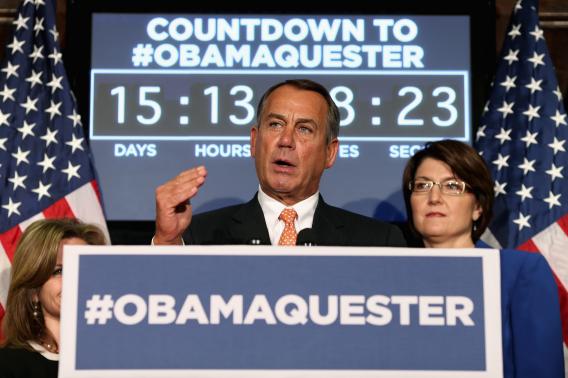
Run for your lives! The Obama Jobs Sequester is coming!

The evil President Obama sneakily – and somehow avoiding the notice of Congress – inserted into a congressionally approved bill a provision that would make large, across-the-board cuts in domestic spending if Republicans and Democrats failed to work together to reach a grand bargain on spending, tackling tax revenues and federal spending in a unified and bipartisan way.

And now that congressional leaders have failed to agree on these items, the undiscriminatingly large cuts are about to fall on the federal budget, which will result in many lost jobs, particularly in the area of national defence, which is just terrible. And all because of Obama. Right?

At least that’s how Kimberley Strassel, writing in The Wall Street Journal, sees it:

A year ago, the president demanded a $500 billion “sequester” of defense dollars as a penalty should Congress fail to cut a grand debt deal. Congress of course failed, and Mr. Obama’s sequester is now imminent. The sequester slash comes on top of the $487 billion in defense cuts Mr. Obama had already ordered in January of this year, threatening the likes of Mansfield.

Defense Secretary Leon Panetta has warned of the damage the sequester will do to national security. Yet the far more immediate political problem for Mr. Obama is that the cuts are compounding his domestic jobs liability—in the final stretch of the campaign.

More than one million lost private-sector jobs, to get down to it, as estimated by groups ranging from the National Association of Manufacturers to the Aerospace Industries Association. Military jobs are on the block, but the bulk of the pink slips will come from private businesses—from giant defense companies on down to smaller businesses that are the economic mainstays of their communities. They’ll come from states crucial for President Obama’s re-election: Virginia, Florida, North Carolina, and more.

So apparently, according to the Kimberley Strassel school of thought, what we should be doing in this recession is cutting government spending, because government doesn’t create jobs, entrepreneurs do. Unless that government spending is supporting jobs in the defence sector, of course, in which case we should be increasing it, dramatically!

Some more “moderate” Republicans argue that while they support cuts in principle, they are appalled by these looming defence cuts in particular because they are across-the-board and arbitrary, and pay little heed to particular defence programs or areas that could be more reasonably targetted for cutting. That’s the point of the sequester that they and their Democratic colleagues agreed to. It inflicts blind, undisciminating pain on areas of government spending precious to both sides of the political aisle, with the intention of presenting such an unthinkably draconian package of cuts that leaders would get together to forge a compromise.

If you don’t like the idea of a scythe being taken to defence spending or to welfare programmes without regard to their individual merit, get together, in the name of patriotism and bipartisanship, and for the sake of the people who elected you, and hammer out a compromise that cuts the welfare state while raising tax revenues to help close the massive hole in America’s federal budget.

Interestingly, you never hear Republicans making the same arguments against across-the-board cuts to welfare programmes, or social security, or food stamps. In those cases, apparently, it is fine to slash away at the budget with little regard for the people who were led to believe by their government (Republicans as much as Democrats) that certain benefits would be available to them, and who planned their lives accordingly, often with little left in reserve.

We can argue the rights and wrongs of this – personally I find the welfare state too generous, and politicians of all sides too cowardly in failing to tell voters the truth about the unsustainability of current levels of provision over the past recent decades – but surely we can all agree that just as you cannot rip a bandage from an open wound and expect the patient to be unharmed, so you cannot remove anticipated benefits or support from citizens overnight, at a time of economic hardship, and expect their lives, or the social fabric, to remain stable.

In fact, there is only one other area of government spending besides national defence that I can think of where Republicans have come out in outraged horror at the mere talk of blanket cutbacks – I’m speaking, of course, about Medicare. Those lofty words about scaling back federal spending and shrinking the size of government sure do fly out of the window awfully fast when one of their core constituencies (in this case, the grey vote) is in the firing line.

But Kimberley A. Strassel is not troubled by any of these arguments or contradictions, content instead to bob gently in the vast ocean of her own ignorance, wilful self-deception and cynically fiscally irresponsible propaganda.

No, for her it is the Obama Jobs Sequester, the Machiavellian outcome that he desired all along in order to gut his own nation’s capacity to defend itself. It’s the only plausible explanation for how we find ourselves in this situation. Unless it isn’t.

SEMI PARTISAN SUMMARY

CULTURE

Pamela Haag, writing at Slate, has had enough of the “mommy” prefix being applied to everything from jeans to porn to jobs to blogs. In an interesting piece, she goes on to argue that the effect of these mommy-isms is to diminish the work or activities outside motherhood that women engage in.

The Economist ponders the recent death of author Gore Vidal and laments that it marks the passing of an age when politics was less…dumbed down. Recalling Vidal’s famous televised altercation with William F. Buckley Jr., they note: “It is hard to imagine men like Vidal and Buckley, two snobbish East Coast intellectuals with lockjaw patrician accents, being invited onto prime-time television now to opine on the hot-button issues of the day. Vidal’s death earlier this week, at age 86, marks not only the loss of a provocative novelist and political thinker, but also the demise of a brand of public discourse. It seems there is no longer a place for the erudite and witty public intellectual in America. Instead of learned allusions to classical literature, public figures, including the president of the United States, are now expected to drop their G’s and speak knowledgeably about the cast of The Jersey Shore”. Indeed.


BRITISH POLITICS

NPR gazes at Britain from across the pond and raises an eyebrow at the marked uptick in explicit British patriotism that has been observed in this jubilee and Olympic year. I think that they do British national pride a disservice saying things such as: “Never before have British sports fans sung the national anthem, or flourished their (proliferating) red-white-and-blue Union flags, with such gusto. Never before have British commentators yelled so loudly at the slightest sign that their one of their countryfolk may secure a medal”. After all, national pride can be expressed in many ways, not all of which require flying a massive flag above a car dealership. But nonetheless, they do have a point. NPR go on to ponder the likely impact of this new-found patriotic expression on the forthcoming Scottish independence referendum.

A really interesting article by Damian McBride, detailing the first 24 hours of the 2007 foot-and-mouth disease outbreak in Surrey, and the then newly-appointed Prime Minister Gordon Brown’s reaction to it. Lord knows I am no fan of Gordon Brown’s – given a few seconds of silence in any social gathering I am liable to launch into my anti GB diatribe – but I must admit that he did have his good qualities (earnestness, attention to detail) as well as the bad. McBride notes: “At the end of those 24 hours, even before we were clear how serious the outbreak was, there was no question – whether you were a government official, a political journalist or a punter watching the TV – that the PM was in control of this crisis and was personally directing every aspect of how it would be dealt with.” This article humanises Brown, and reminds me that no matter my stark disagreements with him on policy, he worked very hard – albeit egotistically and misguidedly – in service to the country.


AMERICAN POLITICS

Washington “elites” are more out of touch than ever with the rest of the country, and far more tolerant of persistent mass unemployment, argues Jonathan Chait, writing in New York Magazine. For those like him, Chait writes, the great recession “…is more akin to a famine in Africa. For millions and millions of Americans, the economic crisis is the worst event of their lives. They have lost jobs, homes, health insurance, opportunities for their children, seen their skills deteriorate, and lost their sense of self-worth. But from the perspective of those in a position to alleviate their suffering, the crisis is merely a sad and distant tragedy.”

Place your bets now. Mitt Romney is beginning to meet with and “audition” the various Republican contenders to take the Vice Presidential spot on his ticket. Some options are more palatable than others, but whether Romney picks a “boring”, safe candidate or takes a risk with an unconventional bold choice will say a lot about how confident his campaign is of victory, or conversely how worried they are about their prospects and are looking for another game-changer.

Charles Krauthammer was obviously watching a different foreign trip than the one the rest of us witnessed as Romney embarked on his overseas tour. Using his Washington Post column to declare the trip an unbridled success, Krauthammer has convinced himself that Romney’s undercutting of the official US position on Jerusalem and criticism of Palestinian culture were somehow smart diplomacy. Others might argue that these actions were contrary to his earlier promises (and standard convention) to avoid criticising US policy while a presidential candidate on foreign soil, and that regardless of ones views on the Middle East peace process, it might be a good idea to avoid enraging one of the two sides before you have even won election.

Romney Gets Owned By The Economist

Ouch.

The Economist seems to have taken an even dimmer view of Mitt Romney’s recent foreign excursion than I did. In a scorching piece subtitled “Like Bush, but without the cosmopolitan flair”, the newspaper rips Romney for what they call his “horn-honking, floppy-shoed clown show” of a foreign trip.

The newspaper rightly lays into Romney for stating before he left on his ill-fated trip that he would not comment on foreign policy matters while on foreign soil (in accordance with usual protocol), but then reneging on his promise and doing precisely that while in Israel. They note:

… he moved on to Israel, where his campaign promptly involved itself in a diplomatic scandal (this time with actual consequences) over whether it had said that Mr Romney would back a unilateral Israeli strike on Iran. Mr Romney went on to declare Jerusalem the capital of Israel, a position no American administration has ever taken because discussions over the final status of the city are the most explosive subject in Israeli-Palestinian peace negotiations. Then this morning, at a fund-raising breakfast largely populated by ultra-rich Jewish Americans, Mr Romney managed to suggest that Palestinians are poor because their culture is inferior to that of Jews.

Sigh. Presidential candidates are just not supposed to do that. Aside from the fact that it is highly irresponsible to start announcing an alternate US foreign policy abroad before the votes have been counted and you have been sworn in to office, explicitly backing the policies of one foreign political party (Likud), or a coalition, unnecessarily meddles in Israel’s domestic politics. It is a blunder committed by someone with no sense of diplomacy and no thought to the consequences of his actions, save for the effect it would have on shoring up his base at home.

The Economist takes particular exception to Romney’s speech at a fundraiser:

“As you come here and you see the GDP per capita, for instance, in Israel which is about $21,000 dollars, and compare that with the GDP per capita just across the areas managed by the Palestinian Authority, which is more like $10,000 per capita, you notice such a dramatically stark difference in economic vitality,” the Republican presidential candidate told about 40 wealthy donors who breakfasted around a U-shaped table at the luxurious King David Hotel.

Don’t say things like that when The Economist is listening. They have facts and figures to hand, and both the time and brainpower to use these facts and figures to make you look like an ass hat:

To make matters worse, Mr Romney got his numbers wrong. Per capita income in Israel is over $31,000; in the Palestinian territories it is closer to $1,500. Those aren’t the kinds of numbers that divide industrious Protestants from happy-go-lucky Catholics. They’re the kind of numbers that divide South Korea from Ghana. You don’t get those kinds of divisions because of cultural differences.

Comparing the income of the average Israeli to that of the average Palestinian, as though their prospects at birth had been equivalent and their fortunes today are largely the result of their own efforts and their “culture”, is gratuitously insulting and wreaks damage to American diplomacy.

It really does wreak damage to American diplomacy. Yes, to some extent Obama did the same thing with his own foreign tour in 2008 – his speech in Berlin where he talked of the need to engage better with the world and partner with other nations, while quite true to my mind, was also perhaps an inappropriate repudiation of the existing American policy under then-president Bush – but this is of a different order altogether. At some point, a future hypothetical President Romney would have to engage with the Middle East peace process, and enraging one half of the debate with needless and groundless attacks on their “culture” are only going to make that already vexing job even more complicated.

Furthermore, the idea that some ethereal thing such as “culture” accounts primarily for the disparity in per capita wealth between the two populations is so absurd as to be ridiculous. A man as supposedly intelligent as Mitt Romney surely understands that, regardless of  your views on where responsibility for the troubles lies, Palestinians and Israelis are not born with equal prospects at birth, diverging only because of one culture’s superiority over the other.

As The Economist wryly notes at the end:

Perhaps at a fund-raising breakfast in New York, Mr Romney might compliment the city’s wealthy Jews and Hindus on their culture of educational excellence, which has made them so much richer and more accomplished, on average, than America’s evangelical Christians and Mormons.

I think we all know that Romney won’t be saying anything of the kind. Calling Palestinian culture inferior carries no penalties back home. Criticising evangelical Christians, on the other hand…

When Homemade Signs Fail

The Obama re-election campaign recently released via Facebook this picture of an Obama supporter holding aloft a hand-written sign, detailing in colourful lettering the reasons why they voted for the president in 2008 and plan to do so again in 2012:

This is all very well and good, notwithstanding the dubious nature of some of the “achievements” listed, but then it all goes wrong in point #8. The placard creator writes:

“Despite inheriting one of the worst economic messes since the Great Depression, he added 2.6 million private sector jobs to our economy, and indications are that the economy is slowly improving. To anyone who thinks it’s been too slow – don’t you know you can’t turn the Titantic around in a day?”

Now, I get the message behind this, and I actually agree with it. The economy was falling off a cliff when Obama took office, and the tales told by Republicans about how sunny and wonderful everything would have been if only John McCain had won and we hadn’t had that awful stimulus package that did nothing to help us are just pure grade A baloney. The stimulus was necessary – much of the money may have been misdirected and there may have been a dearth of “shovel-ready” projects in which to invest, but it is a great falsehood to argue that it made things worse.

However, I also think that any election literature that includes the phrase “indications are that the economy is slowly improving” is pretty weak and perhaps should not see the light of day. And the Titanic metaphor?

Apparently you “can’t turn the Titantic [sic] around in a day”. In fact, you probably can’t turn it around at all, given the fact that the wreck lies two miles beneath the surface of the north Atlantic ocean. But if it were still afloat, I’m sure that it’s turning circle wouldn’t be that bad. Then again, maybe that’s why it hit the iceberg.

But do you really want to be comparing the US economy to the Titanic? Really? Is that wise? Are you just trying to give some ammunition to the Romney campaign at this point?

Come on, Obama campaign, you can do better than this.


# you can’t turn the titanic around in a day

The End Of America As We Know It? Hardly.

Andrew Sullivan posts an excellent retort to Mitt Romney’s fear mongering that the United States is about to make a binary flip from being a free enterprise nation to having a “government-run economy”, based on this illuminating chart:

As you will note, the line indicating growth in corporate profits (in billions of dollars) obstinately refuses to go in the direction that it would need to point in order to signify the government-led smothering of the private sector that Romney wants us to believe is currently taking place.

The Republican presidential candidate has been giving speeches bemoaning the notion that President Obama doesn’t understand capitalism or the free enterprise system, and that this ignorance is leading Obama to implement policies that are harming the economic recovery. Romney has advanced this line of attack frequently, most recently at a campaign event in St. Louis, Missouri, though to be fair, he seems willing to ascribe Obama’s supposed failures to ignorance rather than malice:

I do not believe this has been done with evil intent or ill will. But for a family watching their house being sold at foreclosure, or the family that is forced to spend their kid’s college savings just to make ends meet, the results are just as devastating.

Oh wait, perhaps not:

I will not be that President of deception and doubt. I will lead us to a better place.

Then, of course, comes the obligatory lie about Obamacare, the Affordable Healthcare act:

Today, government at all levels consumes 37 percent of the total economy or G.D.P. If Obamacare is allowed to stand, government will reach half of the American economy. And through the increasing controls government has imposed on industries like energy, financial services and automobiles, it will soon effectively control the majority of our economic activity.

This line only works if you are ill-informed enough to actually believe that Obamacare effectively appropriates and nationalises the entire US healthcare industry, bringing it under government ownership as opposed to just regulating the industry to a higher degree and increasing the customer base of the insurance companies through the individual mandate. So it’s basically a big fat lie, though Romney is clever enough to choose his words carefully, stating “government will reach half of the American economy”, a quite meaningless phrase, but one that deliberately and incorrectly suggests ownership and control of half of the US economy without actually putting him on the record as having said so.

And finally, the crux of Romney’s argument:

One must ask whether we will still be a free enterprise nation and whether we will still have economic freedom. America is on the cusp of having a government-run economy. President Obama is transforming America into something very different than the land of the free and the land of opportunity.

We know where that transformation leads. There are other nations that have chosen that path. It leads to chronic high unemployment, crushing debt, and stagnant wages.

I don’t want to transform America; I want to restore the values of economic freedom.

This is what really irritates me about the Romney argument, this idea that there is a binary choice between “free enterprise” and “government-run”, that America has always dwelt on the free enterprise side of the line and that Obama wants an old-school socialist planned economy. It is borne out of the total allergy to nuance or shades of grey currently affecting the Republican party, and is one of the main reasons why I cannot bring myself to support them at the moment.

Of course there is no such binary choice. What percentage of GDP would have to be consumed by government spending for “free enterprise” to officially be declared dead according to the Romney definition? 37%, the current figure? 50% + 1? Something else? All conservatives – myself included – want to see government spending account for as small a proportion of GDP as possible, and most would agree that the current level – in Britain as well as in America – is too high. But the size of government has expanded under both parties, and though Obama may be guilty of failing to reverse the trend, he has at least slowed the rate of increase in the size of government, when the stimulus measures are factored out. For Mitt Romney to suggest that the US is teetering on the brink of becoming a planned economy under Obama when government spending accounts for 37% of GDP is not only the worst type of scaremongering, it also ignores the significant contribution that his own party made to the problem.

And as for this narrative about Obama seeking to “transform” America, to turn it into something unrecognisable from before – while it may be the only narrative that Romney can hope to ride to the White House in November, it is also untrue. Obama is a centre-left politician implementing mostly centre-left policies, some of which would actually have enjoyed a measure of support among Republicans if they had been proposed by a President Bush, Cheney or McCain. But for Romney to get out the vote, he must convince his supporters of something patently untrue, that Obama is a radical, a dangerous subversive trying to alter the fabric of America.

I’m an economic conservative, I believe in a small state and limited government involvement in private markets. But given the choice between someone on the centre left who is making an honest effort along Keynesian lines to solve the economic difficulties facing America and someone on the right who screams “socialism!” where none exists, and who remains in denial about his own side’s complicity in the downturn and the detrimental effect that his policy proposals would have on the recovery, I have to hold my nose and support the centre left guy.

Which is a shame, because it would be nice to have a genuine choice in 2012.