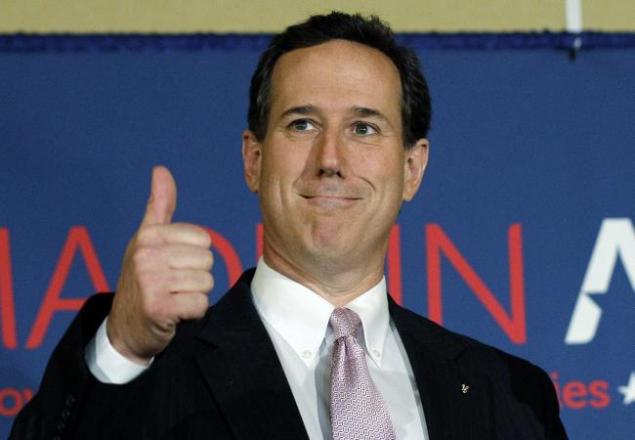
Santorum Lurks

Rick Santorum

In case anyone was worried that Rick Santorum had taken his Republican primary election loss, or the GOP’s presidential election blow-out too much to heart, they need fear no longer.

RealClearPolitics reports that, undeterred by the now undeniable shift away from his socially regressive, paternalistic, authoritarian positions on just about all social issues, he is laying the groundwork to run for the Republican nomination once again in 2016.

Scott Conroy from RealClearPolitics writes:

The main event during Santorum’s impending return to Iowa will be his keynote speech in Urbandale at the annual spring fundraising dinner for the Iowa Faith & Freedom Coalition, a Christian conservative group that holds deep influence among evangelical caucus-goers in the state. He also is slated to participate in a Des Moines luncheon on behalf of a pro-life medical research group.

In both appearances, Santorum is expected to defend what he has called the “soul of the Republican Party” against forces within it that are increasingly eager to downplay or reconsider longstanding aspects of its platform.

His eagerness to remain on the front lines of this intra-party fight comes after Santorum spent much of the 2012 campaign defending his hard-line positions on social issues while also aiming to expand his appeal by touting his blue-collar credentials and economic populism.

Apparently, Rick Santorum is particularly eager to ensure that the GOP does not follow in the footsteps of Senator Rob Portman and others, and continue to “evolve” on those social issues where they are increasingly at odds with public sentiment:

But well before the 2016 GOP field begins to take shape, Santorum’s paramount political priority is to push back against the winds of change within the party. In particular, he’s focused on a de-emphasis — and in some cases an evolution — of stances on social issues in order to attract more moderate voters in general elections and acknowledge shifts in the broader electorate’s views.

In an interview with the Des Moines Register this week that set the stage for his upcoming visit, Santorum was asked about the recent avowals of support for gay marriage made by Republican Sens. Rob Portman of Ohio and Mark Kirk of Illinois.

Santorum dismissed the growing notion that further movement within the GOP on the issue is inevitable, given polls showing a majority of Americans now support same-sex marriage.

“The Republican Party’s not going to change on this issue,” he said. “In my opinion, it would be suicidal if it did.”

I suppose one must admire Santorum’s consistency. He doesn’t believe that the GOP should evolve politically in terms of their stance on gay marriage, just as he rejects the notion of biological evolution in nature.

Two universal truths of politics in the United States of America – Iowa will continue to play a disproportionately large role in vetting and selecting presidential candidates given it’s sparse population and lack of relative real importance in the union; and Rick Santorum will remain thoroughly uncompromising on all matters social and “moral”.

Thatcherism’s Losers

The public and media reaction to the recent death of Margaret Thatcher has played out in exactly the way that I and probably everyone else in the nation had been predicting for the past decade.

The former prime minister was lionised in the right-wing press, and indeed by myself, as someone who quite literally saved the country, halting and then dramatically reversing what was considered by many to be a slow and inevitable national decline.

She was remembered as a “divisive” leader by the left-leaning media, some of whom grudgingly acknowledged the necessity of many of the economic policies which Thatcher brought about, while others chose to set reality aside and focus exclusively on the negative aspects of her time in office.

Some people showed their bad taste by holding spontaneous celebratory street parties on hearing the news.

And finally, of course, everyone got huffy with everyone else for not responding to Baroness Thatcher’s death by their own personal definition of the “appropriate” way.

Of course it is fitting that we recognise and remind people of the enormous positive contribution – the most significant of any post war politician – that Thatcher made to the United Kingdom, and to the world. But we would be doing ourselves an intellectual injustice, and helping to ensure that the next visionary British conservative leader (whoever he or she may be) will also be labelled as “divisive” and hated by many, if we do not understand the lingering bitterness which led to speeches such as this one, made by the Labour Member of Parliament for Hampstead & Kilburn (London), my local MP Glenda Jackson:


Harsh and bitter words, borne of harsh and bitter experiences. But were the people who lost and suffered the most from 1979-1990 really let down by the prime minister, or by someone or something else?

I would argue that it was not the prime minister herself who failed Thatcherism’s biggest losers, but by the long line of political leaders in Britain heading back to the end of the Second World War and the subsequent post-war settlement, which brought about the nationalisation of industry and the freedom from competition that allowed so much of the British economy to atrophy and wither over time, gradually becoming less and less sustainable and competitive with each passing year, until only the harsh but necessary medicine of Thatcherism was able to save the country, at a much higher social cost than might otherwise have been the case.

We can see an excellent modern-day example of this exact argument being made by the highly popular Republican governor of the state of New Jersey, Chris Christie:


Replace the phrase “unfunded pension obligations” with “state-owned industries” in this speech and you have an eloquent defence of Thatcherism that you can deliver in a single minute. Christie explains that he understands the anger and frustration of the people in his state who are materially losing out in terms of stagnating wages for public sector jobs, trimmed pensions for retired state workers, and a host of other measures that the governor considered harsh but necessary in order to put New Jersey on a sound and sustainable financial footing, but that his policies are necessary because none of his predecessors had the political courage or common decency to level with the electorate about the problems that lay ahead, and the changes and sacrifices that would have to be made.

In Britain, those who lost out the most tended to work in inefficient, state-owned industries such as coal mining or car production, where Britain simply did not have a competitive advantage. They had effectively been lied to, and shielded from competition, by nearly all of the political leaders in Britain since the end of the Second World War. Just as generations of New Jersey politicians had promised their public sector workers generous pension and benefit entitlements that they knew would become unsustainable over time, so generations of British politicians promised the population here that heavy industry, state-owned monopolies and industrial relations tilted in favour of union bosses were sustainable in the long-term.

Could and should more have been done to support people who lost their livelihoods as the Thatcher reforms took effect across the country. Absolutely. And we need to ensure that when a future conservative leader makes the next set of necessary reforms (the urgent rationalisation and shrinking of the public sector in Britain) that adequate support is given to people in terms of new job placement and new skills training. There are parts of the United Kingdom where over 50% of employment comes from the public sector, a ridiculously high number – people busily providing and receiving government services to and from each other, and only half of the workforce engaged in private sector activities that generate value and wealth. But as we move away from this failed model, it is not morally acceptable, or politically viable, to rationalise the public sector without providing the necessary transitional support. We can, for example, have no more communities decimated – though the British public must also play their part by increasing our notoriously low labour flexibility and being willing to relocate for work.

Margaret Thatcher achieved much during her time in office. Lord knows that in today’s age of focus groups, granular polling of every single issue and the obsession with following public opinion, we need a leader who is a true conviction politician, and who persuades people to their cause rather than slavishly seeking positive headlines in The Sun or The Daily Mail.

But while conservatives such as myself celebrate the extraordinary legacy of Margaret Thatcher, we need to be sure that we formulate and advocate policies that avoid her pitfalls as well as emulate her great victories.

In Memoriam

Prime Minister Margaret Thatcher, on taking office in 1979


In the course of the 20th century, it fell to two prime ministers to save the United Kingdom – Churchill in wartime, and Thatcher in peacetime. Our nation has suffered an irreparable loss today with the passing of Baroness Thatcher. May she rest in peace.

And I would just like to remember some words of St. Francis of Assisi which I think are really just particularly apt at the moment. ‘Where there is discord, may we bring harmony. Where there is error, may we bring truth. Where there is doubt, may we bring faith. And where there is despair, may we bring hope’ …

Margaret Thatcher, 13 October 1925 – 8 April 2013.

The Compassion Monopoly


Today saw the installation of Justin Welby as 105th Archbishop of Canterbury.

The service was moving, with many elements incorporated to reflect the international diversity of the worldwide Anglican communion. Although myself a Roman Catholic, I wish the new Archbishop of Canterbury the best and pray for him as he seeks to tackle the many challenges facing his church.

I was, however, momentarily distracted from the beauty of the service by this image of a protester in Canterbury, shown on the BBC News website here.

We’ll let the misspelling of the word “privatise” go.

But both Pope Francis and Archbishop Welby can hang up their hats and go home, because this lady clearly has such a direct line to the Lord that she is able to tell us God’s political stance on any issue of the day. With such an ability we should probably make her a Lord Spiritual so she can sit in the House of Lords and meddle in British lawmaking with the others.

Christ would “NOT” privatise the NHS? Really? What does He think about Clinical Commissioning Groups? Is it okay with Him if private firms perform non-clinical work for NHS hospitals (such as cleaning or catering), or must this be owned and managed by the state too? And I have a feeling I know her answer, but does our Lord support the renationalisation of the railways in Britain?

Why does the left have such a monopoly, a stranglehold on the idea of compassion in our country?

Why is it that to speak out against the state taking such a large, meddling role in all of our lives marks one out as a mean-spirited and cruel person, indifferent to the needs of others?

And why do we all buy in to the idea that in order to be charitable and compassionate, we must funnel our efforts to help our neighbours, the less fortunate and the downtrodden through an inefficient state bureaucracy?

If the counterargument is that people would be selfish and insufficiently generous without the heavy hand of government coercion and taxation to take wealth and redistribute to those in need, what does this say about the leftist’s view of human nature?

Did it ever occur to this protester that perhaps it is directly because the state plays such a large part in everything that we do, from cradle to grave, that the church to which she belongs is withering and shrinking by the year?

To a great extent, aside from the divine aspect, has the British welfare state not done away with the purpose of church, of knowing your neighbour, of being part of a community, altogether?

I ask these questions because the answers to these issues of how best to act charitably, to help your neighbour and provide for those in need seem to be self-evident to so many on the left. Of course, they say, we must give more to the government so that they can give back to us according to our need. Certainly the newly-installed Archbishop of Canterbury, Justin Welby, seems to subscribe to this mindset, from what we know of his recent remarks.

I could not disagree more vehemently.

Budget 2013 Drinking Game – The Results

Well, Budget 2013 is now behind us, though the frenzied analysis continues unabated.

We heard George Osborne’s more-of-the-same speech.

We heard Ed Miliband’s “I would do roughly the same, but make things slightly worse” rebuttal (despite the deputy speaker’s unfortunate rhetorical question asking Labour backbenchers why they didn’t want to hear their own leader).

It’s time to check our scorecards and see how we fared in the Semi-Partisan Budget 2013 Drinking Game!

Semi-Partisan Budget 2013 Drinking Game - The Results!
Semi-Partisan Budget 2013 Drinking Game – The Results!


Well, the results are in and it looks as though I have done rather well.

The most magnificent triumph, of course, was my correctly predicting that George Osborne would have a “Marco Rubio” moment mid-speech, and urgently grasp for a glass of water. I awarded myself extra points for that prognostication.

Some, of course, could not be proven one way or the other – the ridiculous rules which still govern the filming of Parliament mean that you rarely get to see a full shot, so I’m not sure who was throwing their order papers, or popcorn, or kicking the seat of the MP in front of them.

But I will take 18/25 as a good result any day. The middle square, of course – an actual sensible policy proposal – was always out of the bounds of possibility, and needless to say did not come to pass.

I hope that you had fun playing, and I would be very interested to hear of any other similar Budget (or other politically) related games that readers may know about. Please do share them in the Comments section underneath this post, or send them to me @SamHooper.

A “fiscally neutral” budget. Rearranging the deckchairs on the Titanic (to use a very tortured metaphor).

Happy Budget Day, everyone!


Semi-Partisan Sam