In their fevered desperation to purge potential troublemakers and ‘entryists’ from the voting rolls, the Labour Party are eliminating people who have every right to take part in the leadership election
It was only a matter of time before the Labour Party’s scattershot and reactionary vetting process ended up turfing out someone who is so clearly and quintessentially Labour that the whole process was instantly rendered ridiculous.
And now, with the expulsion of Public and Commercial Services Union general secretary Mark Serwotka, it has finally happened: the political party created to carry the voice of trade unionism into Parliament has expelled one of those very same voices for failing to share the “aims and values” of the Labour Party.
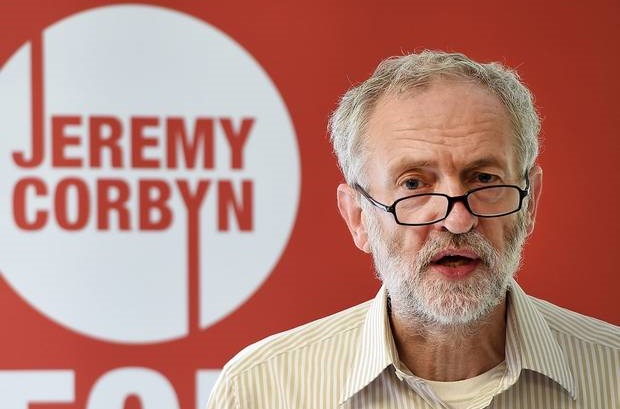
Mark Serwotka, general secretary of the Public and Commercial Services (PCS) union, voted for Jeremy Corbyn, but was told his vote would not be counted.
Mr Serwotka has previously publicly criticised Labour’s “move rightwards”.
Labour said it would not comment on individual cases but said people “who don’t share aims of values of the Labour party don’t get a vote”.
The PCS, which represents civil servants, is not affiliated to the Labour Party and is part of the Trade Union and Socialist Coalition, which stood against Labour candidates at the general election.
Just so we are clear: the general secretary of the main union representing public sector workers (you know, the kind of workers that Labour actually likes and supposedly exists to represent – contrast with ‘the bankers’) is being denied the opportunity to join the party and vote for its leader. Because to be a trade union leader and represent the interests of your members according to your conscience is now anathema to the values of the Labour Party.
Andy Burnham’s Labour leadership campaign has its flaws, but these grasping allegations of sexism are cynical, shameful and unfounded
I dearly hope that one Andy Burnham rally was not all it took for me to become “part of the change” or whatever desperately lame slogan his supporters are now using, but today I actually find myself defending the man.
I have to take exception to the storm of manufactured outrage swirling around social media simply because Andy Burnham failed to agree – when asked on the radio – that he should effectively step aside from the leadership contest so that a woman can win.
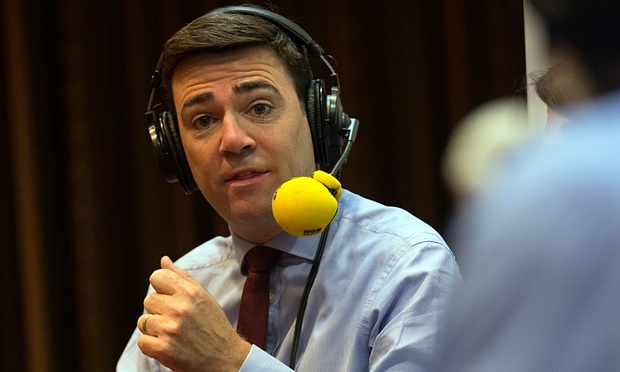
During BBC Radio 5 Live’s Labour leadership hustings today, Andy Burnham was asked whether it would be “great” if Labour chose a female leader. And Burnham, realising that to say yes would be to effectively denigrate his own campaign, replied “When the time is right, when the right leader comes along”, clearly meaning when the future woman leader did not have to win at his own expense.
But in today’s charged and cynical atmosphere – fed at all times by the virtue signalling Twitterverse – you would think that Burnham had ordered his two female leadership opponents out of the leadership contest and back to the kitchen.
Andy Burnham is not without good ideas, some of them even quite radical. But they risk being drowned out by an over-willingness to indulge in the Labour Party’s favourite hobby: raging against the Evil Tories
It’s fair to say that this blog has not been Andy Burnham‘s biggest fan throughout the Labour leadership campaign – “bland non-entity” being my most charitable description thus far of the Shadow Health Secretary and MP for Leigh.
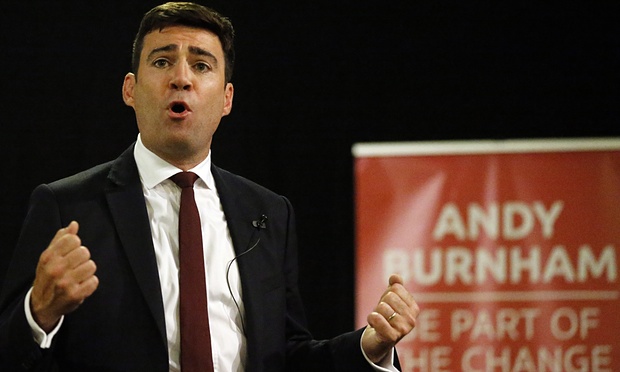
Having attended Burnham’s latest rally in London yesterday, however, I must give credit where credit is due and walk back some (but by no means all) of my criticism. Clearly Andy Burnham does have convictions, though in many cases his policy prescriptions are inevitably contrary to my own. And Burnham spoke well, albeit in that polished and structured way that you only really notice in contrast to the frank, off-the-cuff style of Nigel Farage or Jeremy Corbyn.
Former Deputy Prime Minister John Prescott gave Burnham a barnstormer of an introduction, reeling off the New Labour: 1997-2010 greatest hits to a warm reception which was most notable because (one heckler aside) the capacity crowd of several hundred seemed willing to give Tony Blair’s Number Two a completely free pass on the Iraq question. And when Burnham came to speak, he did so with the wry humility of someone who was once the frontrunner but now seems doomed to scrap with Yvette Cooper for second place.
Burnham was at his best when trying to look beyond sulking opposition to austerity and focus instead on the bigger, more transformational changes he wants to bring about, like bringing social care under the umbrella of the NHS. When asked what new Labour policies could ever appeal both to Scotland and the south-east of England, Burnham cited the 1945 Labour government which “had policies of scale, of ambition, of hope”.
Here’s what happened when I met Labour leadership candidate Andy Burnham after a campaign event in London
Rather than just criticising from afar, I decided to make an effort to see all of the candidates running for the leadership of the Labour Party, in the hope that they might seem more interesting – if not inspiring – in person, when not filtered through television screens or newspaper columns.
First up was Andy Burnham. So earlier tonight I waited outside St. Pancras parish church near Euston in London with a surprisingly large number of supporters waiting to hear Andy Burnham speak.
Overall, Burnham was fairly impressive, though he had the advantage of addressing a capacity crowd buoyed up by the irrepressible John Prescott as a warm-up act. Full impressions of the evening will come later, but suffice it to say that while I still favour Jeremy Corbyn because of the sorely needed ideological difference that he brings, Andy Burnham is not without good ideas of his own.
I spoke with Andy Burnham at the end of the event. I was particularly interested to discuss how – if at all – Andy Burnham intended to reconcile the seething anti-Tory hatred within the Labour Party with the need to persuade and win over current Conservative and UKIP voters in coming elections.
Below is the transcript of my interview:
Question: Your speech has obviously gone down well, you had a standing ovation. You talked about the Bullingdon Boys quite a lot, you talked about the Tory cuts, you talked about Iain Duncan Smith “terrorising disabled people” with ESA changes, and that goes down very well in this hall. But what happens when you try and take the message outside of this room, outside Labour supporters? What happens in 2020 when you try and fight the general election when, let’s face it, you’re going to have to win the support of people who voted Tory and might not like to hear that they have been complicit in maybe a genocide of the disabled or the persecution of the sick? How do you take this passion, but do it in a way that doesn’t necessarily alienate the half of the country who might vote for the Conservatives or for UKIP?
Andy Burnham: Well, I trust in the decency of the British people. They don’t want to see disabled people worrying from one day to the next, full of anxiety, and I think they see how the things that they [the Tories] are doing are cruel. Unfair. Because if people can’t work, people support the idea that they have help. If people can work, then people want to see them helped into work, but Duncan Smith goes further than that, and they’re taking support off people, money off people, who have no ability to replace that income. And the stress, the anxiety that causes is just wrong.
So that’s what I’ve said and I will stand as Labour leader for a fair and humane benefits system, but actually also responding to the concerns people have about immigration, about the economy, I’ve said that we should do that. This party shouldn’t just talk to itself – I said that tonight – it should talk for the whole country, and that’s what we’ll do under my leadership.
Question: And on that note, how does your party connect with aspirational Britain? So we get the compassion, that’s very clear, and that comes through loud and clear in your voice and in the supporters, but what about the people who are striving, you know, maybe trying to move up into those top income tax brackets and don’t think that that is necessarily a bad thing? How do you win them over to the Labour Party and to your cause?
Andy Burnham: Well that’s a really, really good question. And I’ve said that I want to lead a Labour Party that helps everybody get on in life, not a party that drags people back or speaks to the politics of envy but helps people get on, so helps people get onto the housing ladder with a very ambitious housing policy that stops young people having to find a huge deposit, that really helps them get an affordable home, that removes that millstone of debt off the backs of young people, so gets rid of tuition fees, supports young people who want a technical education. These are the policies that I believe in, and actually, when it comes to older people, have a situation where nobody loses everything they’ve worked for just because they happen to be vulnerable and need care. These are the policies that I’ve got and I believe they can speak to the whole country.
You can decide for yourself whether you think Andy Burnham answered my questions or not. But I came away feeling that the message had not quite penetrated, or been fully understood. Burnham’s answers were still predicated on the idea that there is a savage attack being carried out on the vulnerable by the Tories, and that anyone in their right mind must be able to see this.
But more concerning to those who care about Labour’s future, even when I provided a golden opportunity to pitch to Britain’s aspirational voters and perhaps talk about rolling back regulation, taxes and the nanny state, Burnham could only talk about what government has to offer the people by way of state handouts and perks. It’s hard to see this message resonating with the millions of aspirational voters who just want to get on, and who don’t look to government as an essential partner in everything that they do.
My full review of Andy Burnham’s campaign event in London will be available here.
Thousands of new members are being purged from the Labour Party ranks, accused of not supporting the “aims and values” of the party. But the stated aims and values of the Labour Party are so bland and generic that they encompass nearly everyone, Tories and militant entryists included.
Do you agree with the aims and values of the Labour Party?
That was the probing question posed to each of the 121,000 new supporters who have swelled Labour’s ranks since May’s general election defeat by providing the party with a name, email address and the princely sum of £3.
With bookmakers already paying out on a Jeremy Corbyn victory in September’s leadership election, the Labour Party is fighting a rearguard effort to thwart potential ‘entryists’ and troublemaking Tories from infiltrating the party with dishonourable intentions. And the test applied to new supporters as part of the vetting process is intended to ensure that prospective supporters share the same aims and values as the Labour Party.
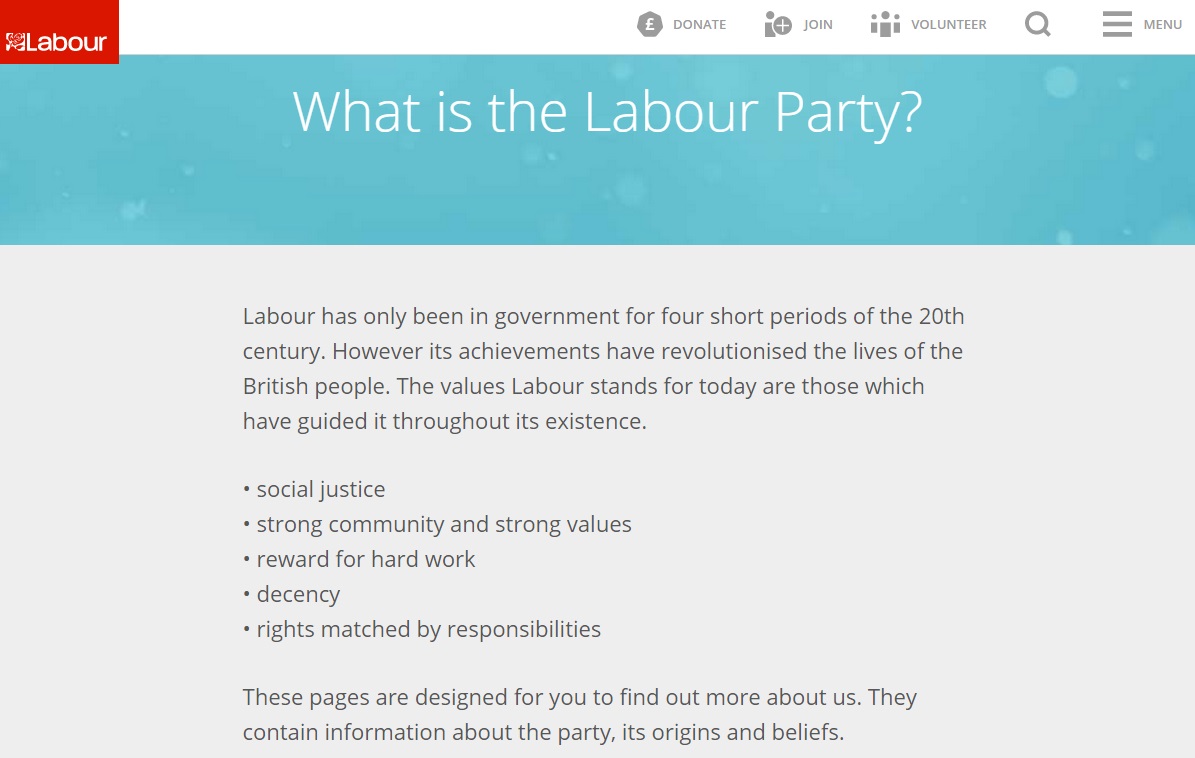
Labour has only been in government for four short periods of the 20th century. However its achievements have revolutionised the lives of the British people. The values Labour stands for today are those which have guided it throughout its existence.
• social justice • strong community and strong values • reward for hard work • decency • rights matched by responsibilities
That one of the Labour Party’s core values is “strong values” tells you everything you need to know about the decline of Labour as a social, intellectual and ideological force, and the utter vacuity at the heart of British politics in general.





 Semi-Partisan Politics