The Police and Crime Commissioner for South Wales, Alun Michael, has generated headlines by requesting something eminently sensible – the devolution of greater policing powers to Wales, and greater control over the criminal justice system.
Mr Michael, a former Home Office minister, said creating the four Welsh commissioners meant that in practice Whitehall has already devolved decision-making about most police activity.
He said the four Welsh commissioners “despite their political range (two Independents, one Conservative, one Labour and Co-operative) have immediately started to work together on Wales-wide issues, with some excellent and fruitful meetings with Welsh government.”
Writing in the Institute of Welsh Affairs journal, he added: “So common sense, pragmatism and purpose have brought about de facto devolution and it’s only a question of when the machinery of government will catch up”.
If it is the machinery of government Alun Michael is waiting for, it could be a very long time indeed before anything happens. The British government, after all, has permitted the organic development of the completely illogical current system where Northern Ireland and Scotland have overarching police structures while Wales and England do not.
Experimenting with different policies and approaches is exactly what should happen in the UK, but it can only happen if powers are devolved equally between the home nations. Establishing the role of police and crime commissioners was a good first step at promoting local police accountability, but this now needs to be backed up by devolution of policing powers to Wales and elsewhere.
As with so many important constitutional matters, change has thus far only come about when aggrieved people in one home nation or another have shouted the loudest. The result has been a constitutional system that resembles a messy patchwork quilt, making no sense either to outsiders or to the people who live under the various jurisdictions.
Welsh First Minister Carwyn Jones has also pointed out the lack of common sense behind the status quo:
Mr Jones said then: “Decisions that affect Wales should be taken in Wales.”
Policing and criminal justice were now “the only mainstream public services which are not devolved to Wales”, and this status quo “is becoming increasingly hard to justify”, he added.
The illogical and unequal devolution of powers to the different corners of the United Kingdom has always been hard to justify; this is nothing new, but always worth pointing out.
Sadly, victory for those who advocate localism and devolution will only further complicate the constitutional situation. But nonetheless, the government would be well advised to heed this call, especially if it is repeated in the findings of the Silk Commission next year. Constitutional incoherency may be harmful and frustrating, but anything would be better than facing another independence referendum.
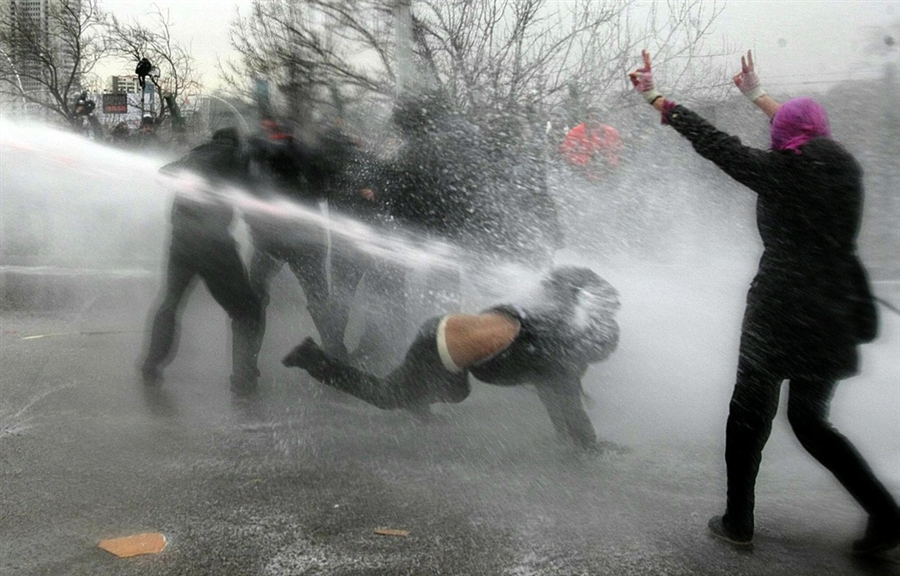
Coming soon to a British town square near you: trigger-happy and power-corrupted police officers, newly armed with water cannon, ready to hose you down with a cooling blast of high powered icy water if the authorities do not approve of the cause or tone of your protest.
The Association of Chief Police Officers, or ACPO, is submitting a request to the Home Secretary, Theresa May, to authorise the use of water cannon in any town or city across England and Wales. They are doing this, they insist, to bolster their ability to control anticipated protests from what they call “ongoing and potential future austerity measures”.
The Association of Chief Police Officers says that the need to control continued protests “from ongoing and potential future austerity measures” justifies the introduction of water cannon across Britain for the first time.
The London mayor, Boris Johnson, has already announced a consultation on the introduction of water cannon on to the streets of London ready for use by this summer.
A new Acpo/College of Policing briefing paper makes clear that chief constables across England and Wales have also been asked to discuss water cannon with their police and crime commissioners and “it is anticipated that the home secretary will be approached in early 2014 in respect of water cannon authorisation”.
This attempt by ACPO to raise the spectre of an implausible large-scale breakdown in public order is complete and utter nonsense, a risible and transparent excuse to bring draconian tools of crowd control to the streets of a generally calm and peaceful liberal democracy.
This is not Ukraine or Greece. And even if we were, like Ukraine, in the grip of large-scale civil disturbances, there is every chance that the fault would rest primarily with the fictitious government and not the fictitious protesters; so why further tilt the odds even further in favour of government power to suppress dissent by arming the police with water cannon?
But the really chilling disclosure comes next:
The police envisage using their water cannon to “exert control from a distance and critically to provide a graduated and flexible application of force ranging from spray to forceful water jets. The mere presence of water cannon can have a deterrent effect and experience from Northern Ireland demonstrates that water cannon are often deployed without being employed.”
Behold the power of the deterrent effect on freedom of speech and assembly. The ACPO will make it widely known that they are purchasing some new, state-of-the-art water cannon, weapons capable of blasting 9000 litres of water into a crowd in just five minutes at potentially deadly force, and sit back and watch the anticipated protests about this or that suddenly fail to materialise – or so the theory goes. But here the enemies of civil liberties may have underestimated the level of public opposition to their scheme.
We may rarely give a second thought to the scenes of plucky, unfortunate foreign demonstrators being blasted off their feet by high power jets of water often shown in television news reports from overseas, but if such a thing were to begin happening in Trafalgar Square or in the shadow of Parliament it would be another matter entirely. The British people will not abide a bully.
Scraping the barrel for recent examples of civil disorder to justify their unprecedented request, the chief police constables produced three very weak cases:
[David Shaw, West Mercia Chief Constable] cites three occasions in the past 10 years when police commanders would have considered using water cannon on the streets of London had they been available.
He names them as the Countryside Alliance demonstration in Parliament Square in 2010, the Gaza demonstrations against the Israeli embassy in 2008-09 and “potentially” the student protests of 2010, when specific locations were targeted.
They would also have been considered during the August riots of 2011 but he concedes they would have had only limited impact on the “fast, agile disorder” seen then.
So apparently farmers and bolshy students number among the most grave threats to law and order currently on the radar of the British police. How heartening it is to know that police chiefs up and down the country are so in tune with the fears and concerns of the communities that they purportedly serve.
More ridiculous still, ACPO themselves admit that water cannon would have been entirely useless in confronting the most recent case of serious civil disturbance in Britain, the August 2011 riots, because the looting and damaging was too fleet-footed and agile. It turns out that people intent on smashing and grabbing merchandise from the windows of electronic goods stores tend not to stand still at the scene of their crime, link arms and form orderly ranks so as to be efficiently mowed down by a hastily-scrambled water cannon.
So what is this really all about? One explanation could be that ACPO are politically agitating, and trying to send a message of their disapproval of coalition austerity policies to the public and their elected representatives, essentially saying “we told you that cutting government spending would lead to chaos and disorder and we were right; now we have to take the draconian step of procuring water cannon to prevent the country from sliding into anarchy”.
This is one plausible possibility – as we have seen only too recently with the Andrew Mitchell “plebgate”scandal, there are those in the police force with very hardened agendas who would stop at nothing to discredit or cast doubt on the performance of Conservative ministers.
But in truth, a more convincing explanation is that the police just really fancy having these new toys to scare and intimidate people, that they have decided that building good community relations with the public and doing the hard work of policing large scale events just isn’t worth the effort when they can just bully the public into cowed obedience much more easily.
They likely pursued this strategy in the belief that vague and nebulous references to potential future instances of moderate civil disorder would be sufficient prompting for Theresa May to roll over and grant their wish in her desire to appear tough on the issue of law and order. The British public can only hope that she has the political courage and commitment to civil liberties to tell ACPO to back off – but based on her record, the signs are not encouraging.
Unwarranted plans to bully and intimidate by the ACPO.
The saving grace of this worrying affair will be the newly-created police and crime commissioners, now in place throughout many parts of the country – officials whose primary job it is to advocate for the local population, highlight their concerns and see them addressed by the police forces.
This brazen move by ACPO will be a good early test of the new commissioners. Do they have real teeth, and the strength to dig in their heels and make the police chiefs focus on local priorities rather than their own private Orwellian ambitions, or will they merely act as a fawning rubber stamp to power?
Two stories in the media this afternoon, each quite different in nature but both pointing toward the same dark, disturbing and authoritarian shift that continues unabated in Britain today.
The officer is heard to say, “we’ll nick you now and I will make your day a living hell, ‘cos you’ll be in that cell all day. What I’ll probably do is I will ask for you to be remanded in custody and I will put you before the magistrate.”
He added: “You’re lucky that I didn’t knock you out. I swore at you, yeah. It got your attention, though, didn’t it?”
Because apparently taking pictures or video of the aftermath of a road accident is now illegal in our country, as is showing anything but the most fawning and servile deference and adulation to the most power-crazed and high-handed officers in the police force.
The second article is chilling on an altogether different level, and chronicles the process by which the UK’s anti-terrorist police decided that it would be in any way appropriate and proportional to haul a twelve year old boy out of his class at school to question him about an event that he had organised on Facebook to protest the planned closure of his local youth club:
Wishart said that after the school was contacted by anti-terrorist officers, he was taken out of his English class on Tuesday afternoon and interviewed by a Thames Valley officer at the school in the presence of his head of year. During the interview, Wishart says that the officer told him that if any public disorder took place at the event he would be held responsible and arrested.
Speaking to the Guardian, Nicky Wishart said: “In my lesson, [a school secretary] came and said my head of year wanted to talk to me. She was in her office with a police officer who wanted to talk to me about the protest. He said, ‘if a riot breaks out we will arrest people and if anything happens you will get arrested because you are the organiser’.
The event was organised in the Prime Minister’s home constituency of Witney in Oxfordshire, but in what possible dark, dystopian world is it okay for the police to make a mountain out of a truly tiny molehill and question the intentions of a young boy who was doing nothing but being an engaged and activist citizen? Our country would be vastly better off if there were more children like Nicky Wishart, who actually care about local issues enough to take a stand rather than festering away in front of the television for hours on end.
But it is the next quote attributed to the police that is truly terrifying:
“He said even if I didn’t turn up I would be arrested and he also said that if David Cameron was in, his armed officers will be there ‘so if anything out of line happens …’ and then he stopped.”
If anything out of line happens, the armed officers will do what, exactly? Shoot a twelve year old boy as some kind of sadistic punishment? What reason is there to mention the potential presence of armed officers, other than to imply that they might do the one thing that regular police officers do not?
The truly scary thing is that we don’t even have to worry about our politicians using their power and influence to get the security services to intimidate and threaten the population on their behalf – the security services seem perfectly willing to proactively do so of their own volition!
We must also ask why it was the anti-terrorist police (who apparently have no real serious threats to the nation on their agenda at the moment to be wasting time on routine public intimidation work, for which I suppose we can all breathe a sigh of relief), of all the many branches of our national law enforcement apparatus, who seemingly felt it necessary to bully a small child about his planned political protest. Has GCHQ intercepted terrorist chatter that Al Qaeda intends to infiltrate local community action groups in order to launch their next attack? Whatever next – fears of ricin or anthrax being baked into scones at a Women’s Institute cake sale, and elderly ladies being detained in their kitchens?
The police make the predictable but ludicrous claim that their intention was not to cause distress or to intimidate Wishart, but was simply part of their standard community outreach efforts:
“On Tuesday 7 December, our schools officer for west Oxfordshire attended the school in Eynsham and spoke to a 12-year-old boy in the company of the pupil’s head of year, about a planned protest. This was not with the intention of dissuading him from organising it, but to obtain information regarding the protest to ensure his and others’ safety. As with any demonstration, we always aim to facilitate a peaceful protest.”
Perhaps the police need to apply the “ordinary person” test and reconsider the likely effect of being yanked out of class and spoken to by police in the presence of a senior teacher with no parents or legal representatives present, on the psyche of a young boy. Is doing what they did more likely to “facilitate a peaceful protest” or to stamp out a potential protest before it ever sees the light of day?
David Cameron needs to send a very clear message to the nation in response to this outrage, as a matter of urgency. And through the locally elected police commissioners, he needs to publicly rebuke and call off the police attack dogs currently biting at the ankles of the British citizenry. Cameron and the commissioners must make clear that individual police officers will curry no favour with their superiors by overzealously applying extreme interpretations of public order laws, and that those higher in the law enforcement hierarchy will receive no special favour from their political masters by using their extensive powers to bully and silence any protest that could be politically embarrassing.
Semi-Partisan Sam is quite unequivocal on this matter. The apology from the police to the family concerned is all well and good, but it is quite insufficient. It is high time that the British police are brought to heel once and for all.




 Semi-Partisan Politics