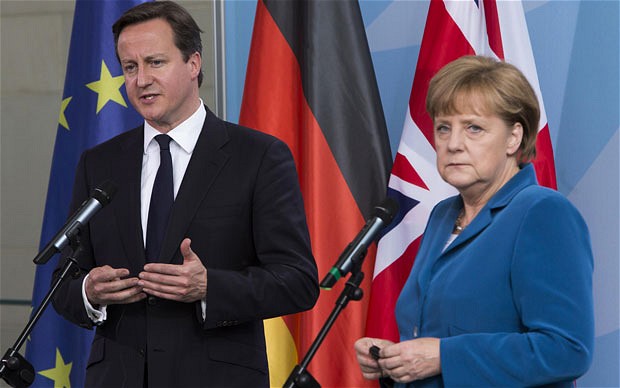
You have to hand it to Michael Fuchs, deputy chairman of Angela Merkel’s CDU party in Germany. If you genuinely want Britain to remain part of the European Union – for intentions noble or otherwise – the best way for other countries to achieve that outcome is by convincing the British people that they too are frustrated by Brussels bureaucracy, that they yearn for real reform, and envisage our humble selves at the heart of this great effort.
And this is exactly what Fuchs has done, presenting the face of German concern about Britain’s place in the EU while his ally Angela Merkel is preoccupied with the far more pressing matter of the Greek crisis.
From the Telegraph:
“I want the UK to stay in the EU, and I cannot even imagine an EU without the UK. I don’t want to imagine it,” [Fuchs] said.
“In particular, for us it’s not good because the UK is a partner promoting a free-market economy, much more than the southern hemisphere in Europe. [Some of these countries] want to have a more state-regulated economy, and the UK is more like us, for instance, like Holland and the northern hemisphere, so we would not be very happy to see it go.”
Mr Fuchs described Brussels as a “huge” bureaucracy that needed to be scaled back. “I fully agree with certain statements of [Prime Minister] David Cameron saying that Brussels need not be such a huge bureaucracy, with so much red tape.
“That’s quite important, I think, and we need Cameron’s help to change it.”
Unfortunately, when someone you normally expect to be an antagonist starts acting very friendly, there is usually an ulterior motive at play. Feigning concern for and agreement with a difficult negotiating partner is straight out of Hostage Negotiation Strategy 101, and just as the man in the FBI jacket doesn’t really care that your wife left you and isn’t really going to arrange that escape airplane filled with cash, so Germany isn’t really about to let awkward old Britain stop the wheels of an EU juggernaut which has been rolling and gaining momentum since the 1950s.

 Semi-Partisan Politics