No, Donald Trump Was Not Swept To Victory By Resurgent White Nationalism

steve-bannon-donald-trump-white-nationalism-media-journalism

No, “nationalism” is not the same as “white nationalism” – and the American Left urgently needs to find a way of opposing populist, protectionist ideas without resorting to the nuclear option of accusing their adherents of being secretly racist

A lot is being written at the moment about the future presence of Steve Bannon as a key adviser in Donald Trump’s administration, and whether this represents a calamity on the scale of the 1906 San Francisco earthquake or more closely resembles the Chicxulub Asteroid which wiped out the dinosaurs 65 million years ago.

We are constantly being told by hysterical news outlets and media commentators that Steve Bannon is a “white nationalist“, which would obviously be utterly appalling and terrible if it were true. But considering that many of the news outlets making the allegation are the same ones screeching loudest about the impact of “fake news” on the election, they seem remarkably unwilling to come forth with evidence of racist, white nationalist sentiments previously expressed by Bannon, and equally unwilling to report the many times when Bannon has disavowed such ideas.

At this point, I have to make the customary disclaimer before those who do not frequently read this blog rip me to shreds. No, I did not and do not support Donald Trump. I dislike Trump’s character as well as many (though not all) of his policies, and believe that he is temperamentally unsuited to lead America, to say nothing of setting an appalling example for younger Americans. Just so that’s clear.

But outlets like the Guardian have accused Bannon outright of being a white nationalist, while prestige outlets like CNN have sought to tar him with association, going up to the line of suggesting that Bannon will advocate for white nationalists.

But nationalism and white nationalism are not one and the same thing. People – including many in the media who should know better – seem more than happy to bolt the two words together, either to aid with the cadence of their sentences or as a deliberate way of smearing nationalism, but the two worldviews are quite different. Nationalism can be boiled down as a “country-first” mindset, prioritising the citizens of a country (no matter their race, gender or other characteristics) over those from outside the country. Such a worldview manifests itself through clear policies on immigration, illegal immigration and foreign policy. Meanwhile, white nationalism seeks to favour typically white protestant people in America over other races, and is manifested through discriminatory and divisive policies of racial segregation and persecution.

Clearly, the two are quite different, and hearing the media talk airily about “white nationalism” as a means of slandering the alt-right or nationalism in general is starting to become extremely tiresome. If people want to attack Steve Bannon’s actual ideas, they should feel free to do so. But lobbing baseless accusations of overt racism with the term “white nationalism” is cheating, a lazy attempt to excommunicate Bannon from respectable political debate without having to do the intellectual heavy-lifting of taking on his ideas. Which is reprehensible.

Gene Callahan puts it well in The American Conservative:

Perhaps, given my limited knowledge of him, Bannon really is, secretly, a “white nationalist,” despite his repeated public rejection of white nationalism. Perhaps he really is, secretly, a supporter of the racist elements of the alt-right, despite the fact that he has said he has “zero tolerance” for those elements. Perhaps he really is, secretly, anti-Semitic, despite his strong support for Israel (a support too strong, by my standards), and despite the character testimony provided for him by many Jews. But the evidence that Bannon holds these hidden views, as far as I have been able to examine it, is pathetic, and entirely inadequate to support such serious charges. No competent prosecutor would ever bring a case against a suspect based on such flimsy evidence.

So is there an alternative hypothesis as to why Bannon has been attacked in this fashion? Well, let us imagine that there is a globalist elite that doesn’t really care at all about the American people. When the housing crisis hit in 2007, instead of bailing out low-income homeowners (many of whom were African-American and Hispanic) who had been duped into taking on adjustable-rate mortgages that only someone with a degree in finance could understand, they instead bailed out the bankers who had made such loans. Instead of worrying about the impact of massive immigration on the lives our our own most vulnerable citizens (many of whom are African-American and Hispanic), they celebrated such immigration, since, after all, it provided them with cheap gardeners and nannies and maids, and their factories with cheap assembly-line workers. Now imagine that they are threatened by the possible ascendancy into power of people who do actually believe that the American government should put the interest of American citizens, be they black or Hispanic or white or Asian, first in our government’s policies? I would imagine that this (entirely imagined on my part!) elite would embark on a relentless smear campaign against anyone expressing such “ethno-nationalist” concern for our own citizens on the part of our own government, so that they could continue to enrich themselves at the expense of the rest of us.

Dear reader, please decide for yourself which hypothesis is most probable.

Read the whole thing if you have a few minutes to spare. This blog is certainly convinced that Callahan is right while the hysterical accusers are wrong. And note: one can still dislike Steve Bannon, his political views and what he stands for. There is just no plausible evidence that he is guilty of the accusations now being thrown his way, and therefore responsible media outlets should stop reproducing them without further evidence.

More importantly, we need to rescue the word “nationalism” from toxic association with white nationalism, which of course remains abhorrent. But nationalism itself is nothing more than a belief in the nation state. Nationalism (not white nationalism) helped to drive the vote for Brexit in the UK because people believed that the European Union is a poor guarantor of our rights and freedoms, more obsessed with building the secretive federal project than actually winning legitimacy in the eyes of its citizens or doing them any good. And so the British people decided that Britain should be run for the benefit of British citizens – all of us, no matter our colour or ethnicity – rather than as a colonial outpost of the Brussels project. And of course the leftist opposition to Brexit has been making shrill claims that the vote was motivated by racism ever since, even though no such evidence exists (and can only be hinted at if one makes the unsupportable claim that opposition to mass immigration is inherently racist).

We now see a similar tale unfold in America following Donald Trump’s election victory. Trump’s endlessly repeated intention to “Make America Great Again” and to put legal American citizens first may be simplistic and lacking in detail. It may even be counterproductive and morally wrong at times, especially if the threat to deport millions of otherwise law-abiding illegal immigrants lured to America by a succession of permissive past regimes is actually carried out. But it is not inherently racist, unless one is willing to take the position that borders are inherently racist, and with them the very idea of the nation state. If this is actually the view of those who criticise Donald Trump and Steve Bannon the loudest, then they should have the courage to openly admit their intention to do away with borders and essentially abolish America. But of course they will not – their support would shrink rather dramatically were they to be so honest.

Steve Bannon call his worldview “economic nationalism”, as described by Peter Nicholas in the Wall Street Journal:

Mr. Bannon, in the interview, said he is animated by an economic populism that has the potential to create an enduring political realignment in the U.S.

“I’m not a white nationalist, I’m a nationalist,” he told Mr. Wolff. “I’m an economic nationalist.

“The globalists gutted the American working class and created a middle class in Asia. The issue now is about Americans looking to not get f—— over.” In a shot at Democrats’ close ties to Silicon Valley, he continued: “They were talking to these people with companies with a $9 billion market cap employing nine people. It’s not reality. They lost sight of what the world is about.”

Mr. Bannon offered a few hints about how Mr. Trump intends to govern. One focus will be a dramatic new public works building program that takes advantage of low interest rates – a project that Democrats have long favored.

“It’s everything related to jobs,” Mr. Bannon said. “The conservatives are going to go crazy. I’m the guy pushing a trillion-dollar infrastructure plan. With negative interest rates throughout the world, it’s the greatest opportunity to rebuild everything. Ship yards, iron works, get them all jacked up. We’re just going to throw it up against the wall and see if it sticks. It will be as exciting as the 1930s, greater than the Reagan revolution — conservatives, plus populists, in an economic nationalist movement.”

One can disagree with parts (or all) of this message. This blog certainly disagrees with throwing fiscal conservatism out the window, frittering away federal money on dubious infrastructure projects and trying to resurrect dead industries in America where global comparative advantage has seen those industries move to other parts of the world.

But millions of Americans – enough to put Donald Trump in the White House – apparently did agree with this message of populist economic nationalism. And you can fisk it all you want, but you simply won’t find a shred of racism in it. That doesn’t mean that Donald Trump does not appeal to racists, or that he has not sometimes courted people with xenophobic beliefs – he has, and it is reprehensible. But still, this is different from Donald Trump’s policy platform and key advisers being openly racist – it is not, and they are not, bad though they are in other ways.

And at some point, the anti-Trump Left is going to have to stop resorting to the nuclear option of declaring people “racist” or “white nationalist” whenever they depart from the centre-left political consensus in America. Not only is it slanderous, it is making some people more fearful than they should be about the incoming administration.

As Scott Alexander put it so well recently:

Stop fearmongering. Somewhere in America, there are still like three or four people who believe the media, and those people are cowering in their houses waiting for the death squads.

Stop crying wolf. God forbid, one day we might have somebody who doesn’t give speeches about how diversity makes this country great and how he wants to fight for minorities, who doesn’t pose holding a rainbow flag and state that he proudly supports transgender people, who doesn’t outperform his party among minority voters, who wasn’t the leader of the Salute to Israel Parade, and who doesn’t offer minorities major cabinet positions. And we won’t be able to call that guy an “openly white supremacist Nazi homophobe”, because we already wasted all those terms this year.

Stop talking about dog whistles. The kabbalistic similarities between “dog-whistling” and “wolf-crying” are too obvious to ignore.

Stop writing articles breathlessly following everything the KKK says. Stop writing several times more articles about the KKK than there are actual Klansmen. Remember that thing where Trump started out as a random joke, and then the media covered him way more than any other candidate because he was so outrageous, and gave him what was essentially free advertising, and then he became President-elect of the United States? Is the lesson you learned from this experience that you need 24-7 coverage of the Ku Klux Klan?

[..] Stop turning everything into identity politics. The only thing the media has been able to do for the last five years is shout “IDENTITY POLITICS IDENTITY POLITICS IDENTITY POLITICS IDENTITY POLITICS IDENTITY POLITICS!” at everything, and then when the right wing finally says “Um, i…den-tity….poli-tics?” you freak out and figure that the only way they could have possibly learned that phrase is from the KKK.

[..] Stop centering criticism of Donald Trump around this sort of stuff, and switch to literally anything else. Here is an incompetent thin-skinned ignorant boorish fraudulent omnihypocritical demagogue with no idea how to run a country, whose philosophy of governance basically boils down to “I’m going to win and not lose, details to be filled in later”, and all you can do is repeat, again and again, how he seems popular among weird Internet teenagers who post frog memes.

In the middle of an emotionally incontinent reality TV show host getting his hand on the nuclear button, your chief complaint is that in the middle of a few dozen denunciations of the KKK, he once delayed denouncing the KKK for an entire 24 hours before going back to denouncing it again. When a guy who says outright that he won’t respect elections unless he wins them does, somehow, win an election, the headlines are how he once said he didn’t like globalists which means he must be anti-Semitic.

Stop making people suicidal. Stop telling people they’re going to be killed. Stop terrifying children. Stop giving racism free advertising. Stop trying to convince Americans that all the other Americans hate them. Stop. Stop. Stop.

And to that we can add: Stop this tacit, corrosive insinuation that nationalism, wanting to put America and American citizens first, is somehow a negative trait in an American president. Stop trying to insinuate that those who want the American government to prioritise American workers are motivated by racism. Stop trying to sneakily undermine the nation state at every turn, or at least have the courage to stand up and proudly declare that you want to bring the era of the nation state to an end and effectively abolish America.

Stop stop stop.

But they will not stop. Making blanket accusations of racism and a “white nationalist” resurgence just feels so good when one is smarting from an unexpected electoral defeat. And it is far easier to cow people into silence by accusing them of racism than it is to deconstruct and oppose the incoming Trump administration’s protectionist, mercantilist ideas – let alone offer a more appealing alternative.
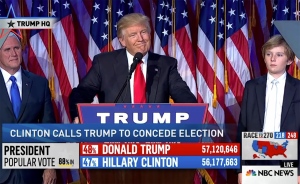
 

donald-trump-presidential-election-victory-speech

donald-trump-hitler-comparison

Support Semi-Partisan Politics with a one-time or recurring donation:

Agree with this article? Violently disagree? Scroll down to leave a comment.

Follow Semi-Partisan Politics on TwitterFacebook and Medium.

Facebook And The Fake News Monster

facebook-news-feed

The mainstream media looks to Facebook and technology to solve the problem of “fake news”, while utterly ignoring their own starring role in driving readers into the arms of more disreputable news outlets

Jeff Chiu has an interesting rumination in Newsweek on the way that Facebook tacitly encouraged the monster of “fake news” which it is now being ordered to help slay.

Chiu writes:

Think back just a couple of years, before the 2016 election cycle and before Facebook set itself up as the world’s newswire. Facebook grew to a billion users by being a social network. It’s where you found old friends and kept up with family. I just looked back at my 2014 Facebook timeline. Almost zero politics! And that’s how most people liked it. Many users back then even beseeched friends to avoid political posts, or muted the violators if they persisted. In real life, most of us don’t want to argue politics with our friends and family, so why would we want to do it online?

Then, over the past two years, Facebook aggressively morphed into a media site. It set up deals with publishers to populate all our timelines with stories. It subtly encouraged users to post stories and to “like” and comment on them. Facebook, of course, did this with its own goals in mind. To maximize profit, Facebook needs to keep users engaged and on the site as long as possible, and to get those users to create or interact with all the content in their feeds. That thrum of activity helps Facebook’s algorithms more deftly target ads to more people, which makes Facebook even more attractive to advertisers.

Since politics is traditionally news, of course that topic started to slip into our feeds, and Facebook’s setup encouraged sinister practices. As users zip through their news feeds, scanning only the headlines, they are more likely to click on and share stories that are outrageous or stir emotions. In other words, Facebook—unwittingly, from what I hear—incentivized clickbait “news” over more serious news, and the success of clickbait opened the way for fake news. “We’re more likely to share inflammatory posts than non-inflammatory ones, which means that each Facebook session is a process by which we double down on the most radical beliefs in our feed,” writes Mike Caulfield, an expert in learning environments. “Marketers figured this out and realized that to get you to click, they had to up the ante. So they produced conspiracy sites that have carefully designed, fictional stories that are inflammatory enough that you will click.”

It’s hard to say whether Facebook is the chicken or the egg in this wave of political propaganda—whether it helped create the acidic and divided politics around the world or if the ugly political environment merely found an accommodating home on Facebook. No doubt it was some of both, and the result is that our feeds are now overwhelmed with wingnut political content that gets amplified even if it’s crazy. During the election, a lot of Facebook users just didn’t care if something was true, says Paul Mihailidis, a media literacy professor at Emerson College. “They saw it as a way to advocate,” he says. “They see a catchy headline, and the default is to share.” If you look globally—the U.S., the U.K., France, Colombia, the Philippines—politics are getting more caustic, not less. In this kind of environment, all the media outlets that now rely on Facebook’s audience are driven to flood us with click-worthy headlines that play to our fears and anger. Every trend line points to more of what we’re growing to hate on Facebook.

The perverse incentives created by Facebook’s dominance and algorithms cannot be overstated. At peak times, when I am actively promoting Semi-Partisan Politics during newsworthy events, up to 50 percent of total traffic can come from Facebook alone, some days even more. Other sites have an even greater dependency on Facebook as a source of traffic.

And for media professionals, with this dependency on Facebook comes the temptation to generate extra precious pageviews by pushing the boundaries of acceptable journalistic practice, whether as a ploy to increase web ad revenue or merely for the supposed prestige of more clicks. All other ways of generating extra traffic – like, say, producing better content – are far more arduous and time intensive than simply being a bit more provocative on Facebook. And the returns are nowhere near as good. It would take a media organisation of exceptional poise and integrity to withstand these temptations. And as we know, there are few publications where the words “poise” or “integrity” come naturally as descriptors.

Compounding the problem is the fact that this Facebook traffic is both fickle and disloyal. One can win the passing attention of their eyeballs for a few brief passing seconds with a catchy headline (and often a provocative picture), but the moment your articles stop appearing in the Facebook feed, the vast majority of users will not go seek you out independently as a publisher of content – as a publisher, you are utterly replaceable by the swarm of other sites churning out often superficially similar-looking stuff.

This leads to an arms race of hysteria in terms of online political coverage, with some of those outlets now shouting loudest about pro-Trump “fake news” being themselves the worst offenders. Many of the headlines or Facebook post descriptions published by left-leaning sites like Huffington Post or MotherJones sound like the breathless, hysterical reactions of a high school student as opposed to sober, reasoned analysis, and of course the same goes for the likes of Breitbart on the right. Every utterance by Donald Trump is “scary”, every pronouncement by Hillary Clinton a “threat to America” – and these people dare to accuse others of generating a toxic climate for political discourse.

Chiu goes on to ponder the implications for Facebook:

Despite recent statements by Facebook CEO Mark Zuckerberg about his efforts to rein in fake news, he won’t be able to do that easily. Zuckerberg hit on the reason when he said it would be problematic to set up Facebook editors or algorithms as “arbiters of truth.” Because—what’s truth? Centuries ago, it was true that the world was flat. When I was a kid, a mom would sit in a car’s front seat and put her baby on her lap and not wear a seat belt. If someone said that was insanely unsafe, you probably would’ve blinked quizzically and said, “That’s not true.”

Facebook apparently is working on software that would flag or block fake news. Last year, Google published research on a knowledge-based trust algorithm that would sort for truth. Some college kids recently got attention for creating a Google Chrome extension they called FiB that automatically labels allegedly iffy sources. British technologist Peter Cochrane recently talked to me about developing software he called a truth engine. These might succeed in banning certain sites or identifying stories likely to be fake because they come from a single source, and yet software solutions can probably never overcome the problem that truth to me might not be truth to you, and truth today won’t necessarily be truth tomorrow.

[..] One constant about the technology industry is that every seemingly bulletproof superpower at some point has a Waterloo. It happened to IBM, AOL, Microsoft, Intel; and it will happen to Apple, Amazon and Google. You might be witnessing Facebook’s moment of truth, in a very literal sense. If Facebook turns into a bottomless cesspool of competing political “truths,” a lot of us are going to soil ourselves and escape to something else.

Frankly, I am a lot less worried about the future of Facebook than I am about the future of political journalism. In Britain, the EU referendum and surprise Brexit vote exposed the mainstream media as horribly glib, superficial, biased and lacking in basic understanding of the topics that they were covering. While the shining ones in Westminster write their articles in prestige publications or pontificate in the TV news studios, one frequently has to turn to the independent political blogosphere – largely strangled in its crib by the big media companies over the course of a decade – for anything approaching serious, granular analysis.

Yet many of these writers are unpaid, doing what they do as a labour of love rather than as a viable career. Many of them could vastly increase their audiences by adopting the same clickbait tactics as practiced by the likes of Buzzfeed, HuffPo or InfoWars. From a medium term career perspective, the best thing that many of these writers and journalists could do for themselves would be to sell out, start trotting out establishment talking points wrapped up in the kind of hysterical catastrophisation which prospers under the Facebook algorithms.

The problem is partly one of human nature: there will always be a much bigger market for sensationalist partisan fluff than serious, sober analyis. But also important is the fact that there is not a neat dividing line between real news and “fake news”. Fake news can incorporate false facts, but also correct facts which have been deliberately misinterpreted or spun. And far more insidious than any one fake news story, no matter how egregious, is the way in which language is often used to subtly change public perceptions over time – note how we now speak about “undocumented” rather than “illegal ” immigrants, a change adopted by nearly all of the mainstream media in America, and now in Britain too.

When the media is secretly complicit in ideologically-driven agendas, trust in the more reputable media is rightly weakened. But this leaves people more vulnerable to peddlers of deliberately fake news, as they search for alternatives. The obvious answer is for mainstream prestige outlets to rediscover their integrity and stop forcing readers away with ideologically skewed coverage, but they will not desist, and so they fuel the exodus of readers away to the fringes of the internet, a place where the more outrageous a story sounds, the more people will read it.

We present this as a crisis of technology – or at least those who work for mainstream publications, unwilling to examine their own culpability, present it that way. If only Facebook could stop people falling prey to the great evil of fake news, they cry in anguish, utterly ignoring the role that they themselves play in driving people toward fake news.

But this is not a crisis of technology. It is a crisis of human integrity, and the prestige mainstream media need to examine their own consciences long and hard before finding fault in other people.


fake-news-newspaper-media-journalism

Top Image: Facebook

Support Semi-Partisan Politics with a one-time or recurring donation:

Agree with this article? Violently disagree? Scroll down to leave a comment.

Follow Semi-Partisan Politics on TwitterFacebook and Medium.


What It Is Like To Be A Donald Trump Supporter On Campus

The New York Times (in a rare change of perspective) publishes a first-hand account of what it is like to be a moderate, unenthusiastic Trump voter at college.

K.N. Pineda writes:

The presidential election was the last thing on my mind on Nov. 8. I had essays to write and Italian vocabulary to learn. Sure, I kept New York Times and Wall Street Journal tabs open on my laptop, but I was uninterested in indulging in conversation about an election that most everyone could agree was a time bomb.

As a student at New York University and the daughter of a civil servant at the United States Department of State, I am familiar with political unrest and its potentially disastrous outcomes in the arms of ignorance and hysteria. I did not hold any particularly strong opinions about Donald Trump or Hillary Clinton. If I had voted, however, I would have picked Mr. Trump. I was focused on school. I had no idea that a few days later I would be dismissed as a “Trump supporter” and a person of “privilege” who “reflected an us versus them mind-set” in an essay by my college roommate in this publication — an essay that would go viral and change my life.

I did not feel that I should lie to my new college friends, especially at N.Y.U., where we are supposed to be open to hearing opposing views, able to discuss them and put any bias aside. I never tried to persuade my roommate to accept my side, my choice or my views. I even agreed with some of her opinions about Mr. Trump, who has said divisive things about Muslims and other minority groups. As an independent, my feelings toward the campaign were very mixed. I felt strongly that as a country we needed to focus on domestic issues, and for me, the Republicans were more prepared to do that.

My roommate has since apologized to me, but in the meantime I have felt the glare of her friends and been heckled on campus by other students. I have been labeled “racist,” “sexist” and “xenophobic” on Facebook. I have been called a “white without a conscious,” a “misogynist,” a “bigot” and a “barbarian” online by people all over the country.

This tale should make the allied anti-Trump forces stop and think firstly about how they are treating their own friends and neighbours, but more importantly about the image they are projecting to the wider country, and thus feeding into America’s future political discourse.

Presumably those most upset about Donald Trump’s election victory would quite like many of his supporters to vote for somebody else, maybe somebody from the Democratic Party, in four year’s time. They should stop and ask themselves whether this goal is more likely to be achieved by seeking genuine dialogue and understanding with people who voted differently, or by loudly and repeatedly accusing them of complicity in bringing fascism to America.

The enhanced cold-shoulder received by K.N. Pineda is also depressing given her own family background:

Here’s my story. My father is Hispanic. My extended family lives in Southern California and New Mexico. Many of my family members are not native English speakers. My maternal grandmother is an Italian immigrant who holds a green card. Her husband died after struggling with drug addiction and alcoholism; she had to work two jobs to make ends meet. My mother was raised by her stepfather, who is African-American and the only maternal grandfather I have known. He is a kind, devout man whom I love dearly. My family and friends come from all ethnicities, religions and sexual orientations.

Attending New York University was my dream. My dad grew up in a trailer home, and my mom was homeless for a period of time. My parents were the first in their families to graduate from college. They have struggled to provide the best for me and my brother. They have sacrificed financially and worked hard to give us a good life. I came to N.Y.U. partly on scholarship and am accruing debt to pay my tuition.

As minorities, my mother, father, grandparents and I have experienced racial hate. My skin may be light, but I understand discrimination. I may not know each person’s individual experience, but am able to empathize with others.

So not a dumb, ignorant redneck then (incidentally, one of the last groups of people that it is okay to openly mock and denigrate in polite society). Rather, Pineda has Hispanic heritage and so is expected to toe the line and adopt all of the political opinions now expected of that racial demographic by the Identity Politics Left, voting one’s own conscience is seen almost as a “betrayal” of one’s ethnic heritage. This is what the identity politics embraced by the American Left hath wrought, at a time when it otherwise ought to be subsiding – electoral segregation.

Pineda’s conclusion makes one wonder why it has fallen to a freshman college student to express these sentiments so eloquently, and exactly what the American media and commentariat think they are playing at with their own coverage:

I know the fear that the election has inflicted. I comprehend the hurt that people feel. We all have reasons for casting our votes. What I do not understand is hatred toward one another. Supporters of both parties have misunderstood and fueled hate out of reckless emotion and ignorance.

The answer is not to further the divide by labeling and dehumanizing one another. We should fight the “us versus them” mind-set. We have spent too much time in our own bubbles, and we need to begin a dialogue that will allow us to understand one another.

Blind fear and hatred are far more powerful than any candidate. How can we assume we know someone based on the color of their skin, their religion, or their political choices? Why should we be afraid to express our opinions? If we see one another not as a Clinton supporter or a Trump supporter, but as human, perhaps we can discover empathy in the troubled nation in which we exist.

The narrative should be one of inclusiveness, openness, respect and love. It is not only about making “America Great Again,” it is about making America home again.

I think it is fair to say that the New York Times could have found far more unpleasant and even harrowing tales of political persecution on campus had they searched, or possessed the political will to do so. Young conservatives were well used to public opprobrium and seeing their free speech rights constrained while left-wing identity politics activists were given the run of campus by craven university administrators long before the election. And Donald Trump’s surprise election victory has only enraged and emboldened these tormentors all the more.

The American Left, (sometimes justifiably) outraged on behalf of the various minority groups for whom they claim to speak, should bear in mind that in the rarefied surroundings of the college campus, they are very much in the majority – an oppressive majority, one might even say, to use the current social justice parlance.

And there is a notable, shameful irony in the way that many anti-Trump activists on the Left are so ostentatiously welcoming of every kind of difference and diversity, save diversity of political opinion.


pop-art-donald-trump-2

Support Semi-Partisan Politics with a one-time or recurring donation:

Agree with this article? Violently disagree? Scroll down to leave a comment.

Follow Semi-Partisan Politics on TwitterFacebook and Medium.

Donald Trump Victory Reaction: Everybody Take A Deep Breath

shun-the-non-believer

America’s new president-elect is bad, but he is hardly evil on a world-historical scale. Unfortunately, the hysterical media reaction to Donald Trump’s election victory leaves no room for nuance or restraint

In these fractious times, it is very difficult for those of us who fall into the “really didn’t want Donald Trump to win, but don’t consider his victory to be quite the end of civilisation” crowd to say anything, for fear of reprisal – not from Donald Trump supporters, but from certain anti-Trump activists who have taken to using a person’s level of anger at the election result as an indicator of their personal moral code or worth.

Since Trump’s unexpected victory, the strong message being transmitted by much of the left-wing post-election commentary has been that if you aren’t rending your garments, taking to the streets with burning torches, retreating to a safe space or dissolving into tears every five minutes then you must be a closeted Donald Trump supporter.

Look: I really really did not want Donald Trump to be the next president of the United States. This blog has been pretty clear about my estimation of Donald Trump and the low regard in which I hold the president-elect. But not every charge flung at Donald Trump by left-wing partisans deserves to stick, because some of them are major overreaches prompted by partisan fervour rather than objective accuracy. And it should be possible to point out where criticism of Donald Trump goes too far, or is flat-out wrong, without being accused of supporting the man himself.

It does nobody any good if this election causes America to fracture into three distinct factions: unapologetic pro-Trump supporters, furious anti-Trump activists and a group of pragmatists who want to make the best of a difficult situation but who have been cowed into sullen silence for failing to pick a side and express either blanket admiration or total hatred for Donald Trump. If the country is to knit back together, it is this final group which must act as the cords which bind the nation’s wounds and bridge mutual suspicion. Assailing people for neither hero-worshipping Trump nor treating him like Hitler really is not the smartest thing to do in terms of improving the toxic atmosphere in American politics.

I’m told that I cannot possibly understand what it is like to be black, disabled, Mexican, female, gay or transgender in Trump’s America. Well, okay. But I did grow up mixed race in 1990s Britain, when not everybody was super friendly toward people who are not white. Sure, I never had to fear being gunned down in the street by a policeman for walking or driving suspiciously, but as a child I have been shoved and called all the worst racial epithets one can think of. I didn’t let it scar me for life and as I’ve grown older I can probably count the total number of verbally or physically hostile interactions over the past decade on two hands, but I certainly don’t have the dreaded “white privilege”. Yet while I certainly do not look forward to Donald Trump’s presidency, I do not fear it in a physical sense.

Donald Trump is objectionable for all of the reasons that the mainstream media has (belatedly) gotten around to pointing out. He is vulgar and thin-skinned, and in a confrontational situation he will use any defining characteristic to taunt or belittle an opponent. If you are fat, Trump will harp on about how massive you are. If you are not conventionally attractive, Trump will be sure to point that fact out to everyone. And most distastefully, he will apparently do the same if you are disabled. Donald Trump is not a nice person.

But there is vast gulf between being personally repellent and representing an active physical danger to the very same people that Trump insults on Twitter, in television interviews or on stage at his rallies. And we need to recognise that fact. It should be possible to abhor Donald Trump’s mockery of a disabled journalist without making the leap of imagination that a Trump presidency will somehow lead to the state-sanctioned persecution of disabled people. It should be possible to oppose Donald Trump’s most ignorant or insulting rhetoric about racial minorities without imagining World War 2 era Japanese internment camps for black people and lawful, legal immigrants.

The point is this: if we go nuclear in every single criticism of Donald Trump, we have nowhere left to go when somebody with truly severely racist or homophobic views comes along. It is important to leave some slack in our language so that we have room left to describe true evil when it crosses our path. If we wear out our strongest warnings and our most alarmist rhetoric on somebody who has a foul mouth but no evident plans to single out American citizens for persecution, what do we do if one day there is a presidential candidate who actively refuses to associate with black, Hispanic, gay or trans people and who runs on an unabashedly Jim Crow platform?

(Furthermore, I feel compelled to note that right now it is the Social Justice, Identity Politics Left which is clamouring to bring back racial and gender segregation, and not the conventional or alt-right).

Even as I write this, I can feel some people becoming outraged and accusing me of being a Trump apologist. But Trump is terrible! Yes, he is really bad. But the momentary catharsis of accusing Donald Trump of every prejudice and evil under the sun, whether each one is deserved or not, is really not worth the additional damage which going nuclear is doing to our political discourse. At some point it might be nice to persuade some of those who voted for Donald Trump in 2016 to vote for somebody else in 2020. It will be much easier to engage them in dialogue if we have not first accused them of being latter-day Nazi collaborators.

If it sounds like I am rather treading on eggshells in this piece, it is because I am. Trump’s election victory has divided America, divided the world, divided families. And maybe two weeks after the election is too soon to expect the blood to have cooled and objectivity to reign. So while I struggle to put into words what I am trying to say, I encourage everybody to read this piece by Scott Alexander of the SlateStarCodex blog, who offers some excellent perspective and advice.

(Hat tip to Brendan O’Neill for bringing the piece to my attention on Facebook).

It’s a long piece of analysis, but I will quote the conclusion, which should be required reading for everyone in America (and anyone else moved to write about American politics):

Stop fearmongering. Somewhere in America, there are still like three or four people who believe the media, and those people are cowering in their houses waiting for the death squads.

Stop crying wolf. God forbid, one day we might have somebody who doesn’t give speeches about how diversity makes this country great and how he wants to fight for minorities, who doesn’t pose holding a rainbow flag and state that he proudly supports transgender people, who doesn’t outperform his party among minority voters, who wasn’t the leader of the Salute to Israel Parade, and who doesn’t offer minorities major cabinet positions. And we won’t be able to call that guy an “openly white supremacist Nazi homophobe”, because we already wasted all those terms this year.

Stop talking about dog whistles. The kabbalistic similarities between “dog-whistling” and “wolf-crying” are too obvious to ignore.

Stop writing articles breathlessly following everything the KKK says. Stop writing several times more articles about the KKK than there are actual Klansmen. Remember that thing where Trump started out as a random joke, and then the media covered him way more than any other candidate because he was so outrageous, and gave him what was essentially free advertising, and then he became President-elect of the United States? Is the lesson you learned from this experience that you need 24-7 coverage of the Ku Klux Klan?

[..] Stop turning everything into identity politics. The only thing the media has been able to do for the last five years is shout “IDENTITY POLITICS IDENTITY POLITICS IDENTITY POLITICS IDENTITY POLITICS IDENTITY POLITICS!” at everything, and then when the right wing finally says “Um, i…den-tity….poli-tics?” you freak out and figure that the only way they could have possibly learned that phrase is from the KKK.

Stop calling Trump voters racist. A metaphor: we have freedom of speech not because all speech is good, but because the temptation to ban speech is so great that, unless given a blanket prohibition, it would slide into universal censorship of any unpopular opinion. Likewise, I would recommend you stop calling Trump voters racist – not because none of them are, but because as soon as you give yourself that opportunity, it’s a slippery slope down to “anyone who disagrees with me on anything does so entirely out of raw seething hatred, and my entire outgroup is secret members of the KKK and so I am justified in considering them worthless human trash”. I’m not saying you’re teetering on the edge of that slope. I’m saying you’re way at the bottom, covered by dozens of feet of fallen rocks and snow. Also, I hear that accusing people of racism constantly for no reason is the best way to get them to vote for your candidate next time around. Assuming there is a next time.

My emphasis in bold. Scott Alexander concludes with this plea:

Stop centering criticism of Donald Trump around this sort of stuff, and switch to literally anything else. Here is an incompetent thin-skinned ignorant boorish fraudulent omnihypocritical demagogue with no idea how to run a country, whose philosophy of governance basically boils down to “I’m going to win and not lose, details to be filled in later”, and all you can do is repeat, again and again, how he seems popular among weird Internet teenagers who post frog memes.

In the middle of an emotionally incontinent reality TV show host getting his hand on the nuclear button, your chief complaint is that in the middle of a few dozen denunciations of the KKK, he once delayed denouncing the KKK for an entire 24 hours before going back to denouncing it again. When a guy who says outright that he won’t respect elections unless he wins them does, somehow, win an election, the headlines are how he once said he didn’t like globalists which means he must be anti-Semitic.

Stop making people suicidal. Stop telling people they’re going to be killed. Stop terrifying children. Stop giving racism free advertising. Stop trying to convince Americans that all the other Americans hate them. Stop. Stop. Stop.

I have no desire to denigrate the fear and pain of anybody who is in genuine fear following Trump’s election victory. I do not take perverse joy from laughing at the terror and misery of other people. But it is my contention that much of this fear has been manufactured by various people and for various reasons – some vaguely noble, others much less so.

Frequently we hear the refrain that various identity groups “no longer feel welcome in America”. Would that include gay people, whom President Barack Obama did not consider worthy of the institution of marriage until changing public opinion (and a big helping hand from Joe Biden) caused him to shift position? Would that include illegal immigrants, whom Hillary Clinton voted to thwart with a border fence and Barack Obama deported in record numbers? Would that include black people, whom the sainted Hillary Clinton once described as “super-predators“?

Once the excitement of the election has properly died down we urgently need to separate the things which are actually concerning about Donald Trump from the frivolous dangers which exist mostly in people’s minds.

Much is (belatedly) being written about how the media failed to do a good job covering Donald Trump’s presidential candidacy in the early months. Quite right too – they chased ratings, broadcast voyeuristically lingering live coverage of his meandering speeches for entertainment rather than educational value and failed to ask tough questions or do proper investigative journalism until way too late in the process.

But the media is failing now in a different way, having overcompensated for past sins by now reporting any hysterical fear about Donald Trump, no matter how absurd or far-fetched, as though it is inherently legitimate and worthy of consideration. Take this hypersensitivity to Donald Trump’s boorish rhetoric coupled with an infantilised population who sometimes seem to prefer to act like helpless babes rather than autonomous and resilient adults, and the result is not pretty. In fact, it is downright ugly.

I am very aware that this blog post is not up to the usual standard – it probably does not “flow” as it should, and is much more a stream of consciousness than anything else. But the bottom line is this: there will be enough work to do scrutinising the Trump administration and keeping its worst excesses at bay for the next few years without also turning on each other, fellow people who opposed Trump’s candidacy.

This post will likely see me damned by those who are fully on board the Trump train as well as those implacably opposed to Donald Trump (as I was) and determined to see only evil in everything that occurs until he departs the scene. So be it. I find it very strange to be in the position of the “moderate middle” for once – somewhere I never find myself when it comes to British politics – but there we are.

I knew there was a reason why I named this blog Semi-Partisan Politics.


donald-trump-presidential-election-victory-speech

Support Semi-Partisan Politics with a one-time or recurring donation:

Agree with this article? Violently disagree? Scroll down to leave a comment.

Follow Semi-Partisan Politics on TwitterFacebook and Medium.

Television News Royalty Receive A Dressing-Down From Donald Trump

Apparently the first post-election meeting between president-elect Donald Trump and the great and the good of America’s television news media did not go entirely smoothly.

The New York Post reports:

Donald Trump scolded media big shots during an off-the-record Trump Tower sitdown on Monday, sources told The Post.

“It was like a f–ing firing squad,” one source said of the encounter.

“Trump started with [CNN chief] Jeff Zucker and said ‘I hate your network, everyone at CNN is a liar and you should be ashamed,’ ” the source said.

“The meeting was a total disaster. The TV execs and anchors went in there thinking they would be discussing the access they would get to the Trump administration, but instead they got a Trump-style dressing down,” the source added.

A second source confirmed the fireworks.

“The meeting took place in a big board room and there were about 30 or 40 people, including the big news anchors from all the networks,” the other source said.

“Trump kept saying, ‘We’re in a room of liars, the deceitful dishonest media who got it all wrong.’ He addressed everyone in the room calling the media dishonest, deceitful liars. He called out Jeff Zucker by name and said everyone at CNN was a liar, and CNN was [a] network of liars,” the source said.

“Trump didn’t say [NBC reporter] Katy Tur by name, but talked about an NBC female correspondent who got it wrong, then he referred to a horrible network correspondent who cried when Hillary lost who hosted a debate – which was Martha Raddatz who was also in the room.”

The stunned reporters tried to get a word in edgewise to discuss access to a Trump Administration.

Wait, and we’re supposed to feel sorry for them?

The pampered Washington television news aristocracy deserve absolutely no sympathy, and while I would much rather they received their dressing down from somebody more worthy of dispensing it than Donald Trump, I can only be glad that the shining ones from CNN and MSNBC were hauled over the coals and made to feel a little bad by somebody.

It was their greed, incompetence, fawning deference to power/celebrity and desperate search for ratings that brought us president-elect Trump in the first place. If CBS’s Les Moonves hadn’t slobbered at the thought of the ratings his network could get just from playing endless rambling footage from Trump rallies during the Republican primaries, if CNN hadn’t been so obsessed with their technical gizmos and determined to report on the presidential debates as though they were heavyweight boxing matches, if MSNBC wasn’t so blatantly in the pocket of the Clinton campaign, then we might not be in this position right now. But they did, and so here we are.

And consequently, Jeff Zucker, Wolf Blitzer, Martha Raddatz, George Stephanopoulos, everyone at CNN and MSNBC and most of the people at FOX (save Chris Wallace, who anchored by far the best of the three presidential debates) fully deserved to receive the hairdryer treatment from somebody (as in being yelled at and belittled, not having their ridiculous TV news hairdos volumized even further).

We need a media that will stand up to power and celebrity and ask difficult questions rather than allowing candidates to trot out rehearsed soundbites, not a bunch of slavish court reporters who instantly switched from curtseying around House Clinton to making an unseemly pilgrimage to Trump Tower to ingratiate themselves with their new overlord.

Like many people, I am gravely concerned about Donald Trump’s attitude toward the media (both in terms of press freedom and the access which his administration is willing to give journalists), but one still has to smile at the likes of Wolf Blitzer being sent packing from Trump Tower with a flea in their ear.

Apparently it is the turn of the print media tomorrow. As a group, they didn’t fall asleep on the job quite as badly as the television guys, but many of them deserve a roasting too. This should be fun to watch.


pop-art-donald-trump

Support Semi-Partisan Politics with a one-time or recurring donation:

Agree with this article? Violently disagree? Scroll down to leave a comment.

Follow Semi-Partisan Politics on TwitterFacebook and Medium.