The G8 summit in Lough Erne, Northern Ireland, finished some days ago now, but our intrepid journalists in the press are still on the case, poring over and analysing the ramifications and outcomes of this latest summit.
Unfortunately, the minds of our (supposedly) best journalists and bloggers are not concentrated on the policy substance of what was (and was not) agreed at the meeting, distracted as they are by something far more important and consequential – the fact that David Cameron insisted on a smart-casual dress code for the world leaders at this year’s G8, rather than the buttoned-up suit and tie look that is par for the course at these events.
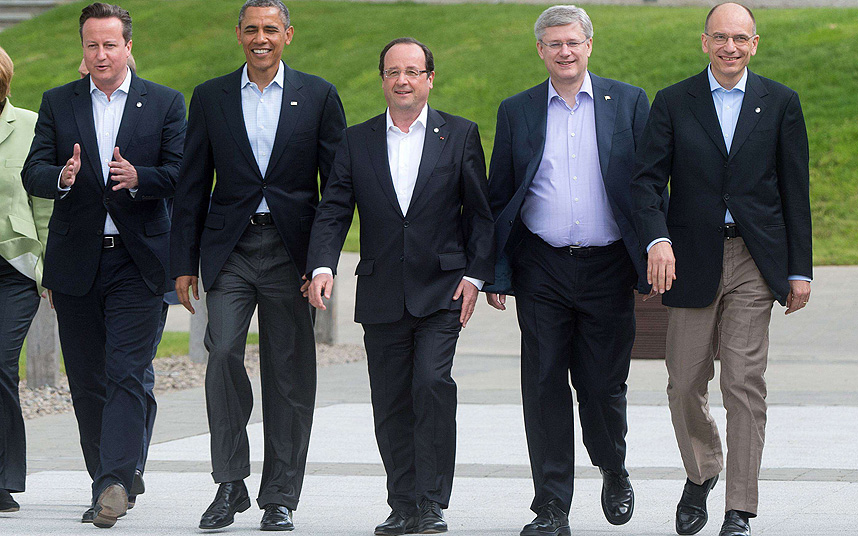
Iain Dale, writing at Conservative Home, sniffs:
Whoever chose Lough Erne as the venue for the G8 should get some kind of honour. As a PR exercise it couldn’t be faulted. The countryside backdrops to all the interviews and press conferences were simply stunning. Less stunning, though, was the fact that David Cameron seemed to have a physical aversion to wearing a tie at any point during the event. Orders had clearly gone out from Number Ten that this was a ‘dress down’ G8, although it was rather difficult to tell whether Angela Merkel had got the message, as in all the pictures I saw she seemed to be wearing the same, tired old lime green jacket. I assume she brought a change of underwear.
What penetrating insight. In The Telegraph, Benedict Brogan thunders:
G8 summits are notorious for their sartorial excesses: matching floral shirts, ponchos, stetsons, it has become a commonplace for the host country to rope the visitors into trying on some sort of local dress. Yet what happens when the world’s most powerful men (sic) gather in the UK? We make them dress like bachelors emerging into the bleary dawn after a vigorous stag party. We might as well ask them to wear jeans. What’s wrong with a bit of understated English tailoring, as a way of plugging one of our more successful exports? In fact, it’s London Fashion Week. There’s all kind of natty pastel numbers available, rather than the blue blazers. But for my money, they should tie one on to show they take the taxpayer – and their responsibilities – seriously.
Someone might be so kind to remind Mr. Brogan that he would be taking his responsibilities as a journalist for a prestigious newspaper more seriously if he focused on the policy agenda of the G8 summit, and not the dress code.
Even The Guardian gets in on the act, with a dedicated feature in their Fashion section:
Not for the first time, the dress code has proved to be one of the trickier aspects of the G8 agenda. Style novice George Osborne underlined the dilemma with his sartorial excuse to BBC Breakfast on Tuesday. “I’m doing what I was asked,” he said. “I got out my jacket and blue shirt.” Forget tax and Syria, smart-casual is tough for these guys.
Cameron demonstrated yet again that for him sleeves rolled up and no jacket semaphores getting down to business. He famously did it on the campaign trail all-nighter and he’s done it at Lough Erne. For him a suit jacket and tie is for everyday prime ministerial humdrum but real power dressing – when he’s hosting international leaders – means pale blue cotton and unironed chinos.
But the real gem comes from the sub-headline to that same Guardian article, which reads as follows:
Forget tax and Syria, smart-casual is tough for these guys. Cameron demonstrated yet again that for him sleeves rolled up and no jacket semaphores getting down to business.
Forget tax and Syria. Indeed. Some people certainly have; unfortunately, they are the people whose job it is to hold our elected leaders to account, to scrutinise, analyse and challenge their activities and policy decisions. With a barely growing economy, persistently high unemployment (we recently celebrated the economy adding 5000 new jobs – a paltry 5000 in country of 65,000,000!) and widespread dissatisfaction with his leadership, David Cameron must have been delighted to be taken to task over his sartorial choices rather than his lacklustre/harmful economic policies and desire for more middle-east adventuring in Syria.
The journalists will no doubt counter that there is a “legitimate public interest” in stories like this, that the public are interested and want to know, justifying all of their column inches on rolled-up shirtsleeves and ties, and the dearth of column inches on the outcomes of the G8 summit. This argument is complete claptrap. The journalists themselves generate the public interest in these process-driven non-stories, thus justifying (in their minds) their decision to cover them in ever increasing detail. After all, it’s far easier to sit at your laptop for twenty minutes and bang out a vapid column about the fashion choices of our politicians than it is to do some real journalism, and pore through meeting minutes and policy papers to educate and inform the public as to what is really going on.
Enough of superficial political “journalism”. David Cameron, Barack Obama and the other six can wear matching gimp costumes to the G8 for all I care; what matters is whether they (for once) manage to cook up some policies that actually benefit the non-elites in our respective countries, and (wishfully thinking) take positive steps toward hammering out a comprehensive EU-US free trade treaty.
But I’m not holding out much hope. Our leaders don’t have the best track record when it comes to acting in our interests, and “journalists” such as Iain Dale and Benedict Brogan seem more interested in clucking disapprovingly at their outfits than scrutinising the decisions that they make.

 Semi-Partisan Politics