Some arguments that are so well-worn and overused that they are accepted as truth with little analysis or proper consideration. One such example is the tired old line that the world of classical music – actually going to classical concerts, recitals or opera performances – is deliberately and unnecessarily intimidating to the uninitiated, the young, the infirm, the poor, the disabled, the racial minority, in short anyone who is not white and upper-middle-class.
From personal experience – as one who is under 30 years of age, mixed race, jeans-wearing, and that highest of cultural crimes, hailing from Essex – I can attest that this argument is complete and utter tosh. One can see how it continues to be propogated – if you hardly ever attend classical music concerts and you are unfortunate enough to defy the odds and have a bad experience, your perception will be skewed, and it is those cases that make the news and opinion pages. But that does not mean that it is typical or commonplace in any way for newcomers or “non-traditional” attendees to encounter condescension, harassment or any other type of misbehaviour when they go to see classical music.
Sadly, this does not stop The New Statesman magazine from succumbing to the conventional wisdom, in an article published yesterday by Andrew Mellor, in which the author moans that “Classical music should be about more than elite parties and private schools”.
Is that what it classical music is all about? That’s news to me. But not to Mellor, who writes:
The truth is that prejudice in our concert halls and opera houses stretches far beyond race. I too have felt the isolation Allen describes, but the difference is I’m a white male who writes about classical music for a living. I’m frequently uncomfortable at the concerts and operas I attend in the UK, and I’m at an average of three per week.
This seems highly doubtful. If you are uncomfortable on a regular basis when you are doing your job as a music critic, there’s probably something more fundamentally wrong in terms of your compatability with your profession than the icy stares and barbed words of some elderly, patrician concertgoers. So what could be causing this discomfort?
The Proms will open on Friday, and if you turn up and buy a programme – which will cost marginally less than a £5 arena ticket – you’ll find it stuffed full with adverts for private schools. The subtext is as clear as it is nonsensical: we’ve all got money, that’s why we like this sort of music.
That concert and opera programmes seem to entertain such a bizarre obsession with private education – I don’t see football clubs whose ticket prices are far more exclusive carrying multiple adverts for private schools in their match-day programmes – is indicative of a sinister brand of class positioning that’s as common front-of-house in the classical music world as it is alien on the stage. Orchestras and opera companies can decide who advertises in their programmes, but they’ve got their work cut out when it comes to the arrogant and judgemental behaviour of large sections of their audience.
It starts to become clear – Mr. Mellor doesn’t like private education very much (he is writing in The New Statesman, after all), and seeing all of these advertisements enticing mummy and daddy to send little Rupert or Imogen to this-or-that private school rubs him up the wrong way.
Where to begin with this? Perhaps the free market argument that economic agents such as symphony orchestras and private schools have the right to make whatever advertising arrangements they like between themselves, and that allowing said advertising does not emply endorsement of the product or suggest that those who do not purchase the product are in any way inferior. Or the fact that it is private money – through advertising, corporate sponsorship and individual giving – that helps to pay for the arts so that young, poorer children such as myself could attend classical music concerts with my mother for very low prices, helping to build the foundations for a lifetime of appreciation and learning.
Mellor then overreacts to that familiar presence at the concert hall, the loudly-spoken “authority” on the music being played:
At so many concerts and operas in the UK, if you don’t look and sound like you know what you’re talking about you may well be stared at, judged and made to feel uncomfortable by someone who thinks they do – an assessment usually based on how you’re dressed, how you talk and what you’re talking about (stay off popular culture/television/non-classical music) or even, as in Candace Allen’s case, what colour your skin is. People around you might well be keen to assert their knowledge by talking loudly and in confidently unchallengeable tones about the last time they saw such and such an conductor or heard such and such a piece. All of this is designed to create an atmosphere of intellectual superiority – far more important, of course, than allowing you to be moved by a great piece of art on your own terms (intellectual or otherwise).
Yes, of course you get these people sometimes. I’ve often heard a concertgoer holding forth, in a loud voice designed to be heard, about the piece of music that has just been played, in order to show off their classical music knowledge credentials. It is by no means a majority though; most concertgoers are happy to sit and enjoy the music without the need to show off, and I have yet to see the case where remaining silent or uttering a less-than-learned comment on a piece of music has resulted in widespread ostracisation by the rest of the audience.
Besides, if I were to take some of my septugenarian friends – fellow Patrons of the London Symphony Orchestra – to a Radiohead concert, or to the V Festival, would they really be extended any warmer a welcome than a young festivalgoer would receive at Glyndebourne? I would wager good money that the elderly classical music concertgoer would be greeted with a good deal more mirth, scorn and derision, and far less courtesy at Glastonbury than would be afforded to a festivalgoer at a piano recital at Wigmore Hall.
Am I wrong about that, Mr. Mellor? Would you argue the opposite? And if not, where is your article bemoaning the closed, insular, cliquish world of popular music?
He then takes aim at the people who actually bankroll the concerts that he attends and writes about:
Stage-bound frippery is one thing, but these precious hierarchies are increasingly creeping front-of-house. As orchestras in particular look to consolidate their donor and sponsor bases in the face of public funding cuts, it’s all too easy to feel as though you’re not part of the club – no access to this roped-off area and that sign-posted “private reception”.
Of course, you would never see such a VIP area at a Premier League football match, or a Rihanna concert. Oh, wait…
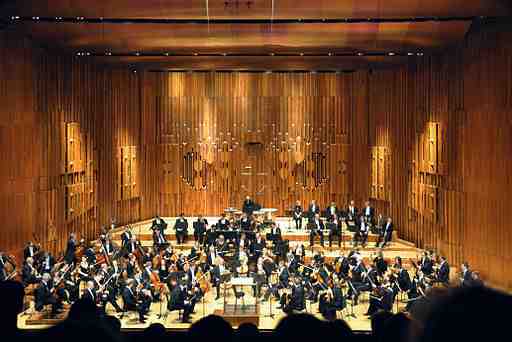
Full disclosure – as a Patron of the London Symphony Orchestra for the past five years, I have had the opportunity to be on the other side of the “velvet rope” at various classical music events, and these receptions really, really aren’t intimidating or off-putting, no matter on which side of the rope you happen to be on the night. In fact, the atmosphere on a typical evening at the Barbican Centre, where the LSO give most of their concerts, is always lively, convivial and abuzz with people of all ages and backgrounds enjoying the music and the occasion.
If a mid-priced glass of wine, a canape or two and the chance to congratulate the Principal Bassoon on a job well done during the interval helps to give a little recognition to the fact that these people (and I am very, very small fry compared to most of them) pay to subsidise a large part of an orchestra’s concert-giving activities, I think that is a fair and reasonable thing to do, given that it does not detract one iota from anyone else’s concertgoing experience.
But what do we know? As the article trumpets at its conclusion: “Andrew Mellor was shortlisted for the New Statesman’s Young Music Critic prize in 2011“.
So he can’t be wrong.


 Semi-Partisan Politics