Lost In Translation

The Daily Mail reports the confounding story that a baby boy was rushed to hospital in north Wales because his parents were unable to fill his prescription – because the prescription was written in Welsh only.

A sick baby was rushed to hospital after a supermarket pharmacy refused to hand his medication to his father because part of the prescription had been written in Welsh.

Aled Mann, 34, took the prescription from the family doctors to his local Morrisons pharmacy counter after his one-year-old son Harley developed a chest infection.

But staff at the supermarket in Bangor, north Wales, refused to give him the steroid tablets because they could not read the note as not all of it was in English.

The father was ultimately able to return to the GP surgery and get a new prescription printed in English and have the prescription filled, but the baby’s condition worsened overnight requiring hospitalisation, leading to speculation and conjecture that the delay (and hence the pharmacy’s unwillingness to fill a prescription that it could not adequately verify) was to blame.

The incident seems to have caused something of an uproar, but not in quite the way that I imagined. For some reason I had expected the consternation to centre on the fact that GPs in Wales are able to issue prescriptions in a language not spoken by the majority of the people in that country (and therefore inevitably more difficult for patients to redeem), but instead the ire is trained more squarely at the retailer, Morrisons, for not making sufficient effort to cater to the needs of the customer.

I love Wales and admire its people, history and natural beauty very much, so I am going to tread carefully here. I’m also a fervent unionist, as any frequent reader of this blog will know, and believe that Wales should remain an integral part of the United Kingdom – but again this is not relevant to the point I am about to make.

To me, this is an issue of public safety. Surely, in a country where everyone speaks English and only a relatively small minority speak or otherwise use the Welsh language, it is in the interests of the patient, and of common sense, for the prescription to be printed in the language which is common to everyone.

The undercurrent of sentiment surrounding the story seems to be that the Welsh parents were in some way discriminated against, and that their baby’s life was endangered, due to the fact that they receive their family healthcare services in the Welsh language. We can thus extrapolate and infer that the correct thing to have done, in the eyes of those who are upset, would have been for Morrisons to employ either only bilingual speakers in their stores, or to ensure that there is at least one bilingual speaker on hand in the pharmacy department at all times. Indeed, the Mail records Arfon Wyn, a local councillor, saying as much on the record:

‘This is totally diabolical. It is the trend of these large supermarkets not to employ bilingual local people and so such terrible events as this can take place.’

But would the real discrimination not arise if employers felt compelled, or were legally compelled, to hire only bilingual speakers at the expense of English-only speakers? Indeed, given that only 15% of Welsh citizens are able to read, write and speak the language with fluency, could it not also precipitate an enormous skills gap and labour shortage?

Here is an image of the prescription in question:

welshprescription

As readers can clearly see, the instructions on the prescription are printed bilingually, in both English and in Welsh. I understand that this is in accordance with the Welsh Language (Wales) Measure 2011, which also created the role of Welsh Language Commissioner who is entrusted with ensuring that Welsh is not treated less favourably than the English language in Wales, and that people can live their day-to-day lives through the medium of Welsh if they choose to do so. The patient-specific parts of the prescription, however, contain crucial information which is in Welsh only.

I would suggest that Dr. Ieuan Parry’s office is not serving its patients very well by providing prescriptions that run the risk of not being understood. Legally, they are completely in the right – indeed, Welsh is technically the only language accorded anything like official status in the whole of the UK – but practically and morally, I am not so sure.

I understand that the maintenance and preservation of the Welsh language is a very dearly held and important issue for some people. But we are talking about a medical prescription for a baby boy being printed with the key parts only in Welsh, a language with which 73% of the people have no familiarity (according to the 2011 census). Some may choose to be outraged at Morrisons for falling short, but I choose to feel more disappointment in the fact that patient safety was effectively jeopardised in pursuit of what seems to be a transparently cultural or political end.

If the goal is the preservation and extension of the Welsh language, Welsh-only prescriptions seems a lousy way of advancing that dream.

Or am I missing something?

Sarah Palin Loses It

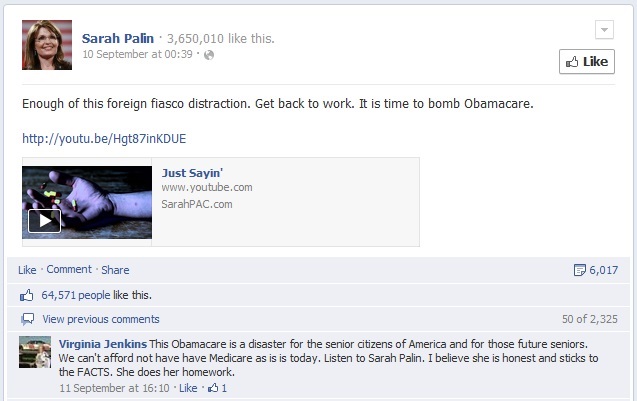
The headline seemed too implausible, too sensationalist to be true, but you can’t make stuff like this up – Sarah Palin called on people to “bomb Obamacare” as her political action committee released their latest anti health reform advertisement:

Palin rails against Obamacare in her usual eloquent, measured tones.

The 2+ minute long video is available to view on YouTube here:


I comprehensively “refudiated” Sarah Palin’s “death panel” claims on this blog a year ago, as did every other sentient person on the internet, so there is no need to cover this old territory. So where to start with this latest deliberately provocative outburst by the half-term governor from Alaska?

Perhaps with the fact that the GOP-led House of Representatives has now voted 40 times to repeal ObamaCare, each time in the full knowledge that the repeal would never pass the Democratic-held Senate, let alone be signed by President Obama.

Or maybe the fact that Obamacare (or the Patient Protection and Affordable Care Act, to use the correct title) is President Obama’s signature domestic legislative accomplishment, he campaigned on a platform of health reform in 2008 and won re-election by a significant popular and electoral college majority in 2012 after having brought it to fruition.

Nor has the “grassroots tsunami” against the bill, invoked by Senator Rand Paul, materialised in any meaningful way. Polls continue to show the American public divided in support of the word Obamacare itself (a testimony to Republican misinformation and scare tactics), but broadly supportive of the various measures contained within the bill.

And so apparently the only recourse left to Palin and her legion of fact-averse followers is to dust off the violent, revolutionary rhetoric as though Obama were King George reincarnate.

I make no apology for always assuming the worst about Sarah Palin’s motives, so my theory for this bizarre use of phrasing in her appeal for a popular revolt against Obamacare is that she deliberately used the word “bomb” in the knowledge that the fiftieth anniversary of the 16th Street Baptist Church bombing was fast approaching, hoping to get a rise out of offended liberals who would then accuse her of race-baiting or racial insensitivity, allowing her to play her patented Palin Persecution Card and receive even more unearned air time.

If you think that this is a harsh accusation to level against someone, recall that Palin has accused the president of the United States of “palling around with terrorists”, treason and a litany of other crimes and misdemeanors. Accusing Palin of being a sneaky, calculating, insensitive charlatan is pretty mild by comparison.

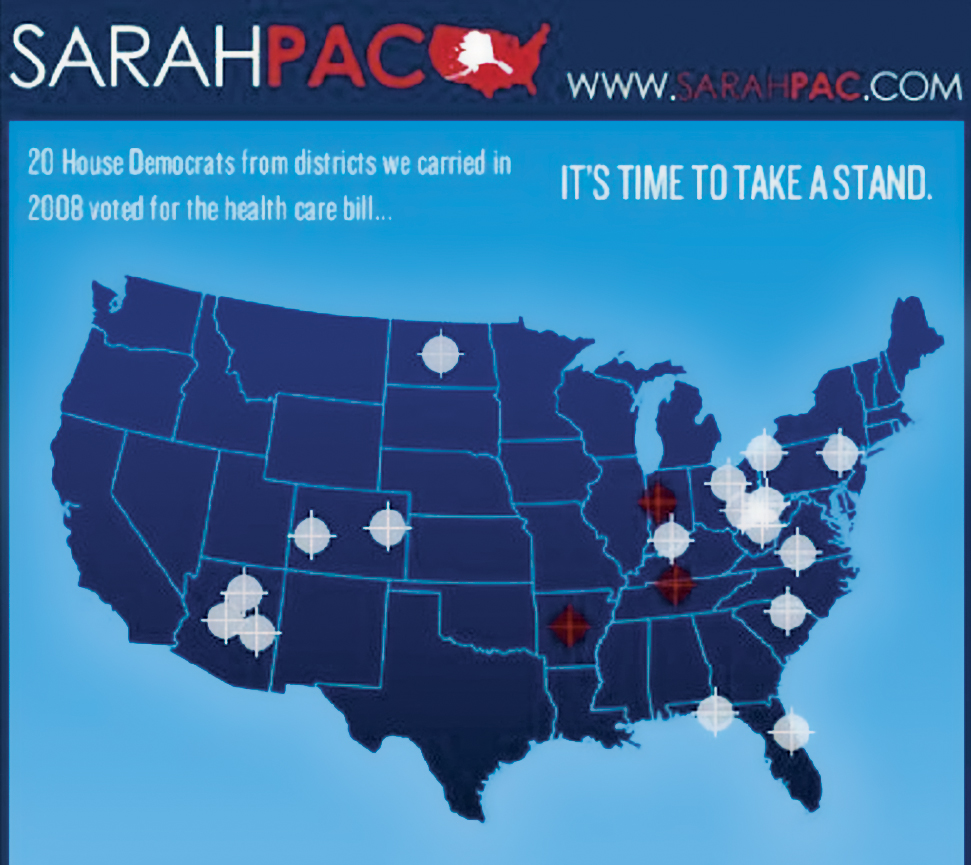
First we had this...
First we had this…

First we had the gun sights over Democratic-held congressional districts that Sarah Palin’s PAC was targeting in the 2010 midterms. Looking at this action in isolation, I can understand and forgive; showing literal targets over parts of the map that Republicans want to target politically does not seem unreasonable or violent to me, and I felt that the left-wing furore and attempts to link the imagery to the Gabrielle Giffords shooting in Arizona were craven and opportunistic.

But there is no comparable popular imagery relating to a bomb. We don’t talk about bombing a goal that we want to accomplish in the way that we might talk about targeting a goal or an aspiration. The word “bomb” has connotations only of violence and terrorism.

Sarah Palin, of course, does not wish for any literal bombs to be detonated in opposition to Obamacare, and would doubtless be horrified and appalled if one of her supporters were to read her words too literally and actually start blowing things up. But she is quite happy to use a charged, loaded word – a word associated only with war and terrorism – in relation to the US healthcare debate, to ensure that her fading political voice gains more prominence.

It doesn’t make Palin a terrorist supporter. But it does reveal her to be a shrewd, conniving, opportunistic and (still) dangerous political presence, willing to say and do almost anything to demonstrate her opposition to President Obama’s policies and legislative accomplishments.

Which, of course, we all already knew.

The Foolishness of Nick Clegg

Nick Clegg


He’s done it again. The latest, desperate Sun-approval-seeking initiative from our restless Deputy Prime Minister and his fellow Liberal Democrats is this – let’s make “drunk louts” pay for their A&E and jail costs.

The Daily Telegraph reports:

Mr Clegg, the Deputy Prime Minister, said he supported the idea of imposing levies on people who get “blind drunk” and end up in hospital or at a police station…

“I’ve actually got quite a lot of sympathy with the basic principle that says why should someone that goes out and gets completely blind drunk, behaves appallingly, gets themselves into trouble and a scrap – why should other people always have to pick up the tab to help them out?” Mr Clegg said.

He said it was unacceptable for the taxpayer to continue to pick up the bill for the National Health Service to treat patients whose injuries were caused as a result of excess alcohol.

Oh dear. If you are going to discuss the implementation of new policy, shouldn’t you at least make it sound as though the idea had not been concocted a mere 30 seconds before you gave it voice on national radio?

At least Nick Clegg still has that minimal level of self-awareness which allowed him to make the disclaimer (not a tremendously encouraging one for a deputy prime minister to make, though) that he hadn’t really thought the policy through very well, and that it might be quite hard to implement:

Speaking during his weekly Call Clegg programme on LBC Radio the Deputy Prime Minister admitted it would be “tricky” to implement the fines but that he has “quite a lot of sympathy with the basic principle”.

Shall we count the ways in which his latest policy idea is particularly stupid? Okay, let’s.

1. It’s quite clear – Clegg admits as much himself – that his policy is focused on what he calls “drunken louts”. But how to classify who and who is not a drunken lout without resorting to the type of class assumptions or profiling that a man of Clegg’s liberal credentials would surely abhor? I’m guessing that if I was a young man wearing a hoodie who tripped on the kerb after a few too many pints of beer of an evening, I might be a prime target for this fine. But what about a smartly dressed young barrister who tripped on her heels after a few too many glasses of port at a company dinner? Still a lout? What does one have to do, or be, to get whacked with the fine?

2. While consuming excessive levels of alcohol is clearly irresponsible, so are many other actions that humans take all the time. Extreme sports. Smoking. We all pay our taxes (well…) so who is to decide which activities will cause us to forfeit the right to the treatments and services that our taxes have paid for?

3. Some people have jobs or participate in activities that have mostly or only positive externalities. Fitness instructors, gardeners, marriage counsellors, drug caseworkers, physical therapy workers. By performing these activities they actually serve to lower the costs that the government would otherwise have to pay in a myriad of ways. Should these people get a small bonus cheque if they find themselves in the hospital? Or are we just going to punish the bad behaviour but not reward the good? Can taxes only ever go up, and not down?

4. If you engage in violent behaviour and end up in a jail cell, should it not be the case that the criminal justice system works effectively enough that if you are found guilty, you are liable for the legal and policing costs that your actions incurred? We all know that the criminal justice system  in our country is laughably broken, but is creating a separate mechanism outside of the criminal justice system to recoup costs from offenders really the way to go, Nick?

In other words, does our deputy prime minister really have nothing better to do, no more pressing matters to fill his day, than sitting in an LBC radio studio and making up demonstrably bad policy on the fly? He gets paid his ministerial salary to do this?

The next election is still two years away. I was hoping that we might be able to squeeze maybe one more year of at least aspirationally real, serious policymaking and governance into this parliament before we had to start listening to nonsense ideas like this one.

The Compassion Monopoly


Today saw the installation of Justin Welby as 105th Archbishop of Canterbury.

The service was moving, with many elements incorporated to reflect the international diversity of the worldwide Anglican communion. Although myself a Roman Catholic, I wish the new Archbishop of Canterbury the best and pray for him as he seeks to tackle the many challenges facing his church.

I was, however, momentarily distracted from the beauty of the service by this image of a protester in Canterbury, shown on the BBC News website here.

We’ll let the misspelling of the word “privatise” go.

But both Pope Francis and Archbishop Welby can hang up their hats and go home, because this lady clearly has such a direct line to the Lord that she is able to tell us God’s political stance on any issue of the day. With such an ability we should probably make her a Lord Spiritual so she can sit in the House of Lords and meddle in British lawmaking with the others.

Christ would “NOT” privatise the NHS? Really? What does He think about Clinical Commissioning Groups? Is it okay with Him if private firms perform non-clinical work for NHS hospitals (such as cleaning or catering), or must this be owned and managed by the state too? And I have a feeling I know her answer, but does our Lord support the renationalisation of the railways in Britain?

Why does the left have such a monopoly, a stranglehold on the idea of compassion in our country?

Why is it that to speak out against the state taking such a large, meddling role in all of our lives marks one out as a mean-spirited and cruel person, indifferent to the needs of others?

And why do we all buy in to the idea that in order to be charitable and compassionate, we must funnel our efforts to help our neighbours, the less fortunate and the downtrodden through an inefficient state bureaucracy?

If the counterargument is that people would be selfish and insufficiently generous without the heavy hand of government coercion and taxation to take wealth and redistribute to those in need, what does this say about the leftist’s view of human nature?

Did it ever occur to this protester that perhaps it is directly because the state plays such a large part in everything that we do, from cradle to grave, that the church to which she belongs is withering and shrinking by the year?

To a great extent, aside from the divine aspect, has the British welfare state not done away with the purpose of church, of knowing your neighbour, of being part of a community, altogether?

I ask these questions because the answers to these issues of how best to act charitably, to help your neighbour and provide for those in need seem to be self-evident to so many on the left. Of course, they say, we must give more to the government so that they can give back to us according to our need. Certainly the newly-installed Archbishop of Canterbury, Justin Welby, seems to subscribe to this mindset, from what we know of his recent remarks.

I could not disagree more vehemently.

Foreign Aid vs Cancer

I should say from the outset that I do not believe a centralised, taxpayer-funded, government-provided healthcare system is the optimal way to deliver healthcare to a population, though I do appreciate the reasons behind the founding of the NHS, and acknowledge that it does deliver generally satisfactory results when compared with other systems, including the various times throughout my life when I have used the service.

I think that the American “best healthcare system in the world!” method is far worse, and that having a concentration of the world’s best medical facilities does not make up for the fact that these world class resources remain off limits to the vast majority of the population with insufficient insurance coverage to pay for them. I also believe that while ObamaCare fixes some of American healthcare’s most egregious flaws (the huge number of uninsured and the ability of health insurance providers to screw their customers), it leaves other problems (the link between health insurance and employers, for example) totally untouched.

Anyway. Since we do have a national health service in Britain, and that consequently healthcare spending must compete with the myriad of other government and departmental priorities from education to national defence, I would hope we could all agree that since the NHS isn’t going anywhere any time soon (being a realist), it should be made to work as efficiently as possible, the levels of spending on it should be justified in terms of tangible outcomes, and equally that the monies which are spent on other areas, to the detriment of healthcare spending, should be able to be justified by the government of the day.

What does all of this have to do with foreign aid, and the money that the British government spends on aid to developing countries?

Well, as right-leaning blogger Guido Fawkes reports today, Prime Minister David Cameron has just been schooled on this very point as he participated in a radio talk show for LBC:


In this video clip, David Cameron is confronted by a caller who (while details of the case are clearly lacking), appears to be in great distress because the additional course of treatment for her cancer is not covered by the NHS, and consequently the potentially life-saving treatment is  unavailable to her. He responds, of course, in meaningless soundbites and platitudes, but the look on his face – much as when Gordon Brown was confronted with the realisation that he had called a prospective voter a “bigoted old woman” on a live microphone – says it all.

Indeed, it is very hard to argue against the caller’s point at all.

There can be no justification that I can think of – none – for giving £1.5bn in aid over five years to a country which spends $31.5bn USD on defence, which has a space programme nominally more ambitious than that of the donor country, and which has explicitly stated that it does not want the funds. None.

And when the government takes such an active role in providing healthcare – not just regulating the system and ensuring universal access, but actively providing the care itself through a national health system – politicians will always be ambushed in this way by citizens who feel that the government’s misprioritisation of resources has let them down.