The Conscience-Free Conservatives

David Cameron - Conservative Party - Coke Zero Conservatives

What self-respecting conservative could now bring themselves to support David Cameron’s triangulating, authoritarian, soul-sappingly unambitious Tory party?

Has the time finally come for small-c conservatives to admit that they have been utterly betrayed by Cameronism, and salvage what dignity we have left by deserting David Cameron’s ideology-free Conservative Party?

Pete North argues the case convincingly in an important blog post deserving of wide coverage, in which he excoriates the modern Tory Party for its rootless, centrist managerialism:

If your values are remotely conservative, look around you. We have not seen a reduction in the size of the state. Sure, the registered number of state employees has gone down but that’s because so many functions have been farmed out instead of closed down or truly privatised. Let me remind you that outsourcing is not privatisation – and given the ineptitude of government procurement it’s not going to save you any money either.

Moreover, the so called party of defence has wasted vast sums of money on big ticket toys, most of which barely work and vastly reduce our capability. This is the party that left us without a maritime patrol aircraft and made a pigs ear of procurement.

We have seen back-tracks on free schools and education reforms, u-turns all over the shop, and whatever you might think of welfare, you don’t have to be a foaming leftist to see that it is failing those most in need. Moreover, what is it in your estimation thinks Britain is showing its mettle going grovelling to 27 other states for permission to make a marginal tweak to welfare and immigration policy?

No, the Conservative party is just a continuation of politics-free managerialism, beset by the usual nannying authoritarianism, big spend, high waste massive government and has baulked at any principled reform in the spirit of Mrs Thatcher. At best we can say that Cameron’s conservatives are marginally less dreadful than Miliband’s Labour party would have been.

I must admit that I find myself coming to the same conclusion – I now look at the party of David Cameron and George Osborne and find it utterly indistinguishable from the party of Tony Blair. Neither believe in truly shrinking the state – in fact, both see electoral advantages in keeping it bloated. Neither believe in empowering the individual over the government. And certainly neither believe in the importance of defending the nation state against antidemocratic supranational entities like the European Union.

I haven’t been a member of the Conservative Party since I left Britain for Chicago back in 2010, but when I came back there was little prospect of me rejoining the party for which I campaigned so enthusiastically that year. At the dog end of Gordon Brown’s reign of terror, a fresh Conservative agenda seemed just what the country needed. But after having somehow failed to win that election outright and entering into coalition with the Liberal Democrats, by 2012 it was very clear that in David Cameron we had found ourselves not a new Margaret Thatcher but rather a reanimated Ted Heath.

Of course, you wouldn’t know it from reading the left-wing press or the Left’s loudest voices on social media, all of whom are convinced that David Cameron’s utterly bland, uninteresting government are on an ideological crusade to drown government in the bathtub, trample human rights and sell off Our Blessed NHS to their corporate crony friends.

This would be the same Evil Tory government which has maintained international development spending at 0.7 per cent of GDP while slashing Defence to the bone, which only half rolled back Gordon Brown’s spiteful and unproductive increase in the top rate of income tax, and which ran for re-election on a manifesto pledging a paternalistic, nanny state “plan for every stage of your life”.

But it is on the question of the European Union and Brexit where the Conservative Party are now betraying their principles and their base most grievously, as Pete North points out:

Put simply, if you want to leave the EU, you have already made up your mind that change has to happen and in this there is no room for sentimentality for the brands that used to represent what we believe. Cameron’s empty shell of a party is in no better shape than Labour and if your loyalty to to a brand matters more then you are part of the problem. And that goes double for Ukippers.

If you are a conservative, Cameron is not on your side. He takes you for stupid with phantom vetoes and bogus reforms. This is a man who is lying to us all and treating us with contempt. In the final analysis it’s up to you to decide what it is you really want. If you do want to leave the EU, don’t come bitching to me for pointing out that the Tory Vote Leave operation is catastrophic. Break ranks and take it up with them.

This is absolutely right. The Tory leadership has been indulged and given the benefit of far too many doubts, and the time has come for small-c conservatives to call the bluff of every single sitting Tory MP who has ever uttered a eurosceptic sentiment – and to rain down shame and unrelenting pressure on those whose commitment was false.

Candidate after Conservative candidate won selection by their local association by prancing around as though they were the World’s Biggest Eurosceptic. But now we know that in too many cases, it was all an act. Handed an unexpected majority, a weak opposition and the lucrative prospect of uninterrupted career advancement, too many of the new generation of Conservative MPs are more interested in securing Tory hegemony in government than actually accomplishing any of the things that one might reasonably expect a conservative legislator to do in office.

Hence the sanctimonious, preachy letter signed by 74 of the new Conservative intake, lecturing their older colleagues on the importance of “party unity” and not doing anything to sow divisions during the referendum campaign. But of course, this advice only applies to eurosceptic MPs – europhiles eager to spout David Cameron’s pro-EU lines are unleashed to say and do as they please in their effort to keep Britain inside the EU. It is only the Brexiteers who are muzzled.

One might ordinarily feel sympathy for these older eurosceptic Conservative MPs, being lectured on the importance of putting the party first and not “banging on about Europe” by the new upstart generation of careerists. But then you look at what veteran eurosceptic Tory MPs are actually saying and doing, and any potential sympathy melts away, to be replaced by sheer incredulity that the people who spent twenty years posing as strong critics of Brussels have apparently given no thought at all to how Britain might best leave the European Union.

This could have been the finest hour of politicians like John Redwood, Michael Gove, Daniel Hannan, David Campbell Bannerman and Mark Pritchard. But instead they have either chosen personal loyalty to David Cameron over trifling questions about British democracy and self-determination by campaigning with the Remain side, or they are firing out contradictory statements and half-baked mechanisms for Brexit which are implausible at best, and outright reckless at worst.

And this failure to live up to their rhetoric is not on some trivial issue or arcane policy area, where political horse-trading is to be expected; it is on the single most defining, central question to face the United Kingdom in a generation. On this acid test of conservative principle, nearly all of the “big beast” eurosceptics within the Conservative Party have been found wanting. As few as five (generally second-tier) Tory ministers could end up campaigning for Brexit.

So what possible reason for the failure of the Conservative Party – given the fact that the long awaited referendum could be very imminent – to express anything other than murmurs of approval for David Cameron’s transparent act of political theatre masquerading as a “renegotiation”?

These are the only plausible motivations which come to mind:

1. Despite what Conservative candidates and MPs said when they sought selection and ran for election, they secretly believe in the EU project and want Britain to remain a part of it

2. They lack faith in Britain’s ability to survive or prosper outside the European Union, and this pessimism overrides whatever euroscepticism they have

3. They simply don’t care one way or another

4. They do want to see Britain leave the EU, but they would much rather see their own careers blossom under David Cameron’s patronage than risk isolation by campaigning against the prime minister

None of these possibilities is appealing. And none makes me eager to sprint to my polling station in 2020 to reward them with five more years.

The Conservative candidate in my own constituency of Hampstead and Kilburn (north west London) was a jabbering fool who thought that the EU was simply magnificent, the bedroom tax was actually a tax, and that Britain should unilaterally disarm and get rid of Trident because the United States would do our dirty work for us should the need ever arise. I didn’t vote for him and he didn’t win, because why would the liberal voters of Hampstead vote for a Tory who walks and talks like a Labour candidate when they could just vote for the real thing instead?

But although this breed of Conservative did not manage to win Hampstead & Kilburn in 2015, it is clear that many others did succeed in forming part of the new intake, while a similar number of longer-serving Tory MPs holding the same wishy-washy views entered the parliamentary party in previous elections.

It may sound harsh, but they are all wasting time – ours and theirs. Now is not a time for vacillating centrists and Red Tory / Blue Labour moderates. Now is not a time for fastidious, parsimonious obsession with our public services to the exclusion of all else, or a prime minister who aspires to be a lowly Comptroller of Public Services rather than a world leader. There are still far too many people trapped in welfare dependency or minimum wage drudgery for us to consider pulling up the drawbridge on radical conservative reform.

Steady-as-she-goes Blairism has now reigned for nineteen years, first under the auspices of New Labour and latterly through the coalition years and on into David Cameron’s majority Coke Zero Conservative government. And it is a dull, authoritarian, uninspiring philosophy for government, worthy of a country which has given up on playing any role in shaping human destiny going forward, preferring to jealously obsess over our public services and what’s in it for me, me, me.

I believe that Britain is better than that, and that we still have much to offer the world – particularly if we can now seize this last, best chance to break free of the European Union and rediscover what it means to be an independent, globally engaged, sovereign country once again.

And if achieving this dream means that David Cameron and the Conservative Party in its current form must be circumvented, undermined, sabotaged, attacked and sent to their Armageddon, then so be it. We will have lost nothing.
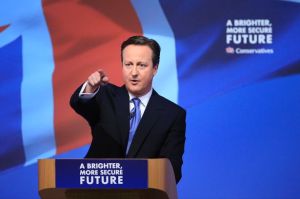
 

David Cameron - What Do The Conservatives Tories Stand For In The Age Of Jeremy Corbyn

NOTE:

I encourage you to read the entirety of Pete’s article, and to follow his blog. The analysis of the coming EU referendum and Brexit process to be found there is far superior to anything you will find in the mainstream media, and if there was any justice Pete would have the kind of platform and following usually only obtained by the C-student nepotism beneficiaries who seem to win many of the coveted gigs writing for prestige publications.

Reading Pete’s blog in particular can be a good reminder of the optimism behind the Brexit movement, and it is essential when we fight this campaign that we do not sound like dreary bores, cranks or obsessives focussing on the negatives of Brussels. For however dreary and stultifying the European Union may be, we are at our best when we present our compelling vision of a modern, forward-looking, globalised Britain which seeks to embrace the world rather than shutting ourselves off in a protectionist, mid-century regional trading bloc.

Agree with this article? Violently disagree? Scroll down to leave a comment.

Follow Semi-Partisan Politics on TwitterFacebook and Medium.

Jeremy Corbyn, Owen Jones And The Thin-Skinned Labour Commentariat

Dan Hodges - Owen Jones - Labour Party

A campaigning journalist or opinion writer must write according to their conscience, without a second thought for whether it helps or hurts their own party in the short term

Owen Jones is angry that his attempts to make sympathetic, reasoned critiques of Jeremy Corbyn’s Labour Party are attracting the same levels of vitriol and hatred that those of us on the Right experience every day.

In his Guardian column yesterday, Jones complains:

I have several criticisms of the Labour leadership, held in good faith and constructive in approach. Because I want the left to succeed – otherwise, what’s the point? The need to build coalitions of middle- and low-income people; to reach out beyond the converted; to have a credible, coherent economic alternative; to rebut smears of being hostile to the country; and so on.

But when voiced, the right will use these as evidence that “even the left is losing faith”. Some on the left will see such suggestions and criticisms as playing into the hands of an aggressive media campaign regarding anything but blind loyalty as treachery. The isolated sympathetic commentators end up almost duty-bound to stay in line.

Such is the unrelenting nature of the media attack, any balanced discussion of the Corbyn leadership risks being shut down. That the media can be so dominated by one opinion – and so aggressive about it – is a damning indictment of the so-called free press. I’m an opinion writer: my opinions appear in the opinion section. But the media is swollen with opinion writers, and in too many cases their work ends up in the news section. A constructive critique of the Labour leadership is still needed for its own sake if nothing else. It is, however, an almost impossible task.

Meanwhile, Dan Hodges – a commentator with absolutely no concern about the potential impact of his words on the short term prospects of the Labour Party – has cancelled his direct debit and cut up his membership card (again) in no small part because of the vicious response to his opinions from the Corbynite Left.

In announcing his decision to quit Labour again, Hodges writes:

I’m done. Yesterday I cancelled my direct debit to the Labour Party. “Why don’t you just sod off and join the Tories”, Jeremy Corbyn’s supporters regularly ask anyone who dares to challenge their rancid world view.

I won’t be joining the Tories. But I am sodding off.

What’s a left wing polemicist to do if they find themselves disagreeing with the direction of the Labour Party in the Age of Corbyn?

It’s funny. Many of us on the right are well used to being called Evil Tories or labelled as heartless, uncaring monsters utterly lacking in all compassion – not because we don’t want to help the poor and disadvantaged, but simply because we don’t believe that endless, uncapped government spending is the best solution.

We are used to mainstream media outlets – heck, even the current Chancellor of the Exchequer himself – unquestioningly accepting and repeating the notion that conservatism is only about helping the wealthy, rather than the many. And when we are not being actively spat on or jostled in the street because of our political opinions, we are still used to being reviled, and our ideas not given a fair shake. And as a result, we have developed superior reasoning abilities, reserves of fortitude and patience, and very thick skins.

The left-wing commentariat utterly lack these qualities. For years they have marinated in the sanctimonious belief that their side has a monopoly on truth, compassion and decency. And since Labour lost power in 2010, it has been the easiest job in the world for them to sit on the sidelines throwing stones at the Conservative government.

(I’ll make an exception here for Dan Hodges, who correctly called Ed Miliband’s vacillating uselessness from the very beginning, and correctly predicted that he would lead the party to electoral ruin. And for his Cassandra-like efforts, he is now a pariah figure in the party he loves, with the small consolation of being David Cameron’s favourite columnist).

But to say that the left wing commentariat have had trouble adapting to the new reality under the leadership of Jeremy Corbyn is a huge understatement. Because now, more than ever, the Labour Party has devolved into warring factions and bitter rivalries. And all of them – MPs, writers and activists alike – are now treating each other with the same contempt and raw hatred that they previously reserved for “Tory Scum” like me.

And it turns out that the Left can dish it out, but can’t take it.

Owen Jones in particular seems to be struggling with the fact that writing critically about tactical errors by the Corbyn leadership is not generating a warmer and more receptive response:

I have several criticisms of the Labour leadership, held in good faith and constructive in approach. Because I want the left to succeed – otherwise, what’s the point? The need to build coalitions of middle- and low-income people; to reach out beyond the converted; to have a credible, coherent economic alternative; to rebut smears of being hostile to the country; and so on.

But when voiced, the right will use these as evidence that “even the left is losing faith”. Some on the left will see such suggestions and criticisms as playing into the hands of an aggressive media campaign regarding anything but blind loyalty as treachery. The isolated sympathetic commentators end up almost duty-bound to stay in line.

And when Dan Hodges found himself implacably opposed to the current direction of his party – with his anti-Corbyn positions being received even more coolly than his tirades against Ed Miliband – he simply upped and left.

One might suggest that Owen Jones & company could learn a thing or two from this site. I’m a natural conservative supporter, though I reluctantly voted UKIP in 2015 out of frustration with the pro-EU consensus, in solidarity with good people like Douglas Carswell who went out on a limb in pursuance of their ideals, and because my local constituency fielded a dithering left-wing Wet Tory candidate. And I made clear that the Conservative Party did not deserve my vote because in every important area – national sovereignty, rolling back the state, fiscal policy, civil liberties and more – they were quite simply not behaving like a conservative party.

This blog is the exact right-wing mirror image of left-wing commentators like Dan Hodges: a natural supporter of my party, but with complete contempt for the current leadership (Cameron and Osborne) and a strong desire to see the Tories move in a more conservatarian direction. Dan Hodges can’t bring himself to remain within the Labour Party while its leadership refuses to countenance military action against the middle age barbarians of ISIS. I can’t bring myself to give money to the Tories so long as their leadership remains slavishly pro-EU and believes that the British people can be distracted from the gradual loss of their sovereignty and democracy by manufactured “table-thumping rows” and a sham renegotiation with Brussels. Or when they field a Conservative In Name Only parliamentary candidate who rails against the “bedroom tax” and thinks that we should do away with our independent nuclear deterrent.

I get a lot of stick for my views. I’m universally hated by the Left (and recently discovered a Tumblr page full of foul-mouthed invective about yours truly), and can hardly get deeply involved in Conservative politics when I disagree so fundamentally and vehemently with the centrist wet rag of a leader who just delivered a resounding general election victory only in the total absence of a viable Labour prime minister in waiting.

But that’s my lot in life, and I accept it. I’ve been called every name under the sun on Facebook and Twitter, earned the opprobrium of friends and acquaintances, and written lots of mean things about my own party, taking them to task for their failure to advance conservative policies while in power. But the one thing I have never done is pull a punch or moderate a sincerely held opinion because of the friends I might lose or the immediate electoral damage I might do to the political party I used to call home.

Love him or hate him, Jeremy Corbyn remained a Labour Party member through all of the long wilderness years of Blairism, years which must have seemed to Corbyn like an unbearable compromise with flawed Tory-lite policies. Ridicule and obscurity were his crosses to bear, and he bore them patiently until quite unexpectedly his fortunes changed.

For many of the left-wing commentariat, however, just a few short months out of power and favour within the Labour movement is apparently already taking a psychological toll on people more used to calling the Tories “evil” and sitting back to soak up the lazy applause than being tarred with the same brush and called Red Tories themselves.

I have no sympathy for any of them. Jeremy Corbyn sits atop the Labour Party because of the wretched job that the centrists and their establishment buddies did in making a convincing public case for moderate Labour. And on the flip side, I accept my share of blame for the Conservative Party’s current directionless, centrist malaise – I should have done more and worked harder in my own small way to keep the party true to Thatcher’s legacy, and fought harder against the Cameron project. Sadly I only began writing in 2012, when it was far too late anyway.

But if nothing else, perhaps now that major and influential left-wing commentators like Owen Jones have been on the receiving end of the same kind of foaming-at-the-mouth left wing demagoguery that libertarians and conservatives receive every day, they will refrain from indulging in it themselves.

Of course, that would require that they stop feeling sorry for themselves long enough to recognise the pattern staring them in the face.

Jeremy Corbyn - Paris Attacks - Terrorism - Appeasement

Agree with this article? Violently disagree? Scroll down to leave a comment.

Follow Semi-Partisan Politics on TwitterFacebook and Medium.

What Does The Conservative Party Stand For In The Era Of Jeremy Corbyn?

David Cameron - What Do The Conservatives Tories Stand For In The Age Of Jeremy Corbyn

With Jeremy Corbyn’s Labour Party consumed by infighting and discredited with the public, David Cameron’s Conservative government could do almost anything it desires. So why is it treading water?

What does the Conservative Party stand for in the era of Jeremy Corbyn?

What do the Tories stand for when they are barely opposed in Parliament, and consequently have virtual carte blanche to do anything they please?

The answer, apparently, is not much of anything. And it’s good to see that more people on the Right are finally starting to get impatient with the lack of conservative conviction flowing from Number 10 Downing Street.

Janet Daley gets straight to the point in her latest Telegraph column, asking what is the point of the Tories if they refuse to radically shrink the size of the state:

It is fairly clear what use the Tories have decided to make of the current lack of opposition. They will become not just the accepted party of government but the only political party that anybody would ever need. Instead of putting forward a specific, identifiable view of what government should be and how it should relate to the people, which they can offer up for debate, they will occupy all the ground, cover all the bases, be everywhere on the political spectrum at once. They will incorporate centre-Left and centre-Right, and make economic intervention live alongside the free market. They will even, as Mr Osborne did in his Autumn Statement, filch the language of enforced equality (“social justice”).

In short, if Labour is not fit to carry on a debate, then the Tories will scrap the idea of debate altogether. They will be all things to all men: the all-purpose, all-embracing, totally inclusive permanent party of government. This new single-party monopoly will incorporate every popular measure, however inconsistent or contradictory, into its amorphous programme. By the time Labour is ready to engage in election-winning argument, there will be nothing to argue about.

Instead of being emboldened by the lack of serious opposition and seeing it as a once-in-a-generation opportunity to do necessary radical things, the Tories have decided to play it for short-term political advantage. The real problems will not be addressed. They will just be fudged – and bought off with fistfuls of money.

The depressing truth is that the Tories in government have made a decision to solidify their grip on power by effectively ceasing to be a small-C conservative party at all, instead rebranding themselves as the only sane choice when the alternative is the Corbyn/McDonnell socialist double act.

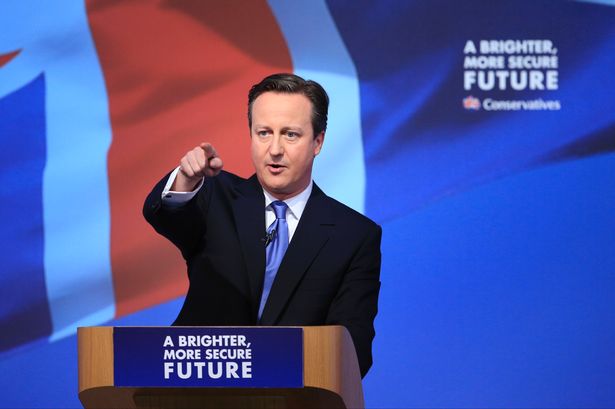
This worrying lack of ideological commitment has been reinforced over and over, whether it’s the Autumn Statement that sounded more like a Gordon Brown-style moneybomb than a fiscally conservative blueprint for government, or David Cameron’s triumphal party conference speech – which even the Independent thought was shockingly centrist.

But not everybody sees it like this. Iain Martin, writing in CapX, sees opportunity in the fact that the Conservatives now essentially govern unopposed:

Corbyn’s leadership does gift the British Conservatives an historic opportunity. Not one of those “they might they win the next general election” opportunities, but the chance to capitalise on Labour’s existential crisis and create a broad-based coalition of interests that dominates the coming decades and turns the UK into an even more dynamic, market-based, technologically advanced, prosperous society.

No. The government can either lead Britain kicking and screaming towards a more dynamic, free and market-based future, or it can create a broad-based coalition of special interests, each with their own collection of whiny, selfish demands and veto rights over national policy. But it cannot do both.

Radical policies of the kind needed to cure Britain’s productivity gap and vastly improve our competitiveness are not borne out of consensual, hand-holding workshops where all of the public service unions and taxpayer funded charities lounge around together brainstorming new ways to extort taxpayer money. Nor are bold policies borne out of the ingratiating desire to please everybody all the time, and never come face to face with a critical newspaper headline.

The radical conservative/libertarian policies that this country needs in order to roll back the state – and empower the people to shape their own destiny rather than remaining vassals of the state or passive consumers of public services – will not be divined by drawing a line half way between the David Cameron and Ed Miliband election manifestos of 2015 and splitting the difference.

When Margaret Thatcher came to power in 1979 she knew that there could be no appeasement with the dismal establishment belief that the best Britain could then hope for was a smoother, more orderly century of national decline than we witnessed during the Winter of Discontent. She knew that Britain needed harsh medicine if things were to be turned around and the patient saved. That didn’t mean that Thatcher rode to battle against every pillar of the post-war consensus simultaneously – nationalised companies and the NHS remained even after her premiership – but it did mean that she was not terrified of being seen as an ideological, even polarising figure. She stood for something.

What do David Cameron and George Osborne stand for, besides keeping the Conservative Party in power and (hopefully) executing a smooth transition from Dave to George by 2020? What kind of Britain do they want to preserve, protect or change? It is almost impossible to tell, because the key decisions – as with the Autumn Statement – are always so depressingly tactical and reactive, not strategic. I was not yet born when Margaret Thatcher became prime minister, but I could describe in some detail her evolving political philosophy and accomplishments in government. By contrast, David Cameron came to power when my political engagement was very high indeed, and yet I would struggle to fill two paragraphs outlining Cameron’s ideology or aims for this country.

Even the few hints of a long-term strategy from the Conservatives – making us more secure, or paying down the national debt – only serve to highlight how far the government is falling short of these goals. The surveillance state continues to expand while the root causes of the extremist Islamist threat are barely discussed, much less tackled; the Chancellor burbles on about fixing the roof while the sun is shining, and yet the deficit is far from eliminated and the national debt continues to increase every single day.

David Cameron - Centrist

But it does not have to be this way. The Conservative Party leadership may be depressingly void of ambition and tainted with the first blush of scandal, but there are green shoots of a future conservative renaissance visible within the party.

Last week I attended a Westminster lobby event held by Conservatives for Liberty, the right-libertarian campaign group for whom I am proud to write. During the course of the evening, we were addressed by five Conservative MPs, each of whom was able to make a far more convincing case for individual liberty in ten minutes than David Cameron has made for the entirety of his premiership.

Chris Philp described himself as a “proud Thatcherite” and dared to make reference to both “The Road To Serfdom” by Hayek and “On Liberty” by John Stuart Mill.

Lucy Allan, the antithesis of a career politician, said “my view is that a real conservative is definitely a libertarian”, and proceeded to speak out against mass surveillance and the rise of authoritarianism in the name of national security.

The irrepressible James Cleverly warned against paternalistic government and the excesses of the public health lobby, saying “I don’t want to live in a world where personal choice is codified. We have a word for that, and that word is fascism”.

John Redwood made a point that the Treasury sorely needs to hear, lamenting that too many MPs “forget they are there to represent taxpayers as well as beneficiaries of state largesse” and describing the state’s overbearing presence in all aspects of life as “a wooden public monopoly that guarantees maximum inconvenience and maximum cost”.

And David Nuttal vowed that he would continue to work tirelessly “to stop the relentless march of the nanny state” and the “massive industry” which supports it.

Of these excellent speakers, Chris Philp, James Cleverly and Lucy Allan (if she stays in politics beyond 2020) are all potential leadership material for the future, particularly in a world where the official opposition is virtually non-existent and the country is crying out for a new, clear sense of direction. Any one of these rising stars have the inspiration and charisma to one day lead the party in a new, more transformational direction.

With the Parliamentary Labour Party seemingly intent on self-administering a near mortal wound with their relentless sniping and bitter briefing against Jeremy Corbyn, a bold new Conservative leader committed to the principles of liberty and a small state (the antithesis of George Osborne, who doesn’t even pay lip service to these ideals) could re-shape the Right and promote a better, more inspiring form of conservatism than the current “Blairism when there’s no money left” status quo.

The fact that David Cameron and George Osborne are watching the slow implosion of the Labour Party and conjuring up plans to woo Ed Miliband voters – rather than capitalise on this once-in-a-century opportunity to execute a real conservative agenda unopposed – reveals their worrying lack of confidence in core conservative principles and values. If the Prime Minister and Chancellor really believed in reducing the tax burden, reforming welfare, building up our armed forces, shrinking the state, promoting localism and devolving decision-making to the lowest level possible (with the individual as the default option), they could do so. They could be building a new, conservative Britain right here, right now. Virtually unopposed.

But Cameron and Osborne are doing no such thing. They simper and equivocate, and talk about fixing the roof and paying down the debt while doing no such thing, and still they attract endless negative headlines for inflicting an austerity which exists primarily in the minds of permanently outraged Guardian readers.

If Britain is not a transformed country in 2020 – with a smaller state, more dynamic private sector and greater presence on the world stage – there will be absolutely nobody to blame other than the party holding the keys to government. The party with the word “conservative” in their name. The Tories will have been in power for ten years and have nearly nothing to show for it, save some weak protestations about having fixed Labour’s prior mismanagement of the economy.

That’s not the kind of party I want to be associated with. That’s not the party I campaigned to elect in 2010, back when it seemed possible that a new Conservative administration might aspire to being something more than a moderate improvement on Gordon Brown.

The Conservatives have a choice. Presented with the golden opportunity of Jeremy Corbyn’s leadership of the Labour Party, the Tories can seize the chance to transform themselves into the party of Allan, Philp or Cleverly. Or they can continue to be the equivocating, triangulating party of Cameron and Osborne.

Yes, of course there’s no point having bold new conservative ideas unless you can stay in power to make those ideas a reality, as the Cameron/Osborne apologists would no doubt respond. But neither is there any point winning and holding power unless you actually have ideas worth implementing.

The Conservatives have the power. And thanks to the Labour Party, they are under no immediate threat of losing that power, no matter what they do in office. So where are the big ideas?

George Osborne - Chancellor of the Exchequer - Budget

Agree with this article? Violently disagree? Scroll down to leave a comment.

Follow Semi-Partisan Politics on TwitterFacebook and Medium.

The Daily Smackdown: The Left’s Manufactured Tampon Tax Hysteria

Tampon Tax - HM Treasury

Left wing activists know that the British government is prevented from lowering VAT on sanitary products (the tampon tax) by EU law. But that doesn’t stop them using the issue to bash the Evil Tories

From observing the outraged reaction to George Osborne’s 2015 Autumn Statement, you would be forgiven for thinking that the Chancellor was launching his own personal war on women, right from his desk at the Treasury.

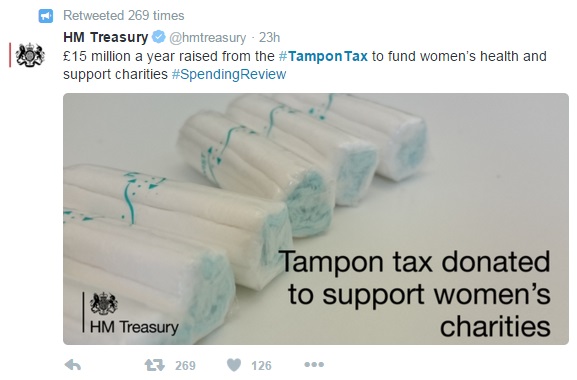
By far the most ludicrous criticism of the Conservative government’s updated spending plans was directed at George Osborne’s plan to divert all proceeds raised from the tampon tax to support various women’s charities.

While delivering yesterday’s Autumn Statement, Osborne said:

“We already charge the lowest 5% rate allowable under European law and we’re committed to getting the EU rules changed. Until that happens, I’m going to use the £15m a year raised from the tampon tax to fund women’s health and support charities. The first £5m will be distributed between the Eve Appeal, SafeLives and Women’s Aid and the Haven – and I invite bids from other such good causes.”

A sensible enough idea given the constraints on the Treasury, no?

Wrong.

Cue lots of ostentatious confected outrage and virtue-signalling on social media, with activists and left wing organisations falling over themselves to accuse Osborne of being a heartless misogynist.

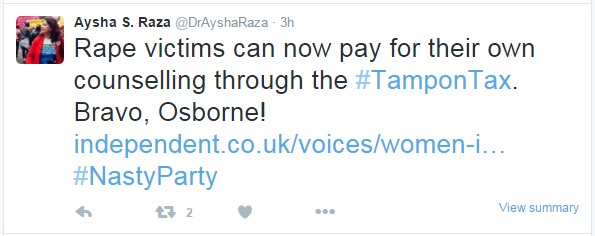
Here’s Labour councillor and NHS high priestess Aysha Raza, riding to battle against those awful, sexist Tories:

Tampon Tax - Aysha Raza


(I debated Aysha Raza on the topic of the NHS on TV last year, and asked her if she could think of any NHS reform or service closure she would support, even if it led to better overall health outcomes for the British people. Her response – a blank stare and a telling silence).

And lots of other people have been sharing the same Independent article by Holly Baxter, in which Baxter admits that Osborne has no power to abolish the tampon tax but still proceeds to rake him over the coals for trying to help vulnerable women with the resulting tax receipts.

From Baxter’s piece:

Since the Tory government has failed women in so many ways, it makes undeniable sense for it to help us to help ourselves. Give a woman a tampon and she’ll use it for free; teach a woman to pay tampon tax and she won’t even cost anything extra to the state when she gets raped, attacked or laid off at work.

So if you’re a woman escaping from an abusive relationship in the Chancellor’s Britain, you can now pay for your own counselling through the redistribution of an unfair tax on your sanitary products. Isn’t that just perfect? It has a beautiful circularity, kind of like the menstrual cycle itself.

But of course this was never meant to be a rational argument; no, this is just about hating the Tories for the sake of it:

Osborne presumably thinks that women will respond gratefully to his announcement, allowing us to finally enjoy the spoils of our luxury tampon tax. ‘What a noble move!’ we are supposed to cry, while shredding our sanitary towels into confetti and sprinkling them in the streets (don’t worry about the waste – it’s all going to charity, girls.) ‘Women can now collectively take responsibility for the provision of support services to women. Finally, we’re being given the means to sort out the problems we created. This truly is the Big Society.

Back to reality, though, and Osborne almost certainly had zero expectations that his announcement would have women dancing in the streets, but was simply trying to do the best he could with the bad hand he was dealt by the EU. But let’s not let reality get in the way of a good Tory-hating session.

To those on the perpetually-outraged, Tory-hating Left, George Osborne can never do right. It is inconceivable to them that the man who (in their fevered imaginations) falls asleep cackling to himself about driving benefit claimants to suicide might actually want to help women, and use the revenues from a tax that he is forced to levy by Brussels to help truly vulnerable women in our society.

Such an honest motive would shatter the worldview of the Angry Left, who are determined to stick to their two-dimensional caricature of conservative thought and keep their leftist worldview blissfully free of nuance. And so the only reason that George Osborne could be considering using the tampon tax revenues to fund women’s services is either to mock them or to “throw them a bone”.

Is it ludicrous that tampons and pads – an essential item, and about as far from a luxury as it is possible to be – are subject to any VAT? Absolutely. But some on the activist Left are more keen to use this inequity to bash the Evil Tories rather than direct their ire at the source of the problem.

And the problem is their beloved European Union, as the BBC helpfully explains:

A spokesman for HMRC says: “The application of VAT in the EU, including rates and flexibilities afforded to member states such as the UK, is governed by EU law.

“The UK applies a 5% reduced rate of VAT to the supply of sanitary products. This is the lowest rate possible under EU VAT law.”

Yes, the inconvenient truth for the Tory-haters is that VAT on sanitary products is not enforced by the malice of George Osborne, but rather by the dead bureaucratic hand of the European Union.

If these virtue-signalling activists were really so concerned about government discrimination against women, they would spend their time and energies criticising Brussels for not having carved out an exemption long ago.

And if they really wanted to exercise their brains, they could ask themselves whether it is really “democratic” for Britain to belong to a massive supra-national organisation which insists on ever-closer union and harmonisation of vast swathes of policy, making it impossible for the British government to do the right thing and end the tampon tax.

But of course there will be no such introspection from the Left. The EU is benevolent and all wonderful, and nothing bad can possibly come from it. Besides, only swivel-eyed racists and Ukippers would ever criticise the European Union, right?

It’s time for these preening social media activists to decide who and what they really care about. Do they actually want to bring an end to the tampon tax – in which case they should start lobbying Brussels or campaigning for Brexit – or do they simply want to flaunt their virtue by making false allegations of misogyny and chauvinism directed at George Osborne and the Conservatives?

Style or substance – what’s it going to be?

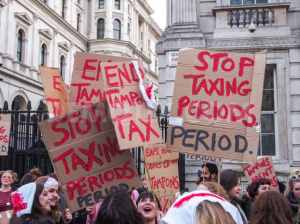
Tampon Tax Protests

Agree with this article? Violently disagree? Scroll down to leave a comment.

Follow Semi-Partisan Politics on TwitterFacebook and Medium.

Budget And Autumn Statement Theatre Is No Way To Run Modern Britain

Homer Simpson - George Osborne - Budget - Annual Statement

The way British governments set budgets and tweak spending plans is a recipe for bad, short-termist decision making

Forget tax credits for a moment. Forget Right-To-Buy, stamp duty, beer duty and the tampon tax. MPs may still be debating George Osborne’s 2015 Autumn Statement, but step back for a moment and look at the broader picture.

Twice a year – once in the annual Budget and once in the Autumn Statement – the Chancellor of the Exchequer gets to his feet and delivers a refreshed set of economic policies in a big, set piece speech where he is essentially forced to favour tomorrow’s headlines over optimal long or even medium term decision making.

Nationally significant policies from every government ministry live or die by the concessions that their ministers are able to wrangle from a Chancellor who is forced by political reality to be more concerned with tomorrow’s Daily Mail headline than the state of our public finances in a year’s time.

Spending decisions are made based on economic forecasts which are sunnier than a warm day on Venus. Questionable political decisions are defended to the hilt, because to question them in light of new data would be to commit the gravest of self-inflicted political wounds, the U-turn. The government of the day rolls out a “smoke and mirrors” act worthy of David Blaine, and all to glam up the fact that they have slightly re-arranged the deckchairs on the Titanic.

And for what? To draw the public in to the political process? To high-mindedly arbitrate complex questions of economic policy? To astutely position Britain  vis-à-vis our global competitors, ensuring that our tax code, infrastructure and labour market are the most attractive in the world?

No. We do it just so that the government of the day – or a nimble opposition (remember those?) – can score political points. And, of course, because it is traditional.

Some traditions – like MPs not clapping in the Commons chamber – are antiquated and affected, but do little real damage. Others – like MPs having to leave the Commons chamber through a specific door in order to vote, rather than availing themselves of fast electronic voting technology – are an irritant, a brake on the smooth running of our legislature.

But some traditions belong in another category – things that do real, actual harm, not just to the running of our Parliament but to the political outcomes which we then have to live with every day. Some traditions actively harm our democracy.

I would submit that the Budget and Autumn State set-piece theatre events fall into this latter category. Politically astute chancellors (like George Osborne on a good day) may relish them because they provide an unparalleled opportunity to draw red lines and create traps for the opposition. The Westminster media may like the status quo, because if nothing else, these events can be moments of real political drama.

George Osborne - Chancellor of the Exchequer - Budget

But besides savvy chancellors and the established media, it is hard to tell who else benefits from the current system other than the cause of Big Government.

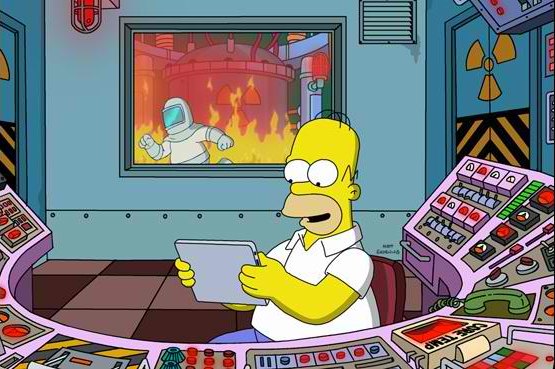
Having two occasions each year when an already-powerful chancellor like George Osborne in an already-centralised country like the United Kingdom gets to play with nearly all of the controls and levers which influence our economy – as though he were Homer Simpson at the controls of Springfield Nuclear Plant – only encourages meddling and tweaking of things that should properly be left to local government and individuals.

When you have direct, ultimate control over which families deserve help buying a house, which people should keep or lose their benefits or how much a person pays in sin taxes for their guilty pleasure, the temptation to use those powers is irresistible. And because of the ratchet effect, it is the easiest thing in the world to give away new perks to favoured interest groups, but nearly impossible to ever claw them back without being exposed to political attack. Even under this nominally conservative government, budgets and autumn statements have often been a one-way ticket to bigger government – or at least more activist state.

No system is perfect. One needs only look across the Atlantic ocean at the United States, with their unseemly debt ceiling fights and government shutdowns (oh, to have one here) to realise that you do not need a Westminster parliamentary-style system to sow budget chaos. But the flaws in our current system are obvious, and have been staring us in the face for years – yet nobody has proposed the slightest alteration, choosing instead to cheer when their side “wins” and whine when the other side is in power and sets a budget with which we disagree.

People did not elect a Conservative government only to have George Osborne sit at the control console of their lives, Homer Simpson-like, flicking switches and adjusting dials here and there in order to manipulate our mood so that we vote Tory again in 2020. If conservatism still means anything, it should mean a healthy scepticism of the state and its power to influence or police human behaviour.

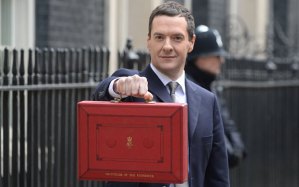
Surely at some point our desire for smaller government and a smarter state has to outweigh our devotion to the dusty tradition of a man standing on the doorstep of his house, waving a red box around.

Autumn Statement - George Osborne - Conservative Government - Man at Control Panel

Agree with this article? Violently disagree? Scroll down to leave a comment.

Follow Semi-Partisan Politics on TwitterFacebook and Medium.