UKIP’s General Election Manifesto: A Serious Offering From A Serious Party

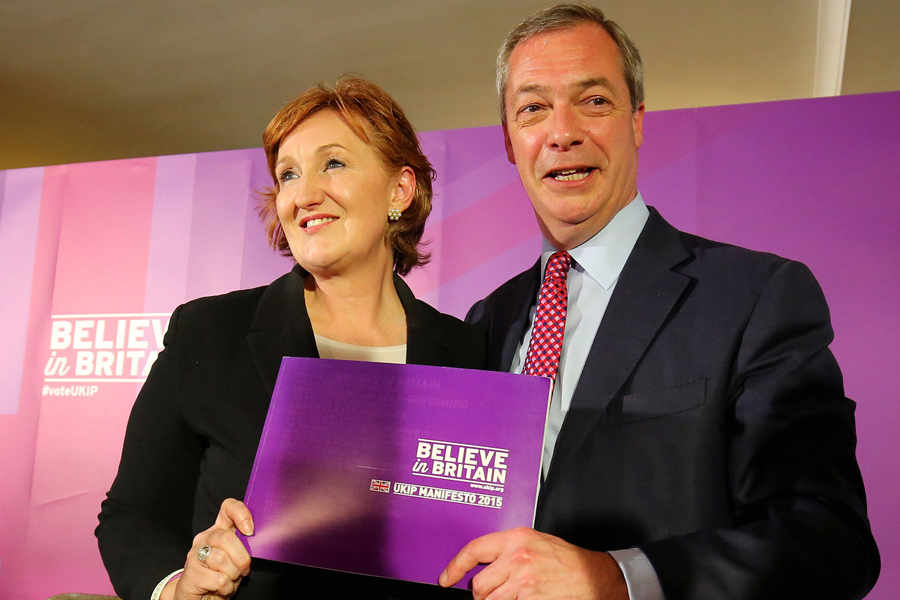
UKIP 2015 General Election Manifesto Launch - Thurrock Essex - Nigel Farage - Suzanne Evans


For British voters who believe in the wisdom of small government and personal freedom – as well as those who believe that the British people are capable of achieving so much more than angrily lobbying for endless new perks and benefits from the state – the 2015 general election campaign thus far has been a dreary, depressing spectacle.

But in Thurrock today, the United Kingdom Independence Party gave what was perhaps their most convincing pitch to voters thus far, with the launch of their 2015 general election manifesto, entitled “Believe in Britain”.

This blog wholeheartedly concurs with the introduction to UKIP’s manifesto, in which Suzanne Evans (Deputy Chairman, Policy) bemoans the remarkable lack of optimism and faith in Britain now evident, to some degree, in all of the other political parties:

If only all politicians could believe in Britain as UKIP does. If only they could share our positive vision of Britain as a proud, independent sovereign nation, a country respected on the world stage, a major player in global trade, with influence and authority when it comes to tackling the pressing international issues of the day.

And on issue after issue, UKIP are making themselves an increasingly plausible, reasonable choice for liberty-minded voters to make when they vote on 7 May.

On fiscal policy, UKIP advocate a flatter, less redistributionist tax structure which puts the Conservatives to shame:

The longer term aspiration of a UKIP government will be to create an income tax structure of a basic rate of 20 per cent, an intermediate rate of 30 per cent, and a top rate of 40 per cent, meaning income taxes will be flatter and lower. Bringing down taxes on working people at the bottom and in the middle ranges of the income scale is our priority. In the longer term, we will aim to restore the personal allowance to those earning over £100,000 and make 40 per cent the top rate of tax for all, as it used to be.

On defence, UKIP can now make a plausible claim to be the new natural party of the Armed Forces, showing a commitment both to our veterans and to the robust defence Britain’s national interests that make the other parties – who have treated the Defence budget as a piggy bank to be raided to fund fuzzy electoral bribes, rather than the most sacred function of a nation state – look opportunistic and immature by comparison:

Continue reading

Labour’s 2015 General Election Manifesto Starts With A Lie, And Then Gets Worse

Labour Party General Election Manifesto 2015 - Budget Responsibility Lock - Debt and Deficit Confusion


Much has been made of the fact that the Labour Party’s 2015 general election manifesto begins with a so-called “Budget Responsibility Lock” to fully fund all spending commitments and reduce the deficit every year – locks and ‘triple locks’ currently being all the rage in British politics.

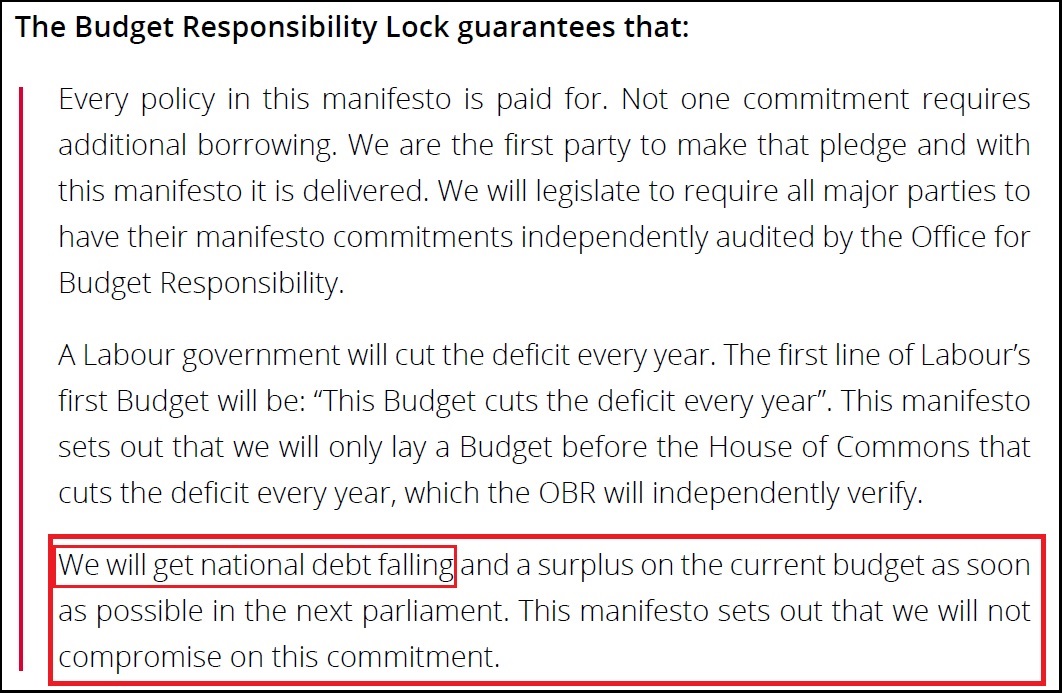
But Labour’s manifesto also begins with a blatant lie, and nobody seems to have called them out on it. So here it is, straight from the preamble to Ed Miliband’s pitch to the voters:

We will get national debt falling and a surplus on the current budget as soon as possible in the next parliament. This manifesto sets out that we will not compromise on this commitment.

No, this manifesto does nothing of the kind. In place of honesty, Labour’s manifesto actually tries to hoodwink the British people by conflating the current budget and eliminating the current budget deficit with the overall budget and eliminating the overall budget deficit.

Eliminating the current deficit is simply not the same as getting rid of the deficit altogether and restoring a budget surplus. The current deficit refers only to the gap between tax receipts and day-to-day government spending (i.e. excluding capital expenditure). Therefore, it is quite possible to run a current budget surplus while still running an overall budget deficit. And why does this matter? Because you can’t begin to pay down the national debt so long as there is any kind of budget deficit!

To deploy one of those awful but ubiquitous credit card analogies:

Continue reading

The Green Party, 60% Income Tax And Lessons From The West Wing


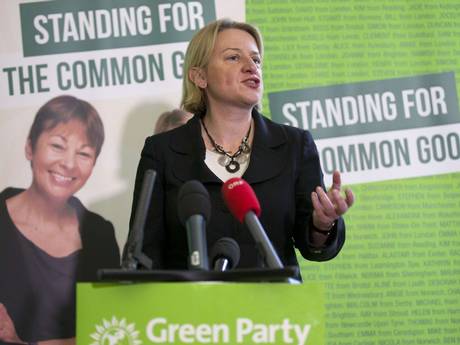
Natalie Bennett and the Green Party decided to use (or rather, waste) one of their rare moments in the media spotlight this weekend to announce their grand plan to levy a 60% marginal income tax rate on anyone earning over £150,000 a year.

The Greens are not even approaching the issue apologetically, with the tired old claim that confiscatory rates of income tax are necessary to fund public services. No, now they are suggesting that wealthy Brits should be hit with punishing rates of tax because apparently Britain’s brightest minds, shrewdest investors and most successful entrepreneurs “take too much” out of our society:

The highest earners would face a 60p top rate of tax under Green Party plans to make the richest “pay back” to society and deter companies from paying “excessive” salaries.

Britain’s top earners currently face a 45p rate on income over £150,000 but Natalie Bennett, the Green Party leader, claimed that they deserved to pay even more.

“What this 60p is for is really to identify the fact that some people are taking too much out of our society, they need to pay back,” she told the BBC’s Andrew Marr show.

You read that right. The Green Party actually believes that the people who invent things, make scientific breakthroughs, create jobs, run Britain’s top industries and make our art and culture the finest in the world take stuff out of our society. The people who already pay the most tax and keep our precious public services ticking over are nothing more than parasites, according to Natalie Bennett and the Greens.

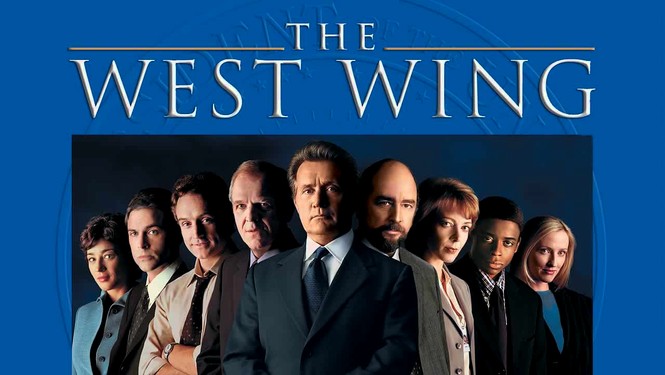
Clearly Natalie Bennett is not a fan of hit US television show The West Wing. If she was, she would know that even starry-eyed left wingers like fictional President Bartlett’s speechwriter, Sam Seaborn, accept that it is unseemly to bash the rich while taxing them to death at the same time.

In one very memorable quote (see the video above), Sam Seaborn says to a union boss:

“Every time your boss got on the stump and said it’s time for the rich to pay their fair share, I hid under a couch and changed my name. I left [my old job before going into politics] making $400,000 a year, which means I paid twenty-seven times the national average in income tax. I paid my fair share. And the fair share of twenty-six other people. And I’m happy to, because that’s the only way it’s going to work. And it’s in my best interests that everybody be able to go to schools and drive on roads.

But I don’t get twenty-seven votes on election day. The fire department doesn’t come to my house twenty-seven times faster and the water doesn’t come out of my faucet twenty-seven times hotter. The top one per cent of wage earners in this country pay for twenty-two per cent of this country. Let’s not call them names while they’re doing it, is all I’m saying”.

Hard to put it much better than that.

Of course, the Green Party delight in the fact that their radically “alternative” politics place them far to the left of even staunchly left-wing opinion.

But given the harm that a 60% top rate of tax would do – and it would be a catastrophic act of economic self-harm, based on Britain’s historical experience and the cautionary tale now underway in France under President François Hollande – even supporters of greater wealth redistribution may well think twice before endorsing this ruinous policy.

Meanwhile, the rest of us are left to wonder exactly what kind of twisted mind convinces itself that success is a bad thing, to be punished and discouraged at all costs?

The West Wing Green Party Natalie Bennett Sam Seaborn - Taxing The Rich - General Election 2015

Natalie Bennett, 60% Income Tax And The Dark Heart Of The Green Party

Natalie Bennett Green Party Income Tax Top Rate 60 Per Cent General Election 2015 2


Imagine an economy that gives everyone their fair share.

That’s what the Green Party website asks us to do, as they pitch their alternative, brave new world to the British electorate.

Put aside the fact that the very idea of a “fair share” is completely meaningless, rendering itself open to redefinition and misuse in any number of ways. What matters is that the Green Party views the economy not as a diverse group of individuals with their own talents, skills and interests, but as a monolothic entity entirely separate from the people, a money-making machine to be cranked up and raided at will in order to fund the social objective of the day.

When you view the economy in this way, it’s natural to see the people who produce and contribute most to the “economy machine” as nothing more than resources to be raided and exploited for the greater good, not as human beings with their own hopes and dreams (and the ability to pick up sticks and move elsewhere if they find themselves being bullied by Big Government).

And it is partly this toxic mindset which drives the Green Party to propose a new 60% top rate of income tax, not just for the yacht-owning super-rich elite but on anybody earning over £150,000 per year.

From the BBC’s report:

The Green Party has announced it would put up the top rate of tax to 60p in the pound.

Party leader Natalie Bennett claimed the move would bring in an extra £2 billion a year for public services.

She said the Greens would like to see a “ten to one ratio between the top paid and lowest paid”.

Not contenting themselves with confiscatory rates of income tax, the Green Party also propose stealing peoples’ hard-earned wealth, which has of course already been taxed at the point it was created (and, in the case of inheritance tax, passed down the generations):

Continue reading

Resisting The Evil Tory Austerity Agenda Through The Power Of Poetry

Austerity poem - David Schneider - Conservative Party


Meet Dave Schneider.

Dave is an actor (as well as being a writer, director, coach, voiceover artist and social media guru).

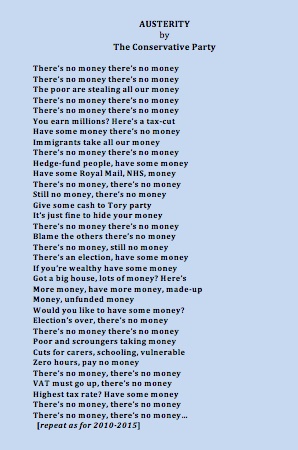
But despite the demands of his multifaceted career, Dave still managed to have a good, long think about the injustices of “austerity”, and produce this gem of a poem.

Here’s the best bit:

There’s no money there’s no money

Hedge-fund people, have some money

Have some Royal Mail, NHS money,

There’s no money, there’s no money

You get the drift.

Naturally, all money belongs to the state, and exists to be parcelled out equally among all British citizens (as well as anyone else who wanders across the English channel, apparently). So Dave Schneider is able to talk about “NHS money” and “Royal Mail money” with a straight face, because as far as he is concerned, money doesn’t belong to the entrepreneurs, risk-takers or investors who create it – it all belongs to the government.

Thus tax cuts are phrased as “have some money” from the state, because in the world according to Dave Schneider, the money never belonged to the people who created it in the first place.

So let’s all join in a rousing chorus of “There’s No Money”. And when we have memorised and recited the Austerity Poem, perhaps there will be time left over to perform some pro-NHS propaganda street theatre.

After all, there’s no such thing as bad art among the anti-austerity crowd.


h/t Vickster51Corner.