Sensing A British Vote To Leave The EU, European Politicians Reach For Insults

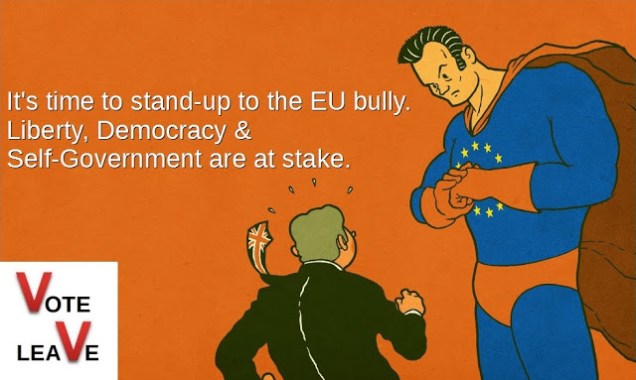
EU bully stand-up

When senior European politicians start reaching for the insults, it suggests that they believe the EU referendum is already lost and that Britain will vote to leave the union

And the latest inductee to the ranks of Foreigners Unwittingly Rooting for Brexit (FURP – it just sounds right) is French Economy Minister, Emmanuel Macron.

The Evening Standard duly reports Macron’s high-handed warning to us uppity Brits:

Britain will be no more significant than the island of Guernsey if it votes to leave the European Union next week, France’s economy minister has claimed.

In an interview with French newspaper Le Monde, Emmanuel Macron said the EU would also have to send “a very firm message and timetable” to Britain if its voters backed Brexit.

He said: “In the interests of the EU, we can’t leave any margin of ambiguity or let too much time go by. You’re either in or you’re out.

“Leaving the EU would mean the ‘Guernseyfication’ of the UK, which would then be a little country on the world scale.

“It would isolate itself and become a trading post and arbitration place at Europe’s border.”

A bit rich, one might think, coming from a minister who presides over one of the most defiantly sclerotic economies in Western Europe, and where the most timid labour market reforms suggested by President Hollande saw the country erupt in flames.

And yes – in the event of Brexit, Britain would of course immediately become just like Guernsey. At least, we would if Guernsey also possessed the fifth largest economy in the world, the second most projectable armed forces, a culture which is admired and consumed the world over, a language which doesn’t require constant governmental protection against decline, a permanent seat on the United Nations Security Council, and…oh yes, Trident nuclear weapons.

It is difficult to know how to interpret “interventions” in the Brexit debate of this kind. Can they be explained away as foreign politicians simply blowing off steam and releasing frustration for the consumption of their domestic audience, or are they intended to be picked up and have an impact here? It is certainly difficult to see how Macron could make such forceful comments without expecting them to be picked up, so let’s assume that this was part of a Brexit comms strategy approved by Manuel Valls and Francois Hollande.

In that case, deliberately provoking the Brits at this late stage in the campaign can only be a sign of desperation, of having given up completely – otherwise the French government would be gritting their teeth and flattering us no end right up until the close of polling. Only if one believes that one’s opponent can not be persuaded and won over does resorting to comically wild insults make any kind of sense.

If we see a similarly belligerent tone when Jean-Claude Juncker makes his eagerly-awaiting appearance on our shores next week then we will know for sure that the EU has indeed already severed its mental ties to Britain, and is preparing itself for the next phase – the negotiation of the terms of our departure.

So, without succumbing to complacency, let us welcome every slight, insult and threat uttered by pro-EU European leaders as a sign that we are doing something right.


European Union - United Kingdom - Britain - Flags

Top Image: The EU Question

Agree with this article? Violently disagree? Scroll down to leave a comment.

Follow Semi-Partisan Politics on TwitterFacebook and Medium.

Cameron The Weakling

David Cameron thinks that publicly exaggerating and flaunting Britain’s supposed weakness and vulnerability will make people vote to stay in the European Union, while having no impact on perceptions of his own leadership

We have already been treated to the spectacle of our wobbly-lipped Foreign Secretary insinuating that he is so inept at managing our foreign relations and defending Britain’s interests that we would likely be “punished” by our European friends if we voted to leave the EU.

And now it is David Cameron’s turn to make an ostentatious public spectacle of just how weak and insignificant he believes we are as a country, and how hopelessly unable to defend the British interest he is.

From Michael Deacon’s sketch in the Telegraph:

Francois Hollande, the President of France, respects the British people. He respects their democratic right to choose how they wish to be governed. He would never wish to put pressure on them. And if, when the referendum comes, they decide that the UK should leave the EU, he will respect their decision.

But, he added casually, there would of course be… “consequences”.

He said the word many times. “Consequences.” There would be “consequences” relating to trade, “consequences” relating to immigration. “Consequences?” Oh, he was “unable to deny” there would be “consequences”.

Was it true, asked a journalist, that if the UK left the EU, France would abandon the deal that helps stop migrants crossing illegally from Calais to Britain?

Monsieur Hollande looked at the journalist equably. Well, he replied. Naturally there would be “consequences”.

All of this took place while our prime minister stood limply next to the French president at his podium, as though French special forces had kidnapped Samantha and the kids and were holding them at gunpoint in the background.

At what point does the dirge-like, pessimistic drivel offered up by the Remain campaign and spouted ceaselessly by loyal government ministers stop making the public question whether Brexit is safe, and start making them question why the hell we pay these people if not to aggressively defend our own national interest?

Not to get all Land of Hope and Glory here, but Britain is still a reasonably big deal in the world. A major economic power, the premier European military power and one of a handful of countries in the world with real expeditionary capabilities, and a cultural reach probably second only to the United States. Most British people know this, and do not buy into the miserablist, declinist view of Britain peddled by so many in the Remain camp.

David Cameron has clearly made a calculation that talking about the catastrophic consequences of Brexit on the United Kingdom will scare up a significant number of votes and thus undermine the Leave campaigns. Never mind that it makes him look like a liar for having previously suggested that he might recommend Brexit if he was not successful in securing his pitiful package of “reforms”. And never mind the galling spectacle of a British prime minister actively and passionately running down his own country for electoral advantage.

Allister Heath picks up on this same theme in the Telegraph:

But the Government and many of its anti-Brexit allies have gone too far: instead of carefully stoking the public’s understandable fear of change, and planting doubt in its mind, they have decided to wildly exaggerate the downsides of leaving. The hit to the economy could be greater than that from the Great Recession, we are told by some hysterical economists, and even that best-selling children’s books would no longer be written because, apparently, no non-British authors or illustrators would be allowed into the UK if we were not part of the EU.

These and many other of the similarly extreme claims that have been made in recent days are laughably implausible, even to nervous, swing voters; fear is only effective as a political strategy if it is credible. Even worse for the Government, it has also allowed a toxic narrative to set in: the idea that it would be powerless to stand up for Britain’s interests and look after our economy in the event of a Leave vote.

It’s all rather pathetic and defeatist. It would be too hard and time-consuming to conclude alternative trade deals, we are warned, and we apparently don’t have the requisite skills in the Foreign Office; there is nothing anybody could do to stop our companies, consumers and tourists being bullied and victimised by vindictive foreign governments; and we would be bulldozed by the angry bureaucrats of Brussels wherever we turn. Dominic Grieve, the former attorney general, has claimed that British expats living in Europe would risk “becoming illegal immigrants overnight”, even though their status would in fact be protected under the Vienna Convention of 1969.

Project White Flag, as we should learn to call it, boils down to one long stream of nauseating, miserable, declinist negativity. Alarm bells ought to be going off in Downing Street: politicians don’t win elections or referenda by pretending to be weak and powerless, and by claiming to be at the mercy of foreign governments.

As this blog has repeatedly stated, the Remain campaign need to make up their minds. Is the EU a soft and friendly club of countries getting together to braid each other’s hair and co-operate on a range of mutually beneficial issues, or is it a snarling, angry organisation which threatens to rough us up if we attempt to leave? Are we in a happy marriage with the EU, or an abusive relationship?

And we British citizens also need to make up our minds about something. We need to decide why we should continue to tolerate having in office a prime minister, foreign secretary and other elected officials who hold our country in lower estimation than many of their own citizens, and who – by their own admission – have stated that they would be unable to aggressively defend our national interest in the event of Brexit.

Because we are rapidly reaching the point where the public may start to question the point of keeping a pampered man and his family installed in Number 10 Downing Street at all,  when all he does is openly boast about his inability to influence other nations and stand up for Britain.


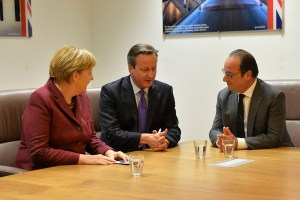
David Cameron - Angela Merkel - Francois Hollande - EU Renegotiation - Brexit

Agree with this article? Violently disagree? Scroll down to leave a comment.

Follow Semi-Partisan Politics on TwitterFacebook and Medium.

Paris Terror Attacks: The World Turns On Its Dark Side

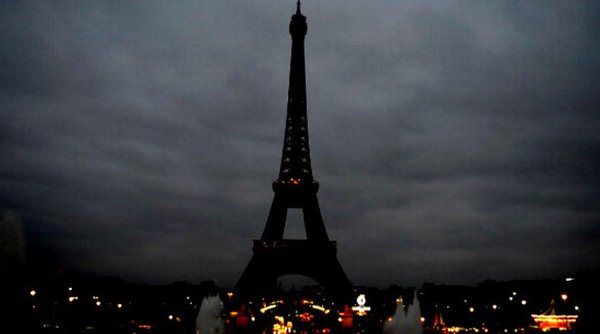
Paris Terror Attacks - Eiffel Tower Dark - 2

Our hearts break for Paris and the French people. For the sake of the victims and their families, our response to these latest terror attacks must be more than the standard denial and clichéd mistakes

Since awful showpiece terrorist attacks like those that tore through the heart of Paris last night are becoming a regular occurrence, it is worth reminding ourselves of the standard political response in their aftermath. It goes something like this:

Day 0: Expressions of shock, sorrow, anger and solidarity

Day +1: Insistence that now is a time for mourning, not asking difficult questions about how or why the atrocities were committed

Day +1, later: The first difficult questions are asked, particularly of the government and security services

Day +2: The intelligence services dust off their wishlist of draconian new powers, and strongly suggest that if only they already had these powers, the attack could have been avoided

Day +2, later: Some brave soul pokes their head above the parapet and tries to start a discussion about the link between unlimited multiculturalism and homegrown extremism, to near universal c0ndemnation

Day +3: The official narrative is established – “we will defeat this terror by giving our intelligence services the tools they need, and making radical or hateful speech illegal”

And so, within a week, the status quo reasserts itself. More civil liberties infringements, more free speech crackdowns, more government surveillance – and then more terror attacks, weeks or months later.

The status quo is not working. As this blog noted shortly after the Charlie Hebdo attacks:

Attempting to start a meaningful conversation about the root causes of Islamist terrorism is, apparently, highly unseemly and inappropriate so soon after an attack. And yet those who make this claim never explain why talking about the root causes of Islamist terrorism in its immediate aftermath is opportunistic and wrong, while conveniently it happens to be the perfect time for governments to demand sweeping, draconian new powers. And that is exactly what we now see.

One thing should now be absolutely clear, though apparently it needs constant restating: There can never be enough surveillance, never enough restrictions on movement, never enough laws banning hate speech to prevent a small number of determined, radicalised citizens – and likely non-citizens who have taken advantage of Europe’s loose borders – from going on the rampage and causing the kind of bloody mayhem that we now see, again, in Paris.

With the exception of the Stade de France, these were soft targets. It is simply not possible to protect every restaurant, every corner bistro or every theatre from a jihadist army of two who turn up in a car, spray innocent people with bullets and speed off to their next target. Concrete road blocks, razor wire, metal detectors and CCTV are of no use against these nimble threats.

So whatever else is said in the aftermath of these latest Paris attacks, let no one pretend that more government surveillance and more draconian crackdowns on free speech – either that of the Islamists or the Islamophobes – are the right answer. At best, these policies – favoured by the French and British governments – are a sticking plaster on an open wound, addressing the symptom but not the problem.

And that problem is the same as it was on 7 January, when Islamist gunmen stormed the offices of Charlie Hebdo, massacring journalists and shoppers at a Parisian kosher supermarket. The problem is that there are people living among us – a very small, but determinedly growing number, either citizens or recent migrants – who may hold the same passports as us and walk the same streets as us, but who feel no connection with us.

Those who propose nothing but even more security would apparently be content to live in a society where a small, segregated minority still hate us, but are thwarted in their attempts to kill us by omnipotent security services. They would be happy to live in a divided, ghettoised, multicultural dystopia, so long as the terror plots are always successfully thwarted.

Those of us who believe in the western and enlightenment values of freedom and individual liberty should not be satisfied with this goal – which is unattainable anyway, since perfect security can never be achieved. We should want a society which is open and welcoming to those who wish to come and contribute, but not credulously undiscriminating in accepting everyone. We should want a society where people feel bonds of kinship and affection which transcend racial and religious boundaries, where a healthy sense of patriotism ensures that there are common shared values which unite us all. But when patriotism and a robust defence of western values is seen as gauche, unseemly and culturally insensitive, there is no way to transmit these essential values to those who most need to receive them.

No government action taken by France in the aftermath of the Charlie Hebdo attacks could likely have prevented these new attacks on Friday 13 November – simply not enough time has elapsed for any bold new government policies to have taken effect. But appallingly, neither have any bold new government policies been proposed, let alone implemented. France still struggles with the existence of economically deprived, socially isolated immigrant communities who feel no allegiance to the country where they live – people who often feel more Muslim than French. Weak to nonexistent border enforcement makes it impossible to properly who control who comes and goes.

Meanwhile, the West – and Europe in particular – is in the midst of its own identity crisis, increasingly uncomfortable defending the principles of liberal democracy, free speech and tolerance. Many would rather bury their heads in the sand and deny the existence of the problem than insist that everyone abide by certain values and standards of behaviour. Too often, a warped strain of Islam has been allowed to run side-by-side with Western culture in a dual, effectively segregated society. And the growing Western culture of victimhood only adds fuel to the jihadist fire.

As Frank Furedi wrote on the tenth anniversary of the 7/7 London bombings:

The redefinition of terrorism as an ideological competitor is linked to the decline in the self-belief of the West. Even before the events of 11 September 2001, never mind 7 July 2005, there was more than a hint of defensiveness about the ability of Western values to prevail over those of their hostile opponents. One conservative American observer gave voice to this sentiment, and concluded that ‘protecting Western culture from foreign assault requires domestic revival’. A decade before 9/11 he warned that ‘the 21st century could once again find Islam at the gates of Vienna, as immigrants or terrorists if not armies’. Today there is little evidence of a domestic revival. Indeed, Western governments are sensitive about their very limited capacity for inspiring their own publics. The problem of engaging the public and gaining its support is one of the most striking features of the post-9/11 political landscape.

[..] There are signs that, in the decade since 7/7, some sections of the British establishment have woken up to the fact that what drives homegrown jihadism is the failure of society to clarify its values and way of life. The constant calls from Cameron and others to teach British values in schools represents an indirect recognition of the absence of such values from young people’s lives. But the values that inspire must be lived; they can’t be recycled through a shopping list of good intentions. Until there is a more courageous attempt to address this problem, tragedies like the London bombings of a decade ago will always be a possibility. The real threat is not the poisonous ideology of Islamic State, but Western society’s failure to live out and stand up for the principles of liberal democracy.

As it is in Britain, so it is in France. Neither country has done enough to tackle the sense of alienation or the crisis of British / French values which make radicalisation possible.

Tim Stanley touches on these points in his moving tribute to Paris in the Telegraph following yesterday’s terror attacks:

The brutality of this attack shows that we are not dealing with an enemy that can be negotiated with, only confronted and beaten. Perhaps that confrontation will be existential. Are we doing enough to integrate everyone, enough to fight poverty, enough to eradicate prejudice? Are we confident enough about our own values to teach and promote them? Are our security measures appropriate? Do we all have to come to terms with living with permanent anti-terror measures (I hope not). And what will our society look like as a consequence of this conflict? Less free, perhaps?

Are we doing enough to integrate everyone? I don’t think that any French or British politician could say that enough is being done. Worse still, it isn’t even a top priority at the moment.

Are we confident enough about our own values? Clearly not – in many cases, we have so little confidence in our own values that we fail to insist that others (recent immigrants and segregated communities) abide by the enlightenment values which have served us so well. In fact, sometimes we make an ostentatious virtue of parading our tolerance of thoroughly anti-enlightenment values, in warped service to “multiculturalism”.

Are our security measures appropriate? Our intelligence services will walk a tightrope here, insisting that they do everything they can to keep us safe, while making clear that if we do not grant them additional powers, any future blood spilled will be on our hands.

But Tim Stanley’s final question is the most pertinent: Do we all have to come to terms with living with permanent anti-terror measures?

That question is best answered with another question: What concrete actions are we taking that might feasibly lead to the rolling back of the semi-permanent anti-terror measures and powers which are now a depressingly familiar part of life? What one single thing are we doing that might mean we need less security and less surveillance a decade from now?

The regrettable answer is that we are doing virtually nothing. The world continues to turn on its dark side, and we can reasonably look forward to a future of more random terror, more sombre presidential addresses and the familiar sight of militarised police SWAT teams crawling over our major cities. This is the new normal, and nothing we are presently doing is going to change that fact.

It is now Day +1. This time, can we break with rotten, failed convention and actually talk about root causes?

Paris Terror Attacks - One World Trade Center - New York

Top Image: Eiffel Tower, darkened after the 13 November attacks: Auskar Surbakti Twitter feed

Bottom Image: One World Trade Center, New York, lit in French colours: Jon Swaine Twitter feed

Scroll down to leave a comment.

Follow Semi-Partisan Politics on TwitterFacebook and Medium.

On Booty Calls and Morning Croissants, Ctd. 2

Former French president Nicolas Sarkozy is now weighing in on the ongoing scandal of the presidential booty calls and morning croissants, claiming that President Hollande has made himself and the French presidency “ridiculous”.

The Telegraph reports the following quote attributed to Sarkozy by French investigative journal Le Canard:

“While everyone has the right to a private life, when one is a public figure and president, one must be careful to avoid being ridiculous,” he is quoted as scoffing.

“Well, that photo of Hollande coming out of his mistress’ place with a motorbike helmet makes Hollande look totally ridiculous. He is the ridiculous president.”

The Daily Mail gives an even less flattering report of Sarkozy’s views:

Former French president Nicolas Sarkozy views his successor Francois Hollande as a ‘ridiculous little fat man who dyes his hair’, it emerged today.

The vicious attack is reported by l’Express, the highly respected Paris news magazine whose editor is a close friend of Mr Sarkozy’s third wife, Carla Bruni.

As I see it, the bottom line is this – in three weeks, the French president has to fly to Washington, D.C. to represent his country abroad and maintain bilateral ties with a close ally. And all anyone will care about is whether Hollande might be found late at night zipping around capitol hill on the back of a scooter, looking for ladies. Even if there are non-scandal-related questions at the joint press conference, the only soundbites that will be reported will relate to the scandal back home in France. Hollande is supposed to make his country look good abroad, strengthen bilateral ties and promote France’s interests. Barring a miracle and a swift resolution to this tawdry affair, he won’t be doing that for some time to come.

The scandal is also now causing disquiet and unrest at home, as Buzzfeed reports that a man was arrested for dumping several tonnes of horse manure in front of the Palais Bourbon in protest at Hollande and the French political class in general:

Image from buzzfeed.com

And so this isn’t just an issue of invasion of privacy, or an educational tale highlighting the different attitudes toward privacy between the French and Anglo-American cultures. This is about basic competence, and the ability of a senior politician and statesman to effectively do their job. Actions taken in ones private life can impact this ability to effectively perform the job, and while the utmost respect and tact should rightly be shown to the president as he works through any problems in his personal life (as many have already argued), the most searching and uncompromising oversight should be applied to his performance in the job.

Francois Hollande has, through his own actions, rendered himself incompetent and, to some degree, incapacitated – politically, at least. This incapacity may be temporary or it may be irreversible, but either way it is self-inflicted and profound. It is down to the French people to determine how long they are willing to tolerate a leader for their failings, not in terms of their personal life but in terms of their ability to do the job.

On Booty Calls and Morning Croissants, Ctd.

The scandal continues, and embattled French President Francois Hollande’s annual new year’s press conference did absolutely nothing to bring any closure to the saga of the early morning croissant deliveries. Hollande did not even deign to acknowledge the disrepute that he is bringing on his nation during the text of his prepared remarks, and when asked about it during open questions he shot the line of questioning down.

So, the economy...
So, the economy…

The Guardian summarises the day’s happenings as well as anyone:

Asked in an exceedingly roundabout way whether Trierweiler was still the first lady, Hollande made clear his view that matters pertaining to his private life should be resolved in private, and said he would be taking no further questions on the subject (although he did promise to sort out his situation before his visit to Washington), and that was pretty much that.

There were one or two mild-mannered attempts to come at the question sideways, by asking about changes to France’s strict privacy laws, for example, and a brave bid by the Associated Press to come at it head on (“Does the president’s image matter?”). All received the same curt treatment.

The nature of the press conference revealed a couple of things to me – firstly, the huge deference shown by the local French press to their political leaders in any matters relating to personal behaviour and actions deemed to belong in the never-well-defined “private sphere”. Several commentators have already picked up on the fact that David Cameron or Barack Obama, embroiled in a similar scandal, could never have walked away from a set-piece press conference so unscathed. But what also shocked me was the unwillingness or inability of the foreign press, less beholden to the French political establishment for future favours and a good ongoing working relationship, to press home the lines of questioning. They had little to lose, but almost without exception they failed to follow up after Hollande declared the subject off-limits.

Still, if the French are content with their current arrangement whereby their politicians are free to engage in any manner of behaviour provided that it does not effect their performance in the day job, I suppose that this must be accepted, and the curiosity/outrage felt by many of us foreigners set aside. It is still my gut feeling that the supposed outrage of the French people at the invasion of Hollande’s privacy is partly a view expressed on their behalf by the elites who harbour skeletons of their own, but the polls suggesting that French attitudes toward Hollande remain unchanged are fairly conclusive.

I am glad to see that various media sources have finally started asking the question that I raised on this blog the same day that the story broke – namely, the implications for President Hollande’s security (and, by extension, the national security of the French republic) given the fact that he was taking off from the presidential palace incognito on the back of a scooter, unattended by any bodyguards during the night. As I said at the time:

Skulking around the capital city in the dark with limited protection, exposing oneself (and the  secure, uninterupted governance of one’s nation) to any risk of kidnapping, physical harm, blackmailing or worse in the pursuit of a booty call, is probably not behaviour that voters would wish to see in a serving head of state. Transgressions which take place before taking office, honestly explained, atoned for and forgiven by the electorate, are one thing. Actively committing further such acts whilst in office is another matter entirely.

Three days later and the Telegraph picks up on this same concern, which if we are to have no expectations for how a head of state conducts him or herself in their private life is the only real area left for criticism.

Le Monde reported Monday that Mr Hollande had visited the apartment on the Rue du Cirque with two trusted police officers in tow and with another team providing extra security, about ten times since last autumn.

But Mr Valiela said security was so lax that the president’s bodyguards failed to spot the paparazzi who had been spying on the apartment and taking pictures of the president arriving and leaving on two occasions just before and after the start of the new year.

The security detail also apparently failed to inquire about who the flat belonged to.

Yikes. This is pretty much the worst case scenario that I had considered – the lean security team being unaware of paparazzi in the vicinity of the president, let alone any more serious threats. My point, I suppose, is that in accepting the office of president and the powers and responsibilities vested in that office, a person has a responsibility to refrain from endangering the continued exercise of those powers. I’m not suggesting for a second that the French president should follow the lead of the United States and travel around in the excessive pomp of an Obama motorcade, not for a second. But being the leader of your country and sneaking off virtually unprotected to consummate a secret relationship seems to be an either/or proposition. The two just don’t sit very well together, even leaving questions of dignity and decorum entirely aside.

The next chapter in the pointedly unquenched rumour mill is that Hollande’s alleged mistress may be pregnant, thus continuing another time-honoured French presidential tradition. The French president may come to regret his failure to tackle the stories swirling about his personal life head-on when he had the world’s full attention.