Little Englander Conspiracy Theories, Eh?

Francois Hollande - Common State - European Union - EU Referendum - Brexit

It isn’t difficult to discern the trajectory of the European Union over the next decades. Just listen to the words of the EU’s leading political figures from past and present

Leave Alliance blogger Paul Reynolds has published an excellent retort to claims by assorted Remainers and EU apologists that those of us who warn of the impending European state are somehow indulging in paranoid fantasies.

For while everyone in the Remain campaign, from the prime minister on downwards, may be shouting “move along, nothing to see here!” while the scaffolding for a single European state continues to be steadily assembled behind their outstretched arms, any objective person can clearly see what is going on.

Among the examples given by Reynolds, in a piece entitled “A Profound Choice”:

“We have sown a seed… Instead of a half-formed Europe, we have a Europe with a legal entity, with a single currency, common justice, a Europe which is about to have its own defence. ” — Valery Giscard d’Estaing, President of the EU Convention, presenting the final draft of the EU Constitution, 13th June 2003

“The proposals in the original constitutional treaty are practically unchanged. They have simply been dispersed through old treaties in the form of amendments. Why this subtle change? Above all, to head off any threat of referenda by avoiding any form of constitutional vocabulary!” — Valéry Giscard d’Estaing, 2007, referring to the the Lisbon Treaty achieving the aims of the rejected EU constitution

“The Constitution is the capstone of a European Federal State.” — Guy Verhofstadt, then Belgian Prime Minister, now an MEP

“The European Union is a state under construction.” — Elmar Brok, Chairman of the European Parliament’s Committee on Foreign Affairs

“Of course the European Commission will one day become a government, the EU council a second chamber and the European Parliament will have more powers.” — German Chancellor Angela Merkel addressing MEPs,  November 2012.

“We need a true political union … we need to build a United States of Europe with the Commission as government and two chambers – the European Parliament and a “Senate” of Member States … European Parliament elections are more important than national elections … This will be our best weapon against the Eurosceptics.” — Viviane Reding, Vice-President of the European Commission, January 2014

“For my children’s future I dream, think and work for the United States of Europe” — Matteo Renzi, Italian Prime Minister, May 2014

 “I look forward to the day when the Westminster Parliament is just a council chamber in Europe.” — Kenneth Clarke, Conservative Chancellor in International Currency Review Vol 23 No 4 1996

Reynolds then goes on to show how this was the plan all along. As it was in the beginning:

Nor should anyone believe that this is a recent development. The EU was always conceived as a vehicle for supra-national federal union, dating right back to its founding organisation, the European Coal & Steel Community (ECSC) established in 1951:

“Through the consolidation of basic production and the institution of a new High Authority, whose decisions will bind France, Germany and the other countries that join, this proposal represents the first concrete step towards a European federation ..”
 — The Schuman declaration May 1950

“By the signature of this Treaty, the participating Parties give proof of their determination to create the first supranational institution and that thus they are laying the true foundation of an organised Europe.” — Europe Declaration made on 18 April 1951, at the signing of the Treaty of Paris establishing the ECSC

Is now:

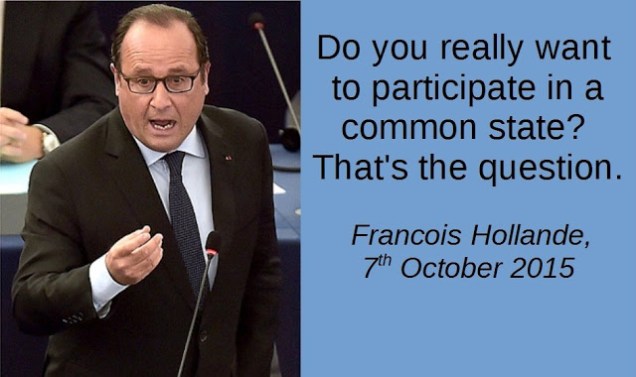
“Do you really want to participate in a common state? That’s the question.” — Francois Hollande, French President, addressing UKIP leader Nigel Farage in the European Parliament, 2015

And forever shall be:

This is reinforced by the proposals for the next EU treaty, The Fundamental Law of the European Union, published by the federalist Spinelli Group of MEPs, through the Bertelsmann house in late 2013. The preamble contains a telling paragraph:

“This proposal for a Fundamental Law of the European Union is a comprehensive revision of the Treaty of Lisbon (2007). Replacing the existing treaties, it takes a major step towards a federal union. It turns the European Commission into a democratic constitutional government, keeping to the method built by Jean Monnet in which the Commission drafts laws which are then enacted jointly by the Council, representing the states, and the European Parliament, representing the citizens. All the reforms proposed are aimed at strengthening the capacity of the EU to act.” 

European Political Union without end, Amen.

The time for childish, wistful self-deception is over. The British people need to wake up and make a decision – as Francois Hollande rightly exclaimed last year, in a moment of rare candour – about whether we want to participate in a common European state, or whether we wish to be independent, like every other major country in the world outside of Europe.

Ignorance about the intentions and trajectory of the European Union is no longer excusable. These quotes are not difficult to be defined. Neither can their existence be denied or countered in the way that the various economic claims on both sides have been subject to ridicule. These statements all exist because the real political leaders of Europe really do intend to take the European Union in this direction. Today’s EU institutions stand as testament to their vision and their determination to make it a reality.

Contrast the determined long game played by the euro federalists (the quotes selected by Paul Reynolds extend from 1951 through to 2015) with the flimsy, ethereal, cosmetic efforts of British politicians to supposedly win “concessions” from the EU. David Cameron’s renegotiation was nothing more than a grubby little fraud perpetrated on the British people, securing meaningless nods of assent from various heads of government acting in their own capacity, not the EU’s, most of whom will soon have moved on and been replaced by successors who do not feel bound to honour the various tidbits promised to Britain.

And leftists are no better. The once proud and principled tradition of left-wing euroscepticism is virtually dead, stabbed in the back by the likes of Jeremy Corbyn and Owen Jones (was the guilt and shame of this betrayal – and he knows he is betraying his true values – the reason why Owen turned in such a weak performance on Question Time last night?). And the leftists are now queueing up to talk about their utterly unachievable pipe dream of hands-across-Europe socialism, pretending to themselves and the rest of us that the EU can somehow be “changed” into a perfect socialist vessel. The EU’s founders and current leaders have been working toward a common state for nearly a century! What gives the likes of Owen Jones and Yanis Varoufakis such misplaced confidence that their little socialist tugboat can alter the course of the EU’s giant oil tanker, steaming at maximum knots toward economic and political union?

No, there are only two choices available to Britain – leave the European Union and seek to become a self-governing democracy once again (like every other major country in the world), or remain in the European Union and continue down Francois Hollande’s path toward a common European state.

There is no third way. David Cameron’s renegotiated settlement is not worth the used napkin on which it is scrawled – as far as the EU is concerned, a “Remain” vote mean that Britain is all squared away and ready to continue the march toward political union.

And those who continue to fatuously claim that the EU is simply about cooperation, trade and sharing cookies with one another are lying – to themselves, and to the British people. That benign version of “Europe” is not on offer in this referendum. We have a choice between independence and re-engagement with the world as a confident, powerful player on the one hand, and continued participation in the journey to a common European state on the other.

Do you really want to participate in a common state?

As Britons step into the polling booth on 23 June, this is the question which should ring in our ears.

 

European Union - United Kingdom - Britain - Flags

Top Image: The EU Question

Agree with this article? Violently disagree? Scroll down to leave a comment.

Follow Semi-Partisan Politics on TwitterFacebook and Medium.

The Seven Deadly Sins Of Pro-European Union ‘Remain’ Campaigners

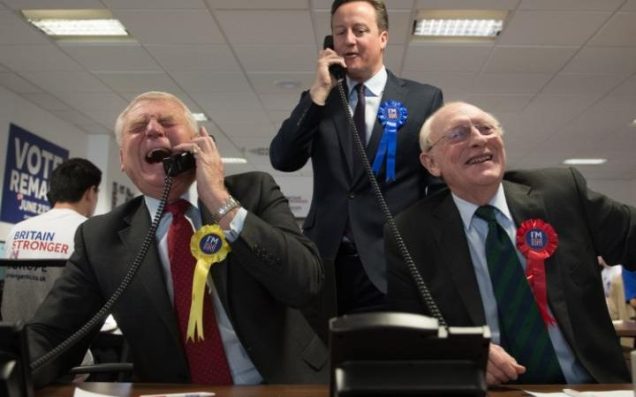
David Cameron - Neil Kinnock - Paddy Ashdown - Stronger In - EU Referendum - Brexit

Zealotry, pessimism, denialism, idiocy, treachery, materialism and sloth – the Seven Deadly Sins of those campaigning for Britain to remain in the European Union

The Financial Times reports on German moves to bring long-simmering plans for an eventual European army back to the boil with the submission of a significant new white paper – the release of which has been conveniently deferred until Britain’s EU referendum is concluded:

Germany is to push for progress towards a European army by advocating a joint headquarters and shared military assets, according to defence plans that could ricochet into Britain’s EU referendum campaign.

Although Berlin has long paid lip-service to forming a “European defence union”, the white paper is one of the most significant for Germany in recent years and may be seized by anti-integration Brexit campaigners as a sign where the bloc is heading.

Initially scheduled to emerge shortly before the June 23 referendum vote but now probably delayed to July, the draft paper seen by the Financial Times outlines steps to gradually co-ordinate Europe’s patchwork of national militaries and embark on permanent co-operation under common structures.

[..] At the European level, the paper calls for “the use of all possibilities” available under EU treaties to establish deep co-operation between willing member states, create a joint civil-military headquarters for EU operations, a council of defence ministers, and better co-ordinate the production and sharing of military equipment.

“The more we Europeans are ready to take on a greater share of the common burden and the more our American partner is prepared to go along the road of common decision-making, the further the transatlantic security partnership will develop greater intensity and richer results,” the paper states.

This is not shocking. This is not surprising. This is what the gradual creep toward European political union looks like. Proposals like this are raised before being quietly deprioritised, seemingly dropped in the face of political backlash, only to be resurrected and advanced once more, each time gaining a little more ground until the end result is achieved – not necessarily by its original name (as with the Constitution) but always in practical effect. No never means no with the European Union. It simply means brief retrenchment before pressing ahead the same thing with a slightly different label.

At this point I do not know what more can be said, what further evidence can be presented, to convince people that the European Union is not the benign, happy-go-lucky club of friendly countries occasionally coming together on a super voluntary basis to fight crime, Save the Earth and braid each other’s hair that they are so desperate to believe it to be.

The EU is not shy about its intended direction of travel. None of the EU’s “founding fathers” were remotely shy about what they wanted their creation to become. For all of its bureaucracy, the Brussels machinery is usually quite transparent in its workings, for those with the patience to look and discover what they do in our name. And yet there persists a massive disconnect between the European Union’s own self-declared purpose and the way in which it is perceived and portrayed in Britain.

I once ran for the train at London Euston station, intending to go to the city of Wolverhampton (don’t ask why). But I didn’t look closely enough at the departure screen, and accidentally boarded the service to Manchester, engrossed on a phone call, only realising my error when the train first stopped at Stoke-on-Trent. But crucially, once I realised my mistake I did not stay on the train in the forlorn hope that by staying in my seat I might still somehow end up in the West Midlands. No – I got off the train and rectified the error. I did so because like most people, on matters of travel I am capable of perceiving and understanding objective reality – in this case, the reality that I was sitting on a train taking me at great speed to somewhere I had no wish to go. My destination and that of the other passengers were irreconcilably different.

As it was with my ill-fated train adventure, so it is with Britain, currently being borne along on the semi-fast service to European political integration. It should now be abundantly clear to everyone that the destination is not “friendly trade and cooperation” as the EU’s desperate apologists claim, and yet many wavering voters still believe that if they close their eyes, ignore the mounting signs and stay fearfully on the train, it will take them somewhere acceptable.

And I don’t get it. I just do not understand those of my fellow countrymen who are educated people and not hardcore European federalists – people who do not want Britain to become subsumed into a European political union or cast aside as the rejected half-member with no influence on the periphery – but who nonetheless intend to vote Remain in this EU referendum. I’m not being dramatic. I have tried very hard to put myself in the position of a soft Remain supporter, and I can no longer do it. Clearly I have passed the Brexiteer event horizon and can no longer turn back, not that I wish to. And I speak as a former hardcore euro-federalist (back in my student days).

Basically, to vote Remain in this EU referendum, one quite simply has to either:

1. Be a committed euro-federalist, eager for a United States of Europe

2. Understand that this is the end goal, abhor it, but think so little of Britain’s prospects as an independent, globally-engaged nation that being part of such a European state seems like the “least worst” option

3. Summon enormous powers of denial in order to ignore the EU’s trajectory and accept at face value David Cameron’s fraudulent assertion that he has secured meaningful concessions from Brussels

4. Be incredibly ignorant of recent history and basic, easy to research facts

5. Actively wish harm to one’s own country and democracy

But perhaps that is not entirely fair. As I wrote recently, I can see how some voters – particularly those from my own Millennial generation – might choose to prioritise short term financial stability over long-term democratic health, though I think that such people seriously underestimate the risks inherent in surrendering the last vestiges of our democracy to an unaccountable supra-national government. And of course some people are just incredibly apathetic.

So there are also the further two possibilities:

6. Self-centred materialism

7. Laziness and apathy concerning an issue of fundamental importance

That’s it. Those are the choices. Zealot, pessimist, denialist, idiot, traitor, materialist or sloth.

If you are planning to vote Remain in the EU referendum, which one are you?


European Union - United Kingdom - Britain - Flags

Agree with this article? Violently disagree? Scroll down to leave a comment.

Follow Semi-Partisan Politics on TwitterFacebook and Medium.

Federalism Is Not A Dirty Word Simply Because It Is Associated With The EU

Towards a Federal Europe

If political and social cohesion is fraying even in the United States, where citizens share a strong common American bond, what chance is there for successful European government?

In her latest Telegraph column, Janet Daley makes an interesting comparison between the prospects of European federal union and those of the United States (currently experiencing its own political turmoil with Donald Trump’s successful insurgency on the Right and a nearly-successful  insurgency on the Left in the form of Bernie Sanders).

Daley writes:

That ideal of the European continent as a unified entity, presenting an alternative presence in the world to the overweening superpower across the Atlantic was once the whole point – wasn’t it?

[..] But, as I say, nobody who favours remaining in the EU is talking up that idea these days. In fact, it’s the other guys – the ones who want to leave – who are most inclined to remind us of it, to the clear embarrassment of the Remainers. Could this be because the political model itself – the American success story of a federation of states joined together under a central government – seems to be going badly wrong? The nation that appeared to have found the ultimate solution to conjoining separate states, each with its own semi-autonomous authority, under one set of national governing institutions is now apparently facing an electoral choice between the demagogic and the disreputable.

I get what Daley is trying to do here, but she makes a leap too far in suggesting that the nature of federal government itself is responsible for American political woes. The federal model has served the United States well for nearly 250 years; today’s problems are indeed mirrored in Europe and America, but they are not the result of federalism, tempting as it might be to discredit federalism in order to prevent its unwelcome imposition on the countries of Europe.

On the contrary, the current political disillusionment and the rise of the insurgent outsider candidates is largely the inevitable consequence of corporatism, an unhealthy perversion of capitalism in which unaccountable and undistinguishable elites from all major parties leech off the state to unfairly consolidate their hold on power, which is common among many Western governments. And tellingly, Daley provides no evidence to back up her assertion that federalism is to blame for this.

Daley then goes on to discredit her argument further with this highly inaccurate portrayal of conservatism in America:

Most disturbingly, the US seems to be prey to the same excesses which are so worrying n the European scene. American federal elections both at the presidential and the congressional level, used to be predictably, boringly moderate. For generations, both the major parties (and there were no others worth considering) could have fit within what was, in European terms, a narrow spectrum of political possibility: roughly the middle ground of the British Conservative party. Capitalism under reasonable controls and a strong defence of individual liberty were the basic tenets of a consensus which underpinned every plausible candidacy, allowing only for differences of emphasis and intonation.

This is wrong on several counts. Firstly, it is a wholly wrong to suggest that the entire spectrum of American political thought would miraculously fit within the British Tory party. To make this claim is to overlook the numerous areas of social policy (gay rights, abortion and religion in public life are just the first which spring to mind) where the British Conservative Party has more or less completely moved on and abandoned its past conservative stances, while the Republican Party continues to exploit the culture wars as a vote-winning wedge issue.

It is also to overlook the fact that in terms of economic policy, the Tories are often comfortably to the left of even the US Democratic Party in terms of their tolerance for state involvement in political life, the scope and depth of the welfare state and – how can one forget – the British worship of nationalised healthcare. True, there are isolated Democrats who openly support a “public option”, but almost nobody in American political life thinks that the NHS is a great model to emulate, or would be caught dead suggesting its adoption by the United States.

In almost every way, the British political spectrum sits (at least) a few points to the left of America’s, with our dreary post-war collectivism standing in marked contrast to the individualism of the United States. To suggest that both Republicans and Democrats would find a comfortable home within the Conservative Party is simply false – even the most Thatcherite of Tory MPs would be laughed out of the GOP as a ludicrous socialist.

Secondly, while recoiling in horror from Trump (admittedly a demagogue) and Bernie Sanders (who this blog admires for bringing genuinely left wing conviction to the debate, if only so that it can be exposed as flawed) Daley seems almost approving when she writes of “predictably, boringly moderate” government which allowed only for slight “differences of emphasis and intonation”. But this is exactly the problem – it is when the major political parties begin to look and sound indistinguishable from one another that a void opens which is often filled by glib and unsavoury types like Trump. In many ways, Britain has been fortunate in this regard – going into the 2015 general election, Labour and the Conservatives could hardly have been more depressingly alike, and yet the worst we have to show for it is a diminished UKIP and Jeremy Corbyn.

Daley appears to be defending consensus politics and railing against demagoguery at the same time, while failing to understand that an excess of the former all but guarantees the latter. Her column also forms part of an unwelcome trend of unnecessarily problematising issues around the EU referendum. Both sides are guilty – mostly desperate Remainers, who in their desperation to win are prone to suggesting that the smallest of bureaucratic or diplomatic hurdles to Brexit is an immovable showstopper, but also many on the Leave side who are apt to grasp at any problem with the EU or any world event and seek to fashion it into a weapon to be fired at Brussels.

In this case, holding Donald Trump and Bernie Sanders up as evidence suggesting that the American federal model itself is broken may help to land a solitary punch on the European Union this once, because the EU’s inexorable direction of travel is toward federal union. But by slandering an entire mode of governance in this way, we limit ourselves when it comes time to think about how we may wish to be governed if and when we leave the European Union. Some – including this blog – actually believe that moving towards a federal United Kingdom following a constitutional convention to be held after Brexit would be a great outcome.

So a plea to everyone on both sides (but in reality, only to those on the Brexit side – for we know that the Remain camp will tell any lie and stoke any fear in their desperation to win): there are sufficient real problems with the European Union as it is now and is soon likely to become without attacking every single word or concept associated with Brussels. So let’s debate where we can win – not getting into a mud slinging contest with trumped up economic figures, and not disparaging every single thing associated with the European Union, but by focusing on democracy and sovereignty, and building a positive vision of how Brexit can be the first step in Britain’s re-emergence as a global player.

The Brexit side is already accused of being alarmist. Let’s not live up to the hype by slandering federalism – a mode of government which has worked exceedingly well for many countries, including the most powerful and prosperous on Earth – in our desperation to slander everything which is also connected with the European project.


European Union - United Kingdom - Britain - Flags

Agree with this article? Violently disagree? Scroll down to leave a comment.

Follow Semi-Partisan Politics on TwitterFacebook and Medium.

At Least Jeremy Clarkson Is Honest About His Euro-Federalist Dreams

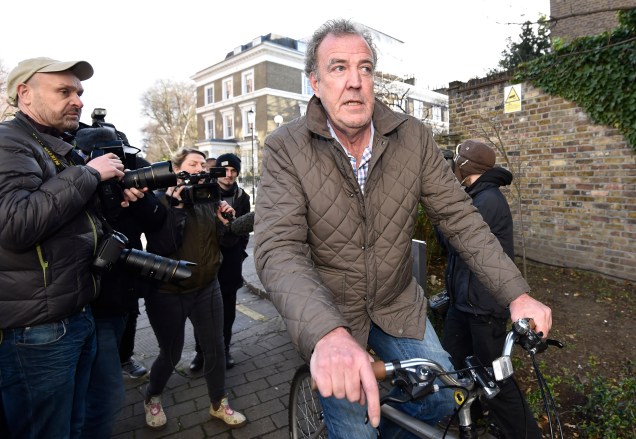
British television presenter Clarkson returns to his home in west London

Unlike most people in the Remain campaign, at least Jeremy Clarkson has the courage and decency to admit that he doesn’t just tolerate the European Union but actually dreams of Britain being part of a federal European country

So that great producer-punching pseudo Man of the People, Jeremy Clarkson, has come out definitively in support of Britain remaining in the European Union – and not just the EU as it is now, but the EU as it yearns to become in the near future, a fully politically integrated federal European state.

No great surprise there – Clarkson has made pro-European rumblings before. But what is surprising (and actually rather impressive) is the full-throated way in which Clarkson embraces his support of the EU.

Unlike nearly every leading politician and personality in the Remain camp, Clarkson does not attempt to flatter us or pretend that he “gets” our concerns about Brussels gradually usurping our democracy. Unlike the deceitful-yet-ingratiating Sajid Javid, Clarkson makes no promises to go back to ranting at Brussels the moment he has helped doom us to continued membership of the EU (though in Clarkson’s case, more ranting is all but guaranteed).

Jeremy Clarkson actually does something which almost nobody in the intellectually squalid, fear-based Remain campaign dares to do – he owns his pro-Europeanism and wears it as a badge of honour, rather than doing what so many Turncoat Tories and others have done, prancing around like the World’s Biggest Eurosceptic before meekly running to David Cameron’s heel and supporting Britain’s continued membership of the EU as soon as the prime minister snapped his fingers.

Clarkson writes in the Sunday Times (+):

I suppose that now is as good a time as any to declare my hand. I’m with the man whose wife we fancy. I’m in.

When Mr Cameron was touring Europe recently, seeking a better deal for Britain by sucking up to the leaders of such places as Romania and Hungary, I watched on YouTube an MEP called Daniel Hannan make an anti-EU speech to a group of, I think, students. It was brilliant. One of the best speeches I’ve ever heard. And, I’ll admit, it made me question my beliefs. But despite his clever, reasoned and passionate plea for us to leave Europe, I’m still in. He talked sense, but a lot of this debate is about how we feel.

In 1973 my parents held a Common Market party. They’d lived through the war, and for them it seemed a good idea to form closer ties with our endlessly troublesome neighbours. For me, however, it was a chance to make flags out of coloured felt and to eat exotic foods such as sausage and pasta. I felt very European that night, and I still do.

Whether I’m sitting in a railway concourse in Brussels or pottering down the canals of southwestern France or hurtling along a motorway in Croatia, I feel way more at home than I do when I’m trying to get something to eat in Dallas or Sacramento. I love Europe, and to me that’s important.

I’m the first to acknowledge that so far the EU hasn’t really worked. We still don’t have standardised electrical sockets, and every member state is still out for itself, not the common good. This is the sort of thing that causes many people to think, “Well, let’s just leave and look after ourselves in future.”

In other words, Jeremy Clarkson is your garden variety Euro-federalist. He looks at the bureaucratic opacity of Brussels, the contempt in which the EU is held by many of its citizens and the fact that cultural and regulatory harmonisation has not been completed to produce a single cultural identity where we all identify as Europeans first and use the same electrical outlets, and concludes that the correct answer is “more Europe”.

Fair play to him. He’s completely wrong, and betrays an almost criminal contempt for the democracy and right to self-determination for which our ancestors fought, bled and died. He is the archetypal person who votes as a consumer – because a harmonised, federal Europe would be better for his wallet and his weekend jaunts to France – rather than as a thinking, engaged citizen. But at least he has the god damn balls to honestly state his position. Hardly anybody in our own elected House of Commons supporting the Remain campaign would dare to do the same.

But then it begins to come off the rails (or the test track). Clarkson continues:

Britain, on its own, has little influence on the world stage. I think we are all agreed on that. But Europe, if it were well run and had cohesive, well thought-out policies, would be a tremendous force for good. I think we are all agreed on that as well. So how do we turn Europe from the shambles it is now into the beacon of civilisation that it could be in the future?

Oh really? We are “all agreed” on that, are we?

Actually, no we are not agreed at all. Our prime minister and foreign secretary may hold our country, its history and present capabilities in astonishingly low esteem, but fortunately the same cannot be said for many of the people. Many of us correctly believe Britain to be one of the few truly indispensable nations on Earth, that our contributions to the arts, sciences, commerce and global security are almost unmatched, and that we could throw our weight around in the world accordingly, if only we cared to stand up for our own national interest once in awhile.

But such views are unheard of outside the Chipping Norton set, the middle class clerisy in general and the fawning circle of friends and admirers surrounding David Cameron (of whom Jeremy Clarkson is one). These people, many of whom came of age at the peak of 1970s declinism and economic doldrums, have at their core a deep pessimism and scepticism about the ability of Britain to survive and prosper as an independent actor on the world stage.

So deeply have they internalised this self-doubt and self-loathing that no matter how much evidence you show them to the contrary – the examples of Australia and New Zealand, say, somehow surviving in the world without being part of an Asia Pacific Union and sharing a common parliament and court – they bat it away without even stopping to think.

Clarkson then sums up:

Right. So let’s switch our attention. Let’s leave the “parish councillors” alone and concentrate our big guns on the real decision makers in Brussels. Let’s have hacks outside their houses all day long, waiting for one of them to do or say something wrong. Let’s make them accountable. Let’s turn them from “faceless bureaucrats” into household names.

That is the biggest problem with the EU right now. Nobody is really concentrating on its leaders. Nobody is saying: “Hang on a minute . . .” And this means they are running amok.

It’s why we need to stay in. So our famously attentive media can try to stop them. To make them pause before they move. To make the Continent work the way the Continent should — as a liberal, kind, balanced fulcrum in a mad world that could soon have Trump on one side and Putin on the other.

And here we have the classic pivot back to “the answer is more Europe!” Rather than looking at public attitudes toward the European Union which range from disengaged indifference to blind, seething rage, Clarkson concludes not that the experiment in political integration by stealth has failed, but rather that we should just come to terms with it and re-order our media and culture around the EU’s artificial construct.

Clarkson is actually saying that if only more journalists doorstopped Jean-Claude Juncker and Martin Schulz every morning with awkward questions about budgets and foreign policy, we would immediately begin to feel more vested in the EU project and finally become enthusiastic Europeans. It’s pure wishful thinking, of course, but then so is everything about the EU, an political organisation build on the the principle of “If you build it, they will come” (they being a European demos willing to be led by Brussels).

But though Clarkson is wrong on nearly every point, cavalier with our democracy to the point that it does not even merit a mention in his article and unabashedly in hoc to the establishment’s ingrained europhilia, still he somehow comes away as the most intellectually honest and respectable of all the high profile Remain supporters.

Unlike an oleaginous Turncoat Tory, Clarkson does not feel the need to butter us up with constant anecdotes about how he hates Brussels just as much as we do, honest. And unlike those bland Remainers on the Labour benches, he does not just mutter inanities about countries “working together”, as though intergovernmental co-operation were not possible without the umbrella of an undemocratic political union.

No, Jeremy Clarkson owns his position, and has the guts to tell us that not only should we learn to love the European Union as it is now, we should actively fight for further political integration:

But, actually, isn’t it better to stay in and try to make the damn thing work properly? To create a United States of Europe that functions as well as the United States of America? With one army and one currency and one unifying set of values?

At last, an honest argument from a Remain supporter – someone who is brave enough to stand up and say “actually, I feel more European than British, I think that the nation state is kind of passé anyway, I’m envious of the size and power of the United States and terrified by the sight of Russia; therefore, we should proceed full speed ahead with the creation of a European country”.

Again: I find Jeremy Clarkson’s argument utterly repellent and contemptuous of our hard-won democracy and liberty. But my God, it’s refreshing to hear from someone from the Remain camp who actually says what they really feel about the European Union.

David Cameron, Philip Hammond, Theresa May and other assorted peddlers of FUD (fear, uncertainty and doubt) – your turn next in the honesty corner.


European Union - United Kingdom - Britain - Flags

Agree with this article? Violently disagree? Scroll down to leave a comment.

Follow Semi-Partisan Politics on TwitterFacebook and Medium.