The Daily Smackdown: David Cameron’s Transparent EU Posturing

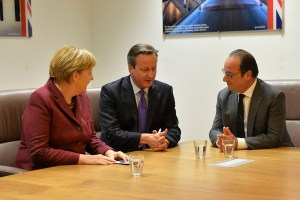
David Cameron - Angela Merkel - Francois Hollande - EU Renegotiation - Brexit

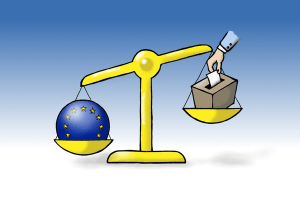
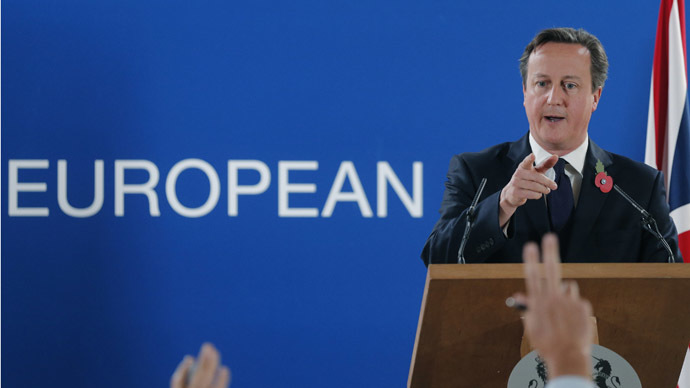
David Cameron has no respect for our intelligence if he thinks we will be fooled by claims that he is seriously considering campaigning for Brexit

Like this blog, the Times instantly saw through the prime minister’s latest desperate, amateurish attempt at brinksmanship and the dissemination of information by an often credulous media.

When David Cameron’s allies leaked that the prime minister was seriously considering recommending a Leave vote in the referendum if his renegotiation continues to be “theatrically spurned” by his EU partners, the story seemed too transparently false to be true. And it is.

The Times commented:

“It is patently clear that [David Cameron] cannot and will not become the man who tossed aside Britain’s EU membership. The hints from his allies that he might do so were a desperate negotiating tactic that has rightly backfired. This sort of melodrama is more likely to make negotiating partners giggle than give way.”

Absolutely. Every one of Cameron’s actions since he reluctantly promised the referendum as a too-little-too-late anti-UKIP defence has reeked of his desperate desire to keep Britain in the European Union at all costs.

As this blog pointed out yesterday:

Anybody with even one foot rooted in reality should be able to tell that this latest court gossip is nothing but spin. Having (unsurprisingly) gotten nowhere with his renegotiation efforts thus far, David Cameron needs to appear tough and resolute for the home audience. After all, it is pretty embarrassing that the leader of a global power and the world’s fifth largest economy has achieved precisely nothing, despite having embarked on a well-publicised begging tour of Europe. When begging and pleading with the Czechs for permission to change UK welfare rules yields no fruit, some kind of strong public stance is essential to preserve any kind of dignity.

The prime minister has never been able to force the words “Brexit” or any other specific phrase about Britain leaving the EU from his lips, and only on rare occasions has he even alluded to the fact that “nothing is off the table” if he judges the results of his renegotiation to be unsatisfactory.

Of course, since Cameron went into the British renegotiation carrying no demands at all – a point worth emphasising, and well made by Richard North at eureferendum.com – he is hardly likely to find his own efforts wanting. Who, given the chance to mark their own homework, would give themselves an F?

And when it comes to nothing being off the table in the event of failure, it remains easier to imagine the prime minister succumbing to a tearful, foot-stamping tantrum on live television than it is to picture David Cameron addressing the nation and declaring that Britain’s national interest would be better served by being outside the European Union.

EU Democracy - Brexit

Agree with this article? Violently disagree? Scroll down to leave a comment.

Follow Semi-Partisan Politics on TwitterFacebook and Medium.

Credulous Media Swallow David Cameron’s EU Renegotiation Myths

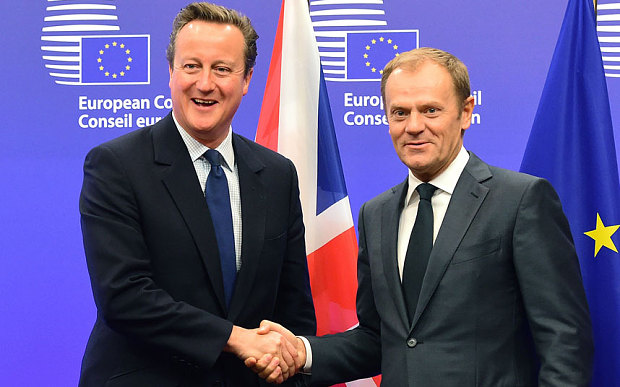
David Cameron - Donald Tusk - EU Renegotiation - European Union - Brexit

Nobody in their right mind seriously believes that David Cameron will campaign for Britain to leave the European Union. But that didn’t stop the media from earnestly reporting Number 10’s Brexit bluster

David Cameron is about as far from being a eurosceptic as a Conservative prime minister could possibly be. Sure, he was forced by the rise of UKIP into pledging a referendum on Britain’s EU membership – despite having previously stated that he didn’t think a referendum was appropriate – but this was only ever a matter of political expediency, not heartfelt desire for Brexit or deep conviction that the people should have the right to decide their own destiny.

But this has not stopped the media from willingly and credulously lapping up the latest spin emanating from Number 10 Downing Street – the risible idea that if David Cameron’s EU partners continue to treat him like the pesky kid at the adult’s table, he might seriously campaign for Brexit.

From the Telegraph:

David Cameron has privately conceded he will have to campaign to leave the European Union if he continues to be “completely ignored” by Brussels, the Daily Telegraph has learned.

[..] It has now emerged that Mr Cameron is telling senior figures in his party that he will be willing to campaign for a British exit if EU leaders do not back down over his key reform plans.

“He has said that if he is completely ignored or if they give him nothing he will campaign to leave,” the source said. “He has made that clear.”

Anybody with even one foot rooted in reality should be able to tell that this latest court gossip is nothing but spin. Having (unsurprisingly) gotten nowhere with his renegotiation efforts thus far, David Cameron needs to appear tough and resolute for the home audience. After all, it is pretty embarrassing that the leader of a global power and the world’s fifth largest economy has achieved precisely nothing, despite having embarked on a well-publicised begging tour of Europe. When begging and pleading with the Czechs for permission to change UK welfare rules yields no fruit, some kind of strong public stance is essential to preserve any kind of dignity.

And let’s be frank – the Telegraph didn’t so much “learn” that Cameron is considering campaigning for Brexit through canny investigative journalism, but rather they probably received a tip-off authorised by the Conservative Party hierarchy to place that narrative into the news cycle.

And what a successful stunt it has been. Now we are duly talking about how the prime minister feels so frustrated with the progress of his renegotiation that he is considering this drastic step, when deep down they (and most of us) know that David Cameron would sooner leave his daughter unattended in Nigel Farage’s local pub than recommend to the British people that they vote to leave the EU.

The truth, of course, is that this was always a sham renegotiation. David Cameron didn’t even bother to consult with the British people as to what they wanted out of any new settlement with Europe before jetting off to Brussels to set out his puny demands, so how could he claim to be representing the public’s real concerns?

This whole exercise has been about starting with the outcome of a “Remain” vote and then working backwards to determine the least possible number of concessions required from the EU to deliver that goal, rather than starting with a hard-headed assessment of Britain’s own national interest or public sentiment. And such a back-to-front renegotiation was never going to bear fruit.

As Mark Wallace points out in Conservative Home:

The conventional wisdom is that the Prime Minister has cut back his list of renegotiation demands in order to reach a swift agreement, in which he can claim victory and then hold an early referendum. That probably was his hope; it would certainly make political sense. Unfortunately for him, each aspect of that plan is foundering while the clock ticks down.

With every day that this supposed renegotiation goes on, Britain looks more and more like the weak supplicant nation asking its superiors for scraps from the table – and being rebuffed. This would be humiliating enough, but it is also self-reinforcing. The fact that our EU partners have already seen Cameron going cap-in-hand around the capitals of Europe begging for concessions (rather than boldly stating the UK’s national interest or presenting a radically different vision of EU membership) means that they are emboldened to give away fewer concessions when he comes knocking again.

Right now, the EU has bigger fish to fry than the Brexit question. And with immigration and terrorism top of the agenda, EU leaders feel confident in pushing our renegotiation way down the list of priorities because they know – even if our credulous media claims not to know – that David Cameron will campaign for a “Remain” vote, come what may.

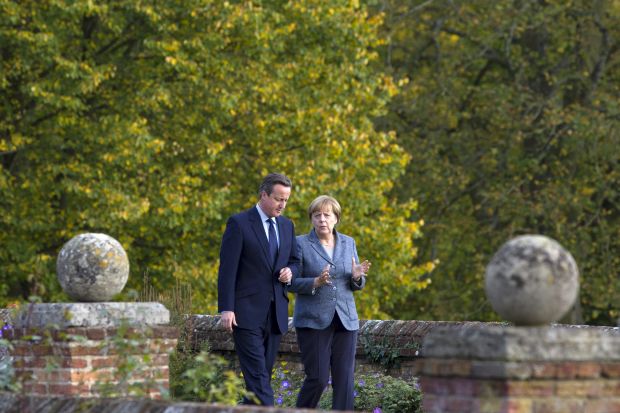
France and Germany are both diplomatically canny countries. If they suspected for a moment that their treatment of David Cameron might seriously cause him to snap and embrace the Brexit cause then they would immediately start making more conciliatory noises. Secretly they might be glad to be rid of Britain, but they know that Brexit would be a stunning, unacceptable repudiation of their vision for Europe. Thus the fact that there is no diplomatic panic in Berlin or Paris is proof that Angela Merkel and Francois Hollande know that their British counterpart remains utterly pliable and sickeningly eager to please.

David Cameron can continue to authorise leaks suggesting that he is contemplating campaigning for Brexit, if it makes him feel better when he is politely ignored by the leaders of other countries a fraction of our size and power. He can promise all the table-thumping rows in the world, too.

But the one thing he cannot do is convince those of us who see through his cheap tricks that he is a real eurosceptic, or that he would ever allow his name to go down in the history books as the man who led Britain out of the European Union.

David Cameron - Angela Merkel - Francois Hollande - EU Renegotiation - Brexit

Agree with this article? Violently disagree? Scroll down to leave a comment.

Follow Semi-Partisan Politics on TwitterFacebook and Medium.

The Daily Toast: To Win, Eurosceptics Must Show That The EU Is Outdated

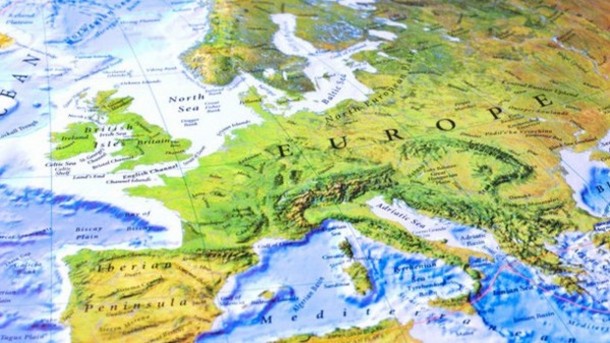
Old Europe Map

Another new initiative for Semi-Partisan Politics – counterpart to The Daily Smackdown (same basic idea, but reversed). Will focus on a different praiseworthy or perspective-changing article, argument or action each day

Allister Heath has a good piece in the Telegraph, where he observes that the europhiles may end up wrong-footing themselves in the coming referendum by buying into the lazy, two-dimensional caricature of eurosceptics as ornery traditionalists who are stuck in the past and afraid of the future.

Heath rightly points out that the europhiles dismiss or underestimate we Brexiteers at their peril, writing “it is always a fatal error to assume that your political opponents are evil or stupid”. I certainly hope that this rule holds true just as it did for Ed Miliband’s vacuous, virtue-signalling Labour Party at the general election.

The hopes of many a lefty were extinguished on May 7  when it emerged that the left-wing echo chamber on Twitter was in fact not representative of the country, and that people other than psychopaths and billionaires actually voted Tory in good conscience. So by all means, let them assume once again that anyone who doubts the inherent virtue of the European Union must be a grumpy retired colonel, a Mafeking stereotype from a run-down coastal town.

Heath writes, in praise of campaign group Vote Leave:

Vote Leave’s core argument is that the EU’s institutions remain stuck in the post-1945 era: an industrial and agricultural world dominated by a few rich nations and overshadowed by the Cold War. In those days, bureaucratic centralism was the fashionable answer; 60 years on, the EU’s creaking, lumbering structures cannot cope with change involving genetic engineering, cybercrime, driverless cars and digital manufacturing.

They are just as debilitated when it comes to addressing contemporary geopolitical risks, including the crisis in the Middle East, the rise of terrorist organisations such as Isil, or even negotiating bilateral trade deals with emerging economies. It is Europe that now has a protectionist mindset, pretending that its borders stop at the Mediterranean while looking on uselessly as Syria is engulfed in a humanitarian catastrophe.

Rather than advocating a retreat into splendid isolation – which is what pro-EU activists wrongly assume Eurosceptics believe – Vote Leave will be calling for increased and improved international cooperation to deal properly with the forces that are changing the world. This, it will argue persuasively, requires different institutions to those that exist today: structures that can tackle problems quickly and that allow decentralised cooperation between nations.

I have my grave doubts about Vote Leave, for reasons well summarised over at the blog Vote to Leave the EU. There are serious doubts as to whether Brexit is the true goal of that group’s leadership, or if they are simply agitating for an initial “no” vote to then strengthen Britain’s hand for a future, “serious” renegotiation with the aim of securing a slightly sweeter deal. But Heath’s broader point is a very good one.

What threadbare arguments could have been made for the European Union back in the 1950s when the world was indeed divided into distinct and competing supranational blocs have lost all of their potency in the twenty-first century multi-polar word. For too long, europhiles have been allowed to portray themselves as forward-looking and progressive. And some really do believe it to be true. But it is increasingly hard to believe that Britain’s national interest is best served when represented through the collective voice of twenty-seven other distinct countries, each with their own unique circumstances and agendas.

Heath continues:

The future will belong to shifting networks of nations, not to monolithic empires. Voters will have to be empowered and kept involved, rather than bypassed through undemocratic transnational democracies. The Inners, who for decades have claimed to represent modernity, are about to be wrong-footed by a campaign and arguments that they will find very difficult to respond to.

It is absolutely essential that this is the case, if we are to achieve the goal of Brexit. This cannot be a campaign focused on some chimerical, glorious past, and if it becomes such a campaign we will be ripped to shreds and lose our last, best hope of regaining national sovereignty.

That means we must focus on all of the things that Allister Heath talks about in his article – how an independent Britain will be free to pursue advantageous commercial and diplomatic deals in our own interest rather than holding one 28th of a say over the common European position, how Britain’s membership fee can be repurposed and reallocated to focus on our own priorities and incentives, and more. But that’s all long term.

We also need an immediate plan mapping out what British secession from the European Union actually looks like. It is imperative that the “Leave” campaign pushes such a plan, otherwise voters will (rightly) conclude that a vote to leave the EU is a leap into the unknown, and choose the stultifying status quo as the safer option.

At present, you would be forgiven for thinking that there is no such plan. Neither of the two main campaign groups spend any time talking about what Brexit might actually look like. Vote Leave certainly don’t mention one (quite probably because Brexit is not their end goal), while Leave.EU are more focussed on attacking the EU than promoting a positive vision of post-EU Britain.

But such a plan does exist. It’s called Flexcit, and if I keep banging on about it on this blog in the coming weeks and months it is only because I have come to realise that the referendum cannot be won without a clear and unambiguous plan for Brexit, and it is high time some of the “heavyweight” eurosceptics publicly adopted this plan or ventured one of their own.

Flexcit is a serious, pragmatic plan which outlines a step-by-step process for leaving the EU and rejoining the world. It doesn’t make undeliverable promises of free chocolate and rainbows for everyone, but it is comprehensive and rigorous, and does what it says on the tin. As I have already said, every serious eurosceptic and Brexit campaigner should read it and give it fair consideration.

Only then, with the referendum won and Britain taking her first steps in the world as a truly independent and sovereign nation once again, can we do as Allister Heath says and show the vanquished europhiles just how forward-looking and ambitious we Brexiteers are for our country.
David Cameron - EU Referendum - Brexit - Human Rights Act

Further reading:

The British Model

Is the penny dropping about Vote Leave’s true intentions?

Agree with this article? Violently disagree? Scroll down to leave a comment.

Follow Semi-Partisan Politics on TwitterFacebook and Medium.

‘Vote Leave’ Hammer Home The Message: “Brexit Is The Safe Option”

Vote Leave - EU Map

Early signs indicate that the “Safe option = Leave EU” message will be hammered home relentlessly with every single eurosceptic talking point, whether it necessarily fits or not

Today’s campaign email from Vote Leave hammers home the “safety first” option of voting for Brexit even more strongly than before.

As well as having a subtle dig at the rival pro-European campaign group Britain Safer in Europe (which launches today) by referring to them by their unfortunate initials “BSE”, today Vote Leave have this to say on sticking with the status quo of full EU membership:

Which is safer – to vote ‘remain’ and keep giving more power and more money every year to a Brussels bureaucracy that cannot cope with the problems of the modern world, or to take back control and negotiate a new, friendlier UK-EU relationship based on free trade and stronger international cooperation, often at a global (not regional) level?
 
Which is safer – to keep going with the 1950s vision of ever more centralisation of power in the Brussels bureaucracy or to build new institutions that allow faster, more agile cooperation on global challenges?  
 
Which is safer – to accept the permanent supremacy of EU law or to trade and cooperate with the EU without accepting the supremacy of EU law, as many other countries in Europe and around the world do?
 
Which is safer – to keep Brussels in charge of negotiating trade deals that affect millions of British jobs or to take back control and negotiate these deals ourselves?
 
Which is safer – to trust big multinational businesses and their lobbyists to make laws over dinner in Brussels, or to take back control?
 
Which is safer – to keep going with the Foreign Office’s hope that eventually Brussels will listen to us, which has failed for 40 years, or take back control and invest in science so we can create and build new industries?  
 
A vote to ‘remain’ is not a vote for the status quo. It means handing over even more power and money to Brussels. We need a new UK-EU relationship. The only way to take back control and get a new UK-EU deal is to Vote Leave.

As I pointed out over the weekend, not all of these “which is safer?” questions work very well. In fact, some of them have very little to do with safety or even stability one way or another.

But today’s campaign email is a real marker of intent. It shows that Vote Leave intend to continue pushing this point and throwing up “safety first” scenarios until a couple of them stick. I’m sure they will be conducting polling and focus groups to further test responses to these messages before discarding the ones that do not work, and refining those that do until they become more deadly rhetorical weapons.

At this early stage, the arguments put forward for Brexit lack any real depth or sophistication – not that the pro-EU arguments are any better. Campaigners realised that the “No” vote in the Scottish independence referendum was won party because the Better Together campaign went relentlessly negative, portraying separation from the UK as a leap into the great unknown. And now they want to seize the tool which is most likely to be used against them (arguing that Brexit represents a leap in the dark) before the pro-EU crowd get a chance.

Mission accomplished, so far. But at some point, the effect of both sides yelling “safety!” at the electorate is likely to cancel itself out. And the question then becomes: what does each side have to offer that will speak to the hopes and aspirations of the British people, not just their desire for safety and stability?

This is where the eurosceptic side could (and hopefully will) run away with the show. Those who want to yoke Britain to the EU come what may can offer nothing but a continuation of what we already have – life as part of an antidemocratic federation, where uniformity and harmonisation are relentlessly encouraged just for the sake of it. The eurosceptics can offer so much more, provided that they avoid reciting an endless list of euro grievances and focus strongly on the opportunities and benefits of re-engaging with the world.

This “which is safer?” rhetoric is all very well, but it is the arguments that come next which will win or lose this referendum.

EU Renegotiation - Brexit - European Union

Follow Semi-Partisan Politics on TwitterFacebook and Medium.

The Glib And Oily Art Of David Cameron’s Superficial EU Renegotiation

David Cameron’s EU renegotiation is less a firm-handed assertion of Britain’s national interest, and more a collusion with fellow EU leaders to dupe the electorate into believing that real reform is possible

The fact that David Cameron’s key demands and red lines for the EU renegotiation now underway are wilfully vague and almost comically detached from the concerns of British voters is hardly news. But this depressing truth is hammered home even more forcefully today with the leaking of the prime minister’s four-point plan to win concessions from Brussels.

From the Telegraph:

Cabinet sources have told the Telegraph they are confident they can find a way to keep Britain inside the EU with better terms of membership. Their plan involves:

  • Forcing Brussels to make “an explicit statement” that Britain will be kept out of any move towards a European superstate. This will require an exemption for the UK from the EU’s founding principle of “ever closer union”.
  • An “explicit statement” that the euro is not the official currency of the EU, making clear that Europe is a “multi-currency” union. Ministers want this declaration in order to protect the status of the pound sterling as a legitimate currency that will always exist.
  • A new “red card” system to bring power back from Brussels to Britain. This would give groups of national parliaments the power to stop unwanted directives being handed down and to scrap existing EU laws.
  • A new structure for the EU itself. The block of 28 nations must be reorganised to prevent the nine countries that are not in the eurozone being dominated by the 19 member states that are, with particular protections for the City of London.

Of these, only one point (the final one) comes anywhere close to defending Britain’s national interest and reflecting the concerns of the electorate. Of the others, the first two points are completely irrelevant, while the third is guaranteed to meet stiff resistance from other EU leaders and will likely require so many other concessions from the government that securing it would be the ultimate Pyrrhic victory.

Continue reading