Tales From The Safe Space, Part 27 – Ohio University, Tear Down This Wall

Ohio University - Trump 2016 - Chalk - Hispanic Latino Student Union - Cultural Sensitivity

At Ohio University, mortal offence is in the eye of the beholder

Another day, another American university cravenly submitting to the identity politics bullies and their weaponised mental weakness.

Now, the president of Ohio University has apologised to students in a letter because unknown other students dared to exercise their First Amendment rights by spraying a political sentiment (expressing support for Donald Trump – pass the smelling salts!) on the university’s famous Graffiti Wall.

The Athens Post reports:

The graffiti wall by Bentley Hall was found painted over with the words “Trump 2016” and “Build The Wall!!” on Thursday.

Some Ohio University students were upset by the display.

“I felt disgust, frustration and I expected more from this campus,” Joshelyn Smith, a senior studying communication and public advocacy, said.

The Hispanic and Latino Student Union at OU put together an emergency meeting that took place in OU’s Multicultural Center after finding out about the mural and ultimately painted over it at 3 p.m. Thursday.

“The goal of the meeting was to start a discussion,” Carla Triana, Hispanic and Latino Student Union president, said. “We heard about (the mural) at 9 this morning, and we had to do something instantaneously. We had to educate people on why this was offensive.”

Yes – clearly nothing was more important than holding an “emergency meeting” to explain why declaring support for a political candidate on a wall honouring free speech is so “offensive” as to warrant seeking out and punishing the perpetrators.

Sadly, much as we saw with the college Equal Opportunities administrators who gleefully shredded the US Constitution in an attempt to soothe the hurt feelings of a student (really an undercover reporter) who claimed to feel “triggered” by the document, Ohio University was lightning quick to apologise to the outraged students.

Even though these students are nothing but bullies, attempting to use their hurt feelings as a weapon to shut down the fundamental free speech rights of others, Ohio University leaders could not find it within themselves to stand up to the identity politics cultists and tell them to grow a thicker skin.

Campus Reform reports:

The president of Ohio University sent a campus-wide email expressing sympathy for those “hurt” by pro-Trump slogans written on a free speech wall last week.

[..] The Hispanic and Latino Student Union called an emergency meeting—attended by university president Roderick McDavis— to “start a discussion … on why this was offensive,” after which they decided to paint over the messages.

[..] McDavis assured attendees that he shared their concerns, and was working to accelerate the development of a cultural competency element for freshman orientation, following that up the next day with a message to the campus community discussing the “beauty and power” of words in the context of sympathizing with those offended by the Trump-inspired messages.

“Yesterday, I met with students and members of our Hispanic/Latino community who saw words that troubled them on the Graffiti Wall,” McDavis wrote. “Indeed, this wall is a place of free speech and expression; however, the words painted were troubling because they had a very different meaning to some than they may have to others viewing the message or even to those who painted the message.”

But this frantic attempt by McDavis to mollify the angry students by adopting their identity politics language and accepting the premise of their complaint is exactly the problem. When you move away from an objective standard of what constitutes unacceptable (or “problematic”) free speech toward a worldview where speech can be restricted or punished based on the subjective feelings and interpretation of certain third parties, then you no longer have anything like freedom of speech.

If the words “Trump 2016” or “Build the Wall” were troubling to some students because they chose to interpret them as “I hate Hispanic/Latino people” rather than “let’s adopt this policy in a (counter-productive) attempt to enforce our border”, does this mean that the political idea can no longer be expressed for fear of upsetting those who apply the worst possible interpretation of the words in their minds?

What about other political statements? If one follows this logic, do we not end up in a situation where any conservative sentiment is liable to be banned after being wilfully misinterpreted by angry students wielding their fragile “mental safety” as a weapon?

(And incidentally, although it does not excuse Trump’s worst rhetoric about immigration, the fact that the identity politics practising American Left immediately interpret any call for immigration control as smoking gun evidence of deep racism – meaning that the political opinions of countless people are effectively made taboo – is one of the reasons why Donald Trump is now serving as such a successful and dangerous pressure release valve for years of previously unchannelled anger).

This is a textbook case of how not to respond to an identity politics-based student power grab on campus. As soon as university administrators conceded the premise of the complaint – that words spoken, written or painted can cause “harm”, and that this is unacceptable even if the harm is only incurred by applying the worst possible interpretation of the speech in question – they lost the war. They frantically scrambled to mollify the students in an attempt to buy themselves peace, but they will only succeed in emboldening the student activists to take offence even more easily and demand even greater concessions in future.

One can predict with reasonable confidence that there will now be one or more forced resignations from the Ohio University faculty or administration in the coming year, either as a result of what has already happened or because of some future non-existent transgression against the student population. And it will be richly deserved, for those who fail to defend academic freedom and free speech have no place running our universities.


Safe Space Notice - 2

Agree with this article? Violently disagree? Scroll down to leave a comment.

Follow Semi-Partisan Politics on TwitterFacebook and Medium.

Republicans Are In No Position To Mock The Democratic Party Primary Debates

In his Morning Briefing email today, the National Review’s Jim Geraghty disparaged last night’s latest Democratic Party primary debate between Hillary Clinton and Bernie Sanders with these words:

‘Yeah, There Was Another Democratic Debate.’ (Stifles Yawn)

Thursday night’s Democratic debate in Brooklyn basically amounted to Bernie Sanders’s repeating all of his familiar attacks against Hillary and her insisting they’re baseless; and her charging that he doesn’t know what he’s talking about, at which point he would counter-charge, “THE GREED AND THE RECKLESSNESS AND ILLEGAL BEHAVIOR OF WALL STREET BROUGHT THIS COUNTRY INTO THE WORST ECONOMIC DOWNTURN” — sorry for the all caps, it’s the only way to accurately capture the volume of Sanders’ high dudgeon voice — “SINCE THE GREAT RECESSSION OF THE THIRTIES, WHEN MILLIONS OF PEOPLE LOST THEIR JOBS AND THEIR HOMES AND THEIR LIFE SAVINGS, YOU’VE GOT A BUNCH OF FRAUDULENT OPERATORS AND THEY’VE GOT TO BE BROKEN UP!”

Below are a couple of highlights, to the extent there were any:

Clinton, last night, defending her judgment: “President Obama trusted my judgment enough to ask me to be secretary of State for the United States.”

Yeah, that line may work really well in a Democratic primary, but you can apply the same “hey, if Obama picked me, I must know what I’m doing” argument to former HHS secretary Kathleen Sebelius, VA secretary Eric Shinseki, short-lived Secretary of Defense Chuck Hagel, all of those wealthy donor ambassadors who knew nothing about the countries where they would represent the U.S . . .

Hillary Clinton: “It may be inconvenient, but it’s always important to get the facts straight. I stood up against the behaviors of the banks when I was a senator.

I called them out on their mortgage behavior. I also was very willing to speak out against some of the special privileges they had under the tax code.”

Bernie Sanders: “Secretary Clinton called them out. Oh my goodness, they must have been really crushed by this. And was that before or after you received huge sums of money by giving speaking engagements? So they must have been very, very upset by what you did.”

I’m sorry, does a political debate no longer count as interesting or exciting unless a deranged mob of populist Republicans are flinging feces at each other or comparing the size of their junk?

Are Sanders and Clinton repeating themselves a lot? Yes – as someone who is deluged by campaign emails and briefings from both sides, that much cannot be denied. But at least the things that they are saying actually matter. They relate to foreign policy, trade policy, crime and punishment, campaign finance and the influence of Wall Street.

The argument in the GOP primary has devolved into little more than pledges to revoke ObamaCare faster than the other (“I’ll abolish ObamaCare by executive order at the beginning of my inaugural address!”) and competing visions for exactly how high the wall should be between the United States and Mexico.

Debates on both sides probably shed a lot more heat than light, but anyone who has watched a few of these things in the 2016 cycle would have to admit that more of substance has been learned on the Democratic side than the Republican side this time round – with the same going for 2012 too, when the Republicans treated us to Michelle Bachmann and Herman Cain.

There is a group – and I can’t say how large it is, but I know it exists from my time living in America – of liberty-minded conservatives out there who are thoroughly disgusted with the Democrats’ record in office and the general direction of the country, but who will stay home or hold their nose and vote for Hillary Clinton before they see Donald Trump or even Ted Cruz in the White House.

(And to those Trump supporters who protest, I would simply say that fighting back at the establishment and sticking it to the man does not have to mean vocally supporting torture and eroding the constitution. In fact, as Britain’s Nigel Farage discovered, it is actually better when the establishment come at you equally hard for holding mostly reasonable position, as their desperation to kill the challenge to their power is then exposed for what it is).

Though I am not yet a US citizen, if I had voted in the 2008 election I would have voted without hesitation for Barack Obama over the John McCain / Sarah Palin freak show. Many others did the same. So forget trying to attract massive new demographic groups to the side of the Republican Party – maybe the GOP should focus more on simply not alienating those people who will reliably vote for any serious-minded conservative, but who are constantly chased away from the party by the carnival of idiots who keep making it to the primary debates.

You can sneer that it is cultural snobbishness at work (and a bit of it is – though not the majority), but it goes deeper than that. And the good news is that the Republican Party will soon have another chance to reinvent itself for a new era as they spend another presidential term in dreary opposition. Hopefully they will not repeat the mistake of 2008, and actually have serious discussion this time about who they want in the party and who they want out, and whether they want to appeal to the better angels or the darkest fears and prejudices of those who are invited to remain.

That process can begin soon. But in the meantime, let’s not get cocky about the Democratic Party primary process, which has seen left-wing politicians with substantially different worldviews tearing chunks out of each other on policy and substance – which is precisely what should happen.

That is the debate that the GOP should have been having this election cycle were they still a functioning party, and were they not now being forced to pay in a lump for every cynical act of alarmism, obstructionism and posturing they have taken since the inauguration of Barack Obama.


Donald Trump - Make America Great Again

Agree with this article? Violently disagree? Scroll down to leave a comment.

Follow Semi-Partisan Politics on TwitterFacebook and Medium.

William Hague’s Bizarre Critique Of Donald Trump

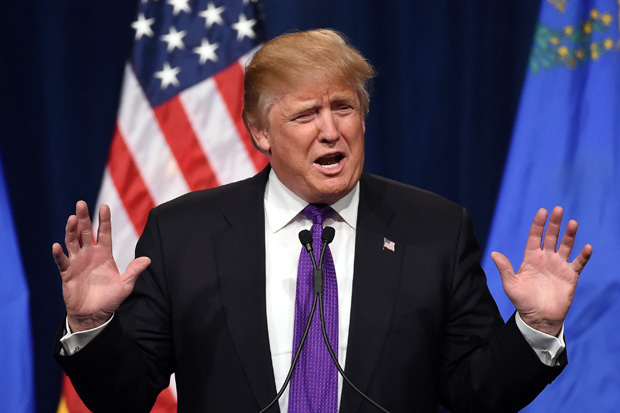
Donald Trump Hosts Nevada Caucus Night Watch Party In Las Vegas

William Hague is just the latest media personality to use Donald Trump’s presidential candidacy as an opportunity for virtue-signalling, rhetorical target practice

William Hague is getting rusty.

The former Conservative Party leader has already shredded his reputation among real conservatives through his shameful support of David Cameron and the Remain campaign. And now, added to that, his latest column on the US presidential election is written with all of the insight of someone who has been paying no attention to the American political scene for years, and is basing their hastily-written column on all of the most tired generalisations from a British television news report.

Whatever happened to the sparklingly witty and intellectually nimble political personality who could keep the House of Commons spellbound (or laughing uncontrollably) with his skills as a raconteur? Perhaps that side of William Hague is curled up in the foetal position, rocking backwards and forwards in shame and incredulity at what the europhile side is up to.

Hague begins with this remarkable statement about the main factors which should disqualify Donald Trump from becoming president of the United States:

Two characteristics make Trump fundamentally unfit to be president: his attitude to women and the way he treats rivals. The first of these, including crude and offensive remarks about female interviewers and candidates, shows deeply patronising instincts.

This isn’t just foul manners. It really matters because the way to liberate the greatest quantity of untapped talent in the 21st century is to achieve the full social, political and economic empowerment of women. Having a leader of the world’s most powerful country who shows no recognition of that cannot be a good idea.

His insulting response to rivals is another disastrous weakness in a potential global leader. The belittling of political opponents – “Lying Ted”, “Little Marco” and so on – shows no grasp of the fact that any president must work with them in Congress the minute he or she is elected. Even worse, Trump’s bullying attitude to other countries – telling Mexico it will have to pay for a wall along its border – would be utterly counterproductive and diminish the power of the USA by destroying its moral authority and crucial ability to persuade others to act.

Of all the things that Hague could have picked as Donald Trump’s disqualifying features, he chooses to virtue-signal and cite Trump’s view of women – as though Trump’s public attitude to women is any worse than, say, JFK’s attitude and behaviour were in private. Of all the things about Trump that Hague can think of, his frequent obnoxiousness is deemed the most serious.

Nothing to do with Trump having no functional knowledge of trade or foreign policy. That’s fine, according to Hague – President Trump can pick all of that stuff up on the fly. But God forbid that the next occupant of the Oval Office says off-colour, crass things about people (despite claiming to have “the best words”).

Hague even goes on to specifically mention some of Trump’s more outlandish statements on foreign and defence policy, so it is not as though he is unaware of them:

When Trump says that South Korea and Japan should have their own nuclear weapons, rather than rely on America, and that the US should stop funding Nato, what he is advocating is the collapse of the entire security architecture of the western world. But the people voting for him and such policies are telling us that they are fed up with paying for the defence of other countries who do very little to look after themselves.

[..] Trump’s other main policy with an impact on all of us is trade protectionism: he wants to impose swingeing tariffs on imports from China and Mexico, and withdraw from new trade agreements. This would be another disastrous act. It would result in widespread retaliation against American products, higher prices for consumers, and lower growth for the world. For Britain, the ninth largest exporter in the world, such policies would be very bad news indeed.

But apparently itching to provoke a trade war and undermining the security structure which has protected the West since the Cold War – with no clear plan for its replacement – is less of a disqualifying factor than Trump’s ongoing feud with Fox News anchor Megyn Kelly.

Hague’s broader point – that by supporting Donald Trump, his voters are sending an important message about longstanding, unresolved problems with the American economy – is a fair observation, though it is one which has been made by many other commentators (including this blog) for some time now and so hardly counts as original.

The awkward truth, of course, is that one of the primary drivers of the rise of populists like Donald Trump is the way that mainstream politicians have comported themselves, behaved in power and failed to govern on the platforms on which they ran for office. It is unsurprising that William Hague makes no mention of his, because he is a prime example of the kind of politician who pushes voters toward populists.

William Hague built a career and a reputation out of eurosceptic posturing. Yes, those who paid attention a little more closely could discern that Hague’s euroscepticism was not of the same nature or intensity of that of, say, Iain Duncan Smith. But Hague was nonetheless happy to hoover up eurosceptic support by making the right noises against Brussels and in favour of British sovereignty – right up until his stunning betrayal of the Brexit movement.

Similarly, the establishment Republicans now shunned and held in derision by Trump supporters also have a record of campaigning and posing one way, but acting in quite another. GOP voters have been let down in turn by cynical politicians cosying up to evangelical Christians and promising them the world, but then failing to prevent the enormous recent social changes in America. They have also been let down by the GOP’s brand of faux fiscal conservatism, which preaches the necessity of belt-tightening and cuts but often succeeds only in cutting taxes for higher-earners and exploding budget deficits.

Meanwhile, the Rick Santorum-esque wing of the Republican Party have either pretended that every American is a job-creating millionaire in waiting or talked about solidarity with the American worker while watching the American middle class getting squeezed and then decimated by the forces of globalisation without enacting a single proposal to help them make the adjustment to the new economy.

William Hague is right when he says “my experience of 30 years of elections is that when you think voters might have gone mad, they are actually trying to tell you something”. Unfortunately, what Trump voters are saying is that they are heartily sick of being lied to and peddled shiny promises of a New America which never come true.

Hague can focus on Trump’s abrasive and sometimes obnoxious personality all he wants, but it will not assauge his guilty conscience nor change the fact that his decision to support the Remain campaign in Britain’s EU referendum means that he himself has become just another flip-flopping politician of the type which feeds, not dampens, populist insurgencies like that of Donald Trump.


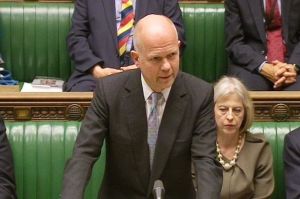
William Hague - Parliament

Top Image: The Spectator

Agree with this article? Violently disagree? Scroll down to leave a comment.

Follow Semi-Partisan Politics on TwitterFacebook and Medium.

The Age Of Trump: As The Republican Party Goes To Its Armageddon

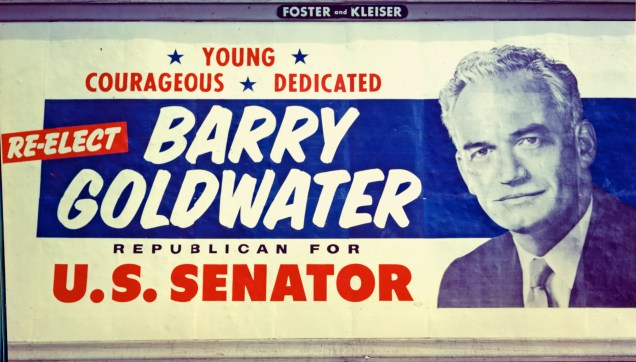
Barry Goldwater - Election Poster

To understand why the Republican Party are on course to lose their third consecutive presidential election, one must look much further back in time than the rise of Donald Trump

It gives no satisfaction to watch any storied political party hurl itself into oblivion – even the US Republican Party, which has frequently infuriated true conservatives with its sanctimonious and hypocritical habit of screeching about the dangers of encroaching socialism under Democratic administrations while themselves consistently cranking up the size and role of the state at every opportunity.

But while it now seems almost certain that the Republicans have thrown away any chance of reclaiming the White House, imploding in a foul-mouthed torrent of bluster and recrimination more worthy of Jerry Springer than a presidential primary campaign, it is worth looking back and asking how the GOP finds itself in this position, and exactly when the seeds of destruction were sown.

I have been reading widely on this, focusing less on the crowing and virtue-signalling Left, and far more on those thoughtful and introspective voices on the Right who are often appalled by the rise of Donald Trump in particular, but often sympathetic to the anti-establishment fervour which fuels his candidacy.

And if I have to pick just one excerpt from one piece to explain the predicament in which the Republican Party currently finds itself, I would encourage my readers to read “I was wrong about Donald Trump” by Daniel McCarthy over at The American Conservative.

In his piece, McCarthy concludes:

Trump succeeds because of more than outsize personality, of course. He attracts some support from everyone who thinks that Conservatism, Inc. and the GOP establishment are self-serving frauds—everyone who feels betrayed by the party and its ideological publicists. Working-class whites know that the Republican Party isn’t their party. Christian conservatives who in the past have supported Mike Huckabee and Ben Carson also know that the GOP won’t deliver for them. Moderates have been steadily alienated from the GOP by movement conservatives, yet hard-right immigration opponents feel marginalized by the party as well. Paleoconservatives and antiwar conservatives have been excommunicated on more than one occasion by the same establishment that’s now losing control to Trump. They can only applaud what Trump’s doing, even if Trump himself is no Pat Buchanan or Ron Paul.

Conservative Republicans™ somehow maneuvered themselves into a position of being too hardline for moderates and non-ideologues, but not hardline or ideological enough for the right. Trump, on the other hand, appeals both to the hard right and to voters whose economic interests would, in decades past, have classed them as moderates of the center-left—lunch-pail voters.

What’s even more remarkable is that movement conservatives, who have been given plenty of warning, ever since 2006, that their formula is exhausted, keep doing the same thing over and over again: they’ll dodge right, in a way that right-wingers find unsatisfactory but that moderates find appalling; then they’ll weave back to the center, in a way that doesn’t fool centrists and only angers the right. Immigration—which was another of George W. Bush’s stumbling blocks, lest we forget—has been the issue that symbolized movement-conservative Republicanism’s futility most poignantly. It’s not even clear that most GOP voters agree with Trump’s rhetorical hard-line on immigration—they just like it better than the two-faced talk of the average Republican politician.

Trump has a plethora of weaknesses, as general election polls amply demonstrate. But just look what he’s up against within the Republican Party: that’s why he’s winning.

I have yet to see the rise of Donald Trump explained as thoughtfully and succinctly as it is in the first three paragraphs quoted above. Sure, McCarthy’s piece does not tackle every aspect of the situation – whole books can and will be written about the causal factors of this huge anti-establishment backlash, which is far bigger than any one political party – but it does explain why the current GOP was so badly positioned to withstand a populist insurgency like Trump’s.

Much like the British Labour Party has become a fractious and increasingly unworkable coalition of idealistic left-wingers, pragmatic centrists and (let’s be frank) soulless political shapeshifters, and much as the historic splits in the Conservative Party are re-emerging following a vacillating 2016 Budget and the party leadership’s betrayal of the activist base on the coming EU referendum, so the Republican Party’s big tent of Reaganites, neo-cons, Evangelicals and social conservatives is collapsing – for those reasons outlined above by McCarthy.

Read the collected output of Rod Dreher too, and this piece by David Brooks, which looks to the future which could yet follow 2016’s rock bottom:

Trump is prompting what Thomas Kuhn, in his theory of scientific revolutions, called a model crisis.

According to Kuhn, intellectual progress is not steady and gradual. It’s marked by sudden paradigm shifts. There’s a period of normal science when everybody embraces a paradigm that seems to be working. Then there’s a period of model drift: As years go by, anomalies accumulate and the model begins to seem creaky and flawed.

Then there’s a model crisis, when the whole thing collapses. Attempts to patch up the model fail. Everybody is in anguish, but nobody knows what to do.

That’s where the Republican Party is right now. Everybody talks about being so depressed about Trump. But Republicans are passive and psychologically defeated. That’s because their conscious and unconscious mental frameworks have just stopped working. Trump has a monopoly on audacity, while everyone else is immobile.

[..] At that point the G.O.P. will enter what Kuhn called the revolution phase. During these moments you get a proliferation of competing approaches, a willingness to try anything. People ask different questions, speak a different language, congregate around a new paradigm that is incommensurate with the last.

That’s where the G.O.P. is heading. So this is a moment of anticipation. The great question is not, Should I vote for Hillary or sit out this campaign? The great question is, How do I prepare now for the post-Trump era?

As Brooks says (perhaps a little naively), this is not necessarily all bad news for conservatives. If we are honest, we have to admit that conservative policies in America and Britain are no longer perfectly calibrated to the challenges of the day as they were in Thatcher and Reagan’s time.

That is not to say that the Left are any better; Lord knows they aren’t. But it does mean we should acknowledge certain facts – like the fact that we still have a stubbornly large permanent underclass, and that for all the irreplaceable benefits of globalisation, there are still those who miss out – and seize the initiative by proposing radical conservative policy solutions to the great challenges of the new century.

In Britain, David Cameron’s Coke Zero Conservative government – or the Ted Heath tribute act, as this blog has taken to calling them – seem to think that One Nation Conservatism means stealing as many of Labour’s left-wing ideas as possible. And in America, Donald Trump’s brand of populist pseudo-conservatism doesn’t believe in One Nation at all, unapologetically carving the country up into winners and losers.

Neither is the correct approach. And as Cameronism and Trumpism run their respective courses, this blog will continue providing commentary and offering suggestions for an alternative conservatism, in Britain and America.


Postscript: This blog has decreased its focus on US politics in the past few years, primarily because I have been London based and fully occupied writing about British political issues. But Semi-Partisan Politics will begin to cover the American presidential election with a little more frequency going forward, partly because I have always remained a close follower of American politics – often more so than the household name journalists dispatched to the States by their newspapers and now portentously reporting back to us as self styled “experts”.

Having lived in America helps – particularly having lived in the American Midwest, not just the coastal enclaves of New York and Washington, D.C. familiar to most British journalists who write about America during election season. And the fact that I am married to a Hillary Clinton-supporting Hispanic Texan helps too. When I write about American politics, I know whereof I speak.

But I am also covering the presidential race because as a conservatarian with one foot firmly planted on either side of the Atlantic (and a heart divided equally between Britain and America), I believe that in my own small way I can bring a perspective to the left/right, authoritarian/libertarian debate that is often missed by those whose thinking and writing is rooted firmly in just one country’s specific conservative tradition.

To borrow an overwrought phrase from the dystopian world of Identity Politics, consider this my contribution to an “intersectional” perspective on conservatism.

They’ll absolutely hate me for that.


Donald Trump Hat - Make America Great Again

Agree with this article? Violently disagree? Scroll down to leave a comment.

Follow Semi-Partisan Politics on TwitterFacebook and Medium.

Preventing People From Attending Donald Trump Rallies Is Undemocratic

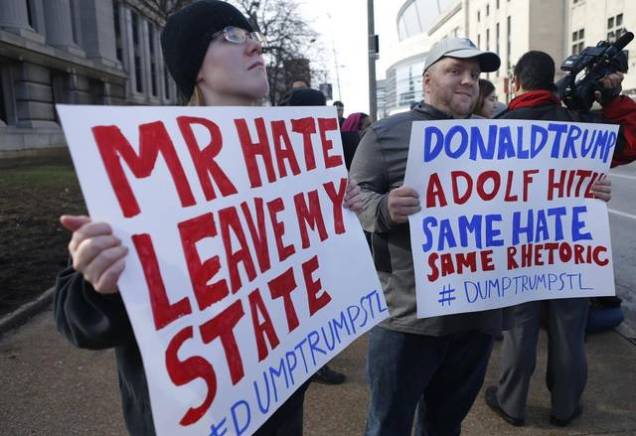
Donald Trump Protesters - St Louis

Shutting down political rallies with the threat of violence and blocking public access to hear a political candidate speak is not behaviour worthy of any citizen of a democracy

People have every right to feel alarmed or even scared about the presidential candidacy of Donald Trump. This blog believes that a Trump presidency, were he to secure the Republican nomination and win the general election, would be jarringly populist at best and economically ruinous at worst, though I dismiss any alarmist talk that Trump is in any way equivalent to the Nazis or other genocidal fascists.

Such hyperbole from anti-Trump activists is thoroughly unhelpful at a time when tempers are already flaring on both sides. After all, if you are a supporter of Donald Trump then having an angry college student yell in your face that you are supporting the new incarnation of Hitler will likely make you quite unreceptive to engaging in further debate and potentially being persuaded to change your views.

But the invective (on both sides) and hand-writing hysteria (primarily from the anti-Trump crowd) are nothing compared to the more blatantly anti-democratic methods by which some liberals are now attempting to shut down Donald Trump’s message rather than take it on in the battle of ideas.

The Huffington Post reports that some demonstrators are now attempting to block public access to Donald Trump rallies to prevent his supporters from hearing him speak, under the banner “Shut Down Trump”:

Protesters on Saturday blocked the roads leading to a Donald Trump rally in Fountain Hills, Arizona.

[..] An ABC 15 anchor reported at least three people had been arrested in connection with the protests. Deputy Joaquin Enriquez, a spokesman for the Maricopa County sheriff’s office, told ABC 15 the arrests were for blocking the road, not protesting.

The roadblock didn’t stop some determined people from getting out of their cars and walking to Trump’s rally.

Tomas Robles, executive director of Living United for Change in Arizona, a workers’ rights organization, told HuffPost that law enforcement was cooperative and treated protesters fairly. He said some Trump supporters “did try to get get aggressive,” but they were not violent.

“It was a peaceful protest, we got our point across, and we showed the nation and our state that just because Arizona at a time has been seen as anti-immigrant and somewhat racist, this is not that state anymore,” he said. “We’re not going to allow people like Trump to spew that rhetoric.”

Note the authoritarian tinge to the words of Tomas Robles, one of the protesters quoted by Huffington Post. Because he and his organisation disagree with Donald Trump, they are “not going to allow” him to air his views in public – at a political rally of all places, that most sacrosanct of venues in terms of the necessity for free speech.

While the rally in question went ahead, the demonstration prevented many Trump supporters from attending and forced others to abandon their cars and walk the rest of the way to the venue:


Hilariously, the Huffington Post – clearly sensing that running a story about liberal activists interfering with a political rally might not sound terribly progressive – felt the need to add the following editor’s note to the end of the article:

Editor‘s note: Donald Trump regularly incites political violence and is a serial liar, rampant xenophobe, racist, misogynist and birther who has repeatedly pledged to ban all Muslims — 1.6 billion members of an entire religion — from entering the U.S.

The obvious implication of this note is that it is perfectly appropriate and justified to stifle and attempt to shut down some forms of speech, and that we shouldn’t think badly of the protesters because they are waging war against a bad person who thinks the wrong things as opposed to a good person, “one of us”, who holds the correct beliefs and whose speech should be protected.

Or in other words: “Don’t worry, Trump and his supporters had it coming. They are bad people”.

The furious liberals outraged at the rise of Donald Trump need to realise that their usual tactic of shouting, screaming and now blockading things that they dislike is actually feeding – not killing – the beast. Maybe they do realise, but simply don’t care. Maybe the opportunity to signal their own moral virtue by ostentatiously raging against Trump is all that they care about.

But until Trump’s most ardent enemies on the Left learn to use their words rather than their fists they will only succeed in undermining free speech and American democracy, making Trump stronger all the while.


Donald Trump Rally

Agree with this article? Violently disagree? Scroll down to leave a comment.

Follow Semi-Partisan Politics on TwitterFacebook and Medium.