In A Democratic Battle Between Westminster And The EU Parliament, There Is No Contest

EU Parliament - European Union - Democratic Deficit

Democracy does not start and end with proportional representation, and claims that the EU Parliament has more democratic legitimacy than the UK Parliament in Westminster are absurd

Continuing his argument against Brexit, Paddy Briggs makes a point on his “Letter from London” blog that I have seen recur several times among pro-EU advocates – namely, that it is the British parliament which lacks democratic legitimacy, and that the EU parliament (by virtue of being elected using a more proportional system) is actually the better and more legitimate of the two.

Briggs writes:

The European Union is not as democratic as it might be but it is still more democratic than the national parliaments of some of its members – including that of Britain. We choose who will represent us in Strasbourg and Brussels (the MEPs) via a fair voting system under which every vote counts. In Britain we have an unfair voting system and even a whole Upper House that is not elected at all!

It shouldn’t be necessary to refute this particular line of argument, but I’ll do so for the record, since a clear effort is underway to turn one of the key weaknesses in the europhile armoury into an unlikely – and misleading – strength.

Democracy is not just a matter of how proportional your electoral system is. You could have the most proportional system in the world, with MEPs allocated precisely according to vote share across the European Union, and you would still be light years away from democracy. Because democracy means so much more than just allocating seats in a legislature according to the vote share of the pitifully small percentage of people who bother to take part in European elections.

And what Paddy Briggs neglects to mention is the fact that the EU has a fundamental flaw far worse than the UK Parliament lacking proportional representation. The EU parliament lacks the first half of the word “democracy ” itself – it lacks a demos.

The unavoidable truth which the EU federalists and Briggs seem desperate not to acknowledge is that most EU citizens simply do not feel European first and foremost. Therefore, any attempt at supranational governance which forms a pyramid with the EU at the top, national legislatures beneath and regional and local assemblies below that is doomed to fail, because hardly anyone recognises the legitimacy of the top layer. Subsidiarity is all very well – Briggs talks it up in his piece, and makes valid criticisms of over-centralised British government – but it is irrelevant if there was never any requirement or demand for the Brussels top layer in the first place.

You can have the best parliament in the world, but if people do not feel a part of the organisation or state which it supposedly serves then it will inevitably become nothing more than an ineffectual talking shop for the failed elites and third-tier politicians who couldn’t make it in the premier league back home. Sound familiar?

Worse still, as the unwanted process of EU integration continues, we will likely see the remaining “moderate” parties squeezed out of the EU parliament entirely, and replaced by parties which – unlike UKIP – may actually be genuinely extremist in outlook, and fully deserving of Briggs’ scorn. At that point, it will be unthinkable to include the EU parliament in the European Union’s central decision-making, and the only part of the whole machine with any claim to democratic legitimacy will be cut out of the loop entirely to prevent Golden Dawn from determining social policy for the whole of Europe.

Paddy Briggs feels like a European citizen – one of my fellow Brexiteer bloggers might well describe him as a proto-EU national just waiting for the state to hatch. And that’s fine. But Briggs is in the tiny minority, and he should have the honesty to admit as much, and recognise that his “European first” identity is not shared by most people in Britain.

One might also mention that an institution can hardly be said to be “democratic” when it is unable to propose new legislation of its own, and is in effect merely a rubber stamp for initiatives cooked up by the European Commission or accountability-dodging national heads of government – again, nothing to do with the different electoral systems in Westminster and Brussels/Strasbourg. If somebody brings me home a surprise dinner from a restaurant of their choice, picked without my knowledge or input, and I only have the choice between eating that meal or going hungry, it can hardly be said that I have freedom of choice over my diet. The same goes for the EU parliament and the legislation which oozes through it.

Briggs goes on to say:

We now have a bizarre situation where the British Government, the leadership of all our respectable political parties, virtually every one of our national institutions, the majority of our Members of Parliament, virtually every major Business (and more) acknowledge the necessity not just of remaining in the EU but in improving the effectiveness of our participation.

But you could (and should) also interpret this statement as evidence that every group with entrenched establishment power – government elites, cultural elites, corporations – is in favour of maintaining the status quo, while euroscepticism is rife among individual private citizens. Which is, of course, actually the case.

There is indeed a divide on the question of Britain’s place in the EU, but the fault line does not lie between sober-minded rational people on one side and frothing-at-the-mouth eurosceptics on the other. The line is drawn between people who currently benefit from the status quo or might potentially lose money in the event of change on one hand, and the little guy – people whose very government is being ripped away from them against their will – on the other.

It is rather disingenuous to suggest that “every one of our national institutions” is in favour of remaining in the EU as though they independently arrived at this decision through clear-headed analysis, while deliberately ignoring the fact that many of these same institutions – from the BBC to universities – also happen to receive large cash grants from Brussels (or rather, from the UK taxpayer via the Brussels pork machine).

Ultimately, the EU referendum comes down to a question of sovereignty. The S-word. Forget the trumped up trade figures on both sides, which are unverifiable and can be fought to a draw. And forget the scaremongering, too. If you truly believe that most people in the UK feel European before they feel British (and I’d love to know who you are hanging out with, if so) then by all means vote “Remain”. You may as well, since the European institutions would indeed then have more legitimacy than the UK institutions – though I would love to see you now explain the low voter turnout in EU elections.

But if you believe – correctly – that the majority of UK citizens feel British more than they feel European, then you have a responsibility to vote for Brexit, because to do otherwise would doom us to remain part of an explicitly political union whose governance is undemocratic by simple virtue of nobody believing in the EU as a legitimate, organic construct. To do anything other than vote for Brexit would be to condemn your fellow citizens to a future where our highest level of governance is at a level we do not recognise or feel a part of. And that would be truly anti-democratic.

I agree with many of Paddy’s criticisms of the current UK constitutional settlement, particularly with regard to the legislature and our unelected upper house. But it is a stretch too far to claim that the EU parliament is somehow more democratic than our own, when hardly anybody can be motivated to take part in EU elections, and even those who do would struggle to tell you the name of their MEP – certainly not the case for the Westminster parliament.

The British political system has many flaws (which is why I am attracted to the Harrogate Agenda as a sensible series of steps to improve our governance) in need of urgent remedy, but to claim that it is in any way worse than that toothless talking shop of an EU parliament is quite simply divorced from reality, cherry-picking facts in support of a tottering narrative.

I hope that on reflection Paddy Briggs will recognise some of the shortcomings in his argument, and retract his assertion that the EU parliament has greater democratic legitimacy than that of the UK parliament. I don’t for a moment begrudge Briggs his sincerely held pro-EU position, but neither will I stand by while europhiles attempt to unfairly denigrate the United Kingdom in an attempt to make their rusting, 1950s anachronism of a European superstate seem more appealing by contrast.

The EU federalist dream must stand and fight on its own merits in this referendum – and its advocates should not pursue a dishonourable victory by attempting to undermine the good standing of the United Kingdom for rhetorical gain.

European Parliament

Agree with this article? Violently disagree? Scroll down to leave a comment.

Follow Semi-Partisan Politics on TwitterFacebook and Medium.

We Know More About Antonin Scalia And The US Supreme Court Than Our Own Legal System

Supreme Court - Gay Marriage - 3

If you have ever read a John Grisham novel or watched Law & Order, you probably know more about the American legal system than the average British citizen knows about our own

When the firebrand US Supreme Court associate justice Antonin Scalia died last weekend, the news made headlines around the world, and the story was covered extensively on the television and print media here in the UK.

Legal experts and part-time America watchers (like me) all came crawling out of the woodwork to offer their analysis of what impact the Supreme Court vacancy will have on the remainder (and legacy) of President Obama’s second term, the likelihood of any Obama nominee being successfully confirmed by the Senate, and the impact of a rebalanced court on American social policy.

All of this earnest discussion and analysis, over a vacancy on a court which sits thousand of miles away, and has absolutely no jurisdiction over anyone in Britain! And yet people were interested – partly because many of us likely have a greater understanding of the American legal system and its personalities than our own.

Today, conservative American publication The National Review bemoaned the fact that a third of Americans don’t know who Justice Scalia was, according to the latest opinion polling. They seize on this fact to (rightly) condemn the disengagement of those who fail to educate themselves on important civic matters:

Strangely, the percentage of people who said they had “never heard of” Antonin Scalia increased from 29 percent in 2001 to 39 percent in 2005. Was that the Greatest Generation, who read newspapers, dying off and the Millennials, who never look up from their cell phones, entering the polling sample?

This is a free country, and you’re free to not care, and free to not pay any attention to, say, one-third and arguably our most powerful branch of government. I understand the sense that it would be a better world if we could spend more time thinking less about what government is doing about more pleasant things — food, sports, movies, home furnishings, how awesome the finale of Gravity Falls was, etc.

But if you choose to pay no attention to these things, and refuse to read anything about them, watch anything about them, or learn anything about them . . . then I’d rather you left the voting to those of us who do care.

The National Review would be shocked, then, to learn just how few citizens of America’s closest ally understand the basic tenets of their own legal system. Because although I don’t have an opinion poll to back me up, I would be surprised if one third of British citizens knew that we even had a Supreme Court, let alone the names of a single one of its justices.

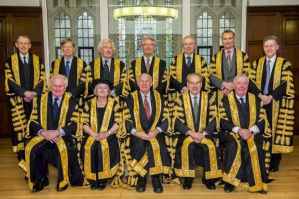
(The PC Left and rabid practitioners of Identity Politics are also missing a trick – eleven of the twelve current justices of the UK Supreme Court are old white men, with the remaining justice an old white woman. Are these people really the most qualified for the job, or did they get their positions through the chumocracy and establishment connections? Why is there no public confirmation process, to give democratic oversight to the selection of new justices? And yet how many times has the UK Supreme Court been picketed by angry Social Justice Warriors demanding ethnic balance on the court?)

I will be honest and start by admitting that before writing this piece, I could only name one justice of the UK Supreme Court – Lord Neuberger, the court’s president. And that’s awful. I write about politics and UK current affairs every day and consume several hours of news on television, the internet and social media besides, but I could only name one person on the bench of the UK Supreme Court. And if I can’t rattle off a handful of names together with a brief commentary on their respective legal and ideological outlooks, how many people are actually able to do so?

How many laymen – people without a direct professional or personal interest in the workings or judgements of the court – actually do know who sits on our own version of the Supreme Court? How many could explain at a high level how the legal system works, with the division between civil and criminal court, the work done by solicitors and barristers, and the hierarchy of trial and appellate courts? Or the difference between the Scottish system and that of England and Wales? All that I currently know, I learned from an Introduction to Business Law course while studying at university – there were no civics lessons in the 1990s National Curriculum. And most others will not have even received this basic primer.

But how are we to fulfil our potential as informed and engaged citizens when we fail to understand how one of the three major branches of government works? Most people have a passable grasp of the executive and the legislature, even if they don’t recognise the Government and the Houses of Parliament using those terms. But I very much doubt that one adult in fifty could explain the fundamentals of our legal system, let alone the many layered intricacies.

UK Legal System - Judges Procession

But flip it around. Why would we know how our legal system works, or recognise the major personalities in the British legal scene? And why should we bother to take the time to educate ourselves?

People in America know the names and ideological leanings of the justices on their Supreme Court for a number of reasons. For a start, they take their civics a little bit more seriously on that side of the Atlantic – something that we could learn from.

But more than that, the American legal system is far more responsive to the citizenry than the British system is to us. One major difference is that many local judges are elected. Now, this may or may not be a good idea – and having watched a number of local races for positions on the bench, I have my grave doubts as to the wisdom of elected judges. But you can’t deny that you are likely to feel much closer to the legal system if you have a direct say in who gets to don the black robes.

Even more important is the fact that unlike we Brits, Americans have a written constitution to act as a common frame of reference when talking about legal matters. Even half-educated Americans will talk about whether something is “constitutional” or not, and apply this test to all manner of public policy debates, from government surveillance to gay marriage. This is important, because it gets people thinking beyond the mere fact of whether they agree or disagree with a particular law, and toward the broader question of exactly why the law in question is good or bad. That’s not to say the ensuing debate cannot still be ignorant and intemperate – it often is – but at least everyone is able to take part in the debate along the same parameters.

Consider the Edward Snowden leaks, when one whistleblower’s actions laid bare the extent of secret government surveillance in Britain, America and the other “Five Eyes” countries. In America, the people – outraged at this secret, systemic violation of their privacy – were able to haul officials in front of congressional committees and debate the legality of the government’s actions with reference to the Fourth Amendment, which prohibits unreasonable searches and seizures. And in due course, the American government had to make a number of concessions and restrict its surveillance activity. In Britain, by contrast, we had David Cameron pompously telling us that he respects the “tradition of liberty” but is basically going to do whatever he wants. And what recourse have we to stop him? None.

Then there is the central role which the US Supreme Court often plays in matters of great social importance in America. In Britain, Parliament’s “elected dictatorship” is the Alpha and the Omega for nearly all significant decisions made in this country – the government can pass or repeal any law almost at will and with no reference to any higher text or law, so long as it can muster the votes in the House of Commons. The courts then simply apply what has been handed down by Parliament, which is sovereign. Refreshingly, this is not so in the United States.

Consider just some of the most famous cases – household names, even to those of us living in Britain. Dred ScottCitizens United. Roe vs Wade. Brown vs Board of Education. We may know next to nothing about American current affairs, but we know that these relate to slavery, campaign finance, abortion and racial segregation. Because in America, the president is not the only person who matters. Nor are the leaders of Congress. The third branch of government matters equally, and how the Supreme Court chooses which cases to hear and applies their interpretation of the Constitution to those cases constitutes a vital check and balance in the American system.

Can you name a comparably important British case? They do exist – the Al Rawi case, for example, with its implications for the legality of secret hearings, or Nicklinson vs Ministry of Justice, which confirmed the current illegality of voluntary euthanasia, or the “right to die”. But few people know about these cases or why they are important, because the British legal system is so much more remote and unaccountable to the people.

St Louis Old Courthouse - Dred Scott Case - 2

Finally, there is the question of sovereignty. The United States Supreme Court is the final arbiter of what is and is not constitutional, and therefore applicable to American citizens. It cannot be shunted aside by an impatient government if it holds up or overturns key legislation, and nor can it be undermined from the outside – the court determines for itself which cases it will hear, and a majority decision made by five out of nine Supreme Court justices will then bind the government and lower courts. This goes against everything that the current British establishment – who are only too happy to wreck every institution and overturn any tradition in pursuit of their short term goals – stand for.

But crucially, the US Supreme Court is also not subordinate to any external or foreign body. By contrast, the UK Supreme Court is treaty-bound to defer to the decisions of the Court of Justice of the European Union (CJEU), and must interpret all UK legislation not through the lens of compatibility with a British constitution, but rather to ensure its compliance with the European Convention of Human Rights. That might sound all well and good until one realises just how broadly “human rights” have come to be defined.

And one must also ask why we as a country do not trust ourselves enough to be the final arbiter of important cases. Are we naturally more barbarous than our European neighbours, and in need of constant judicial restraint by our moral betters on the continent? Whatever the answer, the inescapable truth is that legal subjugation to an external, supranational body is the antithesis of national democracy.

So to recap, there exist a number of deficits between the American and UK legal systems in terms of ensuring citizen understanding and engagement with the judicial branch of government, namely:

1. A weaker sense of civic duty and engagement in Britain

2. Greater democratic distance between the people and the legal system in Britain, compared to America

3. Lack of a written British constitution as a common frame of reference when discussing legal matters

4. A much clearer link between decisions made in the US Supreme Court with American social policy

5. Lack of sovereignty: the American legal system is sovereign and subordinate to no external body, unlike the British legal system which is subordinate to EU law

US Supreme Court

There is no good argument for continuing to abide such a remote, elitist and unaccountable legal system as we suffer in Britain. None. And anybody tempted to sniff haughtily at the American system, with their elected lower court judges and Scopes Monkey Trial culture wars should remember that however passionate and unseemly the public discourse can sometimes be across the Atlantic, this is only because more American people are actually engaged citizens with a moderate grasp of how their country actually works. We should be so lucky to have a system as simple, accessible and easy to explain as they have in the United States.

And it should be a source of great shame to us that our journalists, politicians and private citizens often know more about another country’s legal system through watching Hollywood movies or Law & Order than they do about our own.

The American public is rightly fixated on the issue of who President Obama will nominate to fill the Supreme Court seat left vacant by the late Antonin Scalia – incidentally a first rate mind and writer of opinions and dissents which are accessible and entertaining even to laymen like myself. They care about who takes up the ninth seat on their Supreme Court, because unlike Britain, their legal system is more than a rubber stamp for the government of the day.

The ninth justice of the US Supreme Court may well end up casting crucial swing votes in important matters of human governance in the next decades, such as the right to bear arms in self defence, the right to privacy and the right to free speech. And these decisions could well have tangible, real-world consequences for the 330 million people who live under the court’s jurisdiction, as well as anybody else to whom the Constitution applies – like your First Amendment right to free speech when you go to holiday or work in America as a British citizen.

Elevating the people and the institutions into the public consciousness is not crass sensationalism, as some may charge. On the contrary, focusing on the personalities helps to elevate the issues to a place of prominence in our public discourse, which is exactly what we should be doing here if our own elites were not so busy trying to hide from public accountability anywhere they can scurry – be it behind the black veil of EU lawmaking in Brussels or the bewigged, dusty obscurity of the British legal system.

It would be ironic if it took the death of a supreme court judge in another country to force Britain to finally take a proper, critical look at our own impenetrable legal system. But public interest in legal matters peaks only very rarely, and so those of us who want to see real legal and constitutional reform have a slim opportunity – but also an obligation – to make our case.

For as things stand, a constitution and legal system in force over 3,000 miles and an ocean apart often feels more familiar – and less remote – than our own.


Supreme Court Justices - United States

Supreme Court Justices - United Kingdom

Agree with this article? Violently disagree? Scroll down to leave a comment.

Follow Semi-Partisan Politics on TwitterFacebook and Medium.

Lost In The Media’s EU Referendum Coverage: Any Mention Of Democracy

EU Referendum - Brexit - Democracy

The media’s fixation with personality politics and the petty ups and downs of individual political careers distracts us from the only thing that matters when it comes to the EU referendum – the future of our democracy

The Times’ Red Box briefing email today leads with more sneering commentary about the supposed shortcomings of the broader anti-EU, pro-democracy Leave campaign:

Maybe it’s a stunt to show how difficult it is to work together for the greater good, thus undermining a key argument for staying in the European Union.

Or maybe the campaigns to leave the EU are a total bloody shambles.

While Remain was pumping out letters to ten million homes yesterday, the Outers were out to get each other. Again.

The briefing continues:

The infighting is also causing another problem: who would want to join this rabble?

Lord Lawson, the former chancellor, has suggested that a senior cabinet minister will eventually lead the Out campaign, though refused at the weekend to say who that might be.

There are suggestions that Chris Grayling and Theresa Villiers are not high profile enough, and the likes of Michael Gove will fall in line and support the PM.

Which leaves Iain Duncan Smith, a former Tory leader who remains popular in some parts of the party and has long argued against staying in the EU.

Yet he too has history with Cummings, who was his director of strategy during his ill-fated leadership before quitting and later declaring: ” Mr Duncan Smith is incompetent, would be a worse prime minister than Tony Blair, and must be replaced.”

Because of course that is the most important question in this whole debate – whose reputation and political prospects will be most enhanced or damaged by the stance they take on the future of British political governance.

What ambitious, self-respecting politician would want to associate their glittering career with the grubby and laughable concepts of national sovereignty and democracy? Which of the petty, superficial personalities who pass for statesmen today will win a coveted promotion, and which will find their career progression halted because they pick the wrong horse in this race? The sheer superficiality of the media’s EU referendum debate coverage absolutely beggars belief.

Is there currently a lot of unseemly (to outward appearances) infighting among the eurosceptic, pro-Brexit crowd? Yes. But a lot of this is necessary fighting. Though our first instinct may be to separate the squabbling factions with cries of “can’t we all just get along?”, in actual fact this fighting serves an important purpose.

Many people and organisations who purportedly oppose the European Union are actually either ambivalent about leaving, or busy spewing out contradictory and uninformed messages which will ultimately harm the Leave campaign and provide the Remain side with plentiful campaign fodder. This harms the Brexit cause, and so must be confronted and dealt with if the Leave campaign is to win the referendum.

Vote Leave in particular is filled to the brim with people who don’t actually want Britain to leave the European Union, but simply want the government to use a “leave” vote as a bargaining chip to extract concessions from Brussels. Meanwhile, UKIP and others are often guilty of promoting an overly simplistic view of Brexit, conjuring a fantasyland where Britain quits the EU on Day 1, bans all immigration on Day 2, and holds a big Bonfire of the Regulations on Day 3.

None of these things are possible, nor even desirable. And pretending that they are achievable reflects badly on the entire Brexit movement. And so while it may appear unseemly to outsiders and the half-interested media, it is essential that eurosceptics have these essential debates now, while relatively few people are watching, so that we go into the campaign with the message that carries the greatest chance of success.

As Ben Kelly points out over at The Sceptic Isle:

[..] it is impossible for everyone to agree and therefore impossible to have one unifiedLeave campaign. The Remain campaign is entirely based on disseminating fear, uncertainty and doubt amongst the populace and propagating myths about Brexit. Thus, as a movement Remain is easy to unify; Europhiles are unified in their duplicity, unjust smugness, their lack of faith in democracy and their inability to stop clinging to an archaic ideology and an ideal that is redundant and bad for Britain.

The debate over leaving the EU is more nuanced and therefore necessarily divided; this makes the europhiles positively gleeful because they see it as an advantage. It isn’t. Those of us who want to leave the EU are now involved in a great competition, a battle of ideas, over how exactly we achieve Brexit both in terms of convincing the public, winning the referendum, and the plan for what we should do with our independence.

Remember, this referendum is the europhiles’ to lose. They have the government on their side, nearly the entire political establishment, the European Union itself and the lion’s share of the funding. They also have the most powerful advantage of all – the incorrect perception, fuelled by the media, that this referendum is a contest between staying in the EU as it is now (the “safe” status quo), and taking some deathly plunge into the unknown. Both of these axioms are utterly wrong, but they are widely believed and toxic to the Brexit cause.

Of course, in reality there is no status quo when it comes to the European Union. The EU is but a process, set in motion half a century ago, whose end destination is a single European state. And frankly, I am getting tired of pointing this out when the EU’s founding fathers and today’s euro-federalists have repeatedly said so in their own words.

At this point, it is for the pro-EU campaigners to explain why a humble organisation that supposedly only wants to promote free trade and co-operation requires a parliament, a judiciary, a flag and an anthem in order to accomplish these basic tasks. It is most certainly not for me to continually explain why the person pointing a gun in our face and demanding that we hand over our cash is in fact a mugger, and not a kind-hearted charity collector.

But it is hard to promote any kind of message about democracy, governance or anything else when all of the oxygen in the debate is sucked up and wasted on breathless speculation about whose careers will be helped or hindered by their eventual stance on the Brexit question.

I couldn’t care less whether Boris Johnson biding his time is a smart move in terms of his Tory leadership ambitions, or whether the likes of Theresa May and Sajid Javid are wise to lie low and obey David Cameron’s command for eurosceptics to keep quiet while his pro-EU ministers are given free reign to sing endless hymns of praise to Brussels. It doesn’t interest me. The only abundantly clear thing is the fact that none of the supposed Conservative eurosceptics truly care about safeguarding our democracy and sovereignty, because if they did they would be promoting Brexit for all they are worth rather than weighing up the options and deciding whether campaigning for Brexit might hurt their careers.

I know it is hard for the legacy media to remain focused on issues rather than personalities for any length of time, but given the gravity of this particular debate – and its profound, far-reaching consequences for how the British people will be governed in ten, twenty, thirty years’ time – it would be nice to see more than the usual token effort.

The current gossipy, high school style fixation with personality politics and the petty ups and downs of individual reputations and political careers is more toxic than all of the Remain campaign’s lies, distortions and evasions put together. For it distracts us from the only thing that matters in this referendum: democracy, and whether we surrender it out of fear, or stand and fight for it.

Britain - UK - European Union - Referendum - Brexit - Punishment Beating

Agree with this article? Violently disagree? Scroll down to leave a comment.

Follow Semi-Partisan Politics on TwitterFacebook and Medium.

Cameron’s Fear That EU Partners Will Reveal Truth About His “New Deal”

British People - EU Renegotiation - Referendum - Brexit

David Cameron is negotiating with the British people on behalf of the European Union, not the other way around

David Cameron’s entire “renegotiation” (in fact in has been no such thing, for there were never any demands made) has all been completely backwards, with the prime minister far more interested in huddling with fellow European ministers to work out what kind of a deal might be successfully snuck past the British people than conducting any kind of listening exercise with the British public to determine what key concerns and demands need to be taken to Brussels.

And we see yet more evidence of this in the Times’ Red Box briefing today, which reports on the understandable concern from the government that the meaningless superficiality of David Cameron’s “reform” will be inadvertently exposed by a fellow European leader or minister who makes the mistake of telling the truth:

British ministers are urging their European counterparts to talk up David Cameron’s renegotiation deal to persuade British voters that it is significant.

There are fears in the UK government that some foreign leaders, who have been irritated by Cameron’s demands, will be publicly dismissive of any deal agreed at next month’s European Council summit.

Senior British figures point to polling that shows that opinion on the EU is evenly split, but if voters think the prime minister has secured “major change” they will vote overwhelmingly to stay.

[..] The nightmare scenario is if a minister from Germany, France or Poland goes on the record to say Cameron’s changes are meaningless window dressing.

The piece goes on to quote polling which suggests that successfully presenting the output from the renegotiation as “major change” dramatically increases the probability of a “Remain” vote:

Asked to “imagine David Cameron has secured a small change in Britain’s relationship with the European Union, securing guarantees over some key issues that he said protected British interests, but without any major change in which policy areas the European Union has powers in”, 38 per cent wanted to leave and 37 would want to stay.

If Cameron “could not secure any change” and the referendum was held with the EU “as it is now”, 46 per cent would leave and only 32 per cent remain.

But if Cameron gets “major change” including “substantial changes to the rules Britain has to follow and British opt-outs from European Union rules in several different policy areas” the result is dramatically shifted

Some 50 per cent of people would then vote to remain, with only 23 per cent determined to leave.

None of this is in any way surprising, and as such it is not really “news” at all. Anybody with their head properly screwed on knows that the government is not conducting a serious renegotiation with the EU in good faith with their mandate from the British people, and that everything we are now witnessing is part of a co-ordinated public perceptions and expectations management effort from a prime minister and a government who made their minds up long ago.

But while this is hardly breaking news, it is still worth taking the time to pause, step back from the daily commotion of the Brexit debate, and marvel at the bigger picture.

The first duties of any elected government – of any prime minister – are to advance the national interest of the United Kingdom, and to fulfil the mandate on which they were elected in the first place. Feeling the pressure from UKIP midway through the last parliament, David Cameron chose to offer a referendum on Britain’s continued membership of the EU – against his better judgement, his personal pro-Europeanism and his (wrong but sincerely held) belief that Brexit would be against our national interest.

But since having been returned to power in May, the prime minister has not acted in good faith based on that mandate. In fact, he has been deliberately deceptive and manipulative, seeking to create and propagate the illusion that he is pounding tables in Brussels and fighting for our priorities in Europe, when he never even bothered to check what those priorities are, let alone insist on any specific concessions.

David Cameron and his loyalist cheerleaders prance around as though they have bravely confronted the EU with a specific list of demands designed to win back sovereignty and secure it forever, when all they did was write a wheedling, begging letter to Donald Tusk hesitantly suggesting a few topics of discussion – half of which were slapped down the same day.

This is how you end up with the risible scenario of George Osborne appearing on Newsnight yesterday to give an update on “renegotiations” which are not taking place, and declaring himself a eurosceptic despite the fact that he is currently engaged in nothing more than a joint marketing effort with our EU partners to hoodwink British voters into thinking that we have won some meaningful concessions:

If David Cameron, George Osborne and the more vacuous half of the Conservative Party can all describe themselves as “eurosceptic” and do so with a straight face, then we are all eurosceptics now. Everyone, from Martin Schulz, Jean-Claude Juncker, Kenneth Clarke and the entire sorry cast of Britain Stronger in Europe would qualify as a eurosceptic by this metric, because everybody concedes that the EU needs reform of one kind or another (even if that reform involves “more Europe”).

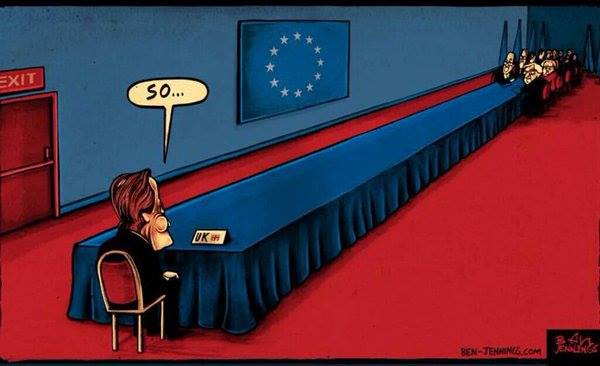
In fact, it is not an exaggeration to say that when it comes to this non-renegotiation, the British public are effectively sitting at one end of the long conference table while the British government schemes and confers with the rest of the European Union at the other end.

I know it is hopelessly idealistic of me, but I expect more from my elected government. And it is getting tremendously tiring waking up every day wondering what new schemes,devices and cunning plans the prime minister of this country intends on using to hoodwink and misdirect the people he supposedly serves into believing that he is in any way working on their behalf.

A greater man than David Cameron – if his devotion to the EU and fear of Brexit were similarly genuine – might have stood up and declared that because he believes EU membership to be strongly in our national interest, he couldn’t in good conscience put it to a popular vote or negotiate in an unbiased way on behalf of the United Kingdom. Yes, such a stance would have further fuelled the rise of UKIP, but at least I could respect the intellectual honesty and consistency.

But David Cameron did not do this. Rather than behaving with honour or principle, Cameron swanned around, pretending to share the public’s concerns about the European Union, and then – as soon as his re-election was secure and the UKIP threat neutralised – zipped across to Brussels to begin plotting with fellow EU heads of government and state as to how Britain’s pesky electorate could best be mollified, placated and distracted while the Brussels juggernaut rolls on unopposed.

And they wonder why there is a strong public perception of a self-serving European political elite who doggedly pursue their own interests in direct opposition to the will and interests of their national electorates!

There is only so much that one can take of duplicitous politicians who pretend to be eurosceptic and favour Brexit when stumping for votes or positive headlines, but whose every action contradicts this stance once in power. And I may have finally reached my limit.

If the EU’s form of parochial pseudo-internationalism really does represent the best future of human governance – and it really, really, really doesn’t – then politicians should come out and say so. They should own their love and admiration of the EU and their lack of faith in Britain, instead of hiding from these things and pretending to be eurosceptics.

I respect any politician of any stripe who has the courage of their convictions – who is able to articulate a sincerely held viewpoint without first running it by a focus group, and whose commitment to their causes runs deeper than exploiting them for electoral gain. That’s why I maintain a degree of respect for Jeremy Corbyn, despite sharing none of his socialist beliefs.

Jeremy Corbyn’s sincere-but-loopy socialism I can respect. The unabashed European federalists in Brussels I can respect, too. Though hardly any of them are democratically elected officials, at least they have the courage to hail their creation for what it is – an embryonic state in gestation.

But David Cameron and George Osborne – europhiles in stolen eurosceptic clothing, actively engaged in perpetrating a moral fraud on the British public – people like that I cannot respect, do not respect and will never respect.

Brexit - Flexcit - European Union

Top image: cartoon by Ben Jennings

Agree with this article? Violently disagree? Scroll down to leave a comment.

Follow Semi-Partisan Politics on TwitterFacebook and Medium.

Forget Migrant Benefits In The EU Debate; What About The S-Word?

Alan Johnson - Labour In for Britain

The EU debate is about so much more than relatively petty questions about migrant benefits and immigration. But few from the official “Leave” campaigns are willing to broaden the debate

It is rare for this blog to find itself in agreement with Labour grandee Alan Johnson, chairman of the “Labour In For Britain” campaign group.

But Johnson is absolutely correct in his criticism – expressed on the Andrew Marr show today – that the EU debate has been narrowed down to an insultingly simplistic degree.

LabourList reports:

Johnson, who is leading Labour’s campaign to stay in the EU, appeared on The Andrew Marr show this morning to make the case for Britain to stay in the EU. He pointed out that issues like climate change can only be solved by countries working together, and that the EU was an essential “political union”.

He slammed the Prime Minister for narrowing the debate, saying there has been a lot of focus on Cameron’s attempt to ban migrants who are in work from receiving benefits until they have been employed in the UK for four years. Cameron is thought to have abandoned these plans in favour of imposing new limits on benefit payments to out-of-work migrants instead of those people in jobs. Johnson said this focus had distracted from other important issues.

Forget the orchestrated shenanigans over David Cameron’s supposed tussle with other EU leaders over migrant benefits – this is a ridiculous sideshow obsessed over by a credulous media, as my Conservatives for Liberty colleague and editor Ben Kelly wearily points out.

But Alan Johnson’s broader criticism is devastatingly accurate. From the outset, particularly on the “Leave” side, the Westminster campaign has been incredibly myopic and unimaginative.

We should expect no better from the prime minister – David Cameron is an avowed europhile, has stated numerous times that his preference is for Britain to remain a member of the EU, and has been unable to force the words “campaign for Brexit” from his lips even as a remote hypothetical. And thus it is no surprise that Cameron went in to the renegotiation with no set demands (contrary to the media narrative) but simply with a begging letter to Donald Tusk pointing out areas for discussion.

And those areas do nothing to assuage the concerns of the thinking eurosceptic or Brexiteer. Because the real problem with our continued membership of the European Union is not immigration, welfare, fiscal policy, social policy or the euro. The real problem is the little-mentioned S-word: sovereignty. Because this one word encapsulates all of the many ways in which the EU infringes upon our democracy.

It’s not about Schengen, or the single market – Britain is already outside the former and a full member of the latter. That’s why when David Cameron comes back brandishing something called “associate membership” we should be immediately suspicious, because it will essentially be a formalisation of the status quo, with all of the existing drawbacks of Britain’s EU membership hardwired into a future new treaty, with a few extra problems sprinkled on top as a garnish.

The fundamental issue of sovereignty will go unanswered, because David Cameron is not even raising it as part of his sham renegotiation, and while the overly credulous may believe that a toothless and unenforceable exemption from “ever closer union” is some kind of great victory, it ignores the fact that our union with Europe is already far too close. The EU remains an explicitly political union (as Alan Johnson happily states in his Andrew Marr interview) and Britain remains firmly part of it.

Neither Leave.EU nor Vote Leave hammer the sovereignty aspect, having decided that scare stories about what the EU will do to “our NHS” (genuflect) and other public services will do more to win over the bovine masses. But sovereignty is the key.

Is Britain to be a real democracy, accountable to its own citizens once again? If so, then we need to recognise – and repeat endlessly – that national democracy and the European Union are fundamentally incompatible.

As the preamble to the Bertelsmann Stiftung report “A Fundamental Law of the European Union” (soon heading our way via the Five Presidents Report) explicitly states:

This proposal for a Fundamental Law of the European Union is a comprehensive revision of the Treaty of Lisbon (2007). Replacing the existing treaties, it takes a major step towards a federal union. It turns the European Commission into a democratic constitutional government, keeping to the method built by Jean Monnet in which the Commission drafts laws which are then enacted jointly by the Council, representing the states, and the European Parliament, representing the citizens. All the reforms proposed are aimed at strengthening the capacity of the EU to act.

It’s right there in black and white – a major step towards a federal union. The EU will drive a wedge between nation states and their citizens by enshrining and expanding the model whereby national governments sign off on laws and policies initiated by the EU Commission, while the people will have redress only through the European Parliament, thus (hope the federalists) gradually legitimising the Brussels and Strasbourg parliament.

But you’ll hear none of this from the major “Leave” campaigns, and certainly from nobody within the Conservative Party. The only real exception at present is the small but growing group of campaigners and bloggers coalescing around Dr. Richard North’s site eureferendum.com, who do a good job holding the media to account and pointing out lazy thinking and writing (sometimes including this blog) which unwittingly aids David Cameron’s agenda.

At least the Left and the “Remain” camps are able to appreciate that the EU referendum is a fundamental question of who we want to be as a country, and where we believe democracy and decision making should rightly sit. They have their particular vision – abhorrent to me, but clear and unambiguous – that the UK is a weak and ineffectual country incapable of robustly defending our own national interests, and that the fifth largest economy, formidable military power and cultural beacon that is the United Kingdom can only survive by dissolving our political identity into the European Union. And they will be repeating this message from now until referendum day.

The “Leave” campaigns have no similar clear vision. They believe that the referendum can be won by reducing the great questions of democracy and Britain’s place in the world to a tedious, nitpicking discussion over how many migrants can be kept out of Britain, or how much money saved by renegotiating the terms of our surrender. Alan Johnson’s view is utterly wrong, but at least he has the confidence to state his case.

When will the Leave campaigns appreciate that the referendum cannot be won if people believe that leaving the EU is a leap into the unknown, or when the only ones talking passionately about Britain’s place in the world are the europhiles?

When will the Leave campaigns stop their myopic obsession with issues like migrant benefits, an arbitrary issue picked by our devoutly pro-EU prime minister, which are only designed to distract our attention from the ultimate deal – associate membership – which will ultimately be presented?

And when will the Leave campaigns get over their overriding fear of the S-word?

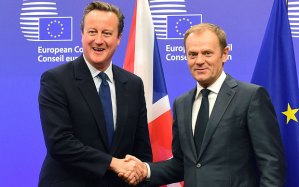
David Cameron - Donald Tusk - EU Renegotiation - European Union - Brexit

Agree with this article? Violently disagree? Scroll down to leave a comment.

Follow Semi-Partisan Politics on TwitterFacebook and Medium.