The Seven Deadly Sins Of Pro-European Union ‘Remain’ Campaigners

David Cameron - Neil Kinnock - Paddy Ashdown - Stronger In - EU Referendum - Brexit

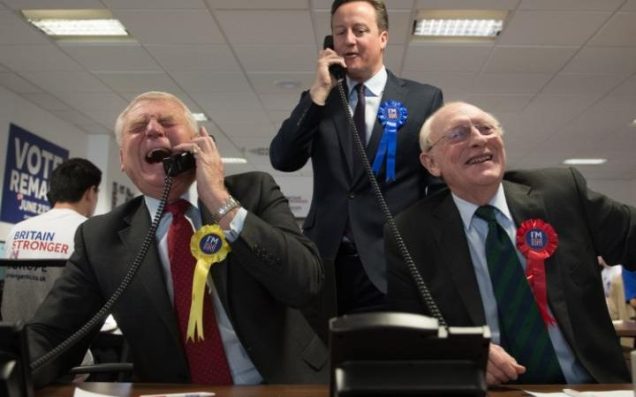
Zealotry, pessimism, denialism, idiocy, treachery, materialism and sloth – the Seven Deadly Sins of those campaigning for Britain to remain in the European Union

The Financial Times reports on German moves to bring long-simmering plans for an eventual European army back to the boil with the submission of a significant new white paper – the release of which has been conveniently deferred until Britain’s EU referendum is concluded:

Germany is to push for progress towards a European army by advocating a joint headquarters and shared military assets, according to defence plans that could ricochet into Britain’s EU referendum campaign.

Although Berlin has long paid lip-service to forming a “European defence union”, the white paper is one of the most significant for Germany in recent years and may be seized by anti-integration Brexit campaigners as a sign where the bloc is heading.

Initially scheduled to emerge shortly before the June 23 referendum vote but now probably delayed to July, the draft paper seen by the Financial Times outlines steps to gradually co-ordinate Europe’s patchwork of national militaries and embark on permanent co-operation under common structures.

[..] At the European level, the paper calls for “the use of all possibilities” available under EU treaties to establish deep co-operation between willing member states, create a joint civil-military headquarters for EU operations, a council of defence ministers, and better co-ordinate the production and sharing of military equipment.

“The more we Europeans are ready to take on a greater share of the common burden and the more our American partner is prepared to go along the road of common decision-making, the further the transatlantic security partnership will develop greater intensity and richer results,” the paper states.

This is not shocking. This is not surprising. This is what the gradual creep toward European political union looks like. Proposals like this are raised before being quietly deprioritised, seemingly dropped in the face of political backlash, only to be resurrected and advanced once more, each time gaining a little more ground until the end result is achieved – not necessarily by its original name (as with the Constitution) but always in practical effect. No never means no with the European Union. It simply means brief retrenchment before pressing ahead the same thing with a slightly different label.

At this point I do not know what more can be said, what further evidence can be presented, to convince people that the European Union is not the benign, happy-go-lucky club of friendly countries occasionally coming together on a super voluntary basis to fight crime, Save the Earth and braid each other’s hair that they are so desperate to believe it to be.

The EU is not shy about its intended direction of travel. None of the EU’s “founding fathers” were remotely shy about what they wanted their creation to become. For all of its bureaucracy, the Brussels machinery is usually quite transparent in its workings, for those with the patience to look and discover what they do in our name. And yet there persists a massive disconnect between the European Union’s own self-declared purpose and the way in which it is perceived and portrayed in Britain.

I once ran for the train at London Euston station, intending to go to the city of Wolverhampton (don’t ask why). But I didn’t look closely enough at the departure screen, and accidentally boarded the service to Manchester, engrossed on a phone call, only realising my error when the train first stopped at Stoke-on-Trent. But crucially, once I realised my mistake I did not stay on the train in the forlorn hope that by staying in my seat I might still somehow end up in the West Midlands. No – I got off the train and rectified the error. I did so because like most people, on matters of travel I am capable of perceiving and understanding objective reality – in this case, the reality that I was sitting on a train taking me at great speed to somewhere I had no wish to go. My destination and that of the other passengers were irreconcilably different.

As it was with my ill-fated train adventure, so it is with Britain, currently being borne along on the semi-fast service to European political integration. It should now be abundantly clear to everyone that the destination is not “friendly trade and cooperation” as the EU’s desperate apologists claim, and yet many wavering voters still believe that if they close their eyes, ignore the mounting signs and stay fearfully on the train, it will take them somewhere acceptable.

And I don’t get it. I just do not understand those of my fellow countrymen who are educated people and not hardcore European federalists – people who do not want Britain to become subsumed into a European political union or cast aside as the rejected half-member with no influence on the periphery – but who nonetheless intend to vote Remain in this EU referendum. I’m not being dramatic. I have tried very hard to put myself in the position of a soft Remain supporter, and I can no longer do it. Clearly I have passed the Brexiteer event horizon and can no longer turn back, not that I wish to. And I speak as a former hardcore euro-federalist (back in my student days).

Basically, to vote Remain in this EU referendum, one quite simply has to either:

1. Be a committed euro-federalist, eager for a United States of Europe

2. Understand that this is the end goal, abhor it, but think so little of Britain’s prospects as an independent, globally-engaged nation that being part of such a European state seems like the “least worst” option

3. Summon enormous powers of denial in order to ignore the EU’s trajectory and accept at face value David Cameron’s fraudulent assertion that he has secured meaningful concessions from Brussels

4. Be incredibly ignorant of recent history and basic, easy to research facts

5. Actively wish harm to one’s own country and democracy

But perhaps that is not entirely fair. As I wrote recently, I can see how some voters – particularly those from my own Millennial generation – might choose to prioritise short term financial stability over long-term democratic health, though I think that such people seriously underestimate the risks inherent in surrendering the last vestiges of our democracy to an unaccountable supra-national government. And of course some people are just incredibly apathetic.

So there are also the further two possibilities:

6. Self-centred materialism

7. Laziness and apathy concerning an issue of fundamental importance

That’s it. Those are the choices. Zealot, pessimist, denialist, idiot, traitor, materialist or sloth.

If you are planning to vote Remain in the EU referendum, which one are you?


European Union - United Kingdom - Britain - Flags

Agree with this article? Violently disagree? Scroll down to leave a comment.

Follow Semi-Partisan Politics on TwitterFacebook and Medium.

On Brexit, Nigel Lawson Should Stick To Being A History Professor

Nigel Lawson - Brexit - EU Referendum

When it comes to the history of the EU, Nigel Lawson actually has his facts straight. It’s a shame he also feels the need to weigh in on the political and economic aspects of Brexit

When he isn’t single-handedly torpedoeing the thinking Brexiteer’s case for leaving the European Union with fatuous and cavalier pronouncements on the economic aspect – or wrongly whipping up fears that Brexit would mean border controls with Ireland – Nigel Lawson can sing quite a nice tune on the issue of democracy and the unabashedly federalist imperative of the EU.

From Lawson’s OpEd in yesterday’s Telegraph:

On the European mainland it has always been well understood that the whole purpose of European integration was political, and that economic integration was simply a means to a political end.

In Britain, and perhaps also in the US, that has been much less well understood, particularly within the business community, who sometimes find it hard to grasp that politics can trump economics.

The fact that the objective has always been political does not mean that it is in any way disreputable. Indeed, the most compelling original objective was highly commendable.

It was, bluntly, to eliminate the threat to Europe and the wider world from a recrudescence of German militarism, by placing the German tiger in a European cage.

Whether or not membership of the EU has had much to do with it, that objective has been achieved: there is no longer a threat from German militarism.

But in the background there has always been another political objective behind European economic integration, one which is now firmly in the foreground.

That is the creation of a federal European superstate, a United States of Europe. Despite the resonance of the phrase, not one of the conditions that contributed to making a success of the United States of America exists in the case of the EU.

But that is what the EU is all about. That is its sole raison d’être.

This is a condensed and fairly accurate restatement of the EU’s underlying purpose, more fully laid out in “The Great Deception” by Dr. Richard North and Christopher Booker – though this essential book makes the additional important point about just how much of the EU’s evolution has taken place by stealth, cloaked in deliberate secrecy.

Anyone still labouring under the illusion (or burying their heads in their sand to convince themselves) that the EU is nothing but a happy-go-lucky club of countries coming together voluntarily to “cooperate” and solve common difficulties together should read “The Great Deception” and let the scales fall from their eyes. For all his other faults, Lawson does at least have a firmer grasp of history than most starry-eyed EU apologists.

Does this OpEd make up for everything else that Lawson has unfortunately done to retard the case for Brexit? No. But it does show quite starkly the positive case for Brexit which the main Leave campaign is throwing away by refusing to commit to an anxiety-soothing EEA-based exit plan and then, once the public’s understandable economic concerns are neutralised, letting the case for democracy speak for itself.


European Union - United Kingdom - Britain - Flags

Top Image: The Irish News

Agree with this article? Violently disagree? Scroll down to leave a comment.

Follow Semi-Partisan Politics on TwitterFacebook and Medium.

If The Remain Campaign Succeed In Cheating Their Way To Victory, Their Joy Will Be Short Lived

EU Referendum - Divisive - Bitterness

There will be no kissing and making up on 24 June

Much like this blog, Pete North is angry at the conduct of this referendum campaign by the arrayed forces of Remain, and sees little point in hiding the fact:

We’ve had decades of their rule, decades of their orthodoxy and no means to challenge their political dominance. We’ve been watching and waiting for years. Watching as successive governments have ceded ever more power, ever more control and have insulated themselves from the wishes of the public. Well, now we’ve got our referendum. And now we see just how deeply the game is rigged.

So we’re angry to say the least. Angry at what has been done to us, done in our name, and angry that once again democracy is being trampled on to preserve the orthodoxy. And we do not take kindly to being lied to.

There’s an old saying that politics is between you, me and the swamp. Minorities on either side, playing games for the votes in the middle. But unlike classic politics, this is not a left vs right dispute. There are only those above the line and those below the line. Those who have the power and those who do not. In this estimation, the establishment holds all of the cards. It has always known a challenge to its legitimacy would one day come which is why it set out to bribe institutions in advance.

We Brexiteers on the other hand have what we have. An angry rabble with keyboards. And let’s face it, none of us are ever going on the front cover of Vogue. We’re a bunch of griping, moaning angry people who seem to hate just about everyone in politics and everything they do. We’re not helped by a pretty shoddy Leave campaign either, with some fairly odious spokesmen.

We are irredeemably spit. We all hate each other. I despise the Toryboys and I loathe Ukip. I hate all political tribalism. I’m not a joiner of clans. But there’s one thing that unites us all. All of us can articulate a better definition of democracy than any of those would would have us remain in the EU – and though we can’t seem to agree on coherent Brexit plan, we all know what democracy is, why we should have it and crucially why the EU is the absolute opposite of it.

And that’s why this referendum really settles nothing. The Remainers will play their little games, steal the referendum and carry on as before; feathering their own nests and consolidating their power. But we’re not going anywhere. We’re not giving up. And we are taking names. Us Brexiteers hold deep grudges. We are in it for the duration.

We will remember Cameron the fraud. We will remember Hague and Corbyn as turncoats. We will remember the frauds like Boris Johnson who used the cause for their own advancement. We will remember the parasites who had their fingers in the till. We will remember all those hacks and policy wonks who twisted the truth. We will not forget what was done here. And unlike 1975 – we have a full record of who said what. The internet never forgets.

And North’s blood-chilling conclusion:

In fact, we are going to be pure poison. If you thought the SNP were sore losers, you ain’t seen nothing. A remain vote will ensure domestic politics remains permanently toxic. While these part timers waft into to the Brexit debate with their tedious rhetoric about Brexiteers being little englanders and xenophobes, and venting their empty rhetoric of cooperation and internationalism, we have been here from the beginning. Will be here at the end.

You can stifle an idea, but you can’t kill one. Especially not that seemingly antiquated notion that the people should be able to refuse their government. The EU may be powerful but it is not stronger than the desire for democracy. And if it takes another generation to get what we want then that is what we will do. There is only one way this fight ends – Britain leaving the European Union. We will either do it amicably and by the book – or we will do it some other way. The general public may well go back into their political slumber, but we Brexiteers will be back – and in between, we are going to cause merry hell.

I should say that I agree with nearly everything in Pete’s piece – as always, his diagnosis of the flaws of the EU is spot-on, and his objections rooted not in shameless partisan positioning (like nearly every Remain supporter on the Left) but in a deep love and respect for democracy.

I can’t say that I look forward to the idea of being “pure poison”, or causing merry hell. But increasingly, I cannot see an alternative if, as is still likely, the Remain camp prevails on the back of a campaign based on sowing fear, uncertainty and doubt.

There are some political issues where I don’t get my way – in fact, as a libertarian / conservatarian living in Britain, it is pretty near all of them – where I am still happy to play the game according to the rules. I think personal taxes are too high, for example, as a result of decades of fiscal drag and Gordon Brown’s only partially-repealed spiteful hike. But I’m not going to take my toys and go home in protest, refusing to engage and participate in the democratic process because we don’t have a flatter tax system.

Likewise with the size of the state. This blog believes that government does far too much for far too many people – including many who are already self-sufficient and do not need government largesse, as well as many who could know self sufficiency if only they had the right short-term help and weren’t indefinitely coddled by the welfare state. But it is not the relatively unambitious and half-finished work of implementing Universal Credit which has enraged me against this supposedly conservative government.

On all manner of issues I’m happy to play for incremental progress, accept the victories as well as the losses for my side, and then move on to the next battle. But this is different. The European Union question is different.

The EU referendum is not about whether we want politics to be a little bit more left wing or a bit more right wing. It is not about tweaking tax policy, industrial policy, reforming benefits, or social issues. It is so much more fundamental than that, because whether or not Britain votes to remain in the EU says in a single gesture what kind of country we are, and what kind of country we want to be.

And the same thing applies at the personal level. I have never had a problem socialising and being friends with people from all across the political spectrum. Most of my social circle probably leans significantly to the Left, if anything, and while it leads to the occasional lively conversation there is always a full measure of respect. But – and I don’t take any great joy in writing this – I do not think I will be able to help thinking less of people who vote for Britain to remain in the EU.

Now, that doesn’t go for every Remain supporter. If I knew that someone is voting Remain because they truly believe in the European project, that they admit that political union is being brought about by stealth but that the ends justify the means, that they “feel” more European than British and want to forge a new combined European state, then I would profoundly disagree with them but I could respect that position. It is a positive (although distasteful to me) vision of Europe, and it is an honest one. I know several people who do take that position, and I am at my happiest when I am debating with them because I don’t feel like part of my soul is dying while I do it.

My problem is with those who either see supporting the European Union as some kind of necessary virtue-signalling act to be accepted in their social circle (oh, aren’t UKIP simply awful, darling?), and those who abrogate any notion of acting as an engaged and enlightened citizens with a responsibility to this country and to democracy, and so vote based solely on their wallets or other narrow personal interests. I will struggle to look upon such people in quite the same way after this referendum.

Maybe that is easy for me to say – I do not have a lot materially at stake in this referendum, financially or otherwise. My job is not dependent on EU funding, and the immediate interests of my family are not threatened by Brexit. All of these are mitigating factors – if my own salary and job security were directly or even indirectly contingent on staying in the EU, I concede that it would take a superhuman effort to overcome the instinct toward confirmation bias which would encourage me to seek out other facts and opinions supporting the Remain case.

But human beings are emotional creatures and the fact cannot be denied: I have a lot invested in this campaign, in terms of this blog and my other campaigning activities on the side. With such an early referendum and with the government doing everything short of stuffing ballot boxes with fake votes to assure a Remain vote, I remain pessimistic about our chances, though I fight to win. But if we lose, the behaviour and motivations of many of those agitating for Remain is such that I will be very angry for a very long time. And I will not be the only one.

(None of this should be taken as a Rebecca Roache-style, “unfriend all my Tory acquaintances on Facebook in a fit of moral grandstanding, virtue-signalling post-election leftist pique” piece of melodrama. But there will be a degree of real disappointment, if for no other reason than it will confirm that those who vote Remain and I clearly see the world in a profoundly, irreconcilably different way).

Britain should be ready for the wave of anger that is likely to break over our heads on 24 June. In the event of a Leave vote, expect a lot of short term hysterics from the virtue-signallers and special interests, most of which will die down once it becomes evident that Britain will be exiting to an EEA/EFTA holding position and maintaining single market access. But in the event of a Remain vote, given the underhanded way that the government has been fighting the referendum campaign, expect the SNP on steroids – a long, guerilla campaign of attrition directed against anyone and everyone who betrayed the Brexit cause.

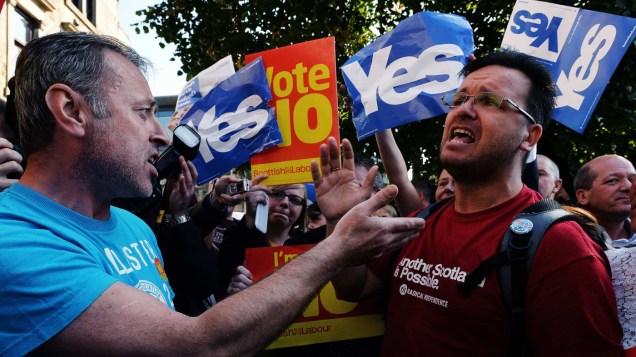
Chris Deerin painted a vivid and I believe accurate prediction of the future in a piece for CapX last year, comparing the likely fallout from the EU referendum to the aftermath of the 2014 Scottish independence referendum:

I have been bemused and fascinated by the number of English people telling me in recent weeks that “it won’t be like Scotland” – that this will be a more sedate affair, will inspire less passion, do less long-term damage. Well, perhaps. But, as we Scots say, ah hae ma doots.

What was most extraordinary about last year’s independence vote was the turnout: 84.5 per cent, the largest since the introduction of universal suffrage in the UK in 1918. Many of those voting were people who had never before even considered entering a polling station. What happened? There was certainly a long, noisy, impassioned campaign. There was global interest beyond anything we’d experienced before, but beyond this were two key factors that I believe drove this historic level of engagement.

The first was timing – the referendum came along after a decade in which every significant British institution had suffered either a scandal, a crisis of confidence or a loss of purpose, from Westminster to the media to the City to the military. The ties that bind had never been looser, respect for the status quo never lower.

Second, people were asked an existential question: who are you? This is not nothing. You will want to answer. You will want to answer on behalf of yourself and your family and your nation. Especially when you realise that the answer really matters – no safe seats to consider, no popular or unpopular incumbent MPs, no First Past The Post system ensuring only a few marginals get all the attention. Every individual counts. This is the big one, for keeps. So: in or out?

Deerin concludes:

Ultimately, we are about to ask the people of Britain an existential question: who are you? They will know that their voice counts this time, and that the consequences of the decision will be enormous and era-defining. They will think about themselves, their family and their country. They will get angry with the other side. Some very harsh words will be exchanged. Tempers will be lost and relationships fractured. And afterwards, whatever the outcome, the losers will be very sore, for a long time.

Not like Scotland? Don’t say you weren’t warned.

Like I say, I have no great desire to spend the next year walking around angry, holding nearly the entire political class in derision and many of my fellow citizens in open contempt. It does not warm my heart, in the same way that many left wing activists clearly revel in their anger and the righteousness of their cause, bleating about socialism and hating the Evil Tories.

But to my mind, there is a right way to vote in this referendum and a clearly, unambiguously wrong way to vote, and it is not hard to tell the difference between the two. The right way strikes a blow for democracy, self-determination and the normalcy of independence enjoyed by every single major country in the world outside Europe, while the wrong way would be to reward people who do not dare to advance their own positive argument for European political union, and so instead spend the bulk of their time pecking over the foibles, inconsistencies and other low-hanging fruit offered up by the hapless official Leave campaign.

In the event of defeat, then, the only question open to disappointed Brexiteers will be whether or not they use that anger and channel it toward some positive action to further the eurosceptic cause. This blog will do just that. Semi-Partisan Politics is in this for the long haul. Because as Pete North rightly says, you can stifle an idea like Brexit, but you cannot kill it.

I continue to fight this referendum campaign to win. But if we are fated to lose, I will not be going anywhere. If my generation is not to be the generation which restores democracy and self-governance to the United Kingdom then we can at least ensure that the flame of liberty is kept alive until it is time to try again – assuming that the doomed project does not implode under the weight of its own internal contradictions and the relentless pressure of global events, making the Brexit debate redundant.

And in the meantime, I and many others will make life as painfully difficult and unfulfilling as we can for all those in public life – particularly those in the Conservative Party – who come down on the wrong side of this referendum. That much I can promise.

 

European Union - United Kingdom - Britain - Flags

Top Image: CapX

Agree with this article? Violently disagree? Scroll down to leave a comment.

Follow Semi-Partisan Politics on TwitterFacebook and Medium.

The Guardian, The EU Referendum And Britain’s Entrenched Sense Of Inferiority

Obama Merkel Cameron Renzi Hollande - 3

A cake-filled misery-laden grey old island…

When does the Guardian become an enthusiastic, uncritical cheerleader for US foreign policy?

Why, when the US president jets in to lecture us all on the importance of voting to remain in their beloved European Union.

Meanwhile, we know exactly what the Guardian thinks about Britain from this giveaway paragraph in their article hailing Barack Obama’s arrival:

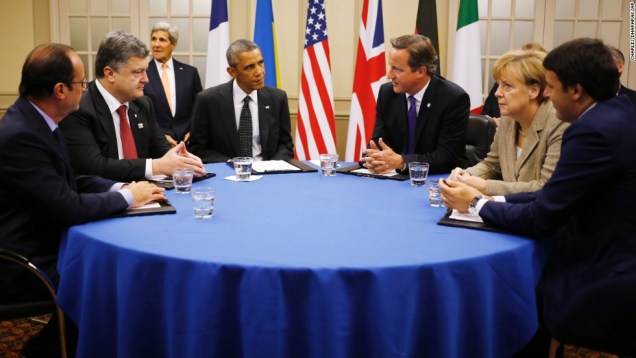
The importance of the UK as a key figure inside the EU club will be symbolically underscored when Obama again meets David Cameron, Angela Merkel, Mario Renzi and François Hollande in Hanover, Germany, on Monday to discuss Syria, Libya and the consequent migration crisis. The implicit message is that the UK outside the EU would not have been invited to such a high-level transatlantic conclave.

Oh gosh! How kind of Italy and France to allow Britain to take part in their Super Important Meeting with Germany and the United States. Of course, puny little Britain – the fifth largest world economy and pre-eminent European military power – would never normally be allowed to sit around the table with François Hollande and “Mario” Renzi, but for the fact that we are part of the same supra-national political union.

Is the Guardian serious? Sometimes it is hard to tell whether this dismal, miserablist attitude toward Britain is entirely genuine, or an attitude which is affected purely for the purposes of keeping our self-esteem just low enough that we don’t get ideas of national independence above our station.

The trouble, though, is that the Guardian is very much a thought leader in this area. Where the Guardian sighs, tuts and shakes its head at the hopeless prospects of puny, pathetic Britain, so many of its readers have been conditioned to automatically do the same. I’m frequently amazed by the number of conversations I have with otherwise intelligent, knowledgeable people who genuinely believe that Britain is a small and inconsequential nation.

It is almost as though someone distilled Britain’s despairing psyche when we were at our 1970s nadir into its purest, bleakest form, and then injected that dismal serum into half of today’s population. Once the infection takes hold, the feeble country that these National Inferiority Virus sufferers hallucinate bears absolutely no relation to the objective reality of modern Britain.

And these are the people who will be voting in the referendum on 23 June. These are the the pessimistic, resigned views which millions of people sympathetic to the Guardian’s position will carry with them into the polling booth. Citizens of a nuclear power, a P5 UN Security Council member, the world’s fifth largest economy and home to the financial and cultural capital city of the world, who nonetheless believe that it is only our membership of the EU which gives Britain’s prime minister the undeserved privilege of being in the same room as the leaders of Germany, France and Italy.

God help us.


European Union - United Kingdom - Britain - Flags

Top Image: CNN

Agree with this article? Violently disagree? Scroll down to leave a comment.

Follow Semi-Partisan Politics on TwitterFacebook and Medium.

Thanks For The EU Referendum Advice, Mr. President. America Should Give Supra-National Political Union A Try

David Cameron - Barack Obama. President Barack Obama - 2

An open letter to Barack Obama, responding to the American president’s heartfelt intervention in our EU referendum debate

Welcome back to Britain, Mr. President. It’s always a pleasure to have you here.

Thank you also for sharing the fruits of your wisdom on how we should vote in our coming referendum to leave or remain in the European Union. Your deep respect and affection for the United Kingdom (and the countless small ways in which you have honoured the special relationship since taking office in 2008) is well known here, and we are sure you would not have made this intervention at David Cameron’s personal request unless you sincerely believed it was the right course of action, and had our country’s best interests at heart.

But before you jet back to Washington DC on Air Force One, Mr. Obama, please allow us to reciprocate by sharing some words of advice for your own country and fellow citizens. We offer this advice in exactly the same spirit with which you blessed us with yours.

Mr. President, it is time for the United States of America to admit that the age of the nation state is over, to let go of excessive pride and patriotism, and form a political Union of the Americas. Don’t waste another moment. Assemble the heads of state from North, Central and South America and immediately sign and ratify a Treaty of Tijuana creating a political and customs union between your respective countries. For this is the only way that the great prosperity which Americans have known in the twentieth century can possibly be preserved in the twenty-first.

Now, we know what you’re going to say. The United States is still the world’s pre-eminent military and economic power. That’s true. But the same was said of the United Kingdom a mere century earlier, and look what a beating Britain took in the first eighty years of the 20th century – a huge expenditure of blood and treasure defending freedom in Europe, a global empire lost and an economy which went from being the world’s largest to smaller than that of Italy.

It was only by the election of Margaret Thatcher joining the European Community that a battered and declining Britain managed to staunch the bleeding and halt the decline. America should seize the initiative, recognise that – like Britain – her best days are firmly in the past, and hedge against the scary and uncertain future by dissolving the political ties which separate her from Canada, Mexico, Belize, Guatemala, El Salvador, Honduras, Nicaragua, Costa Rica, Panama, Suriname, Colombia, Argentina, Venezuela, Peru, Paraguay, Uruguay, Bolivia, Chile, Ecuador, Guyana, French Guyana and Brazil.

Consider: America’s economy will soon be overtaken by China in terms of raw nominal GDP, as will that of our own blessed European Union. And the population of the United States is dwarfed by both India and China, two developing countries with nuclear arsenals and strong regional interests which are often at odds with America’s. If you wait too long to band together into a regional political union based on your shared continental values it may be too late – China will divide and conquer the continent.

No one country from the Americas can hope to stand up to China or wield the leverage to sign the amazing trade deals that one of your potential successors is promising. Only by binding your fate inexorably to that of Venezuela and Ecuador can the United States hope to secure a fair deal. Remember: united you stand, but divided you fall.

And speaking of being united, isn’t it about time that any citizen of North or South America was able to live, work or retire anywhere they please? The new American single market for goods, services and capital is incomplete if there is not also a single labor market, and so the very first act of this new Union of the Americas should be to abolish national borders and establish passport and visa-free travel across the entire continent.

Now, some may object to this with shrill warnings about national security, but consider – as part of this new Union, the United States will have access to the world-class intelligence services of Peru and Costa Rica. As we all know, national security cooperation is only possible through full political union, and so by joining this Union of the Americas the CIA and FBI will for the first time ever be able to share information with Mexico and Canada for the prevention of crime and terrorism.

We anticipate that your labor unions will also kick up a fuss at the thought of millions of economic migrants from South and Central America moving to the United States in search of work and higher living standards. But if you give Tony Blair a quick call, he will tell you that it is possible to overcome these objections by furiously ignoring them and labelling anybody who gets angry about the suppression of wages and conditions as a racist or xenophobe.

So how should this Union of the Americas work? Well, we humbly suggest that you model it on our own European Union, whose institutions are so beloved by all European citizens and whose founding fathers are no less well-known and revered than Thomas Jefferson, James Madison and Benjamin Franklin.

Of course you will need a government for this union. We have found that a Commission of 28 mostly failed politicians from our respective countries serves this purpose very well indeed. This body will be the only one which can propose new laws for your union, so finding the right calibre of candidates is important. It’s the strangest thing, but former prime minister and presidents who left office under a cloud of scandal and popular dissatisfaction often turn out to make amazing commissioners. We don’t know why it works, it just does.

You will need a Parliament for your union, too, in order to act as a rubber stamp for new directives and legislation. But it is no good having each country voting along national lines – remember, the goal is to gradually weaken and erode national identity so as to gain public acceptance for our new Union of the Americas. So each member state should be divided up into regions, with each region represented by a number of MAPS (Members of the American Parliament). You might think that the United States is already ideally divided into fifty such constituencies in the States, but this is entirely the wrong way of thinking. The regions should be arbitrary places to which nobody feels any sense of connection or belonging. Geographic descriptions like “North East” and “South West” are always a good choice, because they help to break down peoples’ backward and antiquated feelings of patriotism and pride in their home, and finally begin to see themselves as the pan-American citizens that they are.

And we can’t forget the judicial branch. Your new Union of the Americas must uphold the rule of law and ensure that national governments, corporations and individuals are in compliance with foundational treaties and Union laws and directives. The American Court of Justice (ACJ) will fit nicely above your own Supreme Court – and of course, any decisions which the US Supreme Court makes are subject to review by the ACJ because lovely though your own Constitution may be, Union Law must have primacy if this new arrangement is to work.

The goal, as you can probably tell, is the gradual accretion of power and responsibility at the supranational level, so that key decisions are taken in Tijuana rather than the capitals of each member state. National identity is so anachronistic, and stubbornly clinging to outdated concepts of nationhood will doom the American peoples to a lost century of relative decline. Now, naturally you may encounter some resistance to all of this from the voters, which is why it is actually best to talk about the whole enterprise exclusively in terms of trade and co-operation. If anybody accuses you of harbouring grander plans for political union, just dismiss them as cranks and conspiracy theorists. It works really well.

And don’t worry – you can keep all of your institutions. Congress, the Supreme Court, the office of the presidency, all of it will still exist under the new Union. It’s just that various powers and responsibilities will need to be outsourced to the supranational level to ensure the smooth running of the new Union. We think you will quickly come to like the arrangement – having dedicated civil servants in Tijuana administering social policy, negotiating trade deals and hammering out a common foreign policy will free up so much time for partisan grandstanding, political fundraising or a few more sneaky rounds of golf.

We know how tiring you have found the partisan gridlock in Washington. Well, by signing the United States up as a founder member of the Union of the Americas, you don’t have to worry about it any more! Democrats and Republicans can continue to posture, argue and filibuster about a whole range of largely symbolic issues, while increasingly all of the governing that actually matters moves to the supranational level. It’s a win-win situation.

I hope that by now you can sense the excitement we feel for the potential of this new Union of the Americas. And frankly, from a selfish European (I nearly said British – old habits die hard) perspective it would make our lives much simpler, too. It is rather time-consuming and expensive to maintain embassies and consulates in so many countries and cities across North, Central and South America. And at times of crisis, I know that Federica Mogherini, our incredibly well-qualified and able High Representative for Foreign Affairs, would find it so much easier if she only had to dial one number to speak to the Americas.

Nation states are a thing of the past. And good riddance, too – they have brought us nothing but war, misery and shame (as our French and German compatriots keep reminding us). So, Mr. President, let your parting legacy to the United States be setting in motion the process of her abolition.

But we do not need to convince you of any of this. After all, it is you urging us vote to remain in the European Union, because you understand the advantages of post-democratic, supranational governance better than many of our own stubborn, backward citizens.

And of course you would never recommend anything for your closest ally that you do not also consider good enough – and earnestly desire – for the United States.

Would you, Mr. President?


European Union - United Kingdom - Britain - Flags

Top Image: Mirror

Agree with this article? Violently disagree? Scroll down to leave a comment.

Follow Semi-Partisan Politics on TwitterFacebook and Medium.