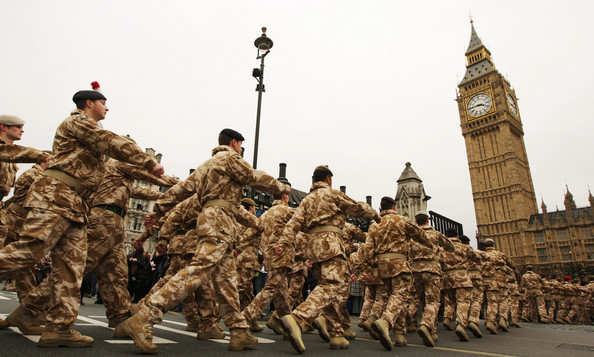
Ministry of Defence ordered to find £1 billion of further cost savings from the defence budget while OFGEM gives £500 million to power companies to make electrical power lines look prettier
Government has no more fundamental duty than the protection of the realm from threats foreign and domestic. But while David Cameron’s Conservative majority government is quick to take action against domestic threats (eagerly spending money and passing laws which undermine our fundamental freedoms and civil liberties in the process), it is worryingly weak when it comes to keeping Britain well equipped to deal with foreign dangers.
In just the latest manifestation of Tory disdain for defence issues, no sooner had the Conservatives secured their surprising general election victory than George Osborne sent an edict to the MoD demanding that they find another £1 billion of cost savings from an already pared back and insufficient budget.
Isabel Hardman, writing in The Spectator, remarks:
Even though the prospect of Britain failing to meet that Nato target is upsetting Washington, and even though it is something that agitates Tory backbenchers, and even though one Labour leadership candidate (Liz Kendall) has said they would stick to 2 per cent, this is unlikely to cause as big a row in Westminster as perhaps it should.
For starters, the Opposition is still officially not endorsing the 2 per cent target. For another thing, one of the best-briefed proponents of the Tories keeping their commitments, Rory Stewart, is no longer chair of the Defence Select Committee and is now a minister. And for another thing, Tory MPs are trying their best currently to behave rather than pick fights. Even if they did, a rebellion organised by a backbencher would number a few dozen at the most and would unlikely to be joined by Labour unless Liz Kendall wins the party leadership. There will be criticism from the sidelines, but few are expecting any sort of real trouble that is troublesome for the government.
Of course, this is only if you measure trouble as being purely confined to the walls of the Palace of Westminster, rather than the sort of trouble the armed forces may be required to deal with but just with even further reduced capabilities, but there we go.








 Semi-Partisan Politics