What Conservative Government? – Part 4, Iain Duncan Smith Resignation

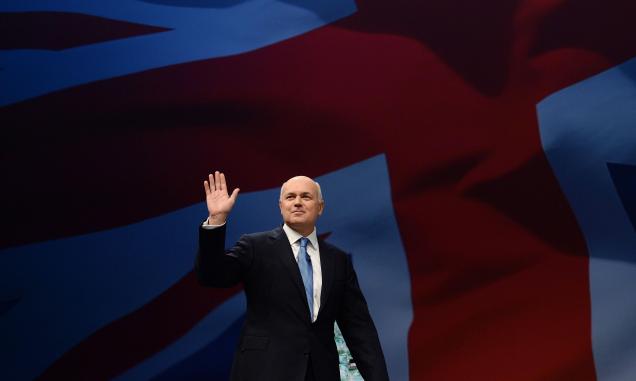
Iain Duncan Smith - IDS - Resignation

How many more ideologically principled, Thatcher-style conservatives can David Cameron’s centrist political machine afford to alienate?

There is a telling line in James Kirkup’s excellent, fair assessment of the full context behind Iain Duncan Smith’s resignation:

The Prime Minister has already done things that will underpin his eventual legacy: winning the Scottish independence referendum and the general election.

Kirkup probably meant this as praise, but in reality it is the most damning indictment of the current conservative government imaginable – far worse than anything that Iain Duncan Smith said in his resignation letter.

Because it is quite true – some of the greatest accomplishments of David Cameron and his core team of loyalists since 2010 are avoiding having the country disintegrate on their watch, and managing to win a second general election against a historically weak Labour leader pursuing a transparently flawed strategy. If the bar for success in British government has truly been set so low then we are in real trouble.

But David Cameron is not a visionary leader. He came to power in 2010 promising to get Britain through difficult economic times, and was re-elected in 2015 promising to be a reasonably competent Comptroller of Public Services. And to be fair to the man, he never really promised to be a great statesman or a formidable world leader.

Being a doggedly centrist technocrat is all well and good, but eventually people quite rightly start to ask what your government is for, besides acquiring the reins of power and then keeping hold of them for as long as possible. David Cameron’s best answer – the main headline from the Conservative Party’s 2015 general election manifesto – was that we should vote Tory because they have a “plan for every stage of your life“.

Nobody within the Conservative Party seemed to care that this sounded alarmingly socialist and suggestive of the Nanny State – people craved security above freedom, it was believed, and so that’s what would be promised and delivered. More of the status quo, whether the status quo worked well or not.

In other words, as this blog has long been saying and my Conservatives for Liberty colleague Paul Nizinskyj has now eloquently written, David Cameron’s role model is far more the steady pair of hands in tough times rather than the visionary, bloody minded reformer – more Ted Heath than Margaret Thatcher.

I won’t lie: my first reaction on hearing the news that Iain Duncan Smith – who together with Michael Gove is one of the few Conservative heavyweights left with any discernible core conviction – had finally snapped and told George Osborne exactly what to do to himself was “great – anything to make the smug little cretin sweat”.

Because George Osborne is David Cameron with less charisma. And since David Cameron has almost no charisma of his own, that puts George Osborne well into negative territory. Given the fact that his blunders (the Omnishambles Budget, tax credits, PIPs) have done as much to colour the political landscape as his “victories”, I also find his reputation as a master political strategist to be hugely overinflated.

If running to the political centre by jettisoning core conservative principle by adopting left-of-Labour policies like a £9 minimum wage counts as political genius then sure – anybody who can successfully cross-dress as a politician from a different party to pick off some extra votes is a master strategist. But it makes George Osborne a lousy conservative.

Not everything in Osborne’s budget was wrong. Should the thresholds for tax brackets move upwards with inflation? Ideally yes, they should do so every year to neutralise the effect of fiscal drag. But to package measures such as this with reductions in the Personal Independence Payments to hundreds of thousands of disabled people is frankly idiotic.

In some ways, this is emblematic of the ridiculous nature of the Budget spectacle, a choreographed event which encourages the Chancellor of the Exchequer to play god with other minister’s departments, either stealing their flagship ideas (as with academies) or otherwise presenting them out of context. But it also speaks to this government’s utter failure to enact a bold, coherent and unapologetically conservative agenda.

Janet Daley sums it up perfectly:

Mr Osborne’s reputation as a tactical political genius has gone south too. Maybe that’s been the problem all along: his understanding of politics was all about tactics – about messaging and grids, presentational gloss and re-branding – and had nothing to do with fundamental, irreconcilable principle. I am prepared to guess that he quite literally does not understand politicians who are prepared to risk everything for an idea, a conviction: a personal moral mission.

He thinks that they are bloody-minded and naive, with no comprehension of the modern science of winning elections. But that, it seems, is not what the people believe: they are beginning to think that their leaders should stand for something, should have a fundamental sense of what they are in politics for. It’s what they call “authenticity”, and it could turn out to be more of a winner than all the clever marketing techniques in the world. Imagine that.

I understood what Michael Gove was trying to accomplish at Education. And I get what Iain Duncan Smith was wrestling with at the Department for Work and Pensions, and admire his semi-successful efforts to get people into work, and to make that work pay more than dependency on the state. Unlike many others who write sanctimoniously but ignorantly about the issue, I have witnessed the welfare state up close, and seen exactly what our “compassionate” system is capable of doing to people when the dead-eyed state machine is responsible for their lives.

I get all of that. But I have no idea what David Cameron is trying to accomplish as prime minister, or what George Osborne thinks he is doing at the Treasury. Because it certainly isn’t paying down Britain’s debts, as they both like to claim. Nor is it guarding Britain’s sovereignty and place in the world – Cameron has gutted Defence, and is in the process of tricking the British people into voting to remain in what he falsely claims to be a “reformed” European Union.

Neither Cameron or Osborne are motivated by the desire to roll back the state and make the British people more free – their heavy-handed government is all for ever-greater restrictions on both ancient and recent hard-won civil liberties, and is seemingly anxious to sacrifice what freedom we have left upon the altar of “national security”.

There is almost nothing about shrinking the state and expanding personal liberty in this government. But there are lots of policies – cutting state spending on the poorest and weakest in society while continuing to lavish stage largesse on wealthy older people (through non-means tested benefits and the lack of a housing supply policy to benefit the young) – which play right into Labour’s hands, making the Tories (and those who support them) look like nothing more than selfish, grubby opportunists, lining the pockets of the already wealthy while others suffer.

In short, I don’t know what this Conservative government is for, besides trying to stay in power and preventing Labour from stealing it. And apart from the work he was doing in his own department, I suspect that Iain Duncan Smith didn’t know either, no matter how much obligatory praise he heaped on Cameron in his resignation letter.

So I cannot do anything but endorse Iain Duncan Smith’s decision to quit. The final straw was no doubt Downing Street’s insistence that Duncan Smith come out all guns blazing in defence of the welfare cuts in the Budget, while simultaneously planning to walk back the proposals themselves – making IDS look like the crazed ideologue and Cameron / Osborne as the calm voices of reason. Who would want to stick around to be treated in that way?

And if Iain Duncan Smith’s resignation destabilises the government – so what? We currently have a nominally conservative prime minister who is busily enacting Tony Blair’s fourth term of office. We effectively already have a Labour prime minister – or a New Labour one, at least.

Maybe an improbable defeat to Jeremy Corbyn’s Labour Party – or a good scare, at least – is the shock the Tories need to dig deep and find a real conservative leader.


Postscript: Iain Duncan Smith’s full resignation letter – which this blog believes was far too generous and courteous – is shown below.

I am incredibly proud of the welfare reforms that the government has delivered over the last five years. Those reforms have helped to generate record rates of employment and in particular a substantial reduction in workless households.

As you know, the advancement of social justice was my driving reason for becoming part of your ministerial team and I continue to be grateful to you for giving me the opportunity to serve. You have appointed good colleagues to my department who I have enjoyed working with. It has been a particular privilege to work with excellent civil servants and the outstanding Lord Freud and other ministers including my present team, throughout all of my time at the Department of Work and Pensions.

I truly believe that we have made changes that will greatly improve the life chances of the most disadvantaged people in this country and increase their opportunities to thrive. A nation’s commitment to the least advantaged should include the provision of a generous safety-net but it should also include incentive structures and practical assistance programmes to help them live independently of the state. Together, we’ve made enormous strides towards building a system of social security that gets the balance right between state help and self help.

Throughout these years, because of the perilous public finances we inherited from the last Labour administration, difficult cuts have been necessary. I have found some of these cuts easier to justify than others but aware of the economic situation and determined to be a team player I have accepted their necessity.

You are aware that I believe the cuts would have been even fairer to younger families and people of working age if we had been willing to reduce some of the benefits given to better-off pensioners but I have attempted to work within the constraints that you and the chancellor set.

I have for some time and rather reluctantly come to believe that the latest changes to benefits to the disabled and the context in which they’ve been made are a compromise too far. While they are defensible in narrow terms, given the continuing deficit, they are not defensible in the way they were placed within a Budget that benefits higher earning taxpayers. They should have instead been part of a wider process to engage others in finding the best way to better focus resources on those most in need.

I am unable to watch passively whilst certain policies are enacted in order to meet the fiscal self imposed restraints that I believe are more and more perceived as distinctly political rather than in the national economic interest.

Too often my team and I have been pressured in the immediate run up to a budget or fiscal event to deliver yet more reductions to the working age benefit bill. There has been too much emphasis on money saving exercises and not enough awareness from the Treasury, in particular, that the government’s vision of a new welfare-to-work system could not be repeatedly salami-sliced.

It is therefore with enormous regret that I have decided to resign. You should be very proud of what this government has done on deficit reduction, corporate competitiveness, education reforms and devolution of power. I hope as the government goes forward you can look again, however, at the balance of the cuts you have insisted upon and wonder if enough has been done to ensure “we are all in this together”.
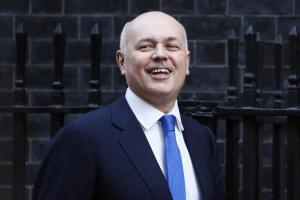
 

Iain Duncan Smith

Agree with this article? Violently disagree? Scroll down to leave a comment.

Follow Semi-Partisan Politics on TwitterFacebook and Medium.


At Least Jeremy Clarkson Is Honest About His Euro-Federalist Dreams

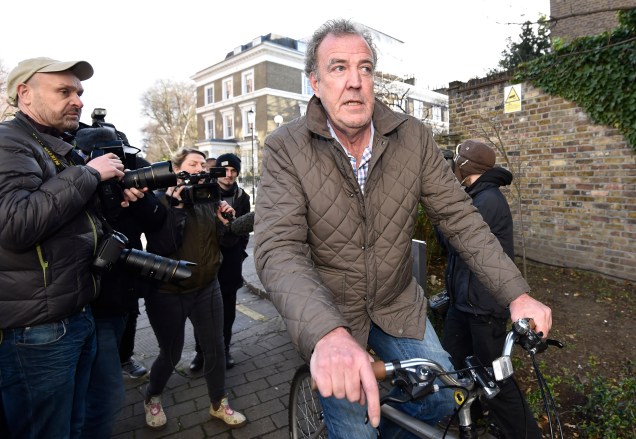
British television presenter Clarkson returns to his home in west London

Unlike most people in the Remain campaign, at least Jeremy Clarkson has the courage and decency to admit that he doesn’t just tolerate the European Union but actually dreams of Britain being part of a federal European country

So that great producer-punching pseudo Man of the People, Jeremy Clarkson, has come out definitively in support of Britain remaining in the European Union – and not just the EU as it is now, but the EU as it yearns to become in the near future, a fully politically integrated federal European state.

No great surprise there – Clarkson has made pro-European rumblings before. But what is surprising (and actually rather impressive) is the full-throated way in which Clarkson embraces his support of the EU.

Unlike nearly every leading politician and personality in the Remain camp, Clarkson does not attempt to flatter us or pretend that he “gets” our concerns about Brussels gradually usurping our democracy. Unlike the deceitful-yet-ingratiating Sajid Javid, Clarkson makes no promises to go back to ranting at Brussels the moment he has helped doom us to continued membership of the EU (though in Clarkson’s case, more ranting is all but guaranteed).

Jeremy Clarkson actually does something which almost nobody in the intellectually squalid, fear-based Remain campaign dares to do – he owns his pro-Europeanism and wears it as a badge of honour, rather than doing what so many Turncoat Tories and others have done, prancing around like the World’s Biggest Eurosceptic before meekly running to David Cameron’s heel and supporting Britain’s continued membership of the EU as soon as the prime minister snapped his fingers.

Clarkson writes in the Sunday Times (+):

I suppose that now is as good a time as any to declare my hand. I’m with the man whose wife we fancy. I’m in.

When Mr Cameron was touring Europe recently, seeking a better deal for Britain by sucking up to the leaders of such places as Romania and Hungary, I watched on YouTube an MEP called Daniel Hannan make an anti-EU speech to a group of, I think, students. It was brilliant. One of the best speeches I’ve ever heard. And, I’ll admit, it made me question my beliefs. But despite his clever, reasoned and passionate plea for us to leave Europe, I’m still in. He talked sense, but a lot of this debate is about how we feel.

In 1973 my parents held a Common Market party. They’d lived through the war, and for them it seemed a good idea to form closer ties with our endlessly troublesome neighbours. For me, however, it was a chance to make flags out of coloured felt and to eat exotic foods such as sausage and pasta. I felt very European that night, and I still do.

Whether I’m sitting in a railway concourse in Brussels or pottering down the canals of southwestern France or hurtling along a motorway in Croatia, I feel way more at home than I do when I’m trying to get something to eat in Dallas or Sacramento. I love Europe, and to me that’s important.

I’m the first to acknowledge that so far the EU hasn’t really worked. We still don’t have standardised electrical sockets, and every member state is still out for itself, not the common good. This is the sort of thing that causes many people to think, “Well, let’s just leave and look after ourselves in future.”

In other words, Jeremy Clarkson is your garden variety Euro-federalist. He looks at the bureaucratic opacity of Brussels, the contempt in which the EU is held by many of its citizens and the fact that cultural and regulatory harmonisation has not been completed to produce a single cultural identity where we all identify as Europeans first and use the same electrical outlets, and concludes that the correct answer is “more Europe”.

Fair play to him. He’s completely wrong, and betrays an almost criminal contempt for the democracy and right to self-determination for which our ancestors fought, bled and died. He is the archetypal person who votes as a consumer – because a harmonised, federal Europe would be better for his wallet and his weekend jaunts to France – rather than as a thinking, engaged citizen. But at least he has the god damn balls to honestly state his position. Hardly anybody in our own elected House of Commons supporting the Remain campaign would dare to do the same.

But then it begins to come off the rails (or the test track). Clarkson continues:

Britain, on its own, has little influence on the world stage. I think we are all agreed on that. But Europe, if it were well run and had cohesive, well thought-out policies, would be a tremendous force for good. I think we are all agreed on that as well. So how do we turn Europe from the shambles it is now into the beacon of civilisation that it could be in the future?

Oh really? We are “all agreed” on that, are we?

Actually, no we are not agreed at all. Our prime minister and foreign secretary may hold our country, its history and present capabilities in astonishingly low esteem, but fortunately the same cannot be said for many of the people. Many of us correctly believe Britain to be one of the few truly indispensable nations on Earth, that our contributions to the arts, sciences, commerce and global security are almost unmatched, and that we could throw our weight around in the world accordingly, if only we cared to stand up for our own national interest once in awhile.

But such views are unheard of outside the Chipping Norton set, the middle class clerisy in general and the fawning circle of friends and admirers surrounding David Cameron (of whom Jeremy Clarkson is one). These people, many of whom came of age at the peak of 1970s declinism and economic doldrums, have at their core a deep pessimism and scepticism about the ability of Britain to survive and prosper as an independent actor on the world stage.

So deeply have they internalised this self-doubt and self-loathing that no matter how much evidence you show them to the contrary – the examples of Australia and New Zealand, say, somehow surviving in the world without being part of an Asia Pacific Union and sharing a common parliament and court – they bat it away without even stopping to think.

Clarkson then sums up:

Right. So let’s switch our attention. Let’s leave the “parish councillors” alone and concentrate our big guns on the real decision makers in Brussels. Let’s have hacks outside their houses all day long, waiting for one of them to do or say something wrong. Let’s make them accountable. Let’s turn them from “faceless bureaucrats” into household names.

That is the biggest problem with the EU right now. Nobody is really concentrating on its leaders. Nobody is saying: “Hang on a minute . . .” And this means they are running amok.

It’s why we need to stay in. So our famously attentive media can try to stop them. To make them pause before they move. To make the Continent work the way the Continent should — as a liberal, kind, balanced fulcrum in a mad world that could soon have Trump on one side and Putin on the other.

And here we have the classic pivot back to “the answer is more Europe!” Rather than looking at public attitudes toward the European Union which range from disengaged indifference to blind, seething rage, Clarkson concludes not that the experiment in political integration by stealth has failed, but rather that we should just come to terms with it and re-order our media and culture around the EU’s artificial construct.

Clarkson is actually saying that if only more journalists doorstopped Jean-Claude Juncker and Martin Schulz every morning with awkward questions about budgets and foreign policy, we would immediately begin to feel more vested in the EU project and finally become enthusiastic Europeans. It’s pure wishful thinking, of course, but then so is everything about the EU, an political organisation build on the the principle of “If you build it, they will come” (they being a European demos willing to be led by Brussels).

But though Clarkson is wrong on nearly every point, cavalier with our democracy to the point that it does not even merit a mention in his article and unabashedly in hoc to the establishment’s ingrained europhilia, still he somehow comes away as the most intellectually honest and respectable of all the high profile Remain supporters.

Unlike an oleaginous Turncoat Tory, Clarkson does not feel the need to butter us up with constant anecdotes about how he hates Brussels just as much as we do, honest. And unlike those bland Remainers on the Labour benches, he does not just mutter inanities about countries “working together”, as though intergovernmental co-operation were not possible without the umbrella of an undemocratic political union.

No, Jeremy Clarkson owns his position, and has the guts to tell us that not only should we learn to love the European Union as it is now, we should actively fight for further political integration:

But, actually, isn’t it better to stay in and try to make the damn thing work properly? To create a United States of Europe that functions as well as the United States of America? With one army and one currency and one unifying set of values?

At last, an honest argument from a Remain supporter – someone who is brave enough to stand up and say “actually, I feel more European than British, I think that the nation state is kind of passé anyway, I’m envious of the size and power of the United States and terrified by the sight of Russia; therefore, we should proceed full speed ahead with the creation of a European country”.

Again: I find Jeremy Clarkson’s argument utterly repellent and contemptuous of our hard-won democracy and liberty. But my God, it’s refreshing to hear from someone from the Remain camp who actually says what they really feel about the European Union.

David Cameron, Philip Hammond, Theresa May and other assorted peddlers of FUD (fear, uncertainty and doubt) – your turn next in the honesty corner.


European Union - United Kingdom - Britain - Flags

Agree with this article? Violently disagree? Scroll down to leave a comment.

Follow Semi-Partisan Politics on TwitterFacebook and Medium.

Cameron The Weakling

David Cameron thinks that publicly exaggerating and flaunting Britain’s supposed weakness and vulnerability will make people vote to stay in the European Union, while having no impact on perceptions of his own leadership

We have already been treated to the spectacle of our wobbly-lipped Foreign Secretary insinuating that he is so inept at managing our foreign relations and defending Britain’s interests that we would likely be “punished” by our European friends if we voted to leave the EU.

And now it is David Cameron’s turn to make an ostentatious public spectacle of just how weak and insignificant he believes we are as a country, and how hopelessly unable to defend the British interest he is.

From Michael Deacon’s sketch in the Telegraph:

Francois Hollande, the President of France, respects the British people. He respects their democratic right to choose how they wish to be governed. He would never wish to put pressure on them. And if, when the referendum comes, they decide that the UK should leave the EU, he will respect their decision.

But, he added casually, there would of course be… “consequences”.

He said the word many times. “Consequences.” There would be “consequences” relating to trade, “consequences” relating to immigration. “Consequences?” Oh, he was “unable to deny” there would be “consequences”.

Was it true, asked a journalist, that if the UK left the EU, France would abandon the deal that helps stop migrants crossing illegally from Calais to Britain?

Monsieur Hollande looked at the journalist equably. Well, he replied. Naturally there would be “consequences”.

All of this took place while our prime minister stood limply next to the French president at his podium, as though French special forces had kidnapped Samantha and the kids and were holding them at gunpoint in the background.

At what point does the dirge-like, pessimistic drivel offered up by the Remain campaign and spouted ceaselessly by loyal government ministers stop making the public question whether Brexit is safe, and start making them question why the hell we pay these people if not to aggressively defend our own national interest?

Not to get all Land of Hope and Glory here, but Britain is still a reasonably big deal in the world. A major economic power, the premier European military power and one of a handful of countries in the world with real expeditionary capabilities, and a cultural reach probably second only to the United States. Most British people know this, and do not buy into the miserablist, declinist view of Britain peddled by so many in the Remain camp.

David Cameron has clearly made a calculation that talking about the catastrophic consequences of Brexit on the United Kingdom will scare up a significant number of votes and thus undermine the Leave campaigns. Never mind that it makes him look like a liar for having previously suggested that he might recommend Brexit if he was not successful in securing his pitiful package of “reforms”. And never mind the galling spectacle of a British prime minister actively and passionately running down his own country for electoral advantage.

Allister Heath picks up on this same theme in the Telegraph:

But the Government and many of its anti-Brexit allies have gone too far: instead of carefully stoking the public’s understandable fear of change, and planting doubt in its mind, they have decided to wildly exaggerate the downsides of leaving. The hit to the economy could be greater than that from the Great Recession, we are told by some hysterical economists, and even that best-selling children’s books would no longer be written because, apparently, no non-British authors or illustrators would be allowed into the UK if we were not part of the EU.

These and many other of the similarly extreme claims that have been made in recent days are laughably implausible, even to nervous, swing voters; fear is only effective as a political strategy if it is credible. Even worse for the Government, it has also allowed a toxic narrative to set in: the idea that it would be powerless to stand up for Britain’s interests and look after our economy in the event of a Leave vote.

It’s all rather pathetic and defeatist. It would be too hard and time-consuming to conclude alternative trade deals, we are warned, and we apparently don’t have the requisite skills in the Foreign Office; there is nothing anybody could do to stop our companies, consumers and tourists being bullied and victimised by vindictive foreign governments; and we would be bulldozed by the angry bureaucrats of Brussels wherever we turn. Dominic Grieve, the former attorney general, has claimed that British expats living in Europe would risk “becoming illegal immigrants overnight”, even though their status would in fact be protected under the Vienna Convention of 1969.

Project White Flag, as we should learn to call it, boils down to one long stream of nauseating, miserable, declinist negativity. Alarm bells ought to be going off in Downing Street: politicians don’t win elections or referenda by pretending to be weak and powerless, and by claiming to be at the mercy of foreign governments.

As this blog has repeatedly stated, the Remain campaign need to make up their minds. Is the EU a soft and friendly club of countries getting together to braid each other’s hair and co-operate on a range of mutually beneficial issues, or is it a snarling, angry organisation which threatens to rough us up if we attempt to leave? Are we in a happy marriage with the EU, or an abusive relationship?

And we British citizens also need to make up our minds about something. We need to decide why we should continue to tolerate having in office a prime minister, foreign secretary and other elected officials who hold our country in lower estimation than many of their own citizens, and who – by their own admission – have stated that they would be unable to aggressively defend our national interest in the event of Brexit.

Because we are rapidly reaching the point where the public may start to question the point of keeping a pampered man and his family installed in Number 10 Downing Street at all,  when all he does is openly boast about his inability to influence other nations and stand up for Britain.


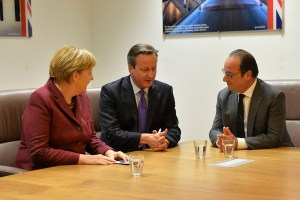
David Cameron - Angela Merkel - Francois Hollande - EU Renegotiation - Brexit

Agree with this article? Violently disagree? Scroll down to leave a comment.

Follow Semi-Partisan Politics on TwitterFacebook and Medium.

David Cameron And Donald Trump – Promising Security Over Conservatism

David Cameron - Donald Trump - Conservatism - Conservative Party - Republican - GOP - Ideology - Security

Donald Cameron and David Trump. Or is it the other way around?

In many ways, you couldn’t imagine two politicians more different than Donald Trump and David Cameron.

The British prime minister (despite his best efforts) exudes an air of privileged, private school entitlement at all times, and has a reputation for making withering (if cruel) put-downs of his opponents in the House of Commons. The increasingly presumptive Republican Party presidential nominee, on the other hand, takes pride in being brash and boastful, and his claim to “have the best words” is as laughable as it is factually inaccurate.

Furthermore, David Cameron was quick to weigh in against Donald Trump when Trump made sweeping and inaccurate generalisations about Britain and Muslims, stopping short of the shrieking and hysterical calls for Trump to be banned from entering the UK, but still condemning him in strong words.

And yet, the two politicians – one seasoned in Westminster politics, the other making a virtue of his inexperience in the ways of Washington – are more alike than it first seems.

In seeking to understand the persistent appeal of Donald Trump to a large and broad swathe of the Republican Party base, Einer Elhauge argues that Donald Trump wins because he promises to be The Great Protector, keeping Americans physically safe and financially secure in an uncertain world.

Elhauge writes in the Atlantic:

The message of his Republican opponents has effectively been: We are more faithful to conservative principles. Trump’s message has been entirely different. He essentially says: I will protect you. I’m conservative, but if protecting you requires jettisoning conservative ideology, I will do so. Protecting you is the prime directive. This message has powerful resonance, especially for voters who feel the Republican Party has failed to protect their interests.

You see this pattern in all of Trump’s deviations from conservative orthodoxy. Take the debate over Planned Parenthood. Like all conservatives, Trump opposes abortions. But he stresses he does not want to stop funding their wonderful work protecting women from cervical and breast cancer. The other Republican candidates simply express a desire to destroy Planned Parenthood outright. Trump’s message to voters: The other candidates will adhere rigidly to ideology, even if it needlessly fails to protect millions of women from cancer. I won’t.

[..] Trump’s signature policy is to build a wall to protect his voters’ jobs. What could evoke protection more than building a huge wall? His opponents quibbled about its feasibility but ultimately adopted the same position. Trump’s message to voters: I care about protecting you enough to propose huge historic projects. The other candidates begrudgingly agreed, but their heart is not in it, so they are less likely to follow through.

Free trade is great, Trump says, but it has to be fair. His opponents just adhere to pure free trade, which does increase the economic pie. But economic research shows that free trade harms some subsets of voters, particularly the working-class voters flocking to Trump. The message to his voters: I will favor free trade only to the extent that I can protect you from harm, perhaps by compensating you using the gains of trade. My opponents will favor free trade even if it harms you.

And as it goes for policy, so it goes for style. Trump consistently eschews the hard-headed statements of fidelity to conservative principle or the Constitution which voters hear from Senator Ted Cruz, focusing instead on cultivating the same “your safety first” narrative:

Trump talks endlessly about his polls, because the polls stress that he is strong enough to protect his voters. He speaks extemporaneously and often crassly in a stream-of-consciousness way, which has many pitfalls but emphasizes that his views are unprepared, authentic statements of his views and that he will thus carry out his promises to protect his audience. He responds aggressively to every attack, no matter how minor, conveying the sense that he will also aggressively protect his voters.

It is hard to deny the success of this approach. Many voters, feeling let down by the stewardship of both President Obama and the reactionary Tea Party dominated Congress which followed in 2010, have lost faith in politicians selling explicitly ideological remedies for America’s ills.

Rand Paul, Mike Huckabee and Rick Santorum got nowhere this election cycle, suggesting that the public’s flirtation with Constitutional libertarianism and social conservatism respectively are not the vote-winners they once were. And the same goes on the Left, with Hillary Clinton now pulling clear of Senator Bernie Sanders in the Democratic primary, despite the huge achievements of Sanders’ campaign.

The situation in Britain is strikingly similar. David Cameron’s general election victory – at Labour’s expense and despite the rise of UKIP, the SNP and Green Party on the radical Right and Left – suggests that while a minority of voters (this blog included) crave stronger ideological differences and a move away from consensus politics, a larger number of people looked at the two main parties and went for the option which they believed would deliver them the most security.

Having secured his coveted Conservative majority government in the general election, David Cameron declared in his victorious 2015 party conference speech:

I tell you: our party’s success in growing our economy and winning the economic arguments has never been more vital.

Nothing less than the security of every single family in our country depends on it.

Before concluding:

And now with couples married because of us, working people backed because of us, the NHS safe because of us and children in the poorest parts of the world saved because of us, everyone in this hall can be incredibly proud of our journey – the journey of the modern, compassionate, One Nation Conservative Party.

This was not the speech of a flinty-eyed ideologue yearning to roll back the frontiers of the state. It was the speech of a leader who calls himself a conservative, but is perfectly willing to use the machinery of government to deliver the social and economic outcomes that he wants – in Cameron’s case, building an election-winning coalition by promising physical, social and economic security over and above freedom and individual liberty.

Ed Miliband, to the extent that his weak leadership stood for anything, ran on a platform of fairness and equality, emphasising entitlement over strength and security. And it got him absolutely nowhere.

David Cameron and the Conservatives, by contrast, ran on a platform of stability and security as the only objective. It wasn’t thrilling, inspiring or glamorous, but given the weakness of his opponents, it was enough to deliver a parliamentary majority that almost nobody predicted.

You can argue that David Cameron represents everything that is ideologically vacuous and wrong with modern British conservatism – as this blog does, loudly and often. But what you cannot do is deny the fact that Cameron has hit on a winning electoral strategy.

That’s why David Cameron ran for re-election with a manifesto pledging a creepy, statist “plan for every stage of your life”.

That’s why the Conservative Party talks about creating a strong economy not as an end in itself, but only in the context of generating more taxes to pay for ever more public services.

That’s why there is not an ancient right or civil liberty that David Cameron and Theresa May will not gladly crush in their effort to be seen as strong in the fight against terrorism.

Sure, they may look and sound different – almost complete opposites, in style and temperament. But both Donald Trump and David Cameron are both essentially playing the same trick – or perpetrating the same fraud – on their respective electorates, depending on your outlook.

Donald Trump was once a Democratic Party supporter and donor, talked up his great friendship with the Clintons and held positions which are diametrically opposed to his current conservative stances. David Cameron, meanwhile, calls himself a Conservative but is busily implementing Tony Blair’s fourth term New Labour agenda.

Neither man is what he publicly claims to be. And certainly neither Donald Trump nor David Cameron can fairly be described as small-c conservatives.


Donald Trump - Make America Great Again - Hat

Agree with this article? Violently disagree? Scroll down to leave a comment.

Follow Semi-Partisan Politics on TwitterFacebook and Medium.

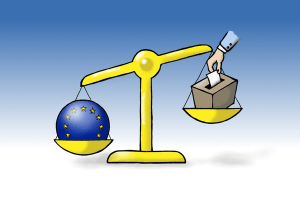
Brexit: How Much Democracy Would You Sacrifice To Reduce Uncertainty?

Brexit - European Union - Democracy - Uncertainty - 3

How much democracy would you give away in the hope of greater short term stability?

Our glorious leader has taken to the pages of the Sunday Telegraph today to offer his standard stump speech, talking down Britain’s prospects as an independent country.

Focusing exclusively on the (mostly) short term costs of Brexit whilst determinedly overlooking the costs of remaining in a relentlessly integrating political union, David Cameron warns:

A year ago, the Conservative election manifesto contained a clear commitment: security at every stage of your life. Britain is doing well. Our economy is growing; unemployment is falling to record lows.

We need to be absolutely sure, if we are to put all that at risk, that the future would be better for our country outside the EU than it is today.

There is no doubt in my mind that the only certainty of exit is uncertainty; that leaving Europe is fraught with risk. Risk to our economy, because the dislocation could put pressure on the pound, on interest rates and on growth. Risk to our cooperation on crime and security matters. And risk to our reputation as a strong country at the heart of the world’s most important institutions.

And in other utterly astounding and headline-worthy news, a group of finance ministers from the world’s leading economies released a statement yesterday, sombrely declaring that Britain leaving the European Union would represent an economic shock.

Or as the Telegraph tells it:

The global economy will suffer “a shock” if Britain votes to leave the European Union, the world’s 20 leading nations have warned.

In a joint statement, finance ministers from the G20 group of major economies unanimously agreed that the risk of “Brexit” posed dangers for international stability.

George Osborne, who is attending the meeting of central bankers and ministers in China, said the danger of a Leave vote on June 23 would represent one of the gravest threats of 2016.

In what will be seen as a coded attack on Boris Johnson, who is campaigning to leave, he added that the leaving the EU would not be “some amusing adventure” but a serious threat to Britain and the world.

Well, that’s it then. Quest for democracy and self-governance cancelled. Call off the referendum and put away all those naive thoughts of Brexit, because the world financial markets don’t like the idea very much, and what’s best for an American hedge fund manager automatically trumps your right to self determination.

Why, oh why do those awful eurosceptics and Brexiteers persist with their alarming and selfish calls for an end to undemocratic, unaccountable, supra-national government? Can’t they see that they are creating economic uncertainty? Won’t somebody please think of the children?

This, by the way, is the same George Osborne who insisted that “we rule nothing out” when it came to possibly campaigning for Britain to leave the EU, until the conclusion of the so-called renegotiation. This opens up the hilarious thesis that while the Chancellor of the Exchequer believes that Brexit would be unspeakably traumatic for Britain and for the world economy, he was nonetheless prepared to recommend that we quit the EU and flirt with so-called disaster, had Britain not secured that precious reminder that we are already under no obligation to adopt the euro (one of our renegotiation “victories”).

If George Osborne is so desperate to warn us that Brexit would not be an amusing adventure, why was he willing to publicly countenance Britain leaving the EU in the event that he and David Cameron failed to win their puny basket of concessions from Brussels? If Britain leaving the EU would inevitably be such a disruptive and traumatic event, why did they insist that nothing was off the table if they didn’t get what they wanted?

But put all of that to one side. The more fundamental question we have to ask ourselves is whether we are happy for every key decision about our civic life to be determined purely by economic forecasts. And not necessarily detailed or well researched forecasts at that, but rather by unverifiable assertions about fickle market sentiment – which inevitably prioritises the short term over the long term, and which can put a price on risk but not on democracy.

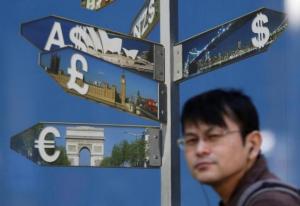
A man walks past various currency signs outside a brokerage in Tokyo
The EU apologists in the Remain camp will throw their hands up in mock horror at this statement, but it is true: some things – like democracy – are more important than money.

In fact, you can tell a lot by observing the times when EU apologists and left-wingers earnestly listen to the voice of big business and the far more frequent occasions when they demonise the “greedy” corporate world. To point out the naked confirmation bias at play here is hardly necessary.

As this blog commented some time ago, when HSBC was making dark murmurings about potentially upping sticks and leaving Britain in the event of Brexit:

Isn’t it funny how the voice of big business – usually the object of scorn and hatred from the left – suddenly becomes wise and sagacious when the short term interests of the large corporations happen to coincide with those of the Labour Party?

Labour have been hammering “the corporations” relentlessly since losing power in 2010, accusing them of immoral (if not illegal) behaviour for such transgressions such as not paying enough tax, not paying employees enough money, paying employees too much money and a host of other sins. In Labour’s eyes, the words of a bank executive were valued beneath junk bond status – until now, when suddenly they have become far-sighted and wise AAA-rated pronouncements, just because they have come out in support of Britain remaining in the EU.

The ability of the British people to determine their own future does not appear as a line item on any company’s balance sheet or P&L account, so of course large corporations – as represented by the minority of FTSE 100 chief executives who recently signed a letter arguing against Brexit – do not care whether the people in their home country live in a functional democracy.

Most businesses are just as happy to make money from operating in oppressive autocracies as it is in free democratic countries; nobody is investing in China out of admiration for that dictatorship’s record on human rights. And indeed it is not the job of corporations to make such value judgements, or to safeguard the constitutional frameworks that hold this or any other country together.

That job falls to our politicians, people who should be able to distinguish corporate self interest from the national interest. And who should be able to distinguish between serious macroeconomic upheavals based on a fundamentally worsening economic outlook and short-term macroeconomic shocks based on spooked markets and jittery investors.

Of course Brexit might cause shock waves and be disruptive in the short term. One of the largest and most influential countries in the world would be leaving the most prominent supra-national political union in the world, and it would be concerning if such an event took place without causing a ripple of attention. But potential economic uncertainty is not the point, and neither is it a sufficient reason to fearfully remain in the EU in perpetuity while overlooking the profound and irredeemably anti-democratic nature of the club.

In fact, one can go further and argue that it is the tremulous fear of uncertainty – and our apparent preference for technocratic risk-minimisation at every turn and in every aspect of our lives – which has sucked the ideological contrast out of our contemporary politics and done so much to encourage voter apathy.

Pete North picks up on this point in an excellent blog post, in which he argues that a little uncertainty might actually be a very welcome development:

This is why the EU sucks. We can have any government of any stripe so long as it performs within a set of predefined parameters and does as it is told. How very dull. In dispensing with democracy we have dispensed with politics and in place of politics we have civic administration where everything is merely about the allocation of resources. Where’s the big idea?

We have heard from every politician the same vague promises about returning power to the people and restoring localism, but we’ve heard it from ardent europhiles who do not see the inherent contradiction in their empty words.

By excluding the people from decision making we have killed off social innovation and enterprise, we have beaten the life out of our education system and where our health system works it is more through luck and the application of cash than actual managerial skill. It is little wonder that business looks overseas for skilled individuals in that our schools are micromanaged to the point of insanity, beating the vitality out of teachers so that children are neither engaged nor educated.

Put simply, there is no longer any uncertainty in politics. The corporates have got their own way. They keep saying if we leave the EU, it will cause uncertainty but that’s actually exactly what we need. We do need some uncertainty that causes to re-engage in politics and to learn more about civic participation and steer decision making. We need some political risk taking so that we can innovate. It might mean a lot improves and it might mean some things break down. But wouldn’t that be more tolerable than the interminable beigeness of modern, post-democracy Britain?

And ultimately, it comes down to that one question: what price does the Remain camp put on democracy?

If the EU is frustrating and imperfect (as all but the most starry-eyed europhiles concede) but leaving would simply be too great a risk, where then is the tipping point? At what point do the negative consequences of gradually but relentlessly losing control over the decisions which affect our lives outweigh a brief wobble in the FTSE 100 or a few sleepless nights for central bankers? And if we have not already reached this tipping point, those who argue for us to stay in the EU have a moral responsibility to tell us where they do draw the line.

Europhiles, particularly those on the political Left, love to portray themselves as progressive and enlightened warriors, fighting for freedom and security for the little guy. Well, here is a blazing example of them doing exactly the opposite in real life.

Given the choice in this referendum to stand up for the right of the poorest and most disadvantaged citizen to exert some limited measure of control over their government by campaigning for Brexit and repatriating sovereignty from Brussels, instead the EU apologists would condemn us to yet more political union with Europe. And all because to do otherwise would go against the wishes of finance ministers, central bankers and certain chief executives. Way to fight for the average citizen!

Risk and uncertainty are not dirty words. And while our prime minister seems to believe that we are a nation of frightened children who are terrified of making important decisions and who instinctively run away from the slightest risk, I choose to hope that there are still enough of us who realise that the EU’s anti-democratic status quo is not the best option for Britain’s future, that David Cameron’s sham renegotiation has done nothing to change that basic calculus, and that a brighter and more democratic future could await us if we dare to ignore the many vested interests and take bold action.

David Cameron went to the country at the general election last year offering a Big Government, nanny state “plan for every stage of your life”. He now asks us to trust that the future he has carefully planned out for us – one of sheltered irrelevance, tucked away in an anachronistic 1950s regional political union – is the best that modern Britain can hope for.

This referendum provides the opportunity for British citizens to show that we hold our country in much higher regard than does our own prime minister – and to help consign David Cameron, together with our EU membership, to the dustbin of political history.


EU Democracy - Brexit

Agree with this article? Violently disagree? Scroll down to leave a comment.

Follow Semi-Partisan Politics on TwitterFacebook and Medium.