Bring The Police To Heel

Two stories in the media this afternoon, each quite different in nature but both pointing toward the same dark, disturbing and authoritarian shift that continues unabated in Britain today.

policedogs

The first is from The Telegraph, serving up video footage of a police sergeant in Gloucester threatening a photographer, admitting to swearing at him and threatening him with physical harm:

The officer is heard to say, “we’ll nick you now and I will make your day a living hell, ‘cos you’ll be in that cell all day. What I’ll probably do is I will ask for you to be remanded in custody and I will put you before the magistrate.”

He added: “You’re lucky that I didn’t knock you out. I swore at you, yeah. It got your attention, though, didn’t it?”

Because apparently taking pictures or video of the aftermath of a road accident is now illegal in our country, as is showing anything but the most fawning and servile deference and adulation to the most power-crazed and high-handed officers in the police force.

The second article is chilling on an altogether different level, and chronicles the process by which the UK’s anti-terrorist police decided that it would be in any way appropriate and proportional to haul a twelve year old boy out of his class at school to question him about an event that he had organised on Facebook to protest the planned closure of his local youth club:

Wishart said that after the school was contacted by anti-terrorist officers, he was taken out of his English class on Tuesday afternoon and interviewed by a Thames Valley officer at the school in the presence of his head of year. During the interview, Wishart says that the officer told him that if any public disorder took place at the event he would be held responsible and arrested.

Speaking to the Guardian, Nicky Wishart said: “In my lesson, [a school secretary] came and said my head of year wanted to talk to me. She was in her office with a police officer who wanted to talk to me about the protest. He said, ‘if a riot breaks out we will arrest people and if anything happens you will get arrested because you are the organiser’.

The event was organised in the Prime Minister’s home constituency of Witney in Oxfordshire, but in what possible dark, dystopian world is it okay for the police to make a mountain out of a truly tiny molehill and question the intentions of a young boy who was doing nothing but being an engaged and activist citizen? Our country would be vastly better off if there were more children like Nicky Wishart, who actually care about local issues enough to take a stand rather than festering away in front of the television for hours on end.

But it is the next quote attributed to the police that is truly terrifying:

“He said even if I didn’t turn up I would be arrested and he also said that if David Cameron was in, his armed officers will be there ‘so if anything out of line happens …’ and then he stopped.”

If anything out of line happens, the armed officers will do what, exactly? Shoot a twelve year old boy as some kind of sadistic punishment? What reason is there to mention the potential presence of armed officers, other than to imply that they might do the one thing that regular police officers do not?

The truly scary thing is that we don’t even have to worry about our politicians using their power and influence to get the security services to intimidate and threaten the population on their behalf – the security services seem perfectly willing to proactively do so of their own volition!

We must also ask why it was the anti-terrorist police (who apparently have no real serious threats to the nation on their agenda at the moment to be wasting time on routine public intimidation work, for which I suppose we can all breathe a sigh of relief), of all the many branches of our national law enforcement apparatus, who seemingly felt it necessary to bully a small child about his planned political protest. Has GCHQ intercepted terrorist chatter that Al Qaeda intends to infiltrate local community action groups in order to launch their next attack? Whatever next – fears of ricin or anthrax being baked into scones at a Women’s Institute cake sale, and elderly ladies being detained in their kitchens?

The police make the predictable but ludicrous claim that their intention was not to cause distress or to intimidate Wishart, but was simply part of their standard community outreach efforts:

“On Tuesday 7 December, our schools officer for west Oxfordshire attended the school in Eynsham and spoke to a 12-year-old boy in the company of the pupil’s head of year, about a planned protest. This was not with the intention of dissuading him from organising it, but to obtain information regarding the protest to ensure his and others’ safety. As with any demonstration, we always aim to facilitate a peaceful protest.”

Perhaps the police need to apply the “ordinary person” test and reconsider the likely effect of being yanked out of class and spoken to by police in the presence of a senior teacher with no parents or legal representatives present, on the psyche of a young boy. Is doing what they did more likely to “facilitate a peaceful protest” or to stamp out a potential protest before it ever sees the light of day?

David Cameron needs to send a very clear message to the nation in response to this outrage, as a matter of urgency. And through the locally elected police commissioners, he needs to publicly rebuke and call off the police attack dogs currently biting at the ankles of the British citizenry. Cameron and the commissioners must make clear that individual police officers will curry no favour with their superiors by overzealously applying extreme interpretations of public order laws, and that those higher in the law enforcement hierarchy will receive no special favour from their political masters by using their extensive powers to bully and silence any protest that could be politically embarrassing.

Semi-Partisan Sam is quite unequivocal on this matter. The apology from the police to the family concerned is all well and good, but it is quite insufficient. It is high time that the British police are brought to heel once and for all.

Our Superficial Media

The G8 summit in Lough Erne, Northern Ireland, finished some days ago now, but our intrepid journalists in the press are still on the case, poring over and analysing the ramifications and outcomes of this latest summit.

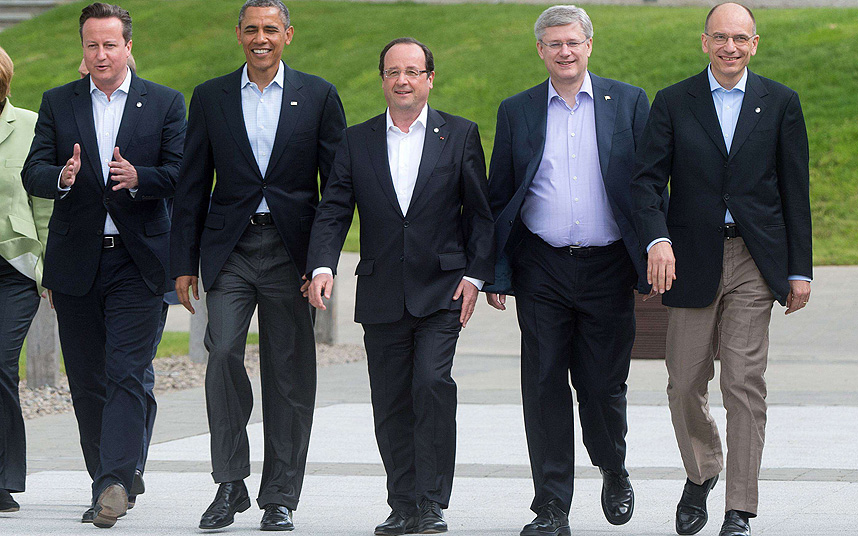
Unfortunately, the minds of our (supposedly) best journalists and bloggers are not concentrated on the policy substance of what was (and was not) agreed at the meeting, distracted as they are by something far more important and consequential – the fact that David Cameron insisted on a smart-casual dress code for the world leaders at this year’s G8, rather than the buttoned-up suit and tie look that is par for the course at these events.

They mean serious business because the ties have come off

Iain Dale, writing at Conservative Home, sniffs:

Whoever chose Lough Erne as the venue for the G8 should get some kind of honour. As a PR exercise it couldn’t be faulted. The countryside backdrops to all the interviews and press conferences were simply stunning. Less stunning, though, was the fact that David Cameron seemed to have a physical aversion to wearing a tie at any point during the event. Orders had clearly gone out from Number Ten that this was a ‘dress down’ G8, although it was rather difficult to tell whether Angela Merkel had got the message, as in all the pictures I saw she seemed to be wearing the same, tired old lime green jacket. I assume she brought a change of underwear.

What penetrating insight. In The Telegraph, Benedict Brogan thunders:

G8 summits are notorious for their sartorial excesses: matching floral shirts, ponchos, stetsons, it has become a commonplace for the host country to rope the visitors into trying on some sort of local dress. Yet what happens when the world’s most powerful men (sic) gather in the UK? We make them dress like bachelors emerging into the bleary dawn after a vigorous stag party. We might as well ask them to wear jeans. What’s wrong with a bit of understated English tailoring, as a way of plugging one of our more successful exports? In fact, it’s London Fashion Week. There’s all kind of natty pastel numbers available, rather than the blue blazers. But for my money, they should tie one on to show they take the taxpayer – and their responsibilities – seriously.

Someone might be so kind to remind Mr. Brogan that he would be taking his responsibilities as a journalist for a prestigious newspaper more seriously if he focused on the policy agenda of the G8 summit, and not the dress code.

Even The Guardian gets in on the act, with a dedicated feature in their Fashion section:

Not for the first time, the dress code has proved to be one of the trickier aspects of the G8 agenda. Style novice George Osborne underlined the dilemma with his sartorial excuse to BBC Breakfast on Tuesday. “I’m doing what I was asked,” he said. “I got out my jacket and blue shirt.” Forget tax and Syria, smart-casual is tough for these guys.

Cameron demonstrated yet again that for him sleeves rolled up and no jacket semaphores getting down to business. He famously did it on the campaign trail all-nighter and he’s done it at Lough Erne. For him a suit jacket and tie is for everyday prime ministerial humdrum but real power dressing – when he’s hosting international leaders – means pale blue cotton and unironed chinos.

But the real gem comes from the sub-headline to that same Guardian article, which reads as follows:

Forget tax and Syria, smart-casual is tough for these guys. Cameron demonstrated yet again that for him sleeves rolled up and no jacket semaphores getting down to business.

Forget tax and Syria. Indeed. Some people certainly have; unfortunately, they are the people whose job it is to hold our elected leaders to account, to scrutinise, analyse and challenge their activities and policy decisions. With a barely growing economy, persistently high unemployment (we recently celebrated the economy adding 5000 new jobs – a paltry 5000 in country of 65,000,000!) and widespread dissatisfaction with his leadership, David Cameron must have been delighted to be taken to task over his sartorial choices rather than his lacklustre/harmful economic policies and desire for more middle-east adventuring in Syria.

The journalists will no doubt counter that there is a “legitimate public interest” in stories like this, that the public are interested and want to know, justifying all of their column inches on rolled-up shirtsleeves and ties, and the dearth of column inches on the outcomes of the G8 summit. This argument is complete claptrap. The journalists themselves generate the public interest in these process-driven non-stories, thus justifying (in their minds) their decision to cover them in ever increasing detail. After all, it’s far easier to sit at your laptop for twenty minutes and bang out a vapid column about the fashion choices of our politicians than it is to do some real journalism, and pore through meeting minutes and policy papers to educate and inform the public as to what is really going on.

Enough of superficial political “journalism”. David Cameron, Barack Obama and the other six can wear matching gimp costumes to the G8 for all I care; what matters is whether they (for once) manage to cook up some policies that actually benefit the non-elites in our respective countries, and (wishfully thinking) take positive steps toward hammering out a comprehensive EU-US free trade treaty.

But I’m not holding out much hope. Our leaders don’t have the best track record when it comes to acting in our interests, and “journalists” such as Iain Dale and Benedict Brogan seem more interested in clucking disapprovingly at their outfits than scrutinising the decisions that they make.

Law? What Law?

I have so much to say about the shocking NSA unconstitutional spying scandal blown wide  open by whistleblower Edward Snowden and journalist Glenn Greenwald that I barely know where to begin.

So I shall begin with a tangent – the repercussions of the case over in Britain, where scandal has erupted because it turns out that Britain’s intelligence-gathering departments have had access to the US PRISM system for a number of years, and have made use of it on occasions to eavesdrop on the conversations of British citizens.

This should be causing people to light flaming torches and take to the streets, but as it stands today in docile modern day Britain, Prime Minister David Cameron is just being made to squirm a bit. The Huffington Post reports:

The foreign secretary, who is due to make a statement on the allegations in the Commons later, has said the law-abiding British public had “nothing to fear” from the work of GCHQ.

However MPs are likely to press Hague on whether the intelligence service has always abided by the legal framework.

Sir Malcolm Rifkind, the chairman of the ISC, told BBC Radio 4’s Today programme that GCHQ would have needed to ask ministers before requesting information on British citizens’ internet activity from the United States.

How comforting. But worst of all were the comments from David Cameron himself, who thought that these flimsy, meaningless words would serve somehow to placate us:

David Cameron has said British intelligence agencies operate “within a legal framework”, as MPs prepare to grill William Hague on GCHQ’s involvement with the American Prism internet surveillance system.

“I think it is right that we have well-organised, well-funded intelligence services to help keep us safe,” the prime minister said on Monday morning.

“But let me be absolutely clear. They are intelligence services that operate within the law, within a law that we have laid down, and they are also subject to proper scrutiny by the intelligence and security committee (ISC) in the House of Commons.”

What the hell does this garbage even mean?

British intelligence agencies are operating within a legal framework. Okay, what legal framework?

He thinks that it’s right to have an intelligence service? Who on earth was saying that it wasn’t?

But the final line is the worst, where he says that the intelligence services are operating within “a law that we have laid down”. Oh, well that’s fine then, let’s all go home.

Does David Cameron at any point mention the particular law under which the intelligence services are operating? Or when this law that “we” laid down was written, voted on and approved? Of course he doesn’t! And I, for one, would rather like to know.

Do you see the difference between having a written constitution and not having one? Do you?

Even if (as in the United States), the President and his administration choose to brazenly flout it, the written constitution at least gives a frame of reference when it comes to determining whether an action is acceptable or unacceptable. Contrast this with Britain, where the most basic laws of the land can (and often are) changed on a whim by the elected dictatorship of a majority government. In Britain, if we are told that a government action that we disagree with is “lawful”, there is no end of Acts and Amendments and revisions and EU law and whatever else to sort through in order to work out whether or not it is so.

The result, of course, is that the British don’t even try. We might kick up a bit of a fuss if someone catches David Cameron devouring live puppies in the alley behind Downing Street one warm summer night, but once his spokesman assures us that he was acting “within the law, within a law that we have laid down”, we would all meekly nod, and let him get back to his puppy-butchering.

This is unacceptable. William Hague and David Cameron need to make crystal clear not only the laws currently on the statute books which allow for spying on the communications of a British citizen (with or without a warrant), but also the specific criteria that the intelligence services use, or at least the threshold of evidence that must be met, when selecting an individual for such a breach of their privacy.

Not that it much matters. David Cameron has lost my vote today.

The UKIP Insurgency

Nigel Farage UKIP voting


Well, those local council elections across England this past week were quite interesting.

The United Kingdom Independence Party has firmly established itself as Britain’s fourth (or maybe even third) party with a strong showing in which they received over 25% of the vote across those wards where they were able to field candidates.

And this despite a volley of negative and dismissive statements ahead of the elections, in which UKIP’s leadership, membership, policy positions and candidate screening processes were all mocked and derided.

Cue lots of hand-wringing about what the Tories can do to win back their disaffected supporters, etc. etc. As The Guardian reports:

A contrite David Cameron has promised to show a surging UK Independence party respect after it gained more than 130 seats in the English county elections and polled 25% of the national vote. The result led the party’s leader, Nigel Farage, to claim the birth of a new and irreversible era of four-party politics.

Cameron, who once described Ukip as fruitcakes and closet racists, admitted his mistake, saying it was no good insulting a political party that people had chosen to vote for: “We need to show respect for people who have taken the choice to support this party. And we’re going to work really hard to win them back.”

Cue also some quite entertaining journalism about the quirky, eccentric nature of British local politics. As Iain Martin writes in The Telegraph:

What is even funnier is the confusion it is causing the leaders of the established political class. They are already emerging for a round of local election bingo, with the key phrases drawn from the standard issue manual used by all the major parties. “We hear what people are saying… people want to make a protest… they want us to get on with the job… people have very real concerns… it’s mid-term… we’ll be reflecting.” But this time, when they mouth the words, they look as though they know their platitudes have been rumbled.

The distress the voter rebellion causes the bigger parties does seem to be an important part of the appeal of Ukip. Voting for Farage is an entertaining way of giving the Tories, Labour and the Lib Dems two fingers. Of course the longer-term implications are not necessarily funny. This is a country, not a comedy club. But large numbers of voters are so disenchanted that they see no possibility of an answer in the old parties. They are having a lot of fun trying to blow up the system.

Of course, this runs contrary to the counterargument that these were only local elections, that off-cycle elections always see the governing party (or parties in this case) punished at the ballot box, and that people will return to one or other of the Big Three come the general election in 2015.

But a 25% share of the vote, and a national second place position, can start to shift perceptions, a fact that Nigel Farage, UKIP’s leader, is no doubt counting on. If people absorb the consequence of these election results and no longer see UKIP as a party of “fruitcakes and closet racists”, as David Cameron once uncharitably called them, their support may not peel away as it has previously done, and we could see a number of newly minted UKIP MPs entering parliament.

But what is contained within the UKIP manifesto? Well, quirky though some of their individual members and candidates may be, the manifesto on which they are running is actually quite appealing to those who favour smaller government. The BBC offers a fair overview, which includes the following:

EUROPE: Nigel Farage says he wants an “amicable divorce” from the European Union. Britain would retain trading links with its European neighbours but would withdraw from treaties and end subscription payments, adopting a similar relationship with the EU to Norway or Switzerland.

TAX: UKIP favours a flat tax – a single combined rate of income tax and national insurance paid by all workers. It claims this would end the complexity of the current system and allow people to keep more of the money they have earned. It would also lead to a major shrinking of the size of the state, which would revert to a “safety net” for the poorest. The party has yet to decide the rate at which the flat tax would be levied. Its policy at the 2010 election was 31% but a recent policy paper suggested 25%. It is having an internal debate about whether there should be two rates.

EDUCATION: UKIP backs selection by ability and would encourage the creation of new grammar schools. It would give parents vouchers to spend in the state or private education sector. It also advocates the return of the student grant system to replace loans.

DEMOCRACY: The party wants binding local and national referendums on major issues.

Freedom from EU meddling and over-regulation. A fair, flat tax. Freeing the education system from those who want uniform mediocrity at the expense of individual excellence. A strong national defence. All of these are causes dear to the hearts of the small-government conservative, and make the party worthy of support.

Of course, with the good also comes the less-good:

ENERGY AND CLIMATE CHANGE: UKIP is sceptical about the existence of man-made climate change and would scrap all subsidies for renewable energy. It would also cancel all wind farm developments. Instead, it backs the expansion of shale gas extraction, or fracking, and a mass programme of nuclear power stations.

GAY MARRIAGE: UKIP supports the concept of civil partnerships, but opposes the move to legislate for same-sex marriage, which it says risks “the grave harm of undermining the rights of Churches and Faiths to decide for themselves whom they will and will not marry”.

LAW AND ORDER: UKIP would double prison places and protect “frontline” policing to enforce “zero tolerance” of crime.

THE ECONOMY: UKIP is proposing “tens of billions” of tax cuts and had set out £77bn of cuts to public expenditure to deal with the deficit.

Anti-science climate change denial is tempered with a pragmatic approach to ensuring energy security through next generation nuclear power. The unfortunate opposition to gay marriage is at least balanced with support for civil partnerships. The spirit of cutting taxes and controlling spending is absolutely right, but the wisdom to wait until a stronger recovery exists is lacking. And the draconian, counter-productive policies on law and order are just bad.

So there is good and bad in the UKIP manifesto, just as there is in the manifestos of the other main political parties. As always, the ultimate question must be who delivers the best package of policies to improve the country?

Until now, I have been fairly dismissive of UKIP’s offering to the electorate, but no more. Here is a broadly libertarian-leaning party, offering a no-nonsense, very pro-British package of policies. And while there is a little too much authoritarianism and social conservatism still in the mix, the failings of the present Conservative-led government to revitalise the economy and enact any of the urgently-needed supply side reforms in Britain make UKIP a potentially viable alternative for my vote.

The UKIP manifesto is worth a read. Are there unsavoury fringe elements within UKIP, and endorsements from without? Certainly. Are there some rather eccentric characters representing the party at the moment, yes. Are all of the policies fully costed and backed with feasibility studies? Of course not – UKIP has never seen power, and remains a less mature political party. But then so were the Liberal Democrats until the 2010 general election gave them the chance to wield real power and become as dour and unappealing to the electorate as Labour and the Conservatives.

We currently suffer under a Conservative-led government that has done barely anything to shrink the scope and size of the state, and the meddling influence of all levels of government in our lives. UKIP promises to do differently.

And, based on their manifesto if not their fringe supporters, would that not potentially be a very good thing for the cause of smaller government and individual liberty?

Budget 2013 Drinking Game – The Results

Well, Budget 2013 is now behind us, though the frenzied analysis continues unabated.

We heard George Osborne’s more-of-the-same speech.

We heard Ed Miliband’s “I would do roughly the same, but make things slightly worse” rebuttal (despite the deputy speaker’s unfortunate rhetorical question asking Labour backbenchers why they didn’t want to hear their own leader).

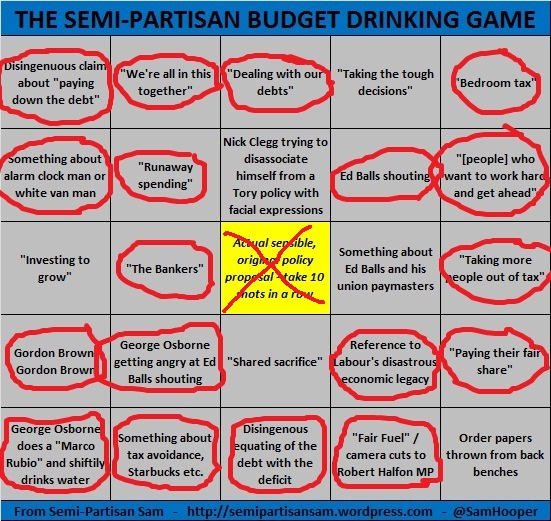
It’s time to check our scorecards and see how we fared in the Semi-Partisan Budget 2013 Drinking Game!

Semi-Partisan Budget 2013 Drinking Game - The Results!
Semi-Partisan Budget 2013 Drinking Game – The Results!


Well, the results are in and it looks as though I have done rather well.

The most magnificent triumph, of course, was my correctly predicting that George Osborne would have a “Marco Rubio” moment mid-speech, and urgently grasp for a glass of water. I awarded myself extra points for that prognostication.

Some, of course, could not be proven one way or the other – the ridiculous rules which still govern the filming of Parliament mean that you rarely get to see a full shot, so I’m not sure who was throwing their order papers, or popcorn, or kicking the seat of the MP in front of them.

But I will take 18/25 as a good result any day. The middle square, of course – an actual sensible policy proposal – was always out of the bounds of possibility, and needless to say did not come to pass.

I hope that you had fun playing, and I would be very interested to hear of any other similar Budget (or other politically) related games that readers may know about. Please do share them in the Comments section underneath this post, or send them to me @SamHooper.

A “fiscally neutral” budget. Rearranging the deckchairs on the Titanic (to use a very tortured metaphor).

Happy Budget Day, everyone!


Semi-Partisan Sam