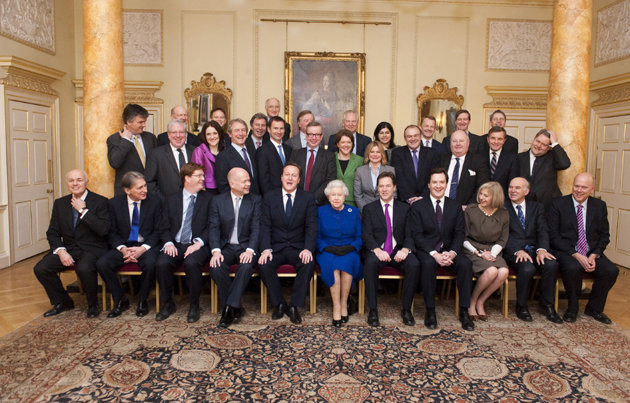
Iain Martin poses an excellent question to restive Conservative ministers and backbenchers currently jostling for position in a 2015 conservative leadership election that may very well never transpire – what would they do for the country if they actually got the job?
A very pertinent question. Watching the unseemly attempts of cabinet member after cabinet member manoeuvre for advantage and brief against perceived rivals provokes unpleasant flashbacks to the time when Gordon Brown finally had his way and muscled Tony Blair out of Number 10 Downing Street, only to become prime minister and realise that he had just fulfilled the extent of his ambition.
With more than a year to go until what will undoubtedly be a closely-fought election campaign, now is really not an appropriate time for self-interested ministers to be promoting their personal prospects at the expense of stable governance. And if they absolutely must indulge in such counterproductive, selfish shenanigans, they could at least give the public some semblance of a reason to believe that they offer a better alternative to David Cameron.
As Iain Martin points out, none of the would-be plotters have yet risen to this challenge:
Some people are positioning ahead of a potential vacancy and talking seriously in private about who the next Tory leader will be. So far it has all been very heavy on personalities and score-settling.
What we hear less of is ideas. What do those who want to succeed Cameron, if he loses, want to do with or for the country? This is, I know, a hopelessly naive question, although I never tire of asking it during a leadership race.
We already have a coalition government that stands for next to nothing. Blaming Labour for the country’s economic predicament and the state of the public finances may be correct, but it doesn’t amount to a platform for governing. And with little more than a year left in the lifetime of this parliament, we can expect precious little more in terms of radical or effective new policies. This mean that the electorate has to make up their minds based on what we can see today. So what is there?
Michael Gove’s education reforms spring to mind as something both tangible and in line with conservative principles, but aside from that, what else can the Tories point to? The period from 2010, when the United Kingdom finally escaped the Gordon Brown terror, has been characterised by retrenchment and burden-sharing and sacrifice-making and painful compromise at every turn. There has been almost nothing positive. Whether it is fiscal policy, defence policy, welfare reform (though credit to Iain Duncan Smith for at least trying), privacy or constitutional reform, it has been an exercise in damage limitation on all fronts.
If the conservatives were (heaven forfend) to elect Boris Johnson as their new leader, or Theresa May, or George Osborne or anyone else, what would they do differently? Why go through the trauma of ditching Cameron and choosing someone else who may be identical, or worse?
Iain Martin proposes a good set of questions, well worth asking, that could help distinguish one candidate from another and maybe tease out some real talent or independent thinking amidst a sea of caution and homogeneity. Making the valid point that voters will not warm to a new leader who only attained his or her position by virtue of being ‘next in line’, he issues the following challenge:
Eventually, the rest of us in the audience – taxpayers, the people who live here, Tories and non-Tories alike – might like to hear what applicants to be Conservative leader and trainee prime minister have in mind, other than stopping each other.
Here are his ten questions:
1) How can the country be more productive?
2) How can we maximise the advantages of globalisation without having to concrete over the whole of southern England to accommodate the millions more who want to be here?
3) Are our banks still too big and how do we get more competition to aid consumers and business?
4) Why is the tax system such a mess of conflicting incentives?
5) Is EU membership really compatible with being a self-governing nation state?
6) Is it even possible to be truly self-governing any longer in the age of the EU, big tech and giant corporates that operate across continents?
7) The Blair/Gove education reforms are up and running – how might they be built on?
8) What is the UK’s foreign policy?
9) What are the threats and how will we defend ourselves?
10) Can the UK be remade to give all its constituent parts, especially England, greater autonomy while still holding together the Union?
While it is absolutely right to challenge those seeking to be David Cameron’s successor to answer these questions, in reality it would be good for all politicians and party leaders to have a stab at addressing them, because these ten questions really form the basis of how we currently see ourselves as a country, and where we want to go from here.
Take the first question on productivity. This could lead to an interesting debate along any number of lines, including trade union reform, European Union membership status, working conditions for interns and apprentices, and more. Already we would see a divide between the mainstream Conservative party MPs who remain deeply eurosceptical, and the more Europhile fringe. Similarly, a contrast would be drawn between the mainstream anti-union position and those such as Robert Halfon MP who have been trying to reintroduce a trade union heritage to the party.
The tax system question is also one that urgently requires answering, not just to help search for the ideal future Tory leader but because the current tax code is such a mess. Some are quite keen to continue incentivising certain ‘good’ behaviours such as marriage through the tax code while others (one dares to hope) might argue for a radical stripping down and simplification of the system. While none of the potential candidates are likely to come out in support of a genuinely interesting idea such as a flat tax, we might see ideas about eliminating the myriad of tax credits in order to lower rates for everyone gain some traction.
Martin’s list is not perfect, and some of the questions are more philosophical than immediately useful. The brace of questions on the EU, for example, are the type of topic that one could imagine being debated at length over canapes at Davos or Bilderberg, but which are of no help in distinguishing future Tory leadership candidates. EU membership is clearly increasingly incompatible with being a self-governing nation state, and will remain that way for as long as the Treaty of Rome’s ‘ever closer union’ call continues to be advanced with no democratic mandate from the European people. And no Tory leader is ever likely to publicly surrender British policymaking to the forces of the EU, multinational business or big tech, no matter what compromises may take place in secret.
The questions on foreign policy and preparing to meet future threats are of extreme importance. While Russia’s annexation of Crimea and continued slide back toward authoritarian despotism is not about to herald a new age of big set-piece land wars in Europe, it will at least hopefully remind UK policymakers that the next unknown threat to the UK will by definition come from out of the blue. Having been chastened by that reminder, Tory leadership candidates might have some refreshing opinions on the size, strength and scope of our armed forces, perhaps with a view toward undoing some of the recent damage done.
The final question on remaking the UK to allow greater (and ideally equal) autonomy for all constituent nations of the United Kingdom, and the need to clearly set out those powers that belong at Westminster, those that belong with the home nations and those that should be devolved to local level is perhaps the most important of all. This blog has long advocated for answering this question by holding a UK constitutional convention to decide these matters once and for all. While this is an extremely unlikely prospect, it would be interesting to know the potential candidates’ thoughts on these matters.
But of course we will hear no opinions on any of these matters, because there are no Tory leadership candidates. And there are no Tory leadership candidates because there is no Tory leadership election on the cards.
The bottom line is this – there are a lot of important questions about the current state of our country and how best to move forward. Iain Martin has done a good service by listing some of these, and any politician who can disengage from the daily grind of politicking and governance for long enough to answer them would be making a valuable contribution to the debate.
But those Conservative ministers and prominent backbenchers inclined to look past the 2015 general election to burnish their leadership prospects while refusing to engage in real debate on the issues are just being opportunistic and cowardly, and do not deserve the air time or our attention.
Those who want to replace David Cameron as leader of the Conservative Party ought to try believing in and standing for something themselves – something other than their own selfish career advancement – before the jostling for position and knife-sharpening gets out of hand.






 Semi-Partisan Politics