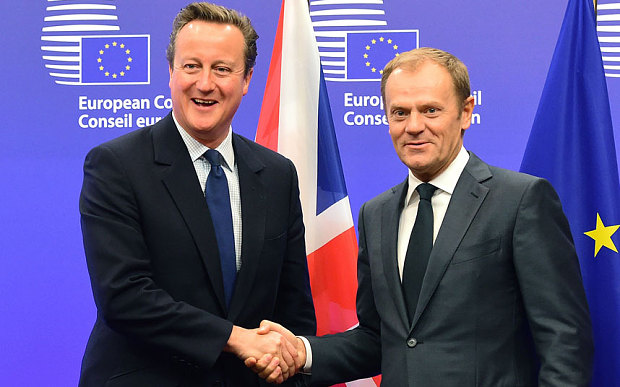
Credulous Media Swallow David Cameron’s EU Renegotiation Myths

David Cameron - Donald Tusk - EU Renegotiation - European Union - Brexit

Nobody in their right mind seriously believes that David Cameron will campaign for Britain to leave the European Union. But that didn’t stop the media from earnestly reporting Number 10’s Brexit bluster

David Cameron is about as far from being a eurosceptic as a Conservative prime minister could possibly be. Sure, he was forced by the rise of UKIP into pledging a referendum on Britain’s EU membership – despite having previously stated that he didn’t think a referendum was appropriate – but this was only ever a matter of political expediency, not heartfelt desire for Brexit or deep conviction that the people should have the right to decide their own destiny.

But this has not stopped the media from willingly and credulously lapping up the latest spin emanating from Number 10 Downing Street – the risible idea that if David Cameron’s EU partners continue to treat him like the pesky kid at the adult’s table, he might seriously campaign for Brexit.

From the Telegraph:

David Cameron has privately conceded he will have to campaign to leave the European Union if he continues to be “completely ignored” by Brussels, the Daily Telegraph has learned.

[..] It has now emerged that Mr Cameron is telling senior figures in his party that he will be willing to campaign for a British exit if EU leaders do not back down over his key reform plans.

“He has said that if he is completely ignored or if they give him nothing he will campaign to leave,” the source said. “He has made that clear.”

Anybody with even one foot rooted in reality should be able to tell that this latest court gossip is nothing but spin. Having (unsurprisingly) gotten nowhere with his renegotiation efforts thus far, David Cameron needs to appear tough and resolute for the home audience. After all, it is pretty embarrassing that the leader of a global power and the world’s fifth largest economy has achieved precisely nothing, despite having embarked on a well-publicised begging tour of Europe. When begging and pleading with the Czechs for permission to change UK welfare rules yields no fruit, some kind of strong public stance is essential to preserve any kind of dignity.

And let’s be frank – the Telegraph didn’t so much “learn” that Cameron is considering campaigning for Brexit through canny investigative journalism, but rather they probably received a tip-off authorised by the Conservative Party hierarchy to place that narrative into the news cycle.

And what a successful stunt it has been. Now we are duly talking about how the prime minister feels so frustrated with the progress of his renegotiation that he is considering this drastic step, when deep down they (and most of us) know that David Cameron would sooner leave his daughter unattended in Nigel Farage’s local pub than recommend to the British people that they vote to leave the EU.

The truth, of course, is that this was always a sham renegotiation. David Cameron didn’t even bother to consult with the British people as to what they wanted out of any new settlement with Europe before jetting off to Brussels to set out his puny demands, so how could he claim to be representing the public’s real concerns?

This whole exercise has been about starting with the outcome of a “Remain” vote and then working backwards to determine the least possible number of concessions required from the EU to deliver that goal, rather than starting with a hard-headed assessment of Britain’s own national interest or public sentiment. And such a back-to-front renegotiation was never going to bear fruit.

As Mark Wallace points out in Conservative Home:

The conventional wisdom is that the Prime Minister has cut back his list of renegotiation demands in order to reach a swift agreement, in which he can claim victory and then hold an early referendum. That probably was his hope; it would certainly make political sense. Unfortunately for him, each aspect of that plan is foundering while the clock ticks down.

With every day that this supposed renegotiation goes on, Britain looks more and more like the weak supplicant nation asking its superiors for scraps from the table – and being rebuffed. This would be humiliating enough, but it is also self-reinforcing. The fact that our EU partners have already seen Cameron going cap-in-hand around the capitals of Europe begging for concessions (rather than boldly stating the UK’s national interest or presenting a radically different vision of EU membership) means that they are emboldened to give away fewer concessions when he comes knocking again.

Right now, the EU has bigger fish to fry than the Brexit question. And with immigration and terrorism top of the agenda, EU leaders feel confident in pushing our renegotiation way down the list of priorities because they know – even if our credulous media claims not to know – that David Cameron will campaign for a “Remain” vote, come what may.

France and Germany are both diplomatically canny countries. If they suspected for a moment that their treatment of David Cameron might seriously cause him to snap and embrace the Brexit cause then they would immediately start making more conciliatory noises. Secretly they might be glad to be rid of Britain, but they know that Brexit would be a stunning, unacceptable repudiation of their vision for Europe. Thus the fact that there is no diplomatic panic in Berlin or Paris is proof that Angela Merkel and Francois Hollande know that their British counterpart remains utterly pliable and sickeningly eager to please.

David Cameron can continue to authorise leaks suggesting that he is contemplating campaigning for Brexit, if it makes him feel better when he is politely ignored by the leaders of other countries a fraction of our size and power. He can promise all the table-thumping rows in the world, too.

But the one thing he cannot do is convince those of us who see through his cheap tricks that he is a real eurosceptic, or that he would ever allow his name to go down in the history books as the man who led Britain out of the European Union.

David Cameron - Angela Merkel - Francois Hollande - EU Renegotiation - Brexit

Agree with this article? Violently disagree? Scroll down to leave a comment.

Follow Semi-Partisan Politics on TwitterFacebook and Medium.

What Does The Conservative Party Stand For In The Era Of Jeremy Corbyn?

David Cameron - What Do The Conservatives Tories Stand For In The Age Of Jeremy Corbyn

With Jeremy Corbyn’s Labour Party consumed by infighting and discredited with the public, David Cameron’s Conservative government could do almost anything it desires. So why is it treading water?

What does the Conservative Party stand for in the era of Jeremy Corbyn?

What do the Tories stand for when they are barely opposed in Parliament, and consequently have virtual carte blanche to do anything they please?

The answer, apparently, is not much of anything. And it’s good to see that more people on the Right are finally starting to get impatient with the lack of conservative conviction flowing from Number 10 Downing Street.

Janet Daley gets straight to the point in her latest Telegraph column, asking what is the point of the Tories if they refuse to radically shrink the size of the state:

It is fairly clear what use the Tories have decided to make of the current lack of opposition. They will become not just the accepted party of government but the only political party that anybody would ever need. Instead of putting forward a specific, identifiable view of what government should be and how it should relate to the people, which they can offer up for debate, they will occupy all the ground, cover all the bases, be everywhere on the political spectrum at once. They will incorporate centre-Left and centre-Right, and make economic intervention live alongside the free market. They will even, as Mr Osborne did in his Autumn Statement, filch the language of enforced equality (“social justice”).

In short, if Labour is not fit to carry on a debate, then the Tories will scrap the idea of debate altogether. They will be all things to all men: the all-purpose, all-embracing, totally inclusive permanent party of government. This new single-party monopoly will incorporate every popular measure, however inconsistent or contradictory, into its amorphous programme. By the time Labour is ready to engage in election-winning argument, there will be nothing to argue about.

Instead of being emboldened by the lack of serious opposition and seeing it as a once-in-a-generation opportunity to do necessary radical things, the Tories have decided to play it for short-term political advantage. The real problems will not be addressed. They will just be fudged – and bought off with fistfuls of money.

The depressing truth is that the Tories in government have made a decision to solidify their grip on power by effectively ceasing to be a small-C conservative party at all, instead rebranding themselves as the only sane choice when the alternative is the Corbyn/McDonnell socialist double act.

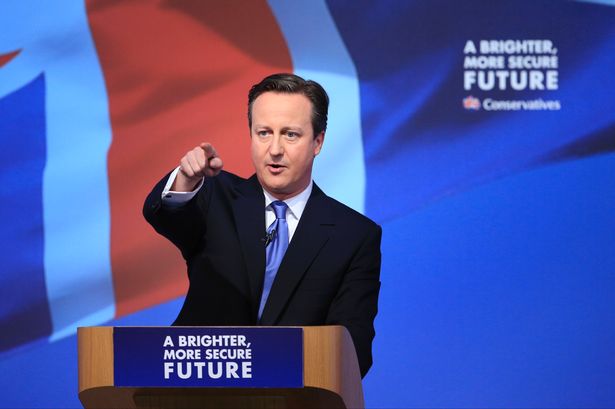
This worrying lack of ideological commitment has been reinforced over and over, whether it’s the Autumn Statement that sounded more like a Gordon Brown-style moneybomb than a fiscally conservative blueprint for government, or David Cameron’s triumphal party conference speech – which even the Independent thought was shockingly centrist.

But not everybody sees it like this. Iain Martin, writing in CapX, sees opportunity in the fact that the Conservatives now essentially govern unopposed:

Corbyn’s leadership does gift the British Conservatives an historic opportunity. Not one of those “they might they win the next general election” opportunities, but the chance to capitalise on Labour’s existential crisis and create a broad-based coalition of interests that dominates the coming decades and turns the UK into an even more dynamic, market-based, technologically advanced, prosperous society.

No. The government can either lead Britain kicking and screaming towards a more dynamic, free and market-based future, or it can create a broad-based coalition of special interests, each with their own collection of whiny, selfish demands and veto rights over national policy. But it cannot do both.

Radical policies of the kind needed to cure Britain’s productivity gap and vastly improve our competitiveness are not borne out of consensual, hand-holding workshops where all of the public service unions and taxpayer funded charities lounge around together brainstorming new ways to extort taxpayer money. Nor are bold policies borne out of the ingratiating desire to please everybody all the time, and never come face to face with a critical newspaper headline.

The radical conservative/libertarian policies that this country needs in order to roll back the state – and empower the people to shape their own destiny rather than remaining vassals of the state or passive consumers of public services – will not be divined by drawing a line half way between the David Cameron and Ed Miliband election manifestos of 2015 and splitting the difference.

When Margaret Thatcher came to power in 1979 she knew that there could be no appeasement with the dismal establishment belief that the best Britain could then hope for was a smoother, more orderly century of national decline than we witnessed during the Winter of Discontent. She knew that Britain needed harsh medicine if things were to be turned around and the patient saved. That didn’t mean that Thatcher rode to battle against every pillar of the post-war consensus simultaneously – nationalised companies and the NHS remained even after her premiership – but it did mean that she was not terrified of being seen as an ideological, even polarising figure. She stood for something.

What do David Cameron and George Osborne stand for, besides keeping the Conservative Party in power and (hopefully) executing a smooth transition from Dave to George by 2020? What kind of Britain do they want to preserve, protect or change? It is almost impossible to tell, because the key decisions – as with the Autumn Statement – are always so depressingly tactical and reactive, not strategic. I was not yet born when Margaret Thatcher became prime minister, but I could describe in some detail her evolving political philosophy and accomplishments in government. By contrast, David Cameron came to power when my political engagement was very high indeed, and yet I would struggle to fill two paragraphs outlining Cameron’s ideology or aims for this country.

Even the few hints of a long-term strategy from the Conservatives – making us more secure, or paying down the national debt – only serve to highlight how far the government is falling short of these goals. The surveillance state continues to expand while the root causes of the extremist Islamist threat are barely discussed, much less tackled; the Chancellor burbles on about fixing the roof while the sun is shining, and yet the deficit is far from eliminated and the national debt continues to increase every single day.

David Cameron - Centrist

But it does not have to be this way. The Conservative Party leadership may be depressingly void of ambition and tainted with the first blush of scandal, but there are green shoots of a future conservative renaissance visible within the party.

Last week I attended a Westminster lobby event held by Conservatives for Liberty, the right-libertarian campaign group for whom I am proud to write. During the course of the evening, we were addressed by five Conservative MPs, each of whom was able to make a far more convincing case for individual liberty in ten minutes than David Cameron has made for the entirety of his premiership.

Chris Philp described himself as a “proud Thatcherite” and dared to make reference to both “The Road To Serfdom” by Hayek and “On Liberty” by John Stuart Mill.

Lucy Allan, the antithesis of a career politician, said “my view is that a real conservative is definitely a libertarian”, and proceeded to speak out against mass surveillance and the rise of authoritarianism in the name of national security.

The irrepressible James Cleverly warned against paternalistic government and the excesses of the public health lobby, saying “I don’t want to live in a world where personal choice is codified. We have a word for that, and that word is fascism”.

John Redwood made a point that the Treasury sorely needs to hear, lamenting that too many MPs “forget they are there to represent taxpayers as well as beneficiaries of state largesse” and describing the state’s overbearing presence in all aspects of life as “a wooden public monopoly that guarantees maximum inconvenience and maximum cost”.

And David Nuttal vowed that he would continue to work tirelessly “to stop the relentless march of the nanny state” and the “massive industry” which supports it.

Of these excellent speakers, Chris Philp, James Cleverly and Lucy Allan (if she stays in politics beyond 2020) are all potential leadership material for the future, particularly in a world where the official opposition is virtually non-existent and the country is crying out for a new, clear sense of direction. Any one of these rising stars have the inspiration and charisma to one day lead the party in a new, more transformational direction.

With the Parliamentary Labour Party seemingly intent on self-administering a near mortal wound with their relentless sniping and bitter briefing against Jeremy Corbyn, a bold new Conservative leader committed to the principles of liberty and a small state (the antithesis of George Osborne, who doesn’t even pay lip service to these ideals) could re-shape the Right and promote a better, more inspiring form of conservatism than the current “Blairism when there’s no money left” status quo.

The fact that David Cameron and George Osborne are watching the slow implosion of the Labour Party and conjuring up plans to woo Ed Miliband voters – rather than capitalise on this once-in-a-century opportunity to execute a real conservative agenda unopposed – reveals their worrying lack of confidence in core conservative principles and values. If the Prime Minister and Chancellor really believed in reducing the tax burden, reforming welfare, building up our armed forces, shrinking the state, promoting localism and devolving decision-making to the lowest level possible (with the individual as the default option), they could do so. They could be building a new, conservative Britain right here, right now. Virtually unopposed.

But Cameron and Osborne are doing no such thing. They simper and equivocate, and talk about fixing the roof and paying down the debt while doing no such thing, and still they attract endless negative headlines for inflicting an austerity which exists primarily in the minds of permanently outraged Guardian readers.

If Britain is not a transformed country in 2020 – with a smaller state, more dynamic private sector and greater presence on the world stage – there will be absolutely nobody to blame other than the party holding the keys to government. The party with the word “conservative” in their name. The Tories will have been in power for ten years and have nearly nothing to show for it, save some weak protestations about having fixed Labour’s prior mismanagement of the economy.

That’s not the kind of party I want to be associated with. That’s not the party I campaigned to elect in 2010, back when it seemed possible that a new Conservative administration might aspire to being something more than a moderate improvement on Gordon Brown.

The Conservatives have a choice. Presented with the golden opportunity of Jeremy Corbyn’s leadership of the Labour Party, the Tories can seize the chance to transform themselves into the party of Allan, Philp or Cleverly. Or they can continue to be the equivocating, triangulating party of Cameron and Osborne.

Yes, of course there’s no point having bold new conservative ideas unless you can stay in power to make those ideas a reality, as the Cameron/Osborne apologists would no doubt respond. But neither is there any point winning and holding power unless you actually have ideas worth implementing.

The Conservatives have the power. And thanks to the Labour Party, they are under no immediate threat of losing that power, no matter what they do in office. So where are the big ideas?

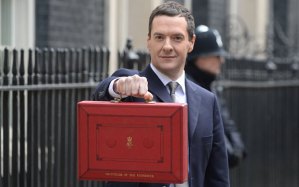
George Osborne - Chancellor of the Exchequer - Budget

Agree with this article? Violently disagree? Scroll down to leave a comment.

Follow Semi-Partisan Politics on TwitterFacebook and Medium.

The Daily Toast: The Right Reasons For Britain To Bomb ISIS In Syria

Britain - Airstrikes - ISIS - Islamic State - Syria - David Cameron - Francois Hollande

Building the case for military action against ISIS in Syria solely on the proposition that it will make us safer at home is over-optimistic, unprovable and damaging to the other, less alarmist (but stronger) arguments in favour of intervention

In his Telegraph piece today, Fraser Nelson understands that airstrikes and other military action against ISIS in Syria are nothing like a magic bullet method of keeping us safe from terrorist attacks, but that they are nonetheless the right thing to do.

Nelson goes on to echo this blog’s concern that building a case for military intervention in Syria based solely (or even primarily) on the overly-optimistic proposition that it will make the streets of London safer will only undermine the other, better reasons for attacking ISIS:

This is a political mission more than a military one. For years, Britain has been haemorrhaging influence in Washington – diplomats there have been shocked to hear France being mentioned as America’s most reliable European partner. Our absence from the Syria campaign stands out – and sends worrying signals about our reliability as a partner. With our troop numbers being cut back, we need partnerships. And this means stepping up to join alliances when the time comes.

This is harder for the Prime Minister to explain. It’s fairly easy to talk in terms of Britain bombing Isil into submission before sending in a 70,000-strong army. It’s harder to admit that bombing hasn’t really worked, and that that army doesn’t really exist and that a better strategy is needed. But if we want a chance of influencing that strategy, we need to join the US-led coalition.

The best case for intervention in Syria yesterday was made not by any minister but by Bob Stewart, a former colonel and now a Tory MP. He had been talking to senior officers in France, he said, and they told him that the country feels attacked and would very much appreciate the support of its closest ally. So it’s time, he said, for a “highly potent gesture” to let our allies see that we’re fully behind them. It’s a less dramatic case for war, but it’s more credible. And far more likely to give the Prime Minister the parliamentary vote that he so badly needs.

Obviously Britain cannot base the decision of whether or not to intervene militarily in another country solely on the affect our participation (or non-participation) will have on the esteem of our friends and allies. There must also be both a legitimate and compelling reason for intervention and a reasonable chance of a satisfactory outcome in order to justify such a grave decision. And though it is very hazy, on balance Britain probably can make a positive contribution if we work with our allies toward a clearly agreed strategy.

But Fraser Nelson is right – equally important in this debate is the way that Britain views its own role on the world stage, and (I would add) the degree to which we continue to live in the fearful shadow of the second Iraq war.

Britain has indeed become an “unreliable ally” over the past few years, not just because of the previous vote against military action in Syria but because of the degradation of our armed forces by a nominally conservative government with messed up priorities. We pared back the army by a magnitude of thousands of experienced, veteran soldiers. We greatly weakened the RAF with cutbacks. And we decommissioned our existing aircraft carriers years before the new ships come on stream, seriously weakening our ability to project force in distant places.

Those brutal cutbacks sent a message. They reeked of a country which had lost faith in its values, its power, its effectiveness and its ability to robustly defend both our allies and our own vital national interest. They spoke to a country which has lost its way, led by politicians more interested in being seen as competent technocrats administering decent public services than fighting evil or changing the world for the better.

Hopefully that shameful time is now finally coming to an end.

The time has come for the British government to show as much commitment to fighting evil and supporting our allies as it does to ramping up the autocratic surveillance state in the dubious name of national security. The time has come to wield the stick abroad where necessary once again, and ease up on the draconian policies which have come to typify our national security response at home.

But first and foremost – as this blog argued yesterday – the time has come for Britain to get up off the mat post-Iraq, and reassert our place in the world. The conflicts of the first decade of this century – with their weak justification and unclear objectives – must not colour our present day judgement to the extend that we freeze in indecision when decisive action and engagement with our allies is needed.

And while nobody can truthfully promise that striking ISIS in Syria will significantly reduce the terrorist threat in Britain, we can say with reasonable certainty that dithering and failing to act against the murderous death cult responsible for attacking our good ally France – slaughtering scores of innocent people in Paris – will help consign Britain to the ranks of middling, introspective and insignificant nations at the mercy of world events rather than shaping them.

This nuanced argument is much harder to make than simplistic pledges about keeping us safe from terror, especially when trying to build support for military action in a cynical and war-weary country. But it is the right argument.

As Fraser Nelson argues – and this blog concurs – it is far better to be upfront about the real motivations for intervention, and trust the British people to understand that it is in all of our interests to ensure that Britain continues to be taken seriously as a major player on the world stage.

Britain - Airstrikes - ISIS - Islamic State - Syria - RAF


ISIS Convoy Syria

Agree with this article? Violently disagree? Scroll down to leave a comment.

Follow Semi-Partisan Politics on TwitterFacebook and Medium.

Should We Bomb ISIS In Syria?

ISIS Syria - France Airstrikes - Paris Attacks

When considering whether Britain should join airstrikes against ISIS in Syria, listen to anyone except those people preaching certainties

Should Britain join the group of countries launching airstrikes against ISIS in Syria?

On balance, yes. But not in the hope or expectation of “keeping us safe from terror”, which is the justification currently being touted by the government. And only as part of a broader strategy, a serious international military campaign and a real commitment to the people of Syria, who are caught in the middle of a ghastly civil war and – in the case of those stranded in ISIS territory – subjugated by one of the most barbaric, theocratic death cults in the history of the world.

I don’t advocate the use of force lightly. This blog rarely ventures onto topics of foreign policy, and for good reason – I’m far from an expert, and unlike some others I am not willing to confidently parrot the opinions of other people out of partisan loyalty or ideological entrenchment.

Today I re-read “I Was Wrong” by Andrew Sullivan, my favourite writer and blogger – sadly now retired from daily blogging. Sullivan was one of the loudest drum-beaters for the second Iraq war, and made the gradual transition from neoconservative warmonger to fierce Bush critic as he realised the gravity of his error – America and Britain’s catastrophic mistake. “I Was Wrong” is a collection of Sullivan’s blog posts from 2001-2008, charting that awful realisation.

I wanted to re-read Sullivan because I wanted to be sure that supporting military action in Syria was in no way a fear or anger-based reaction to recent acts of terror, to the Paris attacks – or the fear of a similar attack in Britain. And it is not. After 9/11, many people were willing to blindly lash out, and were too quick to put their faith in leaders who they mistakenly trusted to identify the real threats and the correct targets. Sullivan himself bravely admitted that he fell prey to this tendency. But in the year 2015, the shock of Islamist terror striking Western cities is no longer what it once was. And we are all more cynical and jaded, both about what our leaders tell us, and what we are capable of accomplishing when we decide to intervene in another country. In short: this is not Iraq all over again.

Today, David Cameron made the case for British military action against ISIS in Syria. The Telegraph sums up David Cameron’s 7-point plan:

  1. Protect the UK at home by maintaining robust counter-terrorism capabilities
  2. Generate negotiations on a political settlement, while preserving the   moderate opposition
  3. Help deliver a government in Syria that can credibly represent all of the Syrian people
  4. Degrade and ultimately defeat Isil, through Coalition military and wider action
  5. Continue leading role in humanitarian support and forestall further migratory flows towards Europe
  6. Support stabilisation already underway in Iraq and plan for post-conflict  reconstruction in Syria
  7. Work in close partnership with allies across the Middle East to mitigate the impact of Isil and other violent extremist groups

There are valid and compelling arguments for military action against ISIS in Syria, but this seven point plan does a poor job of making the case.

Point 1 is immediately ludicrous. Yes, there is the possibility that Syrian refugees may find their way across the continent of Europe to our shores, where they then go on to commit a terrorist atrocity. But we should be far more concerned about that stubborn rump of alienated British Muslims who already live among us and carry our passports, but feel no connection with or fidelity to our country. The 7/7 bombings in London proved definitively that we are perfectly capable of incubating our own terrorists in this country, with no need to import them.

David Cameron’s claim that Syria airstrikes will “protect the UK at home” should be treated extremely sceptically, because there is no compelling evidence that destroying the current overseas rallying point for Islamist extremism will do anything to tamp the fires of extremism within our own borders.

Points 2 and 3 sound suspiciously like nation-building. And again, no matter how accurate the RAF’s Brimstone guided missiles may be, they are not nimble enough to bring sworn enemies to the negotiating table or forge the beginnings of a political settlement. Regrettably, Britain and America have a weak track record when it comes to nation-building. And we can hardly be said to have learned the full lessons of Iraq when the publication of the Chilcot Report is shamefully delayed so as to allow those who come in for criticism the opportunity to airbrush their mistakes and imperfections from the public record.

Points 6 and 7 have a moderate chance of success at best. But with the exception of Israel, it is by no means certain that Britain’s so-called allies in the Middle East remotely share our objectives. Some of them actively fund and give succour to the same extremists who threaten us. The War on Terror has driven the United Kingdom into the arms of that repressive, barbaric kingdom, Saudi Arabia – a medieval land where lashings, crucifixions and beheadings are still deployed against blasphemers, and where many a terrorist ideology has been incubated.

In an ideal world, Britain would have nothing to do with the whole benighted region, diplomatically, until they achieve democracy and freedom on their own – but since necessity forces us to suck up to Saudi Arabia and other such Utopias in exchange for morsels of intelligence about the very same terrorist plots that they tacitly support, we will likely continue to make more enemies than friends in the Middle East.

Only points 4 and 5 of Cameron’s list are realistically achievable. Yes, we can degrade and defeat ISIS as an organisation. If Britain, America, France and other powers are determined then we can rain down fire on enough ministries, military posts, safe houses and supply routes that ISIS lose the majority of their territory and cease to be a potent regional presence. Clearly ground troops will be required to do the work that drones and missiles cannot, but whether the 70,000 potential Free Syrian Army fighters will be of sufficient number or quality to do the job without outside reinforcement is uncertain.

But the radicalised Muslims who flocked to the ISIS banner will not awaken as if from a trance the moment that David Cameron and François Hollande land on the flight deck of the Charles de Gaulle to declare “mission accomplished”. They will not suddenly see the light and re-embrace Western enlightenment values. They will simply cast around for the next group to join. And be assured, another group will come to fill the vacuum – just as ISIS is eclipsing Al Qaeda, and Al Qaeda eclipsed its jihadist predecessors.

None of these flaws in David Cameron’s 7-point plan for successful action in Syria are reason enough to reject military action. But they do show that bombing alone will not be enough – while the West may not have the appetite to pour in the blood, effort and money required to finish the job.

ISIS Convoy Syria

So when it comes to weighing the decision about whether to bomb Syria, beware of anyone offering cast-iron certainty on either side of the argument – be it Momentum and Stop the War on the left, or David Cameron and the hawks on the right.

For the truth – once the ideological blinkers and two-dimensional worldviews are stripped away – is that this decision is an impossibly close call, and one in which the absence of counterfactuals means that we will likely never know for certain whether we were right to intervene or not.

All that we can say for certain is that it is not the binary question of Yes/No which will make a success or failure of Western policy in Syria. What matters is not the decision about whether to bomb or not to bomb, but rather how the military action unfolds if it is authorised, what our tactics are, and how it fits into a broader plan to defeat the Islamist threat.

The military question itself is relatively straightforward in all of this. If we really wanted to defeat ISIS specifically as an organisation and wannabe state, the Western powers and their allies – working closely with the Free Syrian Army and others – are physically more than capable of doing so, if we put our minds to it.

But that does nothing to solve the broader jihadist threat. Where once we feared groups like Islamic Jihad, now we fear Al Qaeda and ISIS. And tomorrow, when ISIS is gone, we will tremble at the thought of some other bronze age group based in another unstable country, wreaking chaos with twenty-first century technology. The recent history of our efforts to defeat Islamist extremism can best be described as Terrorist Whack-a-Mole. You hit one organisation and another pops its head up somewhere else.

So don’t support bombing ISIS in Syria because it will help to keep us safe from terror attacks, because it won’t. In the short to medium term it will make no difference at all. A bomb next month in Leicester Square will not condemn the decision any more than another year without a major terrorist attack on British soil will vindicate the decision to begin striking ISIS in Syria. And beware opportunists who suggest otherwise.

The only real criteria which should be met in order to support military action in Syria are:

  1. Reasonable cause to hope that such action will materially defeat ISIS
  2. Fewer civilians expected to be killed or radicalised as a result of such action than would be the case without further intervention
  3. Confidence that the vacuum left by ISIS will not be filled with something even worse

Above all, this must be an humanitarian mission. In order to get public buy-in it will almost inevitably be couched in the language of “keeping us safe” in Britain – or fighting them over there so that we don’t have to fight them on the streets of London, as Matthew Hancock said this evening on Question Time (perhaps unwittingly channelling President Bush). But this is an unrealistic promise, one which sets the target for success so high that it will inevitably be missed. Even total victory in Syria will not end the Islamist threat, which is just as potent within Europe’s borders as it is in the Middle East. And we can hardly bomb Brussels or the slums around Paris.

A humanitarian mission is something achievable – if we work very, very hard, we can probably get ourselves to a place where we can say with some confidence that fewer people were killed, maimed or brainwashed than would have been the case had we done nothing. That’s likely to be as good as it gets – but those are the messy realities of our world.

That may not be enough for some, who either oppose military action because it is not the magic bullet for ending Islamist extremism or support it believing that it will. Both viewpoints allow perfection to become the enemy of the good – or the tolerable. There is no perfect solution on the table.

The anti-war Left need to drag themselves out of the shadow of Iraq and remember that Britain has a proud history of previous military and humanitarian interventions around the world which were right and justified and successful. And they must realise that there can be no negotiation with ISIS, and no realistic diplomatic solution in Syria until a military victory is won.

The terrorism-thumping Right need to appreciate that decimating ISIS militarily will in itself do nothing to defeat the ideology behind it – and in fact, any military action may exacerbate that aspect of the problem. Therefore, Britain should not take another step toward further armed involvement in Syria until something resembling a long-term plan is agreed between all of the major powers currently intervening in the region.

And both sides must remember that this is not Iraq all over again. The “something must be done” brigade are not leading us down an obviously wrong path as they did after 9/11 – we know precisely what is currently happening in Syria, and we are in no danger of precipitating a bloody Iraq-style civil war through our actions, because one is already bubbling along quite nicely without us.

Lastly, both sides should remember the best traditions of Britain as a force for good in the world. We remain one of the great economic and military powers of the world, with unique capabilities that we could bring to bear against ISIS. The mistake of Iraq must not allow us to abrogate our responsibility to project our power in defence of liberty and freedom where there is a compelling case to do so.

It’s time Britain got up off the mat after Iraq, and started fulfilling our responsibilities to the world once again.

David Cameron

Agree with this article? Violently disagree? Scroll down to leave a comment.

Follow Semi-Partisan Politics on TwitterFacebook and Medium.

For In The Final Analysis

John F. Kennedy, May 29, 1917 – November 22, 1963

“So, let us not be blind to our differences, but let us also direct attention to our common interests and to means by which those differences can be resolved. And if we cannot end now our differences, at least we can help make the world safe for diversity. For, in the final analysis, our most basic common link is that we all inhabit this planet. We all breathe the same air. We all cherish our children’s future. And we are all mortal.”

For those of us who have grown up never having heard a great contemporary political speech, here is the remarkable speech given by President John F Kennedy at American University on June 10, 1963.

Kennedy was assassinated on this day in 1963, fifty-two years ago.

Powerful words, but does Kennedy’s analysis still hold true in the Age of Jihad – when we are preoccupied with ISIS and Al Qaeda rather than the Soviet Union, and when our enemies eagerly embrace death and have no thought at all for their children, let alone their own earthly future?

Imagine David Cameron giving a speech like this about the threat posed by Islamist terrorism, or Britain’s future relationship with the European Union. Imagine David Cameron, George Osborne, Theresa May, Boris Johnson, Jeremy Corbyn, Chuka Umunna, Yvette Cooper, Tristram Hunt, Andy Burnham, Tim Farron or Nicola Sturgeon giving this speech. Try picturing it without laughing out loud.

The challenges today are different to those faced by Kennedy and our political leaders half a century ago. But rarely have our political leaders seemed so helpless, so inadequate to the tasks at hand. At best, our current prime minister might be described as a reasonably competent Comptroller of Public Services. And it is far from certain that he even aspires to be anything more.

They say that we get the politicians and leaders we deserve. If so, the time has come for us all to engage in some serious introspection.

JFK - John F Kennedy - American University Commencement Address

Scroll down to leave a comment.

Follow Semi-Partisan Politics on TwitterFacebook and Medium.