Who Can Now Respect David Cameron The Liar?

David Cameron - Gloucester - EU referendum - Protected Status - Farming

A visceral, unyielding, slow-burning anger

Then looking darkly at him swift-footed Achilleus answered: ‘Hector, argue me no arguments. I cannot forgive you. As there are no trustworthy oaths between men and lions, nor wolves and lambs have spirit that can be brought to agreement but forever hold feelings of hate for each other, so there can be no love between you and me, nor shall there be oaths betweens us, but one or the other must fall before then to glut with his blood Ares the god who fights under the shields’s guard.

– Homer, Iliad

The process by which I fell out with the current Conservative Party has occurred in several stages.

First, there was the initial astonishment that David Cameron could not muster a proper election victory against a Labour Party led by Gordon Brown, of all people. Then there was the frustration of the coalition years, when it was not always entirely clear how much Nick Clegg and the Liberal Democrats might be shouting down and diluting the conservative “better angels” of the Tories. And then during the 2015 general campaign there was the incredulity bordering on rage that no, in fact the LibDems if anything had been a restraining influence on the more despicably authoritarian Tory tendencies, and that Cameron envisioned the same dismal society built on the continual feeding and worship of our public services (and sainted NHS) as Ed Miliband’s rootless Labour Party.

But until now, my beef with the Conservative Party leadership (and supportive rank and file) has been ideological, not personal. I had accused the Tories of selling out ideologically and failing to boldly make a proper conservative case to the country, but I still saw it in terms of political calculation.

No more. The EU referendum has awakened a rage against the Conservative Party within me that I do not know how I will manage to suppress when it comes to local and national elections, even (especially?) if it means handing victory to their enemies. Why? Because on the single most important political decision this country has to make in a generation, they lie and cheat and tilt the balance, and do so with such smug, smarmy condescension and aristocratic entitlement that it beggars belief. From the prime minister on down, with too few honourable exceptions, the Cabinet and parliamentary party are comprised of craven careerists who are in the process of selling out their country – and democracy itself – either out of laziness, ignorance, greed or a toxic combination of all three.

Now, in other words, my problem with the Tories is personal.

Case in point, David Cameron’s attempt to sow more fear, uncertainty and doubt in the minds of the British electorate by peddling false myths about Brexit. It now appears that the prime minister is going around the country coming up with tailored apocalypse scenarios for different voters and demographics in every region of the country.

Writing in the Gloucester Citizen, David Cameron warns:

In the South West alone, more than 60,000 are employed in agriculture and more than 28,000 in food manufacturing, with the region having received around £371million in EU Common Agricultural Policy grants in 2014 supporting those jobs.

Between 2010 and 2014, the total income from farming across the South West increased by 49 per cent, to £666million, as farmers – along with all British businesses – reaped the benefits of access to the single European market of 500million people.

If we leave the EU and our farmers have to operate under World Trade Organisation rules, things would be very different.

They could be faced with annual tariffs of up to 40 per cent and huge additional costs – for example, £240million for beef and £90million for lamb.

Protected status enjoyed across Europe by our unique products, such as Gloucestershire cider, Single Gloucester cheese and traditionally-farmed Gloucester old spot pork, will be lost.

In other words, if you so much as think warmly about Brexit and regained British independence from the EU, the commercially protected status of locally produced foods will be not only threatened, but definitively lost.

This is a lie. I’m sorry, but there is no other word for it. This blog is slow to anger and slow to impugn the motives and character of politicians, preferring to go for their ideas. But when he writes these words in a local newspaper, the prime minister is lying to us.

Richard North wearily explains over at eureferendum.com:

As usual though, the fear tactic relies on half-truths and deception – and the ignorance of the media and politicians. And not least of these deceptions is the omission of rather crucial information: the scheme also applies to third countries.

Applicants from outside the EU can register their products with their national authorities, which then pass on the details to the EU, where they are then – after due process – recognised as protected process.

The system can be seen at work here, when in May 2011 four Chinese agricultural products received protected status in the EU, bringing the total to five, with another five being processed through the system.

In a reciprocal move, the Chinese authorities set in motion the recognition process for “ten celebrated European products”. These were: Grana Padano; Prosciutto di Parma; Roquefort; Pruneaux d’Agen/Pruneaux d’Agen mi-cuits; Priego de Cordóba; Sierra Mágina; Comté; White Stilton Cheese/Blue Stilton Cheese; Scottish Farmed Salmon and West Country Farmhouse Cheddar.

Thus to represent British products being at risk when we leave the EU is a plain, outright lie. And even if the Prime Minister doesn’t know he’s lying, some of the people briefing him must know the truth. There is almost certainly calculated deceit being perpetrated here.

So the prime minister is blatantly lying. He is suggesting that protected status for foodstuffs is contingent on EU membership when this is clearly not so. And he is appealing to the basest instincts of Gloucester farmers, producers and citizens, hoping that they will unthinkingly vote for what he tells them is their personal interest without thinking for themselves.

Completely unable and unwilling to articulate a positive vision for the European Union of which he is so desperate to keep Britain a part, David Cameron is reduced to peddling outright falsehoods, deceptions and lies in local newspapers as his grubby Remain organisation trawls for votes.

North goes on to give the wider context, painting (as always) a vivid and fascinating picture of a world of global regulation and harmonisation in which the UK is constrained from fully participating by having to operate through the filter of the European Union:

Furthermore, these reciprocal arrangements are only the tip of the iceberg of what is, in fact, a vast global scheme based around the World Intellectual Property Organization (WIPO), administering what are known as “geographical indications”.

The scheme relies on a network of treaties and agreements, starting with the Paris Convention adopted in 1883, the Madrid Agreement of 1967, the Lisbon Agreement of 1958 and the protocol to the Madrid Agreement concluded in 1989.

These tie into the 1995 WTO TRIPS Agreement (Trade-Related Aspects of Intellectual Property Rights), which enable the system to be extended globally. Part of the WTO Doha round, this agreement is opening the way for other trading nations to protect their own traditional products and brands, to the same level enjoyed under EU law.

Despite this, there are complaints The EU is using its coercive power and the UK outside its system could provide a vital corrective, helping other nations to develop their own systems.

All pertinent information which is lost as soon as our prime minister opens his mouth or takes out his pen and begins lying to us – and when the press fail to do their own due diligence, either parroting his scaremongering as unquestionable truth or doing the Fox News “fair and balanced” thing where they allow two deceitful idiots to yell half-baked untruths at each other for five minutes in place of objective reporting.

But exactly how much of this tawdry and manipulative behaviour are we supposed to accept from our prime minister, and still reunite as a big happy Conservative Party family afterwards, let alone as a nation?

I for one have reached my limit. I never renewed my Conservative Party membership when I returned from the United States in 2011 out of suspicion that things would go this way, but I still expended time and energy defending David Cameron and his ministers on this blog, which I now bitterly regret. And to this day I still believe that my natural home lies within the Conservative Party – albeit a more Thatcherite version, rather than David Cameron’s lame Ted Heath tribute act. So I will remain here, hanging around on the margins, waiting to see if the Tories one day rediscover their soul and become again the party which saved this country from decline and permanent irrelevance.

But this present betrayal will not be forgotten, and if I am ever in a position to cause David Cameron and his band of lying, manipulative fellow Remainers within the Conservative Party even the slightest annoyance, inconvenience or frustration I will do so with great relish and personal satisfaction.

David Cameron has made an enemy of me – but not only me, also the thousands and even millions of Conservative voters who found their prime minister fighting against them on the wrong side of this EU referendum campaign. This may not trouble Cameron now, while his opponents on the Left remain largely incoherent and disorganised. But this lack of effective and united opposition will not last forever, and at some point in the future David Cameron will be in need of allies and ideological defenders.

And on that day, the prime minister will come to realise his mistake in recklessly and brazenly encouraging open hostilities on his right flank.

 

European Union - United Kingdom - Britain - Flags

Top Image: Gloucester Citizen

Agree with this article? Violently disagree? Scroll down to leave a comment.

Follow Semi-Partisan Politics on TwitterFacebook and Medium.

The Moral Mission Of Iain Duncan Smith

Any leftists taking a break from singing “Ding, dong, the witch is dead!” following the recent resignation of Iain Duncan Smith from the cabinet might want to invest 50 seconds watching this video.

Guido points out:

Filmed in December, well before his resignation, before the cynics cry foul. Anyone doubting whether IDS’ moral mission was genuine should watch.

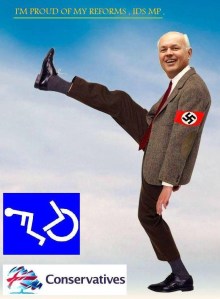
It’s not about Evil Tories hating the poor and the sick and wanting them to suffer. It was never about that. Some on the left may find it quicker and easier to caricature the politics and philosophy of those with whom they disagree, but I don’t think that any sane, rational person can now look at what Iain Duncan Smith tried to do at the Department for Work and Pensions and say that he was in any way motivated by malice.

When the Left are willing to come to the debate with suggestions of their own for welfare reform (besides chucking more money at the same broken system), we can have a debate – and sometimes perhaps even find common ground, through radical ideas like universal basic income.

When the Left are able to stop virtue-signalling and begin with the assumption that conservatives are not evil but simply have different ideas for how to achieve a just and fair society, we can have a healthy debate on the issues even if we rarely achieve a real meeting of minds.

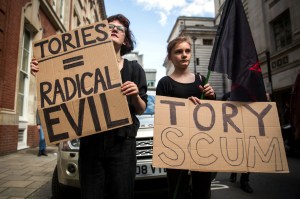
Or, you know, they can just keep shouting about the heartless Tory scum.


Iain Duncan Smith - Tory Scum - Conservative Party - Nazis

Agree with this article? Violently disagree? Scroll down to leave a comment.

Follow Semi-Partisan Politics on TwitterFacebook and Medium.

If The Conservative Government Is Truly Evil, Where’s The Left Wing Revolution?

Jeremy Corbyn - Hipster - Middle Class Left Wing

Virtue-signalling, vacuous middle class leftists are all talk and no action

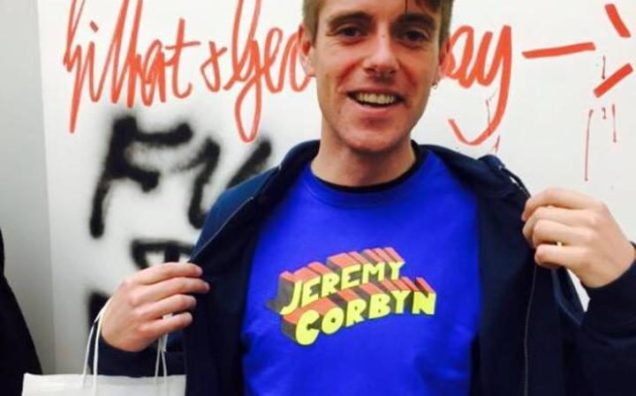
According to many a Corbyn-cheering, well-heeled leftist, modern Britain resembles an unjust, “neoliberal” dystopia in which the Evil Tories and their Evil Banker friends leech off the real producers and heroes in our society (usually people who are net recipients of government spending, curiously recast as the being most virtuous of all).

To this mindset, George Osborne is not simply wrong on the economics, he is engaging in a deliberate war of attrition against the poor, and Iain Duncan Smith’s abortive efforts to reform the welfare state were part of a Nazi-inspired eugenics programme to kill off the sick and disabled.

All of which begs the question – if David Cameron’s centrist, soul-sappingly unimaginative Conservative government really is evil incarnate, why do its many opponents content themselves with mere polite protest and ineffectual rants on social media?

If I believed for a moment that the state was engaged in a deliberate extermination of its weakest and most vulnerable citizens, I hope to think that I would have the moral clarity and fortitude to either take up arms against the government or to work for its downfall using every skill and talent at my disposal. And yet those who actually do believe that the Tories are “evil” can usually be found clad in skinny jeans and non-prescription hipster glasses, waging “resistance” via their (capitalism-produced) smartphones while sipping a hand-crafted flat white.

My Conservatives for Liberty colleague Martin Bailey sums up this moral hypocrisy perfectly in a piece entitled “The impotence of the middle-class Left”.

Bailey writes:

If I thought that the world was controlled by a secret ‘Neo-Liberal’ elite that oversaw government and mass media across the globe, I would do something about it. Take up arms, man a barricade, refuse to comply. If I genuinely believed that democracy was a sham and we were all willing drones to corporate bosses, I wouldn’t stand for it.

So what do they do? They sit in comfort and plenty streaming idle profanities across Twitter and Starbucks. They can’t even find an independent coffee shop in which to plan the revolution. Anonymous abuse of anyone on social media who dares to question their orthodoxy is about as rebellious as a wet fart in an empty train carriage. Che would be turning in his grave.

The EU referendum is a perfect example of stupefying left wing impotence, with thousands of social justice warriors happy to forget the glaring absence of democracy and willing to accept the biggest corporatist cartel in history, all for the fear that someone they know may or may not lose their job. I guess the revolution will have to wait, eh Comrade?

Read the whole piece, it is a highly entertaining takedown of the Left’s hypocrisy and wilful misunderstanding of capitalism.

And to my mind, there are only two explanations for the gulf between the Virtue Signalling Left’s angry talk and their lack of action commensurate with the inhuman Evil Tory threat that they constantly decry.

Option 1 – The left-wing outrage at the present Conservative (often in name only) government is completely fake, in which case the failure of its opponents to take concrete action makes perfect sense – after all, they are only invoking the memory of the Holocaust as a cynical political ploy to demonise their opponents and paint them as heartless and deliberately cruel.

Option 2 – Their outrage is genuine and they honestly believe that conservatives have blood on their hands, but they are also too cowardly to risk their own relatively privileged and comfortable lives by coming to the aid of the supposedly oppressed. In other words, the middle class Left are happy to parade their hatred of the Evil Tory Scum on social media and to friends, but would continue to let society’s most vulnerable people suffer and die before than risking their coveted London homes, worldly possessions and personal liberty by backing up their fighting words with real action.

Manipulative cynics or moral cowards. The only question remaining is which reflects worse on the virtue-signalling middle class Left?


Postscript: I happen to believe that most middle class leftists fall into Option 1. It’s trendy to moan about how beastly the Evil Tories are being, and posting a few IDS-as-Hitler memes on the internet is a good way to quickly signal to other bovine minded people that you are one of the “good guys”.

But that’s not to say that there are not also a number of credulous cowards out there – that is, people who genuinely believe the anti-Tory effluence which pours from their mouths and keyboards, but are too darn selfish to risk anything of theirs by physically attempting to stop the genocide that they believe is underway.


More Left Wing Hate Watch here.


Bankers Toffs And Tory Scum - General Election 2015 - London Protests - Downing Street

Agree with this article? Violently disagree? Scroll down to leave a comment.

Follow Semi-Partisan Politics on TwitterFacebook and Medium.

The Age Of Trump: As The Republican Party Goes To Its Armageddon

Barry Goldwater - Election Poster

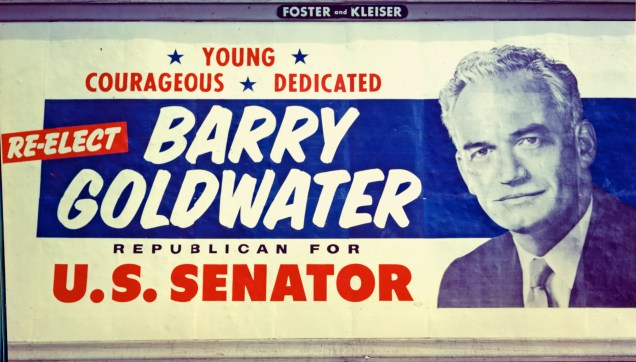
To understand why the Republican Party are on course to lose their third consecutive presidential election, one must look much further back in time than the rise of Donald Trump

It gives no satisfaction to watch any storied political party hurl itself into oblivion – even the US Republican Party, which has frequently infuriated true conservatives with its sanctimonious and hypocritical habit of screeching about the dangers of encroaching socialism under Democratic administrations while themselves consistently cranking up the size and role of the state at every opportunity.

But while it now seems almost certain that the Republicans have thrown away any chance of reclaiming the White House, imploding in a foul-mouthed torrent of bluster and recrimination more worthy of Jerry Springer than a presidential primary campaign, it is worth looking back and asking how the GOP finds itself in this position, and exactly when the seeds of destruction were sown.

I have been reading widely on this, focusing less on the crowing and virtue-signalling Left, and far more on those thoughtful and introspective voices on the Right who are often appalled by the rise of Donald Trump in particular, but often sympathetic to the anti-establishment fervour which fuels his candidacy.

And if I have to pick just one excerpt from one piece to explain the predicament in which the Republican Party currently finds itself, I would encourage my readers to read “I was wrong about Donald Trump” by Daniel McCarthy over at The American Conservative.

In his piece, McCarthy concludes:

Trump succeeds because of more than outsize personality, of course. He attracts some support from everyone who thinks that Conservatism, Inc. and the GOP establishment are self-serving frauds—everyone who feels betrayed by the party and its ideological publicists. Working-class whites know that the Republican Party isn’t their party. Christian conservatives who in the past have supported Mike Huckabee and Ben Carson also know that the GOP won’t deliver for them. Moderates have been steadily alienated from the GOP by movement conservatives, yet hard-right immigration opponents feel marginalized by the party as well. Paleoconservatives and antiwar conservatives have been excommunicated on more than one occasion by the same establishment that’s now losing control to Trump. They can only applaud what Trump’s doing, even if Trump himself is no Pat Buchanan or Ron Paul.

Conservative Republicans™ somehow maneuvered themselves into a position of being too hardline for moderates and non-ideologues, but not hardline or ideological enough for the right. Trump, on the other hand, appeals both to the hard right and to voters whose economic interests would, in decades past, have classed them as moderates of the center-left—lunch-pail voters.

What’s even more remarkable is that movement conservatives, who have been given plenty of warning, ever since 2006, that their formula is exhausted, keep doing the same thing over and over again: they’ll dodge right, in a way that right-wingers find unsatisfactory but that moderates find appalling; then they’ll weave back to the center, in a way that doesn’t fool centrists and only angers the right. Immigration—which was another of George W. Bush’s stumbling blocks, lest we forget—has been the issue that symbolized movement-conservative Republicanism’s futility most poignantly. It’s not even clear that most GOP voters agree with Trump’s rhetorical hard-line on immigration—they just like it better than the two-faced talk of the average Republican politician.

Trump has a plethora of weaknesses, as general election polls amply demonstrate. But just look what he’s up against within the Republican Party: that’s why he’s winning.

I have yet to see the rise of Donald Trump explained as thoughtfully and succinctly as it is in the first three paragraphs quoted above. Sure, McCarthy’s piece does not tackle every aspect of the situation – whole books can and will be written about the causal factors of this huge anti-establishment backlash, which is far bigger than any one political party – but it does explain why the current GOP was so badly positioned to withstand a populist insurgency like Trump’s.

Much like the British Labour Party has become a fractious and increasingly unworkable coalition of idealistic left-wingers, pragmatic centrists and (let’s be frank) soulless political shapeshifters, and much as the historic splits in the Conservative Party are re-emerging following a vacillating 2016 Budget and the party leadership’s betrayal of the activist base on the coming EU referendum, so the Republican Party’s big tent of Reaganites, neo-cons, Evangelicals and social conservatives is collapsing – for those reasons outlined above by McCarthy.

Read the collected output of Rod Dreher too, and this piece by David Brooks, which looks to the future which could yet follow 2016’s rock bottom:

Trump is prompting what Thomas Kuhn, in his theory of scientific revolutions, called a model crisis.

According to Kuhn, intellectual progress is not steady and gradual. It’s marked by sudden paradigm shifts. There’s a period of normal science when everybody embraces a paradigm that seems to be working. Then there’s a period of model drift: As years go by, anomalies accumulate and the model begins to seem creaky and flawed.

Then there’s a model crisis, when the whole thing collapses. Attempts to patch up the model fail. Everybody is in anguish, but nobody knows what to do.

That’s where the Republican Party is right now. Everybody talks about being so depressed about Trump. But Republicans are passive and psychologically defeated. That’s because their conscious and unconscious mental frameworks have just stopped working. Trump has a monopoly on audacity, while everyone else is immobile.

[..] At that point the G.O.P. will enter what Kuhn called the revolution phase. During these moments you get a proliferation of competing approaches, a willingness to try anything. People ask different questions, speak a different language, congregate around a new paradigm that is incommensurate with the last.

That’s where the G.O.P. is heading. So this is a moment of anticipation. The great question is not, Should I vote for Hillary or sit out this campaign? The great question is, How do I prepare now for the post-Trump era?

As Brooks says (perhaps a little naively), this is not necessarily all bad news for conservatives. If we are honest, we have to admit that conservative policies in America and Britain are no longer perfectly calibrated to the challenges of the day as they were in Thatcher and Reagan’s time.

That is not to say that the Left are any better; Lord knows they aren’t. But it does mean we should acknowledge certain facts – like the fact that we still have a stubbornly large permanent underclass, and that for all the irreplaceable benefits of globalisation, there are still those who miss out – and seize the initiative by proposing radical conservative policy solutions to the great challenges of the new century.

In Britain, David Cameron’s Coke Zero Conservative government – or the Ted Heath tribute act, as this blog has taken to calling them – seem to think that One Nation Conservatism means stealing as many of Labour’s left-wing ideas as possible. And in America, Donald Trump’s brand of populist pseudo-conservatism doesn’t believe in One Nation at all, unapologetically carving the country up into winners and losers.

Neither is the correct approach. And as Cameronism and Trumpism run their respective courses, this blog will continue providing commentary and offering suggestions for an alternative conservatism, in Britain and America.


Postscript: This blog has decreased its focus on US politics in the past few years, primarily because I have been London based and fully occupied writing about British political issues. But Semi-Partisan Politics will begin to cover the American presidential election with a little more frequency going forward, partly because I have always remained a close follower of American politics – often more so than the household name journalists dispatched to the States by their newspapers and now portentously reporting back to us as self styled “experts”.

Having lived in America helps – particularly having lived in the American Midwest, not just the coastal enclaves of New York and Washington, D.C. familiar to most British journalists who write about America during election season. And the fact that I am married to a Hillary Clinton-supporting Hispanic Texan helps too. When I write about American politics, I know whereof I speak.

But I am also covering the presidential race because as a conservatarian with one foot firmly planted on either side of the Atlantic (and a heart divided equally between Britain and America), I believe that in my own small way I can bring a perspective to the left/right, authoritarian/libertarian debate that is often missed by those whose thinking and writing is rooted firmly in just one country’s specific conservative tradition.

To borrow an overwrought phrase from the dystopian world of Identity Politics, consider this my contribution to an “intersectional” perspective on conservatism.

They’ll absolutely hate me for that.


Donald Trump Hat - Make America Great Again

Agree with this article? Violently disagree? Scroll down to leave a comment.

Follow Semi-Partisan Politics on TwitterFacebook and Medium.

What Might A Post-Osborne Conservative Party Actually Look Like?

Britain Election

George Osborne has political enemies. But are they also ideological opponents?

What hope is there that the Conservative Party might realistically follow a different intellectual and ideological path after the Age of Cameron and Osborne?

While there have been precious few public signs of senior cabinet or backbench, leadership-calibre Conservative MPs willing to make a public stand for a smaller state and greater individual liberty, perhaps we should be encouraged by the fact that many Tory MPs apparently hold such a low opinion of George Osborne, the navigator largely responsible for the party’s current centrist course.

James Kirkup has been surveying attitudes to the Chancellor within the parliamentary party:

How much trouble is Mr Osborne in? Put it this way: Tory MPs who a few months ago were so wary of his power over their future that they flinched at the mention of his name are now speculating about whether he will keep his job.

By way of evidence, here are some things Conservatives have said to me about the Chancellor in recent days. Two of the quotes below come from serving members of the government. One is from someone who holds a senior office in the Tory hierarchy. One is a backbench MP who could easily have a prominent place in Cabinet in a year or two.

1. “No chance. None. Zero. Never going to happen. Dead. Deader than dead.”

2. “He has been found out. He doesn’t believe in anything and no one likes him. It was useful for people to support him when he was on the way up, but no one will stick with him on the way down.”

3. “The thing about George is that a lot of people think he’s a bit arrogant and rude, but that’s because they don’t really know him.

“Well I’ve worked with him pretty closely for several years now and so I know that the truth is that in person he’s actually much worse than that.”

Kirkup goes on to chart a path back out of the wilderness for Osborne, which is of far less interest to this blog, which ardently hopes that the Chancellor and his “New Labour Continued” strategy perish in the desert.

But there is no point looking forward to the departure of Cameron and Osborne unless there is a reasonable prospect of them being replaced by other, better alternatives – future leaders whose conservatism does not retreat at the first sight of negative headlines, and who know when the pain of public opposition is worth the gains (i.e. not in pursuit of a paltry £4bn of savings from Personal Independence Payments for disabled welfare claimants).

Back in November of last year, this blog pointed out that winning power only to implement Tony Blair’s unrealised fourth term of office was a waste of a Conservative administration, and that those who campaigned and voted Tory deserved better:

The fact that David Cameron and George Osborne are watching the slow implosion of the Labour Party and conjuring up plans to woo Ed Miliband voters – rather than capitalise on this once-in-a-century opportunity to execute a real conservative agenda unopposed – reveals their worrying lack of confidence in core conservative principles and values. If the Prime Minister and Chancellor really believed in reducing the tax burden, reforming welfare, building up our armed forces, shrinking the state, promoting localism and devolving decision-making to the lowest level possible (with the individual as the default option), they could do so. They could be building a new, conservative Britain right here, right now. Virtually unopposed.

But Cameron and Osborne are doing no such thing. They simper and equivocate, and talk about fixing the roof and paying down the debt while doing no such thing, and still they attract endless negative headlines for inflicting an austerity which exists primarily in the minds of permanently outraged Guardian readers.

If Britain is not a transformed country in 2020 – with a smaller state, more dynamic private sector and greater presence on the world stage – there will be absolutely nobody to blame other than the party holding the keys to government. The party with the word “conservative” in their name. The Tories will have been in power for ten years and have nearly nothing to show for it, save some weak protestations about having fixed Labour’s prior mismanagement of the economy.

That’s not the kind of party I want to be associated with. That’s not the party I campaigned to elect in 2010, back when it seemed possible that a new Conservative administration might aspire to being something more than a moderate improvement on Gordon Brown.

In other words, in order to make an exciting potential future leadership candidate, the Conservative MPs rolling their eyes as the Chancellor of the Exchequer self destructs (or uses up another of his nine political lives) must not simply dislike George Osborne – and there is increasing evidence that his support is a mile wide but an inch deep – but actually have an entirely different vision for the party.

That rules out all of the most obvious successors (Theresa May, Nicky Morgan, Philip Hammond, Michael Fallon, Jeremy Hunt) as well as those one-time Bright Young Things who have recently proven their unreliability by failing to come out in support of Brexit (Sajid Javid, Stephen Crabb, Matt Hancock, Rob Halfon).

Unfortunately, that mostly leaves a pool of potential candidates who are probably too new to Parliament to mount a credible leadership bid by 2020, or citizen politician types who have already publicly disavowed any future leadership ambitions. This blog took a warm liking to Chris Philp (if only he can be cured of his europhilia), David Nuttall (with some specific policy reservations) and James Cleverly when these MPs recently addressed a Conservatives for Liberty lobby event, and also Lucy Allan – though the latter’s social media exploits and alleged behaviour towards her staff raise some worrying temperamental questions.

Kwasi Kwarteng is also a sound conservative, advocating a return to a contributory welfare state as well as being an excellent author. Dominic Raab is very bright, and strong on individual liberty and meritocracy.

None are what you might consider to be household names at present. In some cases, that may have the potential to change by 2020, depending on what happens and whether any of these candidates are promoted into the cabinet as the Conservative Party approaches the end of David Cameron’s term.

But the green shoots of a British Conservative revival do exist. They are small and fragile at present, and no matter who is leading Labour in 2020, Cameron’s successor will have to contend with Tory Fatigue after ten years back in government, making the urge to tack to the centre even harder to resist than it is already.

Which is all the more reason why this blog believes it is now imperative to identify, support and champion those future leadership prospects who fit the profile of an heir to Thatcher rather than another disappointing, Cameron-style Ted Heath tribute act.


Conservative Party Logo - Torch Liberty - Tree

Agree with this article? Violently disagree? Scroll down to leave a comment.

Follow Semi-Partisan Politics on TwitterFacebook and Medium.