–
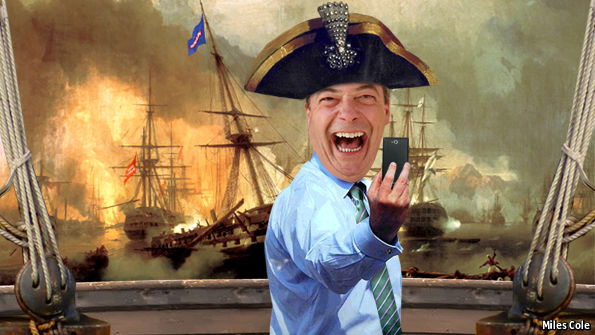
How to suck at modern citizenship, by The Economist
The Economist has, inevitably, now thrown its support behind the campaign to keep Britain in the European Union.
Their endorsement of the EU is full of the usual denial about the EU’s trajectory and bromides about cooperation and not weakening Europe at a time of global uncertainty, but more astonishing is their condemnation of the very campaign in which the Economist – like all other major media outlets – played a major role.
In a separate piece published concurrently with their endorsement of Remain, the Economist declares:
Such has been Britain’s EU referendum. David Cameron first promised the vote in 2013, spooked by UKIP’s success in local elections and importuned by UKIP-inclined MPs on his Conservative benches. The result has been an unedifying campaign that has both bolstered Mr Farage and carried his imprint. It has been divisive, misleading, unburdened by facts and prone to personality politics and gimmicks. What might have been a hard-nosed debate about Britain’s future, about the pros and cons of EU membership, has turned into a poisonous row about the merits of what is ultimately Mr Farage’s vision of England: a hazy confabulation of content without modernity; of warm beer, bowler hats, faces blackened by coal dust; of bread-and-dripping, fish-and-chips, hope-and-glory.
The outcome has been a contest with the logical architecture of an Escher drawing: Remain and (in particular) Leave issuing assertions that double back on themselves, Möbius-strip arguments that lead everywhere and nowhere. Knowledge has been scorned (“I think people in this country have had enough of experts,” huffs Michael Gove, the pro-Leave justice secretary). Basic facts have fallen by the wayside: Mr Cameron claims Brexit would help Islamic State; Leave implies Turkey, with its 77m Muslims, is about to join the EU. The complicated reality of an evolving union and Britain’s relationship with it has been ignored.
[..] To some extent the referendum has revealed things that were already present: the growing void between cosmopolitan and nativist parts of the country, the diminishing faith in politics, the rise of populism, the inadequacy of the left-right partisan spectrum in an age when open-closed is a more salient divide. Yet it is hard not to conclude that the campaign has exacerbated all of these trends. Polls suggest that trust in senior politicians of all stripes has fallen. And that is just the start. If Remain wins on June 23rd, Brexiteers will tell voters they were conned. If Leave wins, Mr Cameron will go and his successor will negotiate a Brexit that does not remotely resemble the promises of the Leave campaign, which trades on the lie that Britain can have full access to the European single market without being bound by its regulations and free-movement rules.
Either way, politics is coarsened. Voters will believe their leaders less. Short of a total reconfiguration of the party-political landscape (possible but unlikely), the existing Westminster outfits will look increasingly at odds with political reality. The currency of facts will be debased, that of stunts inflated, that of conviction sidelined. It will be de rigueur to question an opponent’s motives before his arguments, to sneer at experts, prefer volume to accuracy and disparage concession, compromise and moderation. Mr Farage’s style of politics has defined this referendum. It will live on in the muscle memory of the nation.
It is frankly astonishing that the Economist can survey the dismal scene of this referendum campaign and choose to be dismayed not by the behaviour of our prime minister – a man who has boldly and shamelessly lied, bullied, deceived, threatened and intimidated the country into voting his way – but rather by the now typical antics of an increasingly sidelined Nigel Farage.
The Economist is quite right to point out that politics has been coarsened throughout this debate. This is partly inevitable – we are debating serious, existential issues in a once-in-a-generation plebiscite. And human nature being what it is, distortions will be made and tempers will flare. But it is thoroughly depressing to see the Economist seemingly hold the people in charge of the country on the Remain side to a lower standard of behaviour than those outsiders, typically with less experience of top level politics, who are advocating Brexit. Apparently we should all be aghast at the fact that there are some Little Englanders and conspiracy theorists on the margins of the Brexit movement, but simply accept that the prime minister of the United Kingdom has become a serial liar who happily threatens his own people.
If a certain style of politics is to “live on in the muscle memory of the nation”, as the Economist frets, it will be the style of politics practised by those on the Remain side who have abused their offices of state, their bully pulpits and any sense of common decency to wage a narrow campaign of fear based almost entirely on economic scaremongering. It will be the Tyranny of the Experts, in which the politically motivated verdicts of Highly Credentialed People are shouted louder and louder to drown out dissent – as though a consensus of “experts” has never been wrong about anything before (and as though democracy can be measured in an economic model).
But since the Economist is so willing to overlook the scandalous behaviour of our own prime minister and concentrate all of its fire on Nigel Farage’s personality, it is worth calling into question the Economist’s own role in this referendum campaign. Have they helped to shed light, to inform, to raise the level of debate? No. They have peddled in exactly the same glibly superficial, personality-based lazy journalism as nearly every other major outlet.
All this time, out of sight of the shining ones at the Economist, there was a rich, informative and inspiring debate taking place online which the rest of the legacy media entirely missed because they were so busy quoting each other and hanging on the every last word of Nigel Farage and Boris Johnson.
The bloggers of The Leave Alliance in particular have exposed the fascinating world of international trade and regulation, and the slowly emerging global single market – comprised of the real global “top tables” – of which Britain could be a part, if only we had the national confidence to stop hiding behind the euro-parochialism of Brussels. This is really interesting stuff, when you dive into it – the kind of topic which might make an excellent Economist Special Report, come to think of it, though it is apparently too obscure for their journalists to take the time to learn.
What the Economist (and many other publications) fails to realise is that Nigel Farage and Boris Johnson do not speak for the entirety of the Brexit movement, least of all the liberal Leavers whom the Economist scandalously misrepresents in their sloppy wet kiss to the EU. A few quick Google searches and some basic human curiosity (combined with a willingness to look outside the Westminster bubble for original thinking and writing) on the part of journalists could have completely changed the nature of this EU referendum. Opened it up. Taken it to a higher level, where we actually debated the importance of global regulation and how Britain can best wield our influence in the global bodies which actually hand regulations down to the EU. We could have spent this time debating the meaning of democracy and sovereignty in the 21st century, and how Brexit could just be part of a process of democratic renewal in Britain.
In short, the Economist has no right to scorn the very referendum campaign in which they were themselves utterly complicit. They could have sought out other, more informed voices and given them a platform and a sceptical but fair hearing. But all they wanted to hear from the Brexit side was the ranting of Nigel Farage, so that is all they did hear. The Economist wanted to see the Brexit campaign as a Little Englander movement spurred by nostalgia, insularity and xenophobia and they made sure to pay attention only to those facts and those voices which reinforced that viewpoint.
And in so doing, the Economist gave its readers exactly what most of them wanted to read – people in that prized demographic too busy being captains of industry with glittering international careers (and buying the Patek Philippe wristwatches advertised on the back cover) to really care much about democracy or how we exercise control over our leaders. Why would they care? They are generally doing very well, thank you very much. Most of them don’t see any need for things to change, or for people to be held to account for bad decisions in government which only ever affected “other people”, very different to themselves.
You can call that what you will. The Economist are certainly very proud of themselves. But to my mind it is shoddy journalism, and a truly rotten form of citizenship.
–
Top Image: Miles Cole, The Economist
–
Agree with this article? Violently disagree? Scroll down to leave a comment.
Follow Semi-Partisan Politics on Twitter, Facebook and Medium.


 Semi-Partisan Politics