Another story from the Vatican, reported by The Telegraph, which is certainly very welcome in the wake of the recent back-slapping self congratulation fests that we have had to endure lately, including the Bilderberg 2013 Meeting and the G8 summit in Loch Earne.
Pope Francis has apparently summoned and met with the Vatican’s ambassadors around the world en masse, and warned them to live humbly and unostentatiously when going about their ambassadorial duties.
He also urges them, when making recommendations to the Vatican for future potential promotees to Bishop, to consider the pastoral abilities of the candidates above all.
The Telegraph reports some details of the Pope’s address:
“There is always a risk … of giving in to that sort of ‘bourgeoisie of the spirit and life’ which drives one to recline, to seek out a comfortable and tranquil life,” he told ambassadors gathered at the Vatican from all over the world.
“Giving in to such a worldly spirit exposes us pastors in particular to ridicule. We would perhaps be applauded by some, but those who seem to approve of us would criticise us behind our backs,” he added.
The Pope said he was keen to meet the ambassadors as a group so he could speak to them about the key role they play in advising the Vatican on local candidates they believe would make good bishops.
“Be careful that the candidates are pastors who are close to the people … are mild-mannered, patient and merciful; that they love poverty … (and lead) simple and austere lives,” he said.
Beware of those who have a “princely psychology” and above all “be careful that they are not ambitious, that they do not seek the episcopate,” he added.
The new Pope is certainly leading from the front on this particular issue. Another day, another sign from Pope Francis that real, lasting, positive change is on the way.
As I was browsing The Spectator website earlier today, I noticed a link to a piece from their archives, an article written to mark the consecration of the newly built Coventry Cathedral on 25 May 1962, half a century ago:
Coventry Cathedral was a temporary spiritual home for me during my time studying at nearby Warwick University, particularly during my second year when the university forced us into off-campus housing in the city. Though I converted to Roman Catholicism at the age of eighteen, I quickly grew to love the Anglican service of Choral Evensong, which I would sometimes attend first at my college in Cambridge and later while studying at Warwick. Though these periods were not anything approaching a high water mark in my ebbing and flowing faith, I do have very fond memories of attending Choral Evensong in these places, and feeling closer to God when I did so.
Coventry Cathedral is a particularly inspiring place. You can walk from the still, quiet, grey remains of the old Cathedral (largely destroyed during the Coventry Blitz on 14th November 1940) to the beautifully designed and lit tranquility of the new building, and the feeling when doing so is quite remarkable.
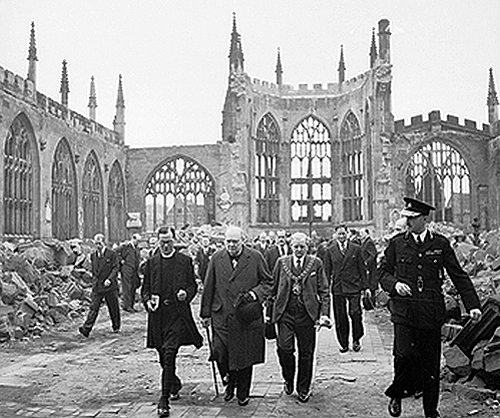
Prime Minister Churchill views the remains of the old Cathedral
The thoughts of the Spectator’s reviewer are worth quoting at some length:
As I stood just inside the glazed ‘west’ wall of Coventry Cathedral, beneath John Hutton’s gaily engraved angels — running, jumping and standing still — I was stunned by the richness of John Piper’s baptistery window, the absolute rightness of the Sutherland tapestry which fills the whole wall behind the altar and the simplicity and serenity of the ‘great barn’ itself — Sir Basil Spence’s own words — in which, from the main entrance, they are the only immediately visible works of art.
It would have been shattering enough simply to see the live version of the building I had admired in models and drawings for several years; it was much more disturbing to hear it. Just by chance, as I approached the cathedral it had been completed — by being filled with music. I cannot remember a more moving experience. With my hand still on one of the tiny bronze door knobs, sculpted as a child’s head by Epstein, I was hit simultaneously by shapes, colours and sounds — the fourteen slender pillars of reinforced concrete which suspend the timber- and-concrete vaulted canopy beneath the roof; the perpetual sunshine that bursts from the centre of deeper colours in the eighty-four-foot-high Piper window, and the familiar hymn tune which reached me — as I reminded myself in an effort to keep emotion in its place — by courtesy of Mr. David Lepine (performing with four manuals and seventy-three speaking stops) aided by acoustic slabs of cork and Weyroc, placed high above the vaulting, and the sound-absorbent surfaces of Sutherland’s Christ in Glory.
I half hoped that by turning my mind towards technical achievements of this kind I would suppress the urge to go away without having the impertinence to write a single word of adverse criticism about the cathedral. So I tore my thoughts away from the simple beauty of the font (a scooped-out boulder from the Holy Land) and Ralph Beyer’s superbly carved lettering on the white stone panels that flank the nave, and tried very hard to see the cathedral as an elegant box of functional tricks. But I had to give in. This is a great and humbling building — a building in which trivial criticisms merely make the critic himself feel trivial. Of course it is a box of functional tricks; but every trick is inspired and designed to help the real user of the building. This is a machine for Worshipping in — a cathedral built round the Communion service.
The ruins of the old Cathedral seamlessly morph into the new building designed by Sir Basil Spence
I like that phrase, “a machine for worshipping in”. I find that it describes very well the utility and efficiency of the building and its contents, as well as the streamlined, modern beauty of the furnishings and commissioned artworks. To my (very) amateur architecture enthusiast mind, Spence’s design epitomises the very best of mid-century architecture. Given the era in which it was commissioned, designed and built, the new cathedral could so easily have been a drab grey brutalist building (not that I object to all of those, but more on that in another blog post), one of many that were being enthusiastically erected up and down the country.
Light streams in through the stained glass of the baptistry window
I will always remember one occasion, one of the first times that I attended evensong at Coventry cathedral. Attendance was particularly light that particular Sunday evening, so one of the Deacons beckoned me from my normal seat in the Nave to sit in the row of seats behind the choir on the raised platform at the front of the church as they sometimes did when there were few attendees. Once I had been guided to my new, front-seat location, however, the Deacon was distracted by some other issue and neglected to tell any of the other arriving congregation members to follow my lead. Soon there was a small gaggle of twenty or so elderly parishioners sitting in their normal places in the Nave, and then me, sitting on the raised section behind the choir, with one of Sir Basil Spence’s soft spotlights gently highlighting my solitude.
And then the organ started to play.
The choir and ministers started to process through to their places from the back of the church, and as they got closer to me, I realised with growing alarm that two of the lead celebrants were walking down the same row that I was sitting on. Was I supposed to move out of their way, or stay there, or acknowledge them or ignore them? I decided to ignore them, and stood there like a lemon while the two men in pointy hats took up position next to me behind the choir. They didn’t seem to be put out at my presence so I figured that maybe I was okay. Not so much.
It wasn’t that anything bad happened; it’s just that in much the same way as you wouldn’t necessarily expect or want to be strapped in next to the pilot for the duration of a commercial flight from London to Paris, neither would you want to be sitting right next to the con-celebrant of a choral evensong service, between him and the congregation, in a large cathedral, when you are not that familiar with the order of service, and haven’t quite mastered the basics of when to stand up and sit down. That’s all I’m saying.
The following week I sat far enough back in the regular seats that the Deacon would not notice me before the service and invite me to “come on down”.
Anyway, enough of rambling anecdotes. I am out of practice at blogging and I’m pretty sure that I need an editor.
But let me close this post by wishing a very happy 50th birthday and a long life ahead to an old friend.
I decided to join the Roman Catholic church at eighteen years of age, and went through the Church’s RCIA programme (the Rite of Catholic Initiation of Adults), which required attending weekly lessons with the parish priest over a period of six months. I look back on the night that I was confirmed into the Church as one of the happiest and most sacred moments of my life, and though the strength of my faith (and my weekly Mass attendance) has seen several peaks and rather more lows in the intervening decade, I still consider myself a member of the Church, and I always intend to be.
Many people have made similar conversions to the Church, notably two of the current Republican presidential contenders, Newt Gingrich, and Rick Santorum. It is said that there is no zealot like a convert, and though I may be the exception to the rule, Gingrich and Santorum appear to prove it rather well with many of their public pronouncements. In many respects, both men are probably better and more observant Catholics than me, at least now (Gingrich), and I don’t presume to judge them at all. What I will do, however, is call them out when they claim to represent the only political party that will defend Catholic teachings and priorities. Because that is pure, grade A baloney.
Said Newt Gingrich of the ObamaCare requirement for employers operating in the public sphere, serving the public and employing people regardless of their religious affiliation, to offer health insurance that includes access to birth control:
“I frankly don’t care what deal he tries to cut; this is a man who is deeply committed. If he wins re-election, he will wage war on the Catholic Church the morning after he is re-elected.”
(Yes, I fear that the O RLY owl is going to be a frequent visitor to this blog).
Really, Newt? Wage war? I’m curious to see Obama’s glistening new clone army sitting in storage, waiting for Inauguration Day in January 2013 when they will be activated and unleashed to desecrate churches and force people into unwilling same-sex marriages across the land.
If I could talk with Mr. Gingrich and Mr. Santorum, I would say: the protection of life should not end at the moment of birth. I will never understand my Church’s current teaching on contraception – especially when male sexual enhancement drugs, in vitro fertilisation and other techniques that can result in the creation or destruction of a fertilised embryo are given a free pass, while contraception, the morning-after pill and stem cell research are not. But I can appreciate the consistency of the argument that all human life is precious, is worthy of respect, and that none should be taken unnecessarily. My own views on abortion are not yet fully developed, but I know that I would want it to be as rare as possible, and yet readily available at least under some limited circumstances (such as the survival of the mother, rape or incest, or in the case of catastrophic developmental anomalies). I understand your policies for caring for and protecting life while it is in the womb. But what effect would your policies have once these children are born? Is it important, as you so often say, that they are born into loving (married, heterosexual) families who are ready for a child, or does it not matter if they are unwanted and abused, or end up in the custody of the state until they reach eighteen years of age? It’s all very well advocating strongly for a new life until it reaches the nine month threshold, but what then?
And to the Bishops, I would say: why do you deny holy communion to politicians who advocate for general public access to abortion services (while not supporting the practice themselves), but welcome with open arms those who support the death penalty, fight measures to improve social justice, support the torture of enemy prisoners or beat the drum for pre-emptive wars around the globe? You diminish your public standing, your credibility and the importance of these other important Church teachings when you do so.
Andrew Sullivan makes a similar point in his excellent blog, with regard to the current enthusiasm in Republican circles to go to war with Iran:
“I’d also argue that pre-emptive war based on an enemy’s alleged intentions, when it publicy declares the opposite, or based on inherent evil or insanity is counter to just war theory. Certainly the rhetoric of Santorum and Gingrich on this subject is a profound attack on Catholic just-war teaching. But don’t expect the Bishops to make any fuss about that. War and torture seem trivial issues to them, compared with access to contraception or gay rights.”
Seriously, maybe I missed this in my RCIA classes. Will a Republican (since they are the ones who claim to have the direct hotline to God these days) please let me know which of these Church teachings it is okay to brazenly defy while still declaring myself a proud standard-bearer for the Church, and which are so inviolable that I would be literally declaring war on Catholicism if I dare to dissent? Thanks.



 Semi-Partisan Politics